Suitcase Carry: An Exercise I like (and you should, too).

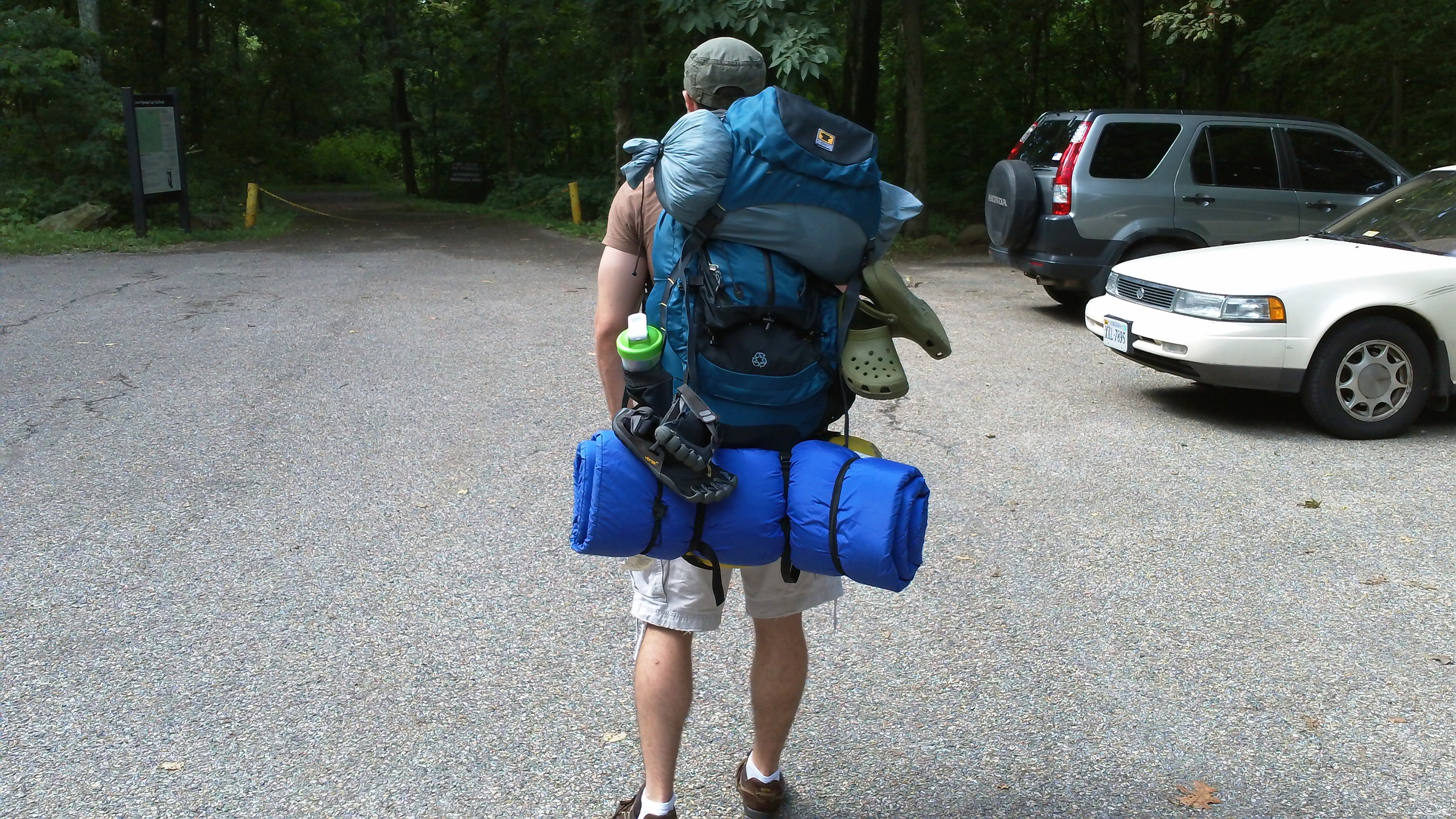
This past weekend I decided, spur-of-the-moment, to take a backpacking trip with a couple good friends of mine. It was incredible, to put it mildly. We loaded up our packs and took them for a 2-day journey along the Appalachian Trail in the Shenandoah. As evening approached, we found a great place near an overlook to pitch our tents. The picture at the top is a photo I snapped of our view of the sunset. As I was hiking along, I was quickly made aware that walking for two days - over uneven terrain with a 40lb pack on your back - makes for a pretty awesome workout. My traps, glutes, hamstrings, and cardiovascular system were all telling me that, just because I was away from the gym for a weekend, didn't mean I was going to get away with time off. To left is a picture snapped just before the start of the journey.
However, the point of this blog post isn't to tell you about my hike, the bears I slayed with my bare hands (they made the first move and attacked first, ok), or the damsels in distress I rescued along the trail. The point of this post is to give you a phenomenal exercise you can do in just about any gym. It isn't anything new, but my hike over the weekend reminded me just how much I love carry variations (due to the pack I carried throughout the trip), and how great they are for you.
The Exercise
Enter the Suitcase Carry. This will hammer your core (emphasis on the obliques and quadratus lumborum), along with your traps, deltoids, forearms, and ankles. Yes, the ankles.
It's tough to truly appreciate this exercise until you try it. See the video below of Ron performing the exercise:
How to Do It
You won't reap or feel the benefits of this exercise unless you walk with as perfect posture as you can. The key is to stand TALL. Your hips are going to naturally drift toward the weight, so do as best as you can to keep the hips from shifting. Shoulders "back and down," and stick your chest out as if your flaunting your stuff at the beach.
Why I Like It
One of the reasons I like this exercise so much is that most of you can do it in nearly any gym, and it kills multiple birds with one stone (see the benefits listed above the video). Just grab a heavy dumbbell, stand straight, and walk for 50-100 yards. Then switch sides. Even if you only have ten yards of space to work with, you can walk back and forth until you reach your target distance. You can use a heavy dumbbell or kettlebell for this. Yes, in the video, Ron has two kettlebells tied together with a towel because we're cool like that.
How much weight or how far should you go? As Dan John put it: You can either carry light weight for long distances, or heavy weight for short distances. I prefer heavy weight for long distances.
We've been doing this exercise for a few years but primarily using a "towel grip," during which you hold a towel looped through the kettlebell. While this is a perfectly good variation, I like tossing in the towel-free version as it takes a bit of stress off the grip (thus your grip will no longer be the limiting factor) and places more of the tension throughout the other areas of the body.
You know when you see people in the airport nearly toppling over to the side because their suitcase is so heavy? It's primarily because their core can't effectively buttress the weaker joints throughout the body. Don't be that guy.
PUPP: The Most Simple (Yet Difficult) Exercise You're Not Doing
Want a surefire yet simple method of making your current workout more challenging, while simultaneously improving your core stability and shoulder endurance? Instead of walking around (or checking your cell phone) during your rest period, get into the top of a pushup position, and hold it right there while keeping your body stiff as a board. Do this for 30 seconds, and then return to your next exercise. Dan John calls this a “PUPP” (Push-Up Position Plank).
Give it a shot for a few rounds. You'll quickly begin to feel your abdominals, chest, and shoulders burning like crazy.
A few months ago I put together a video of enough anti-extension core exercises to last you a lifetime:
However, most people (and I'm no exception), could really just use PUPP for a loooongg time and continue to garner the benefits from it. After a while, you can elevate the feet, place your feet in suspension straps, or place a weight on your back. The progressions are nearly endless, and believe me when I say you don't need to progress too quickly.
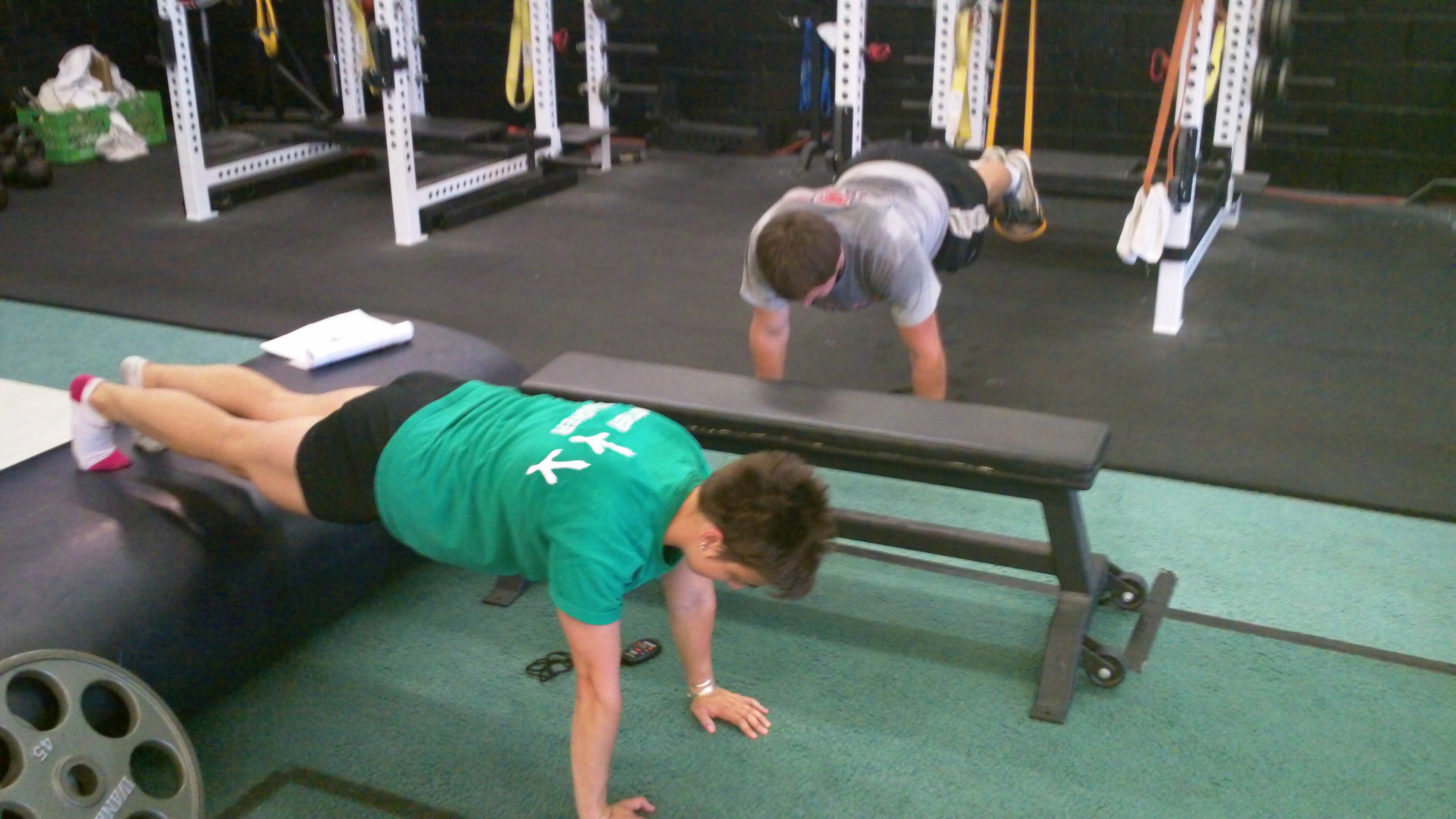 Above is a picture of Kelsey and Carson both performing a PUPP. Kelsey is using the method I described above, and Carson is doing it as an actual exercise in his training program, holding it for 60 seconds (when you have your feet in TRX straps, you won’t want to do it more than a few times).
Note that this exercise is only as challenging as you make it. Sure, most people can hold themselves up for a minute. But few can do it correctly, and thus reap the full benefit of it. Your glutes should be squeezed so tight that a walnut would be cracked between them. Your stomach should be maximally braced to the point that if I were to suddenly punch you in the gut, you wouldn’t feel it. No sagging of the low back, and you should be able to draw a perfectly straight line from the top of your head through your heels (no reaching forward, or looking up, with the head).
Try it. That shaking throughout your torso occurring at the halfway point is your body telling you that you’re not too advanced for planks.
Other Applications Moving along a similar thread, I’ve found that the PUPP also makes an excellent exercise for those struggling to either:
a. Do their first perfect pushup b. Improve their max number of bodyweight pushups (ex. as in a military challenge)
A lot of people go up in smoke when they attempt the pushup because their core musculature fails in its role as a stabilizer, as opposed to the primary movers (ex. chest, shoulders, and and triceps) failing. By the way, by “core” I’m referring to the 30+ muscles that attach to your pelvis, not just your abs! All of these muscles must learn to work as a unit, and the pushup position hold aids you in your quest to achieve this.
So get to work, and enjoy some newfound stability and strength-endurance in your upper body and lumbopelvic regions.
-Stevo