Rely on Strategies, Not Willpower, Part 2

strategies
In Part 1, we discussed how a major key to success in fueling our bodies with good foods is to rely on strategies. A good plan of action will trump willpower, every time.
While there are many strategies one can use, I'm going to give you seven right here and now. Aren't I awesome?? Let's get right to it:
1. Hold Yourself Accountable.
If things are looking pretty dire, holding yourself accountable to someone may be exactly the kick in the pants you need. I recently wrote about this in detail HERE, so no need to elaborate much for the moment.
2. Pre-chop Your Vegetables.
Pretty self-explanatory, yet astonishingly effective. This blew my socks off when I first tried it and saw how effective it was. I don't know about you, but I find it rather annoying to cut veggies (especially those large broccoli bushes) . This being the case, it's guaranteed I'm not going to chop them when I arrive home, tired and hungry, from work at 9pm. However, if I've already chopped them, then they're all ready to go to throw on a frying pan, into a pot, or whatever. Tossing in a generous portion of herbs and spices will make them actually taste good, too.

DCIM100SPORT
On a Saturday or Sunday, simply take a bit of time to chop of a ton of veggies. Onions, peppers, carrots, squash, you name it. Then you can either divide them into separate containers, or just mix them all into one. This makes it a piece of cake to intake plenty of vegetables throughout the week. A personal favorite of mine is to keep a container of sliced bell peppers (various colors), and sliced onions to throw on the frying pan in the morning for egg omelets.
3. Always Have a (Nutritious) Meal Handy.
This takes a bit of planning, but will really help those random bouts of hunger that suddenly hit you. A recent favorite of mine has been to mix chopped carrots, beans, chick peas, asparagus, brussels sprouts, and canned chicken in a big baking dish:

DCIM100SPORT
Douse the dish with spices (I use cumin, chili powder, and garlic powder), mix in olive oil, and then top with some honey-flavored goat cheese (*the magic maker*) and bake in the oven for thirty minutes or so. I'll then divide up the dish into a bunch of tupperware containers to use on an as-needed basis.
It tastes better than it may sound, and is going to get you much closer to fitting into those skinny jeans than a bagel will.
4. Make Smoothies.
I have at least one of these every day. Super easy to make, and you can toss virtually anything in them. Not to mention, they're a great way to satisfy a sweets craving. Take them with you to work on a car trip and you're good to go. See the video below for one of my favorite recipes. If you have a cat to help you (like I did), even better:
5. Eat a Good Breakfast.
While scientists and dietitians may debate on which meal of the day is really the most important, I'm convinced that what you eat for breakfast will set the tone for the rest of the day. Simply put: If you gobble down a quick bowl of sugary cereal on your way out the door, then you're more than likely going to crave other sugary foods and sweets throughout the remainder of the day. Conversely, if you fuel your body with some lean proteins and healthy fats, then you'll be less prone to cave in to "problem foods" later in the day.
6. Give the Inside of Your Cupboards a Makeover.
If it's in your home, you're going to eat it. Plain and simple.
As such, if you have any "kryptonite" foods (you know what I'm talking about) that you tend to binge on for comfort, throw them away. If it's not in your home, you can't eat it.
7. Plan to Break the Rules 10% of the Time.
This is a staple guideline of John Berardi's Precision Nutrition system. Oftentimes, aiming for 90% compliance will get you much further than aiming for 100% compliance. When we shoot for perfection, we tend to enter a fail-->guilt-->fail-->guilt-->fail further-->guilt cycle that spirals us down to a place worse than where we started.
Achieving 90% adherence to a good plan will still deliver outstanding results, while still allowing ourselves not to be miserable. Going out for a special dinner? Get dessert and don't feel guilty about it. Ate well throughout the week and hit some benchmarks at work? Grab a burger and beer with your buds on Friday and enjoy it.
Just keep in mind what 90% really is. If you eat six times a day (42 feedings a week), this means that 38 of those 42 feeding opportunities can't contain crap. Or, if you eat three times a day (21 meals a week) then that leaves you only two, yes two, opportunities to indulge.
Most people think that they're at 90%, when really, after doing the math, they're only at 80% or so. I remember Rachel Cosgrove saying (paraphrased) that getting from 80% to 90% is one of the toughest barriers to break, yet also the biggest difference-maker when it comes to body composition and health.
Well, there you have it. Athletes can use the above tips to ensure optimal performance on game day and speedy recovery between training sessions. Everyone else can use them to feel better and keep body composition in check. Now get to it! After all, information without action is merely entertainment.
Cluster Training: Your Meathead Tip of the Day
Note - This is a re-post from about a year ago:
Cluster Training is a form of interval training in which, much like track athletes, the goal is to increase strength-endurance by manipulating and cycling work and recovery phases. Clusters, specifically, involve performing one or more repetitions with 10-20 seconds rest between each repetition or “cluster” of repetitions, in the case of an extended set.
Notes for cluster success:
Minimum load used is a 5RM for 4-6 sets
Extensive clustering – 4-6 repetitions with 4-6RM and a 10 second rest between each cluster.
Intensive clustering – 4-6 sets with 75-90% 1RM with 20 seconds rest between online casino repetitions for 4-6 repetitions total. Ex: 6x1x4 @ 80-85%
Clusters are best used in moderation during times when a plateau needs to be smashed to continue forward progress. I would suggest only applying this method once a week for a two- or three-week wave.
Rely on Strategies, Not Willpower, Part 1
It seems that people are often under the impression that I'm a sort of fearless and incorruptible freedom fighter when it comes to eating healthy and staving off temptation in the food realm. In fact, when I worked in the physical therapy clinic, all the therapists even brought in hard-boiled eggs and/or veggie+fruit platters for my birthday (instead of the typical cake+brownie+muffin celebratory nibbles). This meant a lot to me, as not only did they think of me on my birthday, but it showed that they knew it would mean more to me to eat snacks that "do the body good" than the usual birthday foods. I've been asked on many occasion - be it throughout college, out at dinner, or at the workplace - how I consistently eat well. How I always seem to pack healthy lunches, snacks, and at the same time avoid the belly-busting items on restaurant menus.
How do you DO it?
Man, I wish I could do that....
Wow, you have such great self-control!
I want your babies.
But the point of this post isn't to gloat. In fact, it's the exact opposite.
You want to know a deep, dark secret of mine? A skeleton in my closet, so to speak? I do NOT have the best self-control when it comes to food. In fact, it's terrible. Absolutely terrible. In reality, my sweet tooth is larger than the state of Kansas, and it is absolutely no sweat for me to crush a garbage disposal in a race to demolish a pint of ice cream. Not kidding. (To those that know me well, I know this doesn't come as a surprise).
However, despite this sad truth, I do still manage to fuel my body with foods that will benefit it rather than destroy it, the majority of the time. And my struggles to prove victorious in this area can help you.
I don't think any of you reading will deny that whole, unprocessed foods and vegetables will provide our bodies with steady doses of energy, allow us to recover faster from lifting sessions or athletic competitions, boost our immune systems, and keep body fat stores at bay. Nonetheless, many of us fail to act on this truth on a daily basis, right? Why?
Why is that, on a given weekend, we can plan to eat healthy throughout the upcoming week, only to find ourselves having consumed more oreos than antioxidants at the end of the week? I'll tell you why. The answer came to me when I was attending a business seminar put on by Alwyn and Rachel Cosgrove. Rachel, while discussing client adherence to nutrition and exercise plans, said something I'll never forget:
Rely on Strategies, Not Willpower.
So true. I mean, how many times throughout the week are we hit with unexpected events that cause to gravitate toward shoving crap down our pie holes? Whether it's being held up at the office for an extra hour (or three), unexpectedly needing to pick up your child at a soccer game, running a few extra errands, getting stuck in obscene traffic (for those that live in NOVA), or saving a vulnerable, homeless kitten from the perils of the wild (if you happen to be a SAPT strength coach), there's no doubt that numerous events can knock us off track.
Countless stressors and time-consuming events are GOING to happen that will tempt you to make a poor decision in the kitchen, and relying on willpower isn't the answer. Willpower is just too fragile for us mere mortals in the crowd. Instead, we need strategies. Strategies are the key to success.
Not to leave you hanging, but I need to stop here. I'm out of time, so I'm going to touch a few critical strategies on Wednesday. Plus, I'm over 600 words for this post so I may have already lost some of you anyway :) Until then, start thinking of some strategies YOU can use - be it related to your nutrition OR training - that can take you where you know you need to go.
Warrior, The Resistance, Mobility, and Happy Birthday Baggins
It is Friday, and in my efforts to make the end of this week a bit lighter for you all, I'm simply going to share a few notes floating around my brain at the moment. 1. Happy Birthday Bilbo and Frodo Baggins. Well, technically their birthday was yesterday, on September 22nd, but, alas, it was Chris's day to post so I wasn't able to give them a proper shout-out on time. Many of you may have missed this important and monumental day; shame on you if you did. Kelsey and I did not. (A side note: I knew I wanted to marry her as soon as she told me, on our second date, that she'd read the Lord of the Rings series three times).
I will most assuredly - and shamelessly - be attending opening night of The Hobbit (releasing December of 2012), especially given that Peter Jackson is directing it. For other Middle Earth fans that may be out there, you can keep up with some video blogs of the filming HERE.
Kelsey and I also had the pleasure of seeing The Return of the King with a LIVE symphony, thank you very much. Yes, it was as amazing as it sounds.

2. A Tale of Two Kingdoms. Martin Rooney recently wrote a fantastic blog post discussing the two "kingdoms" currently at war in society. It's short and simple, yet thought-provoking. I love most of Martin's writings and instructional videos as he's extremely talented, funny, and also possesses infectious energy as he talks about strength training. Do yourself a favor and read it here:
A Tale of Two Kingdoms - Martin Rooney
If you're looking for a preview, watch the video below (not only is it hilarious but also passes along a pretty deep and important message):
3. Warrior. Was amazing. I'm honestly not a huge fan of most fighting movies (I often find them awfully-predictable), but I felt Gavin O'Connor did a great job directing this one, and Tom Hardy REALLY hit a home run with his acting. The ending was a liiitttllee iffy, but all in all an awesome film filled with SWEET fight scenes while at the same time being emotionally engaging.
Okay. Let me get to the real reason I liked this film (Spoiler: shameless man-crush announcement). Tom Hardy's traps were the most awesome things I've ever seen. I mean, given his body weight and frame, they were quite impressive. I can say with full confidence that Chuck Norris would turn tail and run just from the sight of them:
Beast. I mean, let's be real here. I think every male on the planet, upon seeing this movie, ran to the nearest gym to load it up on some farmers walks and direct trap work. Heck, I know for me personally, on Monday the first thing I did during my training session was shrug deadlift.
Trap-specialization phase for October anyone? Alright, I'm kidding (but not really).
4. Movement Quality. The older I get, and the longer I spend working at a computer, the more I realize just how important it really is to maintain and/or restore lost ROM at our joints. This could be an entire article or blog post in and of itself, but I'm convinced that even taking ten minutes a day to invest in our joint mobility and soft tissue restrictions will go a longer way than many of us even realize.
After all, it really doesn't take that long to run through a quick series of spiderman variations, a yoga plex or two, warrior lunges, walking knee hugs and cradle walks, BO t-spine rotations, forearm wallslides, and quadruped extension-rotations, to name a few. Or, even just throwing in a few static and contract+relax drills while at a coffee shop.
That's it for today. Hope everyone has a great weekend!
Black Bean Poop…it’s delicious…
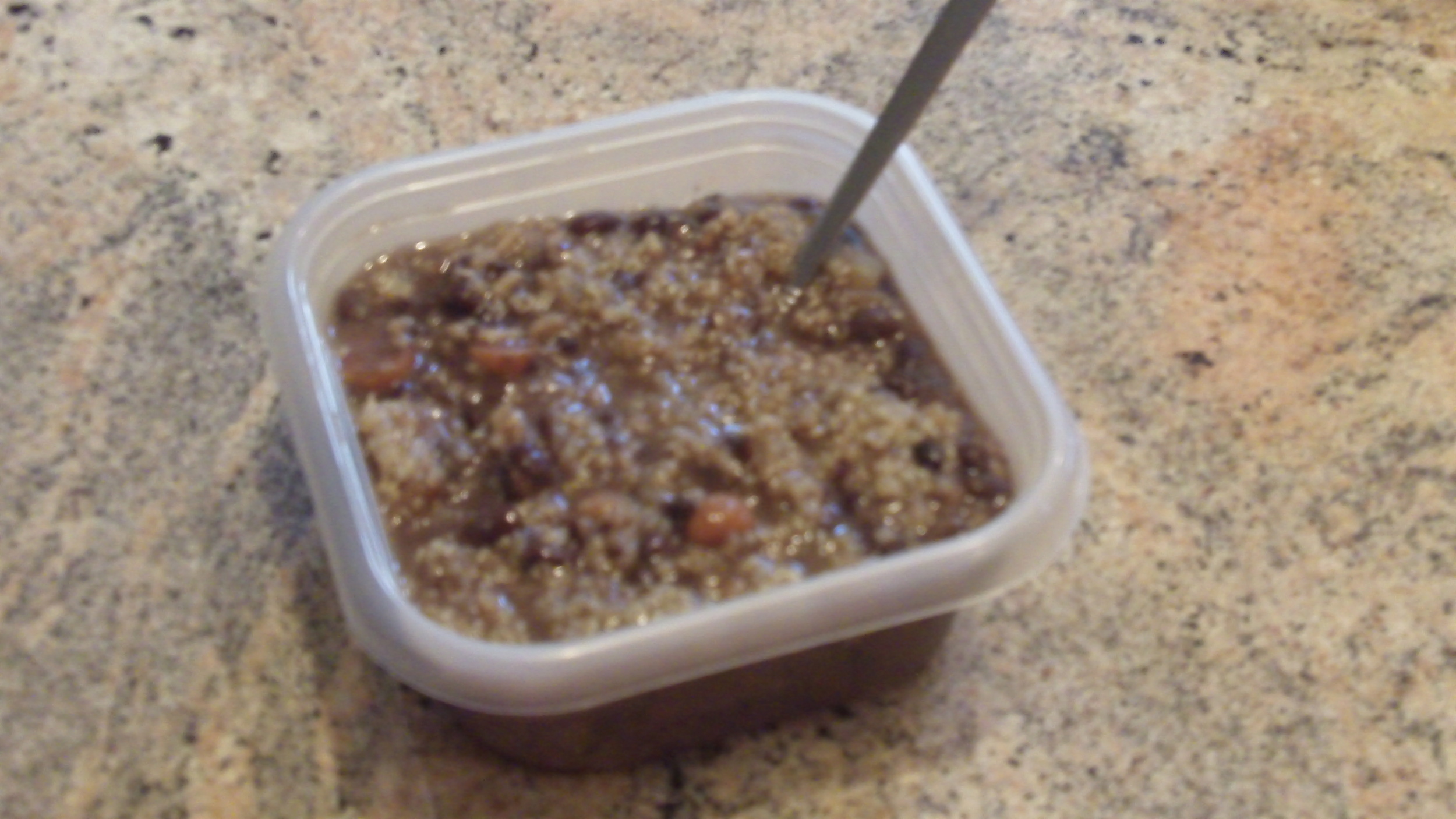
Not only is my wife drop-dead gorgeous (points), but she’s a terrific cook (double points…take notes boys). One of her specialties, and a meal my taste buds and colon love dearly, is her version of “Black Bean Soup,” which I prefer to call Black Bean Poop…I’m sure you can deduce why. It’s both nutritious and delicious…I mean it’s so good it almost tastes bad for you…plus it’s an extremely versatile meal, and it’ll last you a long time. The recipe: (serves a bunch, you’ll have leftovers which is awesome)
Food prep:
-Open 3-4 cans of black beans; a standard can, not the Costco barrels
-A generous couple handfuls of chopped carrots
-1/2 of a white onion, chopped into fairly fine bits
The cooking:
In a deep soup pan, begin by sautéing your carrots and onions in olive oil (enough to coat the bottom of pan) until soft. Once soft, add minced garlic (garlic lovers can be generous), and saute for a bit longer; careful not to burn the garlic.
Next, add 1 tbsp of cumin, a few generous shakes of cayenne (good cooks don’t measure, duh, and I like mine spicy), 3/4 tsp coriander, 32 oz. beef broth and the 3-4 cans of black beans (juice included). Stir it all up and let simmer for 15-20min.
Stroll to television and witness the Sox continuing to choke away the wildcard…make a u-turn back into the kitchen.
We like to serve our black bean poop on a bed of quinoa. See quinoa label for cooking instructions.
After the soup has simmered for about 15-20min, take your hand blender and gently blend until you’ve reached your desired soupy consistency; I like mine chunky. After blending, add ½ cup of dry sherry, and stir it up.
Take your quinoa off the stove, mix the two together, and enjoy!
What’s great is that later in the week your leftovers can be used to make bean burritos; add some fresh slices of avocado and a sprinkling of cheese…and now you’re eatin’ gooood.
The cure for the common case of constipation,
Sous Chef Chris
Trimming the Fat: Some of My Fastest Gains Ever
Every now and then I like to peruse my old training logs, peeking back in time to take a glimpse at what I was doing in the weight room; be it three months ago or three years ago. The other day I decided to flip through my logbook from college, and was suddenly reminded of the sudden, and dramatic, shift my training took at one point. You could call this my "Enlightenment," or, when I discovered that it was possible to accomplish more in less time. You see, for the first few years of college, I was following a classic bodybuilding split, utilizing tips I had picked up from the muscle mags and various personal trainers that crossed my path. I would work 1-2 body parts a day, training six days per week on the average. Each of these training sessions lasted about 90-120+ minutes, and I would utilize about 4-5 exercises per muscle group, performing 4-5 sets for each exercise. I'd incorporate just about every exercise I could think of, "attacking my muscles from all different angles" just like the magazines told me I needed to do. I was doing pretty well for myself, too: adding some muscle here, getting stronger there, maybe getting a new vein in my arm. *high five!*
After all, the more I could squeeze in, the better, right?
However, toward the end of junior year, I decided it was time to seriously investigate my training. This meant looking beyond the magazines in the grocery aisles, and seeing past what the majority of gym-goers were doing. To make a long story short, this is when I discovered some extremely valuable information and began reading from authors/strength coaches who actually knew their stuff. The strength coach for Virginia Tech was also extremely accommodating and patient with me, answering the endless slew of questions I incessantly threw at him as I first began to shadow his work with the athletic teams.
I suddenly realized that I didn't actually need to train 12 hours per week to become bigger or stronger. It was far from essential to do 25-30 exercises per week. It wasn't necessary to spend an entire day on one body part. And it wasn't required to perform countless drop sets and supersets of isolated delt, bicep, and tricep work to make my shoulders and arms grow. In fact, it turned out that a mere 20% of my efforts was responsible for 80% of my results. I became educated on the minimum effective dose, or, the minimal stimulus required to produce a desired outcome.
It was time to "trim the fat," so to speak, with my training. I wanted to test this for myself, to see if it was REALLY true. I mean, it's one thing to read about it, hear others talk about it, but it's a completely different bear to induce change upon YOURSELF, especially when there's a young ego at stake.
As such, I made up my mind to undergo a plan that would have me training no more than four days per week, and my sessions would be required to take no longer than an hour (excluding warm-up). Inspired by Alwyn Cosgrove, I decided to choose only two different workouts, and I would alternate between the two every time I set foot in the gym. I had a "Workout A" which was essentially lower body emphasis, and a "Workout B" which was upper body dominant. Here it is below:
Workout A (Lower Body)
Workout B (Upper Body)
A) Squat B) Deadlift C1) Bulgarian SplitSquat C2) Barbell Step-Up
A1) Incline DB Press A2) Seated Cable Row B1) DB Military Press B2) Pullup C1) Close-Grip Bench C2) Ab something
That was it. For six weeks, that is all I did.I would typically perform Workout A on Mondays and Thursdays, and Workout B on Tuesdays and Fridays. A method of undulating periodization was applied for the sets and reps each day.
And what do you know? My arms, shoulders, chest, and legs all continued to grow, despite the fact that I was I was training only four hours per week. This was one-third of the time I was spending in the gym all throughout high school and the first half of college. I had more free time, the workouts were surprisingly brutal (especially on the high rep squat days), I didn't constantly feel sore, and I was receiving an increasing number of the "So, what have YOUbeen doing?" or "What supplements have you been taking?" (<== lol) questions.
Now, there's no doubt that some of my gains can be attributed to the fact that I dialed in my nutrition further, and was actually deadlifting for the first time (in fact, I'd go so far as to say that deadlifting alone attributed to the majority of my gains). Also, one will almost always experience progress in one form or another when switching up the routine. However, there was no doubt that something was working.
In fact, things were working so well that I decided to enter a new eight-week cycle:
Workout A (Horizontal Push/Pull)
Workout B (Lower Body)
Workout C (Vertical Push/Pull)
A1) Bench Press A2) Bent-Over BB Row B1) Incline DB Press, Neutral Grip B2) Seated Cable Row
A) Snatch-Grip Deadlift B1) BB Forward Lunge B2) BB Step-Up C) Ab something
A1) BB Overhead Press A2) Pullup/Chinup B1) DB Arnold Press B2) Lat Pulldown
And the gains continued to come. I was stronger and leaner, I felt better, and, yet again, was accomplishing this in far less time that I had for the years prior.
An Important Note Were these "perfect" programs? Not at all. (Is there a such thing anyway??). In fact, looking back, there are quite a few obvious tweaks I would make. HOWEVER, at the time, I was trying my best to apply the principles I had learned in my research. And that's the important part.
Summing all this up, here are the take home points:
- Less is more. You can nearly always accomplish the same, if not more, by trimming the fat in a training program. Water boiled at 100ºC is boiled. Higher temperatures just consume more resources that could be used for something else more productive.
- While the high volume bodypart split routines can work for the genetically elite, they often aren't the best choice for the majority of trainees (and, as a side note, certainly not athletes).
- You don't need 6+ hours a week to get stronger, lose fat, or put some lean body mass on your frame.
- When in doubt, choose exercises that are multi-joint over single-joint.
- Deadlifts are awesome.