For Your Reading Enjoyment
Unfortunately I'm quite short on time today, so I'm going to pass on a couple reads I think you'll enjoy. Both two-part series come from Brian St. Pierre, who keeps a fantastic website that primarily centers around nutrition. I check his site a couple times a month, and there were a few I found over the past four weeks or so that really hit home.
1. Why Pointing the Finger at Carbs is Missing the Point: Part 1 and Part 2
Here Brian does a fantastic job directing people away from idiocy and brings us back to seeing things with a clear lens. As Alwyn Cosgrove once exclaimed: "Regardless of pesticides, fructose levels, etc., people who eat the most fruits and vegetables are healthier than those who eat the least. You're going to have a hard time convincing me that the current obesity epidemic is a result of people eating too many apples!"
2. Tips for Time Management: Part 1 and Part 2
Given that I deleted my Facebook account in college to help me manage my time better, on top of the fact that my wife and I don't even pay for basic cable due to TV being an utter time-vacuum, I felt this short series really hit the nail on the head and offered some very practical+effective tools to improve one's sense of well-being.
That will do it for today. Be back soon!
Pomegranate Juice Reduces Muscle Soreness?
The Journal of Strength and Conditioning Research published a paper entitled "The effect of pomegranate juice supplementation on strength and soreness after eccentric exercise" in July of 2011. Here is the abstract:
The purpose of this study was to determine if pomegranate juice supplementation improved the recovery of skeletal muscle strength after eccentric exercise in subjects who routinely performed resistance training. Resistance trained men (n = 17) were randomized into a crossover design with either pomegranate juice or placebo. To produce delayed onset muscle soreness, the subjects performed 3 sets of 20 unilateral eccentric elbow flexion and 6 sets of 10 unilateral eccentric knee extension exercises. Maximal isometric elbow flexion and knee extension strength and muscle soreness measurements were made at baseline and 2, 24, 48, 72, 96, and 168 hours postexercise. Elbow flexion strength was significantly higher during the 2- to 168-hour period postexercise with pomegranate juice compared with that of placebo (main treatment effect; p = 0.031). Elbow flexor muscle soreness was also significantly reduced with pomegranate juice compared with that of placebo (main treatment effect; p = 0.006) and at 48 and 72 hours postexercise (p = 0.003 and p = 0.038, respectively). Isometric strength and muscle soreness in the knee extensors were not significantly different with pomegranate juice compared with those using placebo. Supplementation with pomegranate juice attenuates weakness and reduces soreness of the elbow flexor but not of knee extensor muscles. These results indicate a mild, acute ergogenic effect of pomegranate juice in the elbow flexor muscles of resistance trained individuals after eccentric exercise.
Sometimes... okay, lots of times... I find strength and conditioning research to be quite limiting and, in the end, not that helpful. It's been well accepted and practiced for years that the best post-training meal to consume is a liquid meal with roughly a 3:1 or 4:1 ratio of carbs:protein.
Pomegranate juice really has nothing more substantial in it (for exercise recovery) than any other fruit juice or a sports drink. It's ALL sugar.
Take this study for what it's worth: further proof that something is better that nothing after you train. I'm sure the study participants would have been better served and demonstrated recovery in the "knee extensor muscles" if they'd been given a pomegranate drink that also included the proper ratio of carbs:protein.
Here's a SUPER simple recipe for a recovery drink I make for myself:
3-4 tbsp Nestle Quick powder
1/2 scoop protein powder
Water
Dunzo.
An Alternative to the Olympic Lifts
First things first, let me put it out there that I LOVE the Olympic lifts (from here on out referred to as the O-lifts). I think they're a fantastic tool to develop strength, power, and enhance athletic potential. Not to mention, I can't help but tip my hat to those that have accomplished near-impossible feats of power with them, and there are few things I find more beautiful than a perfectly executed snatch. In fact, while I currently can't back this up with any scientific research, I'm convinced that Maximus utilized the O-lifts as part of his training arsenal to utterly own anyone who stood in his way in his quest to avenge the death of his family.
HOWEVER - and as Sarah recently noted in her Squat vs. Box Squat post - the O-lifts are an extremely complex movement that many ELITE athletes spend their entire lives perfecting. Not to mention, 99 times out of 100, the limiting factor in the athletes we work with at SAPT is simply a lack of strength. They lack the strength (and subsequently, joint integrity...) and neuromuscular control to produce and decelerate movement, and THIS is the primary reason that they can't seem to improve their change-of-direction speed, or throw that ball faster.
In fact, the interesting thing is that even if I wanted to start them off with O-lifting, the majority of them would lack the strength to do that, too! Walking someone, and strengthening them, through the squat and deadlift progressions will actually help them with the O-lifts (cleans, snatches, jerks, etc.), but performing the O-lifts WON'T necessarily have carryover the other way around and help them become better at squatting and deadlifting. It's just not a reciprocal relationship like that.
Nevertheless, this post isn't about sparking a "Should I O-lift or Not O-lift a New Trainee" debate. If you are a coach that has found this to work for you, then great. I respect that. We have just found that, especially with consideration to the fact that we often don't work with a given athlete for more than six months at a time, we can accomplish more in less time by working with other tools in the "strength coach toolbox."
And, while I may personally feel that the majority of athletes spend too much time on the speed-strength end of the spectrum and really don't need a whole lot of "speed and power" work (at least, initially) to enhance their athletic potential, I still feel it's important to incorporate explosive movements in training to teach someone how to control their body in space. Not to mention, these movements will often serve as a CNS primer for the squat and deadlift portion of the session, just like the O-lifts are often performed prior to strength work.
What do we use to accomplish this? Jumping!
Yes, jumping. Anyone from a beginner to an advanced athlete can utilize this powerful tool that is much more "dummy-proof" than the O-lifts. While I'm not going to list the specific progressions we'll use with someone, I just wanted to make a quick point.
Take, for example, two jumping variations we use; the box jump and the hot ground to tuck jump (the latter shown the video):
In both variations, if doing them correctly, you'll still be producing force through the "triple extension" motion that the O-lifts are frequently praised for working. This being, simultaneous extension of the ankles, knees, and hips. Essentially all this means is that the toes are pointing down, and the knees and hips are straightening out.
Note the similarity of the body position (specifically at the joint angles of the ankles, knees, and hips) during the picture of O-lift in the very beginning of this post, and my body positions during a box jump, and a freeze-frame of the same hot ground jump performed in the video above:
Box Jump:

Hot Ground to Tuck Jump:

Crazy, huh? As an added bonus, one of the most difficult portions of the O-lifts is ACTUALLY achieving triple extension. If you youtube nearly any run-of-the-mill person doing an O-lift, and carefully watch their ankles/knees/hips, you'll quickly see that they're not even doing the very thing that makes the O-lifts so beneficial!
Also, with some of the jumping variations, you also receiving a bit of often-neglected hip flexor work at greater than 90 degrees of flexion, such as in the top of the hot ground jump:

Now, these jumps must be progressed appropriately, just as a skilled coach of the O-lifts would do with a trainee. And, the volume must be monitored, as mindlessly having an athlete jump around until their knees explode isn't going to help their vertical. Usually fifteen TOTAL reps will be more than enough to receive the intended benefit.
Again, what I am NOT saying is to avoid the O-lifts like the plague. Again, they are phenomenal tools, and there's no chance that jumping variations could take the place of O-lifting in the appropriate scenario.
But, like anything, one should be sure they understand where he or she (or someone they're coaching) is honestly at when taking into consideration what will be the most bang-for-your-buck training approach, given the time and resources you may have at your disposal.
Inspiration from Matthias Steiner
So, yesterday I began to type up a post related to Olympic lifting, when I was reminded of a video Chris and I had watched together over a year ago that had literally blown our socks off. We were in the middle of a lift and it swiftly gave us a roundhouse kick to the face and re-centered our perspective on things. Not only did it remind me that there are people out there cleaning, and then pressing overhead, more weight than I can deadlift, but it showed me yet another example of what can be accomplished when your mind is unshakably fixated upon something.
Maybe most of you have already seen this; if not, then I encourage you to watch it below. This is taken from the 2008 Summer Olympics in Beijing, and features Matthias Steiner, who, at age 25, is competing for the Gold medal. The most moving part about this was not only did he clean and jerk 258 kilograms (that's 568 pounds for us Americans....yep, I'll wait for you to regain consciousness....), but his young wife of only two years had died in a fatal car accident the year before.
While Matthias knelt by her deathbed, he made a promise to her that he would become an Olympic champion.
He was the underdog in the tournament, and cleaned+jerked over 20 pounds more than he had ever lifted before. (For those of you who understand elite-level lifters, you know how incredible this was considering Matthias's training age). I think my favorite part about this is watching his face as he stepped onto the platform and grabbed the bar. Despite the fact that there were millions of people watching him, there was NOTHING on his mind except the fact that he WAS going to rip that bar off the floor and throw it overhead.
Matthias took his body and mind to a level that most of us will never even dream of. He defied logic, and slapped the face of the limits that are often imposed on us by others. He took something tragic that happened to him and made it into something good. Instead of sulking in a corner for the years following his wife's tragic death, he allowed the loss of her to push him and strengthen him to the point of accomplishing a near-impossible promise. The last promise he ever made to her.
An indelible lesson for all of us.
FREE TRAINING & delicious Cauli Couscous!
In case you hadn't heard, right now you can experience our distance coaching system for 2-weeks absolutely FREE!!! That’s right, we’re opening-up the vault so you can try a taste of SAPT goodness for yourself:
- 2-weeks (6-sessions) of carefully balanced and scientifically backed programming. This program is designed to mobilize, strengthen, and condition a moderately active adult!
- Step-by-step, in depth coaching cues to ensure you’re performing the movements correctly!
- Training videos presented in HD and accessible via most mobile devices!
To receive your 2-weeks of free programming and access to our online database of exercise videos click HERE. Fill in the relevant fields and indicate “I’d like to try the 2-week free Distance Coaching Trial,” and a SAPT rep will be in touch with you shortly to provide you your program!
Cauli Couscous Recipe; taken from Jen Comas-Keck from elitefts.com:
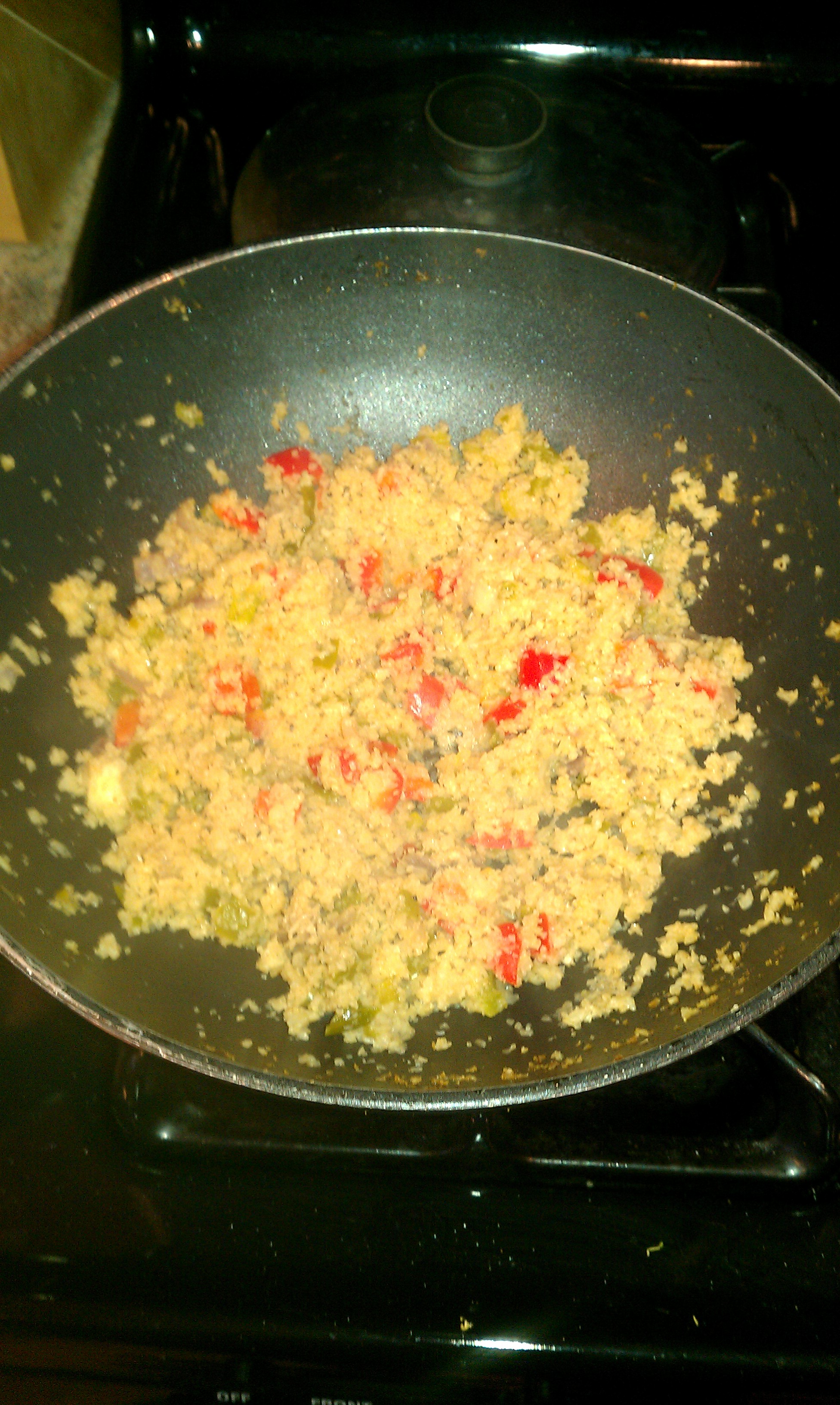
Ingredients: Head of cauliflower 2 - 4 cloves of garlic 1 TBSP olive oil Green onions Purple Onion Red pepper Green pepper Couple Tablespoons of low sodium organic stock - veggie, chicken or beef will work
Seasonings: Dash of sea salt Dash of pepper Dash of cumin Dash of chili pepper I threw in some shredded carrots and jalepenos, too because I'm a fan of the muy caliente.
First, cut the cauli florets off. Then shove'um in the food processer, a couple quick pulses will do...you don't want to end-up with cauli-mash...
Next, heat up the tablespoon of olive oil and toss in your garlic and onions and get those warmed and carmelizing. Next, add the other veggie accoutrment to soften them up.
Lastly, add your cauli, along with the stock and seasoning (season to preference). Let simmer, flip your steaks, cut-up your avocado, a little red wine never did anybody no harm, and alotta made most pretty happy. All aboard the flavor train.
Enjoy,
Chef Boyaromo
Remember Why You're Here
The other day, one of our baseball guys was deadlifting and, upon finishing his second work set, turns to me and asks if he can put another ten pounds on the bar. Given that his form was less-than-impeccable, I gave him a simple "No." In fact, I wanted him to take it down ten to twenty pounds, as it was his lumbar spine that was buckling (I wouldn't have been as concerned if it was something like failing to keep his neck packed or forgetting to finish the movement with his glutes). He immediately became exceedingly frustrated and started rambling about how he felt like he wasn't as strong as he thought he should be, and that he ought to move UP, not down, for his next deadlift set, how he felt it had been too long since he improved in his squat and deadlift, yadda yadda yadda.
I asked him: "Well, how have you been playing on the baseball field?"
He replies: "I've hit more home runs, my 60-yard dash time improved, and my movement, positioning, and throwing from home plate has become way better as compared to last year." (note: he's a catcher)
I then reminded him that he had averaged only one training session every 7-10 days over the past six months at SAPT (due to in-season baseball and then traveling the country playing on various club/select teams), so he was not only fortunate to have maintained his strength levels in the weight room but also - and more importantly - his markers of sport performance had IMPROVED.
I concluded with: "Don't you think this is a pretty darn good indicator that we have accomplished what you came to SAPT for in the first place?"
Our goal with him was not to put up huge lifting numbers, but to help him become a better baseball player. Does squatting, deadlifting, performing single-leg work, and movement training help us get there? Absolutely, but there's a point where we can't force bad form just for the sake of hitting a weightlifting PR that day. Not to mention, we each get only one spine. Yes, just one. It's not worth destroying it over a 10-lb deadlift personal best.
Now, this athlete is pretty accomplished (committed to a Division 1 program and was one of only two players in the entire Northern Va region to be named to the Nationals roster for the Area Code Games), so I couldn't blame him for wanting to succeed in every endeavor he put himself into. But it reminded me of something I heard from Jim Wendler when he was talking about strength training the football team under him:
"We're chasing wins, not numbers."
So simple and profound. So often we get caught up in the minutia that we forget what our primary goal was in the first place. We can't see the forest for the trees, so to speak.

Don't forget to keep the primary goal, the goal.
- If your goal is sport performance, remember that it's not the end goal to have a gigantic bench press or squat. - If your goal is fat loss, why are you obsessed about your strength levels not being what they used to be? - If your goal is maximal strength development, should you really be performing three to four conditioning sessions a week so that, heaven forbid, your "work capacity" slightly diminishes?
Heck, I remember during the Fall of 2009 I was following a program specifically designed to improve my squat, bench, and deadlift numbers. Yet, I was also performing these insane conditioning sessions multiple days per week (see video below), and wondering why my numbers were stalling!
Note: Yes, if I could go back in time, I'd give myself a quick scissor kick to the face.
My mentality in 2009 reminded me of a football player we're currently working with. He's about 170lbs soaking wet, and has been musing that he can't seem to put on any weight. But when we give him some very practical suggestions on adding some size he responds with, "Well, I also want to keep myself looking good, too."
(Dude, don't worry, your six-pack isn't going to go anywhere if you pack on some size in order to open up a can on the football field).
It's tempting to chase multiple qualities at one time, but I've found that the body responds better to sticking to ONE goal at a time, as opposed to trying tackle everything at once. In other words, it would be better for you attack fat loss, HARD, for one to two months, and then go back to your standard strength-oriented program afterward than it would for you to try and accomplish both (fat loss and setting lifting PRs) at the exact same time.
So, to conclude, remember why you're in the gym in the first place. The big picture, so to speak; and allow that to dictate your choices. Don't miss the forest for the trees.