Another Sugary Experience
I have to expand on a portion of my post on StrongGirlsWin.com from yesterday: the 3-Hour Glucose Tolerance Test. So, the test is screening for Gestational Diabetes and you only have to take this version if you fail the 1-Hour Tolerance Test (which I did).
There are, of course, strict rules to follow to keep the test valid:
- Eat a diet containing at least 150g of carbohydrates per day for 3 days prior to testing.
- Fast for 8-hours before consuming glucose solution.
- Drink solution containing 100g of glucose within 5-minutes. Think throwing back about 4 shots in 5-minutes… maybe not the best idea.
Then you sit for 3-hours that are interspersed with blood drawing every hour.
Doesn’t sound too bad does it?
Well, for me, this is about as bad as it gets in terms of medical testing. I have strong dislike for fasting, having my blood drawn, being forced to drink huge amounts of sugar, and sitting still for long periods of time. I’m not trying to exaggerate or be funny, I really don’t like any of those things.
In fact, I almost didn’t get the test done at all. After all, I’ve “been there, done that” with my first pregnancy. So, why should I put myself through this hellish experience again?
Aside from simply “getting over myself” and acting like an adult, I pulled up some research to educate myself on the risk factors associated with babies who are born to women with gestational diabetes and decided I did, in fact, need to get over myself.
A couple of the most notable risk factors for the child that I didn’t know include: increased likelihood of becoming diabetic at some point in their future life and falling into a coma if the doctors don’t know they need to monitor the newborn’s blood sugar levels. Those were the two points that resonated with me.
Well, anyway, this got me thinking about how absurd it is to consume so much sugar in one sitting, much less in one single day. But, that’s exactly what people do ALL the time!
Here are a number of popular beverages you or a loved one probably consumes regularly. All have around 100g of sugar:




You may think I'm being a bit dramatic about this whole thing. It's just a standard test, after all. But diabetes has a history in my family and I recognize my body's own regulation of its blood sugar levels as a natural challenge - pregnant or not. I've actively been trying to provide myself the best quality foods for about 10 years now and the idea of failing any sort of glucose test is frightening for me!
The good news is I passed my second test and the doctor assured me failing the first version is NOT a sign of things to come... not sure if I totally believe her. I think I'll just keep my head down, focused on continuing to consume high-quality whole foods and will have to enjoy Shamrock Shake commercials instead of indulging in the real thing:
A Little Deadlift Experiment, Part 1
 Over the past five weeks of training I added 40lbs to my deadlift.
"Whaaattt?? Are you some kind of magician?" you ask?
No, not necessarily, but I've been doing a little bit of experimenting, along with training my deadlift with a bit of unconventional methodology. First, a bit of background information.
In early 2011 I deadlifted 410lbs for a PR. Then, in mid-2011, I contracted Lyme's Disease. I was bed-ridden for weeks and literally did not even have the strength/energy to watch the movies that friends brought by my house to help me pass the time. Fortunately (*understatement alert*), I was on the road to recovery relatively early considering my illness, and the doctors told me how amazing it was that I was up and walking so soon.
Needless to say, I now have a much deeper appreciation for how blessed I am to be where I currently stand with my health. Lyme's is an absolutely miserable disease and my heart goes out deeply to all those who find themselves battling it for years on end.
Moving on with the story, Lyme's completely sapped any strength I had previously obtained, and nearly left me back at Ground Zero with regards to my training.
To give you an idea, my first training session back in the gym (Fall 2011) entailed 3x6 pullups and 3x8 pushups.
And I nearly puked.
Even though I lived in convalescence for quite some time, I continued with my training, trying to be as perseverant yet prudent as possible. Eventually I worked back up to deadlifting 225lbs, but it felt heavy. And I mean heavy.
Fast forward six months, and - after feeling completely healed from the disease - pulled 385lbs for a single.
My Experiment
Next, I decided to play Mr. Scientist and play with a deadlifting experiment. To be honest, I was spinning my wheels a bit with my training, so I decided to work on a lift that I admittedly suck at: The Deadlift.
Over the past five weeks, I deadlifted every day, Monday through Friday. Yep. Every. single. day. Take the weekend off, rinse, lather, repeat.
What were the results? I went from 385lbs to 425lbs in those five weeks of training! Here is the video from Test Day 1 (I'll be "sort of maxing" every four to five weeks):
Some Closing Thoughts:
1. I am, admittedly, not a good deadlifter. Squatting has always felt more "natural" to me personally, primarily due to the fact that I have a very long torso relative to the length of my legs. I've had to work much harder than (some) others to bring my deadlift up, and it's still not what I would consider awe-inspiring by any means.
This was, however, a major victory for me after experiencing the large serving of humble-pie that Lyme's served me with in 2011. Not gonna lie, I gave myself a little, personal fist bump after doing this, and praise God every day that He has given me back my health in order to continue one of my greatest passions.
Like I said, you don't truly appreciate your health until it is taken from you.
2. Honestly, when I woke up on Testing Day last week, I wasn't sure what was going to happen. Was I going to pull less than 385lbs? Was I going to be stuck at the same weight? Could I pull more?
My original goal was to climb back up to 405lbs, but I was pleasantly surprised to find how fast and "easy" the weight felt. This is why I went ahead and added another 20lbs to the bar to go for the 425 pull.
3. Note that I "sort of maxed," as I had a bit of room in the tank on that 425lb pull. I still stand by what I said that this is the way to go to avoid burning out and ensure (at least as much as one can ensure) continued progress.
4. No, I am not going to unveil the exact program I used. I'm going to continue tweaking and refining the plan, and see where it continues to take me. I do ask that you refrain from going out and performing heavy deadlifts every day after reading this. This is NOT what I did and you'd be digging your own grave if you go out there and begin pulling heavy Monday through Friday.
5. Although I improved 4olbs over this 5-week period, it was, admittedly, a lifetime PR of 15lbs. I'm interested to see how things progress (if at all) and how my body continues to react to this type of training plan.
6. Don't worry, after I'm done with the experiment, I'll unveil what I did. So keep your eyes peeled.
Good Fitness (and Life) Reads for the Week: Do You Hate Mondays? How Can a Woman Do Her First Chinup? Why So Many Youth Pitching Injuries?
Hope everyone is having a great Friday. Let's get right to the list:
Do You Love Mondays? - Martin Rooney
 "Do you count the minutes until work is finished on Friday? Do you wish Sunday had 30 hours instead of 24? Is Monday the most difficult day to hear the alarm clock? If you had all the money in the world, what would you do for a living?
Rooney Rule: Successful people love Mondays.
Being successful isn’t about being rich, it is first about untying your “knot” and being happy. Most people measure success in wealth. I believe that you cannot put a price on doing what you love." - Martin Rooney
This post really resonated with me, as I left two career paths deemed "foolproof" by society (first engineering, and second, physical therapy) to pursue doing what I ultimately loved: teaching others how to become stronger, faster, and look and feel better via a career as a strength and conditioning coach.
It wasn't easy, and I faced a lot of questioning by well-intentioned peers and parents, but it was one of the best decisions I ever made.
Did it take some treading in deep waters? Yep. Were there some moments where I wondered, "Is this really going to work out?" Sure. Did I have to (and still do) put in some very long days? Yep. Did it require me to "jump," hoping the net would appear? You bet. Was it worth it? Every moment.
This post hit it spot on: You can't put a price on doing what you love.
Well said here Martin.
Chin-Up Progressions for Women (The One Rep Hump) - Part I, Part II, and Part III - Tony Gentilcore
 "If you have the ability to grow a human being inside your body and push it out, you undoubtedly have the ability to bang out a chin-up. And might I add: in MUCH less time than nine months." -TG
Here Tony put together a fantastic three-part series on helping females get over that "one-rep hurdle" in the realm of chinups. It wasn't so much the progressions that were the "ah-hah" moment for me (although they're certainly great progressions), but how much he emphasized the attitude most females take toward doing their first pullup/chinup.
If you don't think you can do something, how do you expect to ever actually do it?!?!
I highly recommend you check this out whether you are a trainer, a female trying to do her first chinup, or a male seeking to help his significant other conquer the bodyweight chin (or, heck, even for the males in the crowd who struggle with that one-rep hurdle).
The Real Reason Why There are so Many Youth Pitching Injuries - Mike Reinold
 Considering that baseball players make up the majority of our clientele, I felt Mike really hit a home run with this one.
That was a pun, by the way. See what I did there?
Anyway, if you are a youth baseball coach - or father, for that matter - READ THIS.
It becomes very exhausting, as a strength coach, when kids continue to show up at your door with arm/shoulder injuries as a result of their coaches failing to do something as simple as educating themselves.
Thanks To All Our Athletes
The best part of being a strength coach is watching our young athletes come in and train hard. It takes little to no motivating from us coaches to get them to come in and smash weight; they have an awesome desire to get better. It’s the best part of our day to see them come train and grow. With that said I wanted to do something cool for the athletes so I decided to put together a video. However, I lack the software and technological talent to do such things so I enlisted the help of my friend Binh. He did an awesome job and captured exactly what I was looking for, so thanks man I appreciate the help. And to the athletes I hope you guys like the video. Thanks for coming in and TRAINING HARD!

A "New" Way of Assisting Pullups
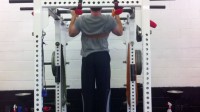 The other day, one of our interns, Tadashi, was messing around with the bands and came up with quite a useful way to assist chinups. As soon as I saw it, I had one of those Why didn't I think of that?! moments.
Wrap the band just around your thumbs as shown in the video below and perform as follows (you can use it for any grip choice...pronated, supinated, or neutral):
The other day, one of our interns, Tadashi, was messing around with the bands and came up with quite a useful way to assist chinups. As soon as I saw it, I had one of those Why didn't I think of that?! moments.
Wrap the band just around your thumbs as shown in the video below and perform as follows (you can use it for any grip choice...pronated, supinated, or neutral):
Why I like this variation:
1. Simply put, it provides a bit less assistance than traditional *BA variations, but it still provides just enough help for those that aren't quite comfortable with chins/pullups yet. It's essentially one more step on the learning curve ladder toward performing a full-range, bodyweight chinup.
2. It completely unloads at the top of the movement, which is perfect for performing isometric holds at the top - for those who are a bit stronger and even closer to getting over that "one-rep hump."
3. With traditional BA chinups, it's fairly difficult to prevent oneself from "swaying" back and forth due to the pull of the band. I find that this variation keeps it much easier to maintain a rigid body alignment.
See the video below for how we have done BA chinups in the past (3 different progressions):
All of those are still awesome, and should be used for those in the beginning phases of conquering the bodyweight chinup. This is simply another tool in the toolbox, if you will.
Reducing Dietary Salt
 I've never been one to worry much about my salt intake, but for this pregnancy I made the decision to really crack down on the added sodium in my diet.
Why? Well, two reasons:
I've never been one to worry much about my salt intake, but for this pregnancy I made the decision to really crack down on the added sodium in my diet.
Why? Well, two reasons:
1. When pregnant with my daughter, I found that often my blood pressure was very low (this is usual for me). But, about 35% of the time it would inexplicably sky-rocket to a borderline high area. I don't know whether it was stress, anxiety, diet, or weight gain that caused this problem.
2. I also had a tough time with swollen feet/ankles by the last trimester of pregnancy 1, so I'll pretty much do anything to avoid that again.
Something to check out and consider: This morning Fooducate posted a blog called 9 Ways to Reduce Your Salt Intake.
I'm only just now reaching my third trimester of this pregnancy, so I don't know if my approach will be effective for the swelling. But, I do know that my blood pressure readings have been quite a bit more consistent and reasonable up to this point.