Slow Tempo Strength Training for Increased Size and Work Capacity
Slow tempo strength training. This involves taking a compound movement - squat, pushup, inverted row, etc. - and performing both the eccentric and the concentric portion slowwwly, without pausing in the top or bottom of the movement. So, for a pushup, you would take 2-3 seconds to lower yourself down, and then immediately transition into a 2-3 second ascent. Rinse, lather, and repeat.
What is this good for?
- Improving work capacity
- To use in the “base” phase of a training plan, to allow for improved recovery capacity during later phases of training (you know what helps you recover in between sets of picking heavy stuff off the ground? Yep, the aerobic system) In fact, both Ryan and Carson did this in preparation for their powerlifting meet last week
- Developing connective tissue strength and overall joint stability
- Augmenting the ability of your muscles (both fast twitch and slow twitch) in their utilization/transportation of oxygen
- Enhancing static strength (think grappling, wrestling, etc.)
- Hypertrophy of the slow twitch fibers (makes them bigger)
For athletes that require a well-developed and powerful aerobic system, it would be wise to spend an entire “block” on slow tempo training (while maintaining other qualities) in the beginning of a training cycle, and then continue to cycle it in during “mini blocks” throughout the remainder of the training year. However, I’d primarily recommend this to athletes that already have a solid base of exercise technique and general strength training, and it’s also beyond the scope of this post to go into how one would do this.
However, today I’m going to stray a little bit from the typical SAPTstrength-style approach, and step away from the athletic performance side of things for a second.
Today, I want to appeal to you bodybuilders and masochists in the crowd.
Slow tempo training, not only has the potential to make ‘dem muscles bigger, but is also one of the most difficult methods to undergo. Not difficult in terms of loading used, of course, but difficult in terms of you just get really freaking tired.
Given that slow twitch fibers are more “endurance-based” in general, and thus highly resistant to fatigue, it takes a fairly high-volume approach to incite adaptations within them.
Pick 4 exercises (ex. squat, pushup, inverted row or cable row, and good morning), and lay out a month of training like so:
Week 1: 4 sets of 10 reps at a 2-0-2 tempo (this comes out to :40 of work). Rest 40 seconds between sets. Week 2: 2 series of 3 sets of 10 reps at a 2-0-2 tempo. Rest :40-:60 between sets, and rest 4-8 minutes between series. Week 3: 2 series of 4 sets of 10 reps at a 2-0-2 tempo. Rest :40-:60 between sets, and rest 4-8 minutes between series. Week 4: Three series3 sets of 10 reps at a 2-0-2 tempo. Rest :40-:60 between sets, and rest 4-8 minutes between series. Then curl up and die.
(Note: Your heart rate should remain BELOW anaerobic threshold during these. If it climbs above this, lower the weight, and/or rest a bit longer between sets).
I guarantee this will be one of the most humbling things you have ever done.
Also, be sure to keep some sort of stop watch or metronome (I use a Gym Boss), as all of you are going to naturally tend to move too slow during the lowering phase, and too quickly through the "up" portion of the lift. The clock helps keep you honest better than you'd think.
I’d start off with 30-40% of your 1RM on the squat, and you may need to elevate your hands during the later sets of the pushups. Yes, you may need to elevate your hands during the pushup portion (especially if you’re actually doing them correctly).
What about loss in power output?
Some of you may be wondering, ”But if I train slow, won’t I become slow?”
Not necessarily.
Muscle power output is directly proportional to cross-sectional area of the fiber. Soooo, if you hypertrophy a bunch of smaller, slow-twitch fibers, essentially making them as large as a “fast-twitch” fiber, and thus the total cross-sectional area of the fibers is equal to that of a fast-twitch fiber, then you can still produce the same level of power.
Not to mention, even when you train “explosively,” your IIx fibers still experience a bit of a transition to the more intermediate side of the continuum anyway. How bout them apples?
Besides you can still (which I recommend), perform a low volume of jumps, med ball throws, and the like to maintain these qualities during a cycle of slow tempo work.
Friday Distractions 4/20/12: Instant Strength via Bracing, To Foam Roll or Not to Foam Roll, etc.
1. First, I'd like to thank all those that emailed me (per my call for aid last Friday) to give me some suggestions for blog material. Given that I've been experiencing plenty of writer's block lately, it was much needed, and I thank you for taking the time to write with your suggestions! (you can thank the "suggestion box" for my post on Wednesday re: what you should eat/drink after your workouts.) For those of you who didn't write me with suggestions of material you want to see here on SAPTstrength....there will be pain....oh, there will be pain.....
2. Here is a fantastic video by Bill Hartman on the "right" way to breathe before a heavy set of squats or deadlifts to effectively brace your midsection and provide plenty of stability for your precious lumbar spine. Although he gives the demo with respect to wearing a belt, you can certainly use this technique even if you don't use a belt.
Although Bill doesn't necessarily showcase it in the video above, he is one smart dude. He's forgotten more things than I have learned, and he's one of those guys that I really wish would put more content out on the internet for us mere mortals/peons to learn from. I've seen a few of his presentations, which basically knocked my socks off.
In fact, I'd argue that one of the toughest (yet vitally important) things, for me personally, is to coach people on bracing correctly during a heavy lift. It's just very difficult to teach someone to do it properly and to get them to do it every time. Bracing properly basically ranks just below ingesting water and food within the hierarchy of needs of human survival. Maybe a slight exaggeration, but I often find that once someone learns to adequately brace, all of a sudden they find that their back stops hurting during squats and deadlifts, and they're able to move heavier and heavier weight in an effective and safe manner.
Hint: If your chest and shoulders are elevating as you brace, you have some work to do.
3. Over the past month or so a blog post (actually written a few years ago) titled "Get off the Foam Roller" began to spread through the fitness industry like wildfire. Mike Boyle then wrote a rebuttal to the article on strengthcoach.com (a paid subscription website), but then released it for free on his blog.
Anywho, while you will still find me on the foam roller for the time being, here are two sides of the debate in case you're interested (the first two links are "against" the foam roller and the last link is the argument "for" the foam roller:
Get Off the Foam Roller - Mike T Nelson Stop Foam Rolling Your IT Band - Greg Lehman Is Foam Rolling Bad for You? - Michael Boyle
5. THIS was kinda funny. I'm sure a lot of you can relate to at least a few of the images representing moments in your life where it's an "Ahhh crap" moment. #16 and #18 were probably the funniest for me. (The link takes you to "The 21 Absolute Worst Things in the World" picture-based article.)
That's it for now....hope everyone has an awesome weekend.
2012 USAPL Richmond Open: Meet Results
I competed in the 2012 USAPL Richmond Open this past weekend and it was a huge success for me. I hit a PR in the squat and deadlift as well as my meet total! I competed at 181 and weighed in Saturday morning at 180.9 after cutting about 10lbs (first time I’ve had to cut weight). For anyone who read my post last week you know that I was very unsure going into the meet so for me to come out with PRs and meeting my goal of an 1100lbs total (finished with 1136lbs)is a huge deal for me. So without wasting any more time here is the video compilation of my attempts...
[vsw id="Mz3Dw8rR52k" source="youtube" width="425" height="344" autoplay="no"]
The only thing that even remotely ruffled my feathers as far as judging went was on my squat. On my first attempt I got red lighted for my depth even though I felt I was below parallel. Then on my second I got a white light but the judge still told me I was almost high. So for good measure on my third attempt I decided to hang out in the bottom so there wouldn’t be any question.
Bench press went alright. I was hoping to get around 325 but after my second attempt I only took a little jump. After all the trouble I’d been having with my shirt I was just glad to get on the board. After watching the videos I noticed a bunch of problems. My arch wasn’t as big as it could have been, I tucked my elbows too much then I didn’t flare them on the way up (this causes a loss in leverage), and for the position I started in I hit to low on my chest which threw off my whole stroke.
My deadlift went a lot better than expected. I actually feel like I could have gone much heavier on my last one but whatever I got the weight and the total. I still need to sit back into my heels more and pull back more as opposed to standing straight up which is very evident on my last attempt.
Right now my upcoming goals are to get stronger and continue to refine my technique on my lifts. I don’t like saying that I have to work on my weak points because as far as I’m concerned everything is weak and it all needs to be worked on. Is this the wrong attitude to have? Absolutely not, as I’ve stated before I don’t like feeling content. The moment I feel content and that I’m strong is the moment that I stop working hard and I don’t ever want to stop working hard.
I want to congratulate Carson on his first meet, he did a great job and we are all very proud of him. I also want to thank everyone who came out to support me and who helped me out with my training and everything else. Thanks to Gabe Naspinski who did my programming and also congratulations to him as well for totaling 2100 pounds at his meet in Tampa! Sean was a great training partner and it was a shame he couldn’t attend but he had some very important things to do in New York but thanks again man! My friend and current SAPT intern Tadashi was my handler for the whole thing and did an awesome job taking the stress off me, wrapping my knees, picking weights, etc. so thanks a lot man I couldn’t have done it without you. Steve was there to handle Carson but helped me out as well, he is a great friend and I’m glad he came down.
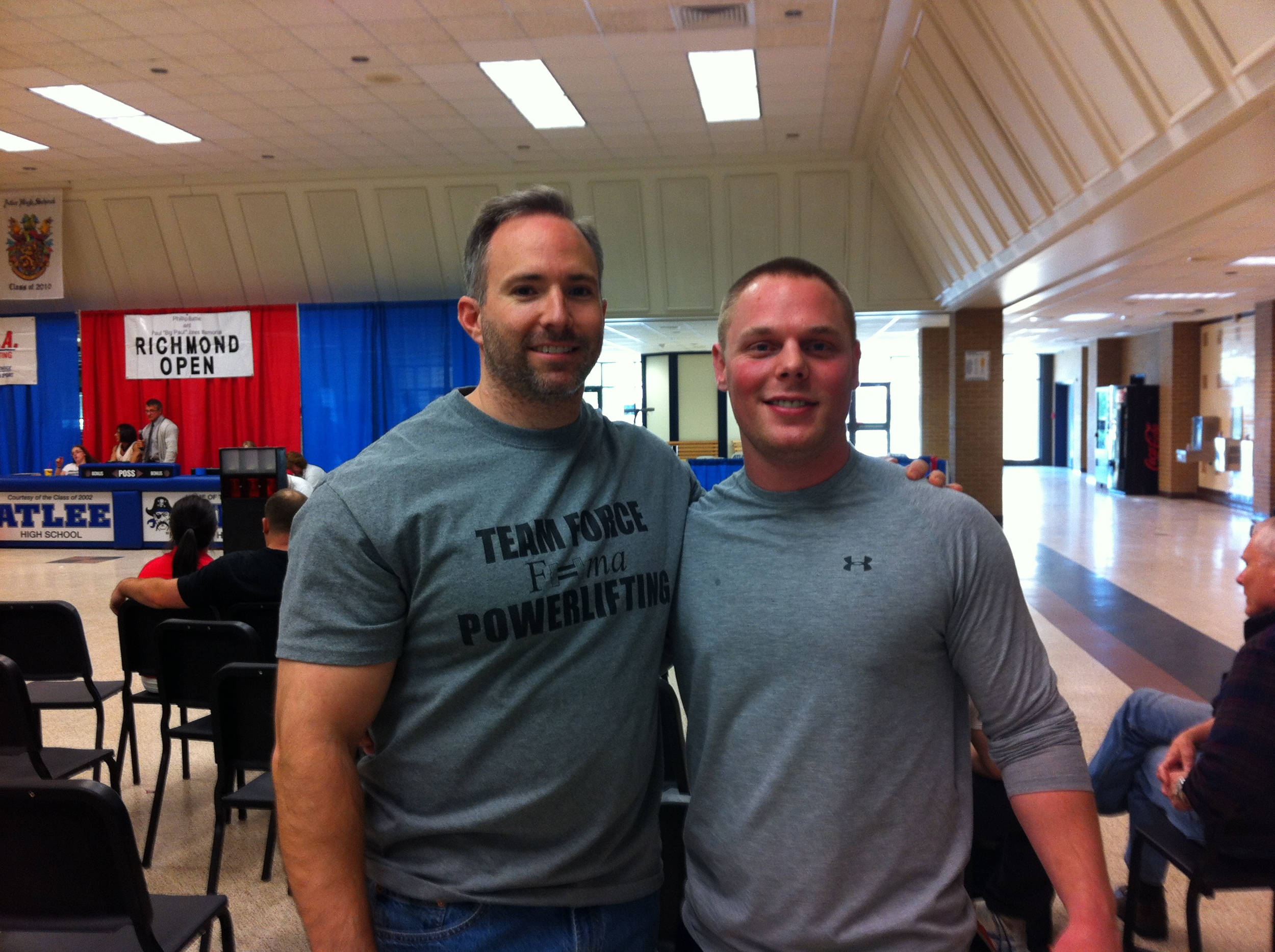
Tim Henriques was in attendance with his powerlifting team as well. Tim is someone that I look up to in this industry and for him to help out and lend his support like he did was a huge deal for me so thanks Tim!
SAPT’s longtime client and friend Ron came down, which was awesome that he would take a whole Saturday to support Carson and I, thanks Ron! Two of my buddies who I’ve been friends with for as long as I can remember came out as well which was cool for me to share this experience with them, thanks guys. Part of my family made the trek to Richmond too. This meant the world to me so thanks to my sisters, Sissy and Stephanie and to my nephew Trevor who is one of my best friends so that was doubly awesome that he came out.
Last but certainly not least I really want to thank my girlfriend Shannon for everything she did, has done, and will do. She learned very quickly how important competing in powerlifting is for me and she jumped right on board. Without any hint of boredom or annoyance she listens to me day in and day out talk about my training successes and struggles which very few people can pull off. She watches my videos and reads my articles and doesn’t think twice about it. She made the trip with me to Philadelphia to spend two days watching a powerlifting meet that I wasn’t even in! She even drove Tadashi and me to this meet and spent 7 hours waiting to film me and support me for only the 3 total minutes that I was on the platform. I am truly lucky to have her in my life so thank you Shannon, I love you very much!
What Should You Eat (or Drink) Before and After a Workout?
This is a common yet important question I receive all the time, so I thought it may interest many of you readers if to briefly discuss it here on SAPTstrength. Now, this topic can get pretty geeky pretty fast, so my goal here is to KISS, give you a quick n' dirty rundown, and avoid delving into the myriad metabolic consequences of resistance training (shifts in hormonal release, the acute and chronic shifts in protein balance, up- and down-regulation of androgen and other specific membrane-bound receptors, etc.), how your pre/peri/post-training nutrition can specifically enhance/attenuate these positive/negative consequences, and related topics that I'm sure the majority of you would rather swallow nuclear waste than read about.*
I realize that most of you only care about the "Okay, so what do I actually do?" question as opposed to all the fancy schmancy science, and "whys" of the issue. (At least I think this is an accurate statement.)
I'll cut right to the chase: The supplement industry will have you believe that you need a very specific formula of proteins, carbohydrates, and [insert X superduperawesome compound necessary to become a walking science experiment and stun your peers into submission]. They tell you that if you don't take their product, then you won't maximize the results of your workout (be it muscle building, fat loss, or athletic performance) and you won't recover as quickly/optimally betwixt training sessions.
Is there any merit to consuming a beverage containing a specific carb:protein ratio (usually 3:1 or 4:1)? Yes.
Do these supplements "work"? Yes. (depending)
Have I ever taken them/recommended them to my athletes and clients? Yes. (minus the ridiculous over-the-top supplements)
Are they necessary to achieve your goals and are you a fool not to take them? NO.
Do I still take them? No. (unless you include fish oil or Vitamin D in this equation)
The bottom line is that nearly any combination of healthy proteins, carbohydrates, and fats pre- or post-training will be plenty sufficient in terms of supplying your body with the necessary nutrients to supply energy and boost recovery.
Here is what I am currently ingesting post training....
Example 1 (Homemade Shake)
- Almond Milk
- (Raw) Coconut Milk
- Protein Powder
- Banana
- Mixed Berries
- Gatorade Powder (for some extra sugar)
- Brazil Nuts (sometimes)
- Kale (sometimes, although I should include it all the time)
Example 2 (A Meal)
- Chicken or Steak (any dead animal flesh will suffice)
- Potato (sweet or baked)
- Mixed Veggies
- Strawberries (or any other fruit)
Try to get your post-workout "feeding" in you within 30-45 minutes of your training session.
As for before training, consume something that is easy on your stomach. It might be similar to the shake I provided above, or something as simple as a banana (or apple) with peanut butter.
It really doesn't need to be more complicated than that.
I'll tell you what, I used to construct my own "optimal" workout drink containing 50g dextrose (simple sugar), 20g whey protein, 5g Leucine (the golden child of amino acids), 5g Glutamine, and even some Vitamin C and E for good measure.
This was the "pefect" post-workout beverage (if there is a such thing), yet am no longer worrying about ingesting that specific of a formula. And you know what? I'm still alive. I'm still getting stronger. I'm still building muscle. My body fat is still at a healthy level. And I recover just as quickly as before. What do you know.....
What do I believe is even more important than your pre/peri/post workout beverage?
Yes, ingesting a quality meal shortly after training will do wonders for your recovery and aiding you in your goals. But you know what? I feel that some of us get so caught up in the intricacies of workout shakes that we miss the big picture.**
Instead of worrying about how many simple sugars we're receiving pre/post training, why don't we concentrate on giving it our all during a set of squats, deadlifts, or chinups?
Instead of wondering if our shake will help us recover fast enough, why don't we make a wholehearted effort to get a full night's sleep and partake in other stress-reducing activity throughout the week?
Rather than stressing over whether or not we remembered to put extra leucine in our shake, why don't we focus on consuming quality foods throughout the remaining 15 waking hours of the day?
Closing Thoughts
- Pre- and post-training nutrition is important, so do it! I don't really care what it is, just have SOMETHING.
- Water makes up roughly 70-80% of your muscle cell composition. So don't forget hydration!
- Supplements can be fantastic for convenience. For example, while traveling, it's much easier to fill a few ziplock bags with Surge Recoveryrather than bringing your blender with you.
- Yes, the "training window" is important for getting in a quality shake/meal, but it will never outshine dialing in your nutrition during the other 15 hours of the day.
- This post is geared toward the majority of the population. Yes, I realize there are outliers (bodybuilders two weeks out from a competition, for example) that will lead to exceptions for my recommendations. For the sake of brevity I omitted those here.
- Keep it simple. Ingest something with some sugar, protein, and even some healthy fats and make sure that it sits well with your stomach.
- From what I can judge from recent research, consuming fats will not significantly slow the absorption of other nutrients (thus hindering recovery) in the grand scheme of things.
- For athletes partaking in multiple training sessions a day: Yes, get in your post-training shakes, FOR THE LOVE!!
- Focus on quality training sessions, getting a full night's sleep, and reducing stress in your schedule. This will trump the potential benefits any workout shake.
*Although, for the record, I totally could. **I knew a guy that literally spent so much time and thought mixing and matching his chemicals for his bazillion shaker bottles, each and every day (while rarely focusing on his actual workouts), that we nicknamed him "Chemistry Set."
Exercise & Your Body's Circadian Rhythm
Anyone who travels across time zones regularly knows quite well about the challenges of trying to quickly get your body on-board with it's new schedule. With the constant quest being to find the perfect combination of rest, food, relaxation, etc. to ease the transition quickly.
So, is there an answer?
A recent study from the University of Kentucky examines the role of "zeitgebers" - or time cues - in helping to reset the body's internal clock.
As it turns out the body has several tried and true time cues. The most common, strongest, and well-known is the role of night vs. day (or dark vs. light). Meals are also an important and well-known cue to help set the body's circadian rhythm.
But, as it turns out, scheduled exercise is also an important time cue:
These data provide evidence that the molecular circadian clock in peripheral tissues can respond to the time of exercise suggesting that physical activity contributes important timing information for synchronization of circadian clocks throughout the body.
What's the best way to quickly adjust to a major time zone change?
- Make yourself sleep when it's dark and wake when it's light outside.
- Eat meals at regular times (Usually have lunch in NY at 1pm? Then eat lunch at 1pm London time, too).
- Stick with your usually scheduled training times. Don't fall for waiting for your body to tell you 11pm "feels right" for training, that will prolong the adjustment process.
Hmm, that list above looks suspiciously like good advice to follow whether your traveling or just looking for good information on how to make the most out of your day and maximize energy levels!
Congrats to Carson Eschmann at the USAPL Richmond Open!
This past Saturday I, along with some of the SAPT crew, traveled down to Richmond for the USAPL Richmond Open powerlifting meet. The entire event was a blast, the energy in the room was infectious, and it was a great opportunity to support fellow competitors and network with some strength coaches in the Northern Va area. I had the privilege of coaching one of our high school athletes, Carson, through his first powerlifting meet down in Richmond. And he rocked it!!
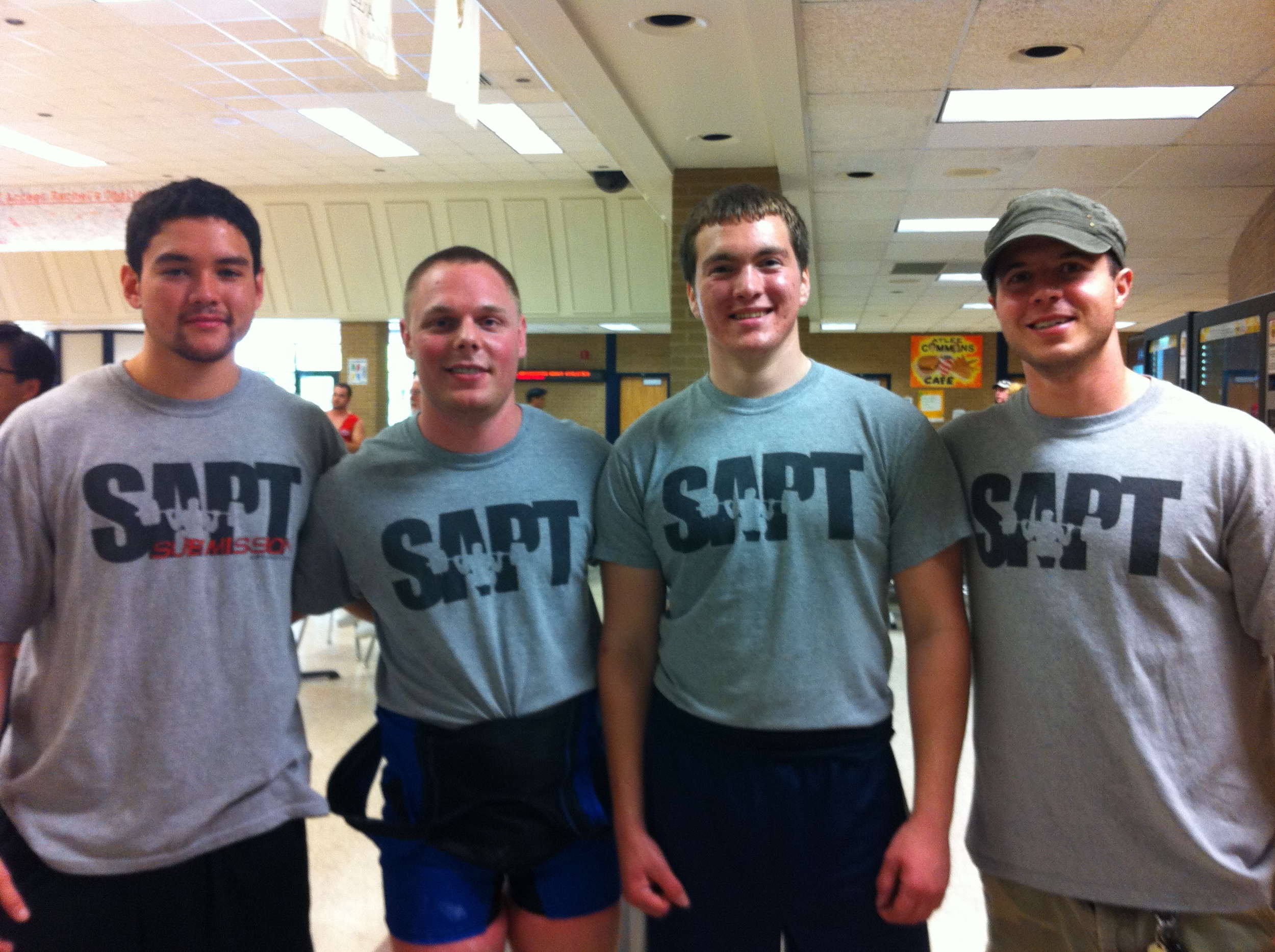
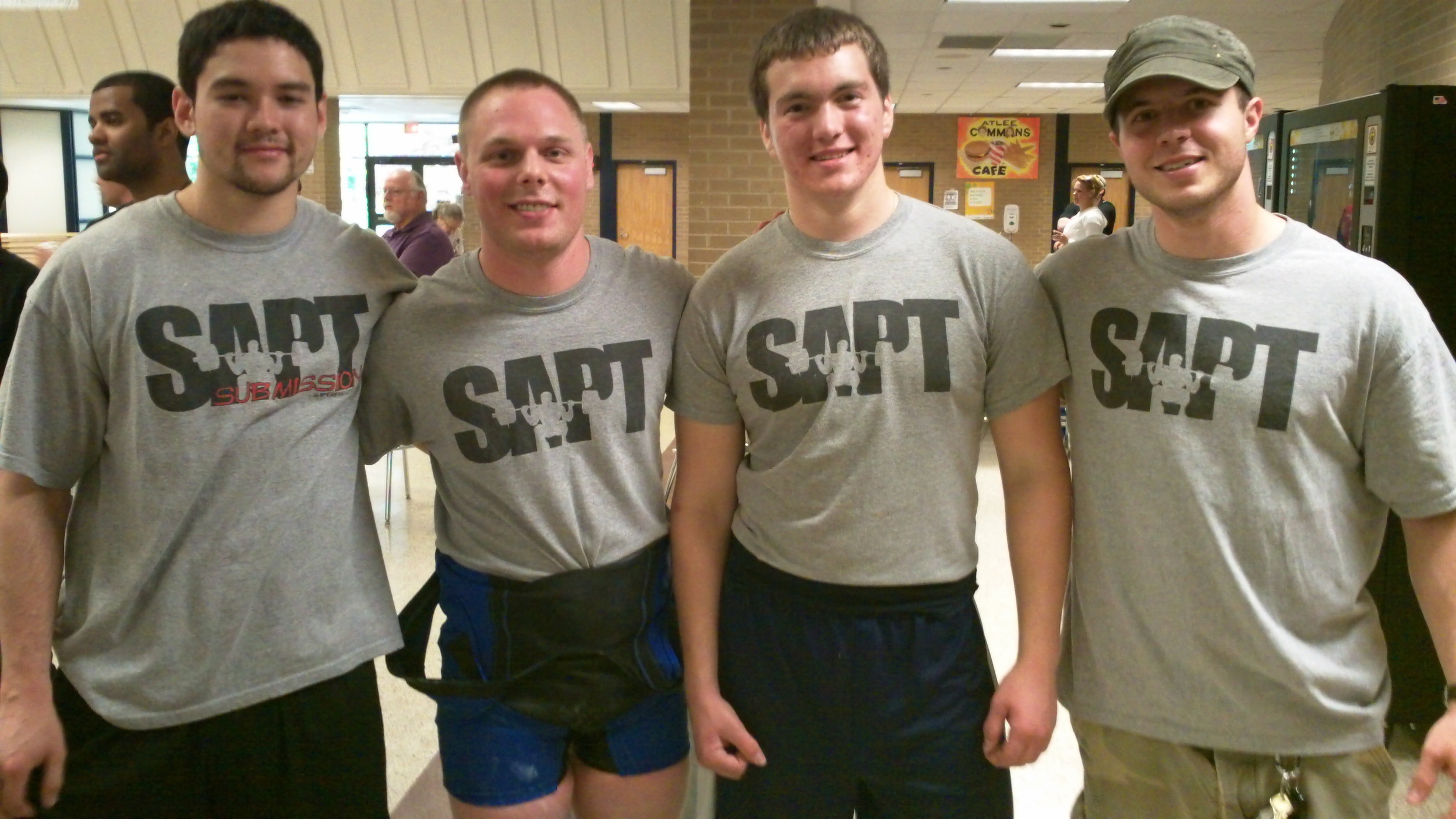 (SAPT intern Tadashi is on the far left, and Carson is in the right-middle. Ignore the other two clowns)
Even though Carson only trained 3x/week with us leading up to the meet (and sometimes less, due to college visits and illness), he set PRs on all of his lifts, and went 9 for 9 on his attempts; something that I think can only be appreciated by those who have competed themselves and have faced the rigors of competition judging. I might also add that he shined above all of his peers with regards to exercise technique, and placed first in his age group/weight class.
Here is a brief video showcasing his 3rd attempt for each lift:
I was going to list a few of the reasons why what Carson set out to do/accomplish is so remarkable, especially considering he is still in freaking high school! Mike Robertson already wrote an EXCELLENT article over at t-nation.com on the topic, however, so I'll direct you there:
7 Reasons Everyone Should do a Powerlifting Meet
(^^^Click Me^^^)
Read the above article, and then give Carson a high five when you're done.
SAPT coach Ryan Wood also competed, and did awesome, but I'm pretty sure he's going to discuss his meet for his blog post on Thursday so I'm not going to steal his thunder now (even though I totally could.....muahahah).
On another note, I place 100% blame on Carson for causing me to split the entire backside of my favorite pair of cargo shorts. Not because his deadlift is so awesome (even though his deadlift certainly does cause many an unsuspecting victim to destroy his or her back of the pants), but because, while in the warm-up room, I was helping Carson get ready for his opening deadlift attempt, and, while leaning over like so, felt+heard a very distinct:
riiiiiiipppppp
moving from top to bottom down my shorts:
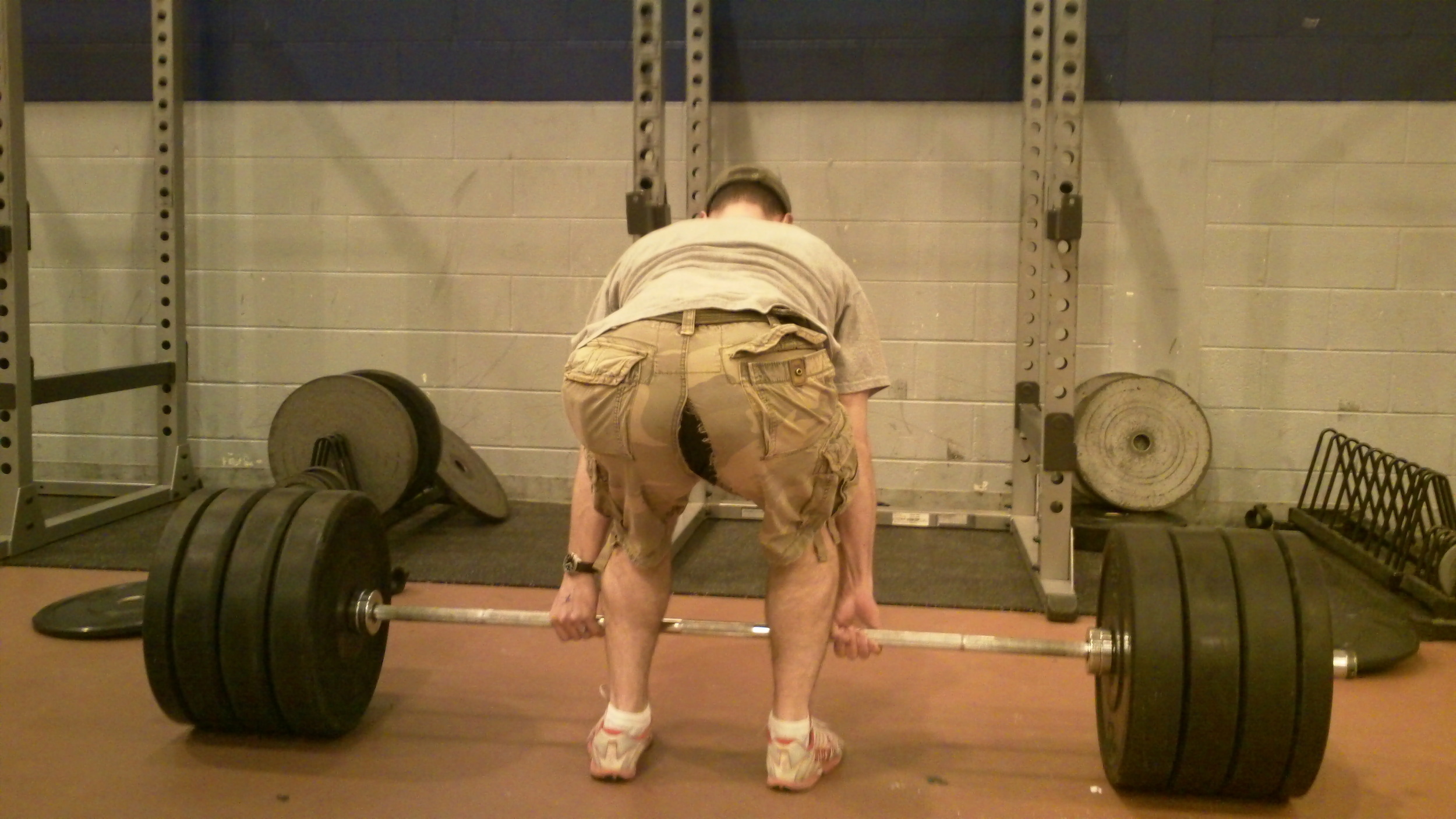 Yep. I had to then spend the entire rest of the powerlifting meet (and the remainder of my weekend in Richmond) walking around with a gaping hole in the backside of my shorts. Curse you, Carson!!!