SAPT Contests through 4/12/15!
We've got some pretty cool contests planned all year long. To kick things off, here are the first two:


Priming Your Programming
Programming is the poetry of the Strength & Conditioning world, except way more awesome and less awkward to talk about in public. Some programs flow smoothly, creating synergy in movement and some seem to be as random and mundane as a lazy haiku. If you're on this site and reading this, chances are that you have experienced both. And chances are, you've seen the differences in effectiveness as well.
Most people will go with simple antagonistic pairings, ensuring that the exercises don't pull from one another. A simple push-pull template works well for this and is a common go-to for any trainer or coach. Others may go with simple muscle group splits within their pairings, addressing certain fibers appropriately while others rest. Some may even choose to do all their sets of one exercise at a time, not worrying about pairings. These are all tangible ways to design a program, but what if I told you that there was a way to have your pairings improve the effectiveness of one another? To, "prime" some of the movements in the program if you will. (It's oddly satisfying dropping the title of your article in the article).
Yes that's right, by putting certain exercises together, you can actually improve the movement efficiency and strength. I've seen this work with individuals of all training ages. We've had experienced lifters PR and we've had newb trainees show significant improvement in execution of the exercise between sets.
The reason for this is biofeedback. With any exercise of corrective or, "functional" measure, you should see some instantaneous changes in movement when done correctly. Whether it's a sudden increase in range of motion or a new found ability to stabilize a joint. Using a movement to practice muscle synchronization or just prime muscle activity can create a temporary increase in function. Pairing movements that carryover with biofeedback is a sure fire way to drastically improve the effectiveness of the workout. Not only will the trainee be able to lift more weight in the applied movement, it will make the improved function stick that much more. It's a win-win!
So what exercises work well together? Ones that are working upon different aspects of the same pattern. So for example, a deadbug is mainly focusing on the ability of the obliques to stabilize the spine as the hip extends and shoulder flexes. This is addressing activation of the anterior oblique sling, a system of muscles that act together in gait eccentrically during the push-off phase and concentrically during leg swing. If this system is dysfunctional, it's going to severely impact the individual's ability to control the rotation during things like gait or throwing. Due to this, deadbugs are a perfect pairing for a lunge variation, especially for those individuals who like to turn out at the hips. By pairing lunges with deadbugs, we're priming the obliques to stabilize the pelvis/torso and talk to the adductors to stabilize the rotation of gait. This will improve the force transmission of the lunge and create better acceleration and deceleration. AKA Better performance!

Thought must also be put into the threshold strategy at which you're training your client. If you plan on pairing two intensive movements, the chance of good carryover between the two will be minimal, though you can still get a great training affect. Of course, as the individual becomes stronger and more trained, they will be able to perform more advanced variations of each and still have them compliment each other. I personally like to scale it by goal of the more compound movement and training level of the client: higher intensity and max strength work = low threshold pairing. Accessory movements = moderate threshold depending largely upon individual's abilities and training age.
** I feel this should be noted: Any low threshold work you do she be able to be done while maintaining good, diaphragmatic breathing, this will carryover much better as it'll address the local stabilizers much more. You can learn more about threshold strategy here.
So for example, if I have a client squatting heavy for their main movement, I will most likely pair that with a quadruped rocking variation. The rocking is a low threshold version of the squat, so it's addressing the tonic muscles (stabilizers rather than prime movers). This will make the local stabilizers within the spine and hips be more active in the pattern and improve the actual squat. I can also manipulate the rocking variation to address any issues in the squat pattern. So if I want to get more out of the anterior chain of stability, allowing them into a deeper position, I may try an RNT quadruped rockback vs a band. You could get as creative with it as you want for your training purposes. I've seen great success with not only getting people squatting better, faster, but even in improving depth and ease of movement in some of my experienced trainees.

You're going to find that certain movements create more biofeedback for some individuals than others. This is where a good evaluation becomes key to really dissect what needs to be addressed. However, for the most part you are going to see that certain exercises just really mesh well with each other to get people moving optimally. This is why if you look at the templates that I have created in Concentric Brain, you will see that my pairings are matched up as such. All I have to do is match the right intensities and ensure that the variations are appropriate for that individual.
Some other pairings that I really like:
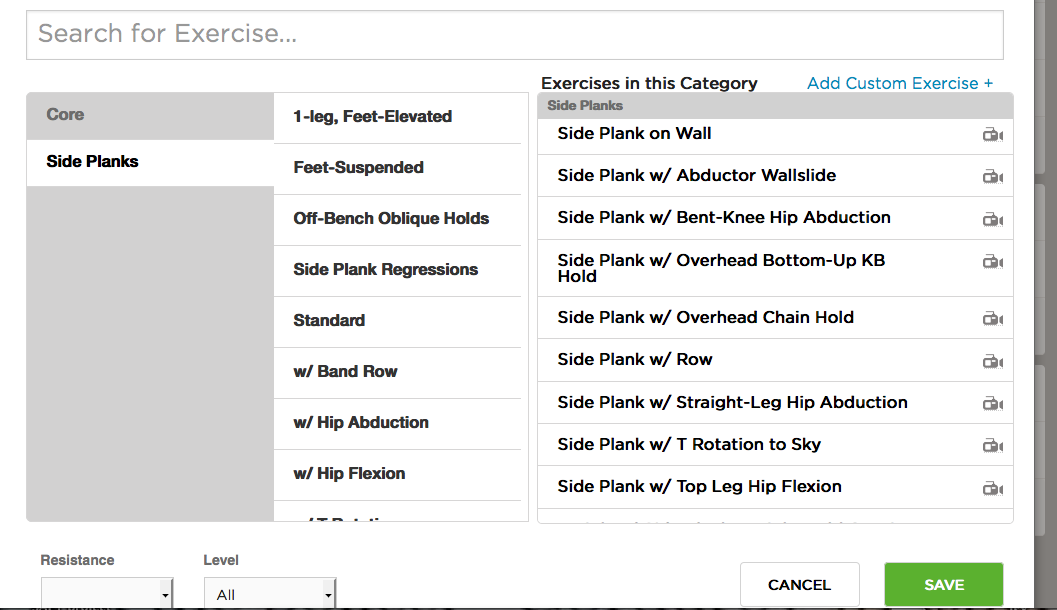
Side Planks and Step Ups: It's pretty common to see some hip hike in step ups, though not at all desirable. A common issue is that people will have poor frontal plane stability and be limited in training this exercise. There is usually some dysfunction in the way the QL, obliques, glute med and adductors talk to each other to stabilize the pelvis in that chain. I have found side plank variations to be great tools for having instant carryover in this pattern. You can choose the variation that puts emphasis on the muscle that you think may be the weak link. They're also very scalable in intensity, making them usable for all levels of trainee.
Bird Dogs and Overhead Presses: Yup, the exercise that has traditionally been a cook-book back care exercise can actually help your overhead press. The bird dog links several movement systems together and when performed correctly should really help with alignment while the shoulder and hip go through full ranges of motion. It's a relatively low threshold movement and as such should get the tonic muscles more active. As I noted in last week's blog, alignment and positioning are the keys to a good overhead press. I've also found that playing with the hand positioning in quadruped rocking variations can be advantageous by creating more scapular stability via the serratus anterior.
SFMA Rolls and Balance Work: Biofeedback actually works on many more levels than just altering range of motion or mechanics. It can actually work with sensory components as well. Many people look at SFMA rolling as a way to disassociate upper and lower limb movements and work on rotational mechanics. They do all of those and because of that, they can have great carryover to almost any movement for those less coordinated. But the other thing they do that is they help to stimulate the vestibular system via the otoliths within the cohclea. Gravity gives us sensory feedback by using the gel-like substance within the otoliths to pull on the hair follicles. Sensory information about the positioning of the hair follicles is sent to the CNS and tells us which way is up. With a lot of people, especially older clientele, this feedback may be muffled due to less sensitivity of the hair follicles. The SFMA rolling patterns make them slowly roll back and forth, causing more movement of the gel-like substance within the cochlea and stimulating the vestibular system. This creates carryover into upright movements by capitalizing on the increased stimulation and its transfer to body awareness. If the rolls are a little too much for someone (they get dizzy easily) then you can even gently rock/shake them while supine to help recalibrate the gel-like substance first. So long as you can put your hands on your client that is.

As you can tell, you can get pretty creative with the combinations. There are several pairings that I use that I didn't even mention in this article for length's sake. All it takes is a bit of thought, creativity and some trial and error. As long as you are taking notes, you'll soon have a toolbox full of pairing variations to get people moving right. This becomes extremely helpful when creating your templates and when put in Concentric Brain, you can easily just pick the variation of the movement appropriate for that person. Once you have your methods and templates down, you will be writing smooth works of art in no time.
Subscribe to our Strength Feed
(Almost) Every Exercise is a Core Exercise!
Yesterday was an awesome day at SAPT. During our 3PM session, we had 6 athletes deadlifting at one time. Considering the deadlift is one of my favorite lifts, the sound of metal hitting the floor repeatedly was music to my ears. After sessions, I was fortunate enough to be able to train my sister, who I love very dearly. She's not the biggest fan of working out, which is pretty funny considering I literally cannot go 4 days without some form of exercise. Ask anyone who really knows me... If I've gone 3 or 4 full days without lifting, I'm going to be pretty grumpy, I won't really be able to give anything else my full attention, and I just won't be Charlie that you've all grown to tolerate.

Anywho, Lexie has been an awesome "client." She's made great progress and she's been doing her best to workout 3 times a week, even though she routinely works 10-12 hours a day. Last night, she came to the gym after a 10 hour shift even though I'm sure that's the last thing that she wanted to do. She's lost 20 pounds so far, and feels mentally and physically stronger than she has in a long time. I'm incredibly proud of her, and very fortunate that she's allowed me to help her over the past few months.
During our session, she was performing a set of stepback lunges and mentioned that she could really feel her core working. It surprised her because a stepback lunge is clearly a leg exercise, right? Not so fast... This may come as a shock, but a stepback lunge is a TOTAL BODY MOVEMENT! Let's break it down and take a look...
- This exercise is working your legs. Notice how I didn't say "This exercise is working your quads." Your body does not work in isolation. Every single muscle in your lower extremities has to contract, whether that be in an isometric, concentric, or eccentric fashion. Those are all fancy kinesiology terms for a muscle that is "resisting movement," "producing force while shortening," and "coming under tension/producing force as the muscle is stretched." Oftentimes, a muscle will contract in an isometric, concentric, and eccentric fashion at different times during the same movement. Lets take the glutes for example: As you stand tall, your glutes are short and, technically, are contracting in an isometric fashion to prevent your hips from flexing and your body from collapsing upon itself. As you take a step backward with your right leg, your left glute begins to undergo a stretch as the muscle lengthens. The glute has to contract ECCENTRICALLY as you near the bottom of the lunge in order to slow you down. If you were to pause at the bottom of the movement, that glute would need to contract ISOMETRICALLY to maintain your hip position. As your pop forward into the starting position, your left glute needs to contract CONCENTRICALLY as it shortens and extends your hips. Now that I've bored you with a bit of biomechanics, let's move on.
- This exercise is also working your arms! You're holding a weight at your chest. If, for some reason, the muscles in your arms and shoulders decided not to take action, the weight would drop out of your hands. Your back is also active, and this segues into our next point very nicely.
- THIS EXERCISE IS ALSO WORKING YOUR CORE/TRUNK/ABS/AXIAL SKELETON/WHATEVER YOUR WANT TO CALL THAT PORTION OF YOUR BODY THAT CONNECTS YOUR UPPER AND LOWER EXTREMITIES! I apologize for the caps, but I need to get my point across. Your core's main function is to aid in force transmission. During a stepback lunge, you're holding a heavy weight in your hands and your goal is to move it from point A to point B. For the sake of clarity, Point A is the bottom of the movement, Point B is the starting/ending point. Your legs need to create force and apply said force to the weight in your hands. Your trunk aids in that force transmission, and acts as an avenue for the force to be applied to the weight in order to move it's mass from Point A to Point B. If, for some ungodly reason, your core decided to completely shut off you would crumple into a heaping mass on the floor. We often see beginners who don't have adequate core strength stumble during these unilateral split-position movements. We watch their upper bodies teeter from side to side, desperately trying to find the stability that they need in order to stay upright.
The bottom line is, ask any normal gym-goer and they'll tell you a stepback lunge is a leg movement. This way of thinking is so misguided. It assumes that the body works in complete isolation. Now this isn't the fault of the individual, rather, it's the fault of society as a whole. Walk into any commercial gym and you'll see machine after machine after machine, each highlighting the 2 or 3 muscles that the exercise is working. It's incredibly frustrating for a strength coach such as myself. Flashback to college.... During my Methods of Human Nutritional Assessment class that I took at Virginia Tech (Go Hokies!), we had one module that was dedicated to introducing us to weight training. We hopped on the leg press, the leg extension machine, the lat pulldown station, and more. I couldn't believe they weren't teaching us how to squat, how to hinge at the hips while maintaining a neutral spine, how to press a load overhead maintaining proper anatomical positioning. I can honestly say that I learned more about my profession by reading blogs and textbooks, watching Youtube videos, and taking part in internships (VT S&C and SAPT) than in class. That is not to say that what I learned in school did not help. Kinesiology and Exercise Physiology were vital in understanding the basics and principles of exercise science. If you want to be a trainer, go to college. Yes, you can take an online certification course and skip that step, but you're missing out on the foundation. That foundation is what will give you the critical thinking skills to scrutinize training philosophies and decide whether their underlying principles are sound.
Now, after that little rant, let's get back to the title of this article. Almost every exercise that you perform at the gym (at least at SAPT because we're friggin' awesome) is targeting your core in some way, shape, or form. Occasionally, we'll get the client who asks to perform more core exercises. It makes me chuckle inside, because if only they knew... That deadlift you just performed? Your last set of squats? The 30-40 pushups that you've knocked out over the course of a session? Yup, you guessed it. All working your core. Anytime an exercises demands that you maintain a neutral spine, your core musculature is working overtime to prevent your hips from sagging and maintain that rigid trunk that allows for efficient force transmission. I really hope this article has helped you look at exercises in a different light. I hope that it reaches the people who actually need to read it. Over the past year or so, I've had a few of my friends ask me to help them with their exercise routine. I always ask them what kind of routine they've been on prior to seeking me out, and 99% of the time it goes something like this... "Mon is chest and tris, Tues is back and bis, Thurs is shoulders and core, and Fri is legs." If you've gotten this far, I don't need to explain why this makes me want to run my head into a brick wall. These are the people that this article needs to reach. If you know someone like this, share it with them. Maybe they'll hop on a 3x/week full-body program, or a 4x/week push/pull routine as a result. They'll be thanking you once they realize how long they've been spinning their wheels.
As always, please reach out if you could use my help. Our main mission here at SAPT is to help as many people as humanly possible. We're in the service industry, so please, let us serve you. Also, in the next few weeks we're going to be launching a huge sale on training packages as well as expanding our facility to double its current size. The sale is going to last 2 WEEKS ONLY, so take advantage of it before it's too late. If you aren't in the area, we also provide distance coaching and fitness consultations. Just ask. What's the worst that could happen?
EDIT:I had a reader (Scott Van Zandt) make a very astute observation while reading this article. He mentioned that we need to make a distinction between what an exercise TARGETS, and what an exercise WORKS. For example, the deadlift targets the lifter's posterior chain, but it works almost every single muscle in the human body. This is absolutely correct. Revisiting the article, the stepback lunge does indeed target the lower extremities, but it also works almost every muscle in the body, just like the deadlift. I love that Scott made this observation, as it doesn't take away from anything said in this article, but it provides me with a fantastic idea for a follow-up post. Next week, we'll talk about weak points that hold experienced lifters back in a given lift, and what the most effective method for bringing up this weak link is. Bravo Scott. Thanks again for input.
Lateral Speed and Agility: It Starts in The Gym
Lateral speed and agility is a concept that can easily (and mistakenly) be overlooked when developing a sports performance program for an individual or team. It’s easy to get caught up in dropping an athlete’s 40 yard time and shuttle times. It can be harder to step back and notice that many sports are played in side moving patterns and at various angles requiring athletes to turn and change direction multiple quickly and frequently. The first portion of this post will focus on the strength training techniques to help the lateral athlete. Because we expect the body to move in a variety of planes on the field or court is important that we train the athlete in a manner that supports this. The basis of lateral speed and agility will be strength. Just like straight-ahead speed, the greater the amount of force one can apply to the ground the faster he or she will move. Here at SAPT we use a variety of tools and exercises to enhance an athlete’s ability to apply force and change directions. Below I’ve listed a few of the simple exercises that could add value to your program with videos courtesy of the crew at Concentric Brain.
Abductor Wall Slides
http://youtu.be/f_hYfkzJ1c0
This is probably my favorite exercise to program for beginners. It takes minimal equipment, works like a charm, and is novice friendly. The range of motion for this exercise may start small and increase over time but it is important extremely important the athlete does not rotate away from the wall with their low back or hike up their hip to find additional range.
Lateral Lunges
http://youtu.be/OMMX4F8zxdU
Lateral lunges are a fantastic exercise to build strength in the quads, hips, and hamstrings. These are all key players in getting players to effectively move side to side.
Lateral Sled Drags
http://youtu.be/hLzmj29I65s
Sled drags are a beginner friendly exercise that allows for many different training outcome based on the loading. For strength days a heavier load could be pulled with a crossover step shown in the video while lighter loads can be reserved for technique days.
Mini Band Lateral Walks
http://youtu.be/JdJWmgu-_iI
Mini bands walks are a fun way to train the muscles of the hip while also challenging torso strength and stability. Two cues I like to hammer home when having athletes perform this exercise is to keep tension on the band throughout the entire set and keep the torso tall and limit rocking.
Check back next week as we take a closer look into some of the drills and exercises we use outside of gym to help lateral athletes get better.
Powerlifting Training for Sports
You must clearly understand the difference between basic training and special physical preparation. [SPP] is different for everybody; one beats up on a tire with a sledgehammer, another does figure eights with a kettlebell, and someone incline presses. Basic training is roughly the same in all sports and aims to increase general strength and muscle mass. Powerlifting was born as a competition in exercises everybody does.
— Nikolay Vitkevich
Don't you want to know more?
I wrote a guest post over at Concentric Brain you can read it HERE.
3 Overhead Press Variations You Aren't Doing
There's nothing more rewarding or manly than taking a heavy weight and shoving it overhead. It's actually a requirement for boys before they can start growing their beards. How the weight gets from point A to B can make a huuuuuge difference on the training effect and your orthopedic health. Many newbs will make the mistakes of hyperextending their back, getting some push from their legs and fidgeting the weight up, not respecting the technique and poise it requires to to execute a strict overhead press. **Just a note, if you're an overhead athlete or if you do not have proper mobility/scapular mechanics, you should not press overhead. It will most likely end up hurting you. If you're not sure if your shoulders are up for it, I recommend reading this article by Todd Bumgardner to find out.**
What's more is that many trainees will often times only stick with one overhead press variation, limiting their progress and shoulder function. Walk into any commercial gym and you'll mainly see peeps pressing dumbells overhead. If you're lucky, you might spy a barbell press. These are both fine variations, but if they're the only two overhead pressing exercises in your repertoire, you're really missing out on optimizing your shoulder mechanics and strength.
Do you like to push a kettlebell overhead every once in a while? That's great! The off-centered load and more centripetal movement of kettlebell pressing, in my mind, makes it more advantageous than it's dumbell counterpart. The traditional movement of the exercise covers more plains of motion and challenges more wrist and rotator cuff strength. Do you turn the bell upside down now and then for a bottoms up press? Awesome! You're training total-body tension, grip strength, and teaching yourself how to drive through the weight's center of gravity(which is a very useful skill for moving weight). These are also great variations that everyone should know about. For today though, we are going to cover 3 press variations that not everyone knows about.
The Z Press
https://www.youtube.com/watch?v=WqcauQS0U6s
Pressing strength, anterior core stability and hip mobility, oh my! This variation seems to challenge it all. It's become a favorite of mine for really reinforcing good torso mechanics during the press. It also will reveal your actual limitations by preventing any excessive extension of the back(which seems to be everyone's go-to cheat) and taking out the legs. This clearly shows any sticking points you may have during the movement so that you can program to break through them accordingly.
If your hip mobility is lagging, then you can try sitting on a 45 lb plate or two to decrease the amount of hip flexion required. If you find that you all of the sudden can't lock out your press when trying this variation, then it's a sign that you probably haven't earned the right to overhead press yet. Back to Todd's article you go!
The video above shows me using a barbell, but you can really lift whatever you want: swiss bar, dumbell(s), kettlebell(s), I've even heard of people getting crazy with some sandbags.
The Javelin Press
https://www.youtube.com/watch?v=2t5shgOhKyE
Remember how I was saying that it's very useful to learn how to lift through an object's center of gravity? Well here ya go! This variation will also help you with your wrist strength and challenge your shoulder stability in a very unique way. The long bar will be teetering at your wrist, this will cause you to have to shift weight and adduct/abduct your wrist to adjust very minutely. You can also press the bar similar to a kettlebell, going from a neutral to slightly externally rotated position. I find myself doing this during higher rep sets(old habits die hard). The momentum the bar gets from this slight rotation will need to be stabilized within the transverse plane, at the shoulder, wrist and elbow.
Whereas the Z press may help you overcome torso and leg cheats, this is going to help the overall efficiency and strength of the drive from your shoulders. One thing that I found to help get accustomed to this movement is to position the exact center of the bar closer to the ulnar side of my hand, it makes it waaaay easier to balance. You will also want to make sure that you do not lose good torso and hip positioning while pressing, especially if you maintain a neutral grip position such as shown. This is made harder by the bar's teetering. You may not be able to tell, but I am actually squeezing my butt and maintaining tension through my anterior core to maintain a neutral pelvis.
The Bent Press
https://www.youtube.com/watch?v=x8hSaCTLnYE
For those that don't know, that's a 48 kilo kettlebell he's got. He's called, "The Iron Tamer," for a reason. This movement takes advantage of structure and position, making it by far one of the most technical overhead press variations. For that same reason, once you've mastered the technique, you can use some pretty ridiculous weight. It's actually an exercise that the old-school strong men used to use to showcase their manliness.
If you haven't yet noticed, a large part to the overhead press is keeping the weight in line with your center of gravity so you have a better line of push. The bent press capitalizes on this and teaches you to really get yourself under the weight, keep tension and use your whole body as a driver. Think of it as a turkish get up mixed with a press in terms of actual goal of the movement. You will need very good hip mobility, thoracic rotation and healthy shoulders to accomplish this exercise. It puts your body in a very unique position to challenge loading of the hips, core tension and shoulder stability/strength; Because of this, it will carryover to more than just your press.
This is definitely not an exercise I would just try to go out and muscle it up. Most people will require some coaching to get it right. I personally am still in the infancy of training this movement and stay relatively light. It serves as a great extended warm up while you're still learning. If you're interested in making this move part of your next program, I'd recommend reading Dave's Book.
Subscribe to our Strength Feed