Are You Really Squatting Correctly?
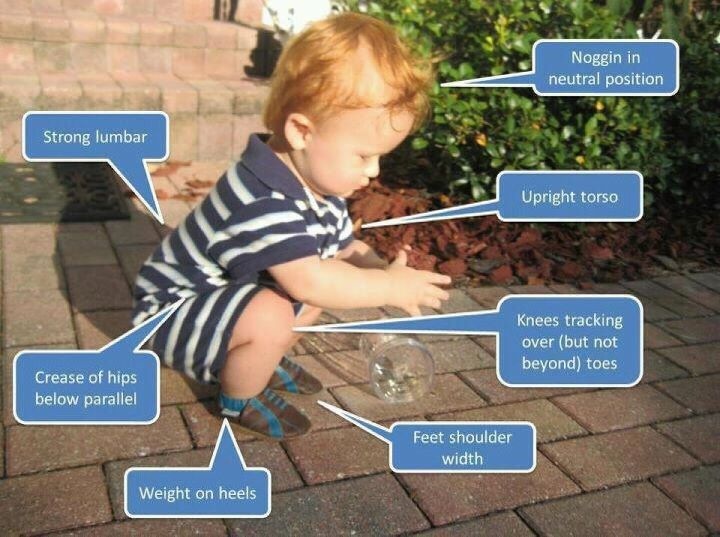
We all know the cue of “drive your knees out” when squatting but have you ever had someone observe your squat or watched yourself on camera when squatting? If you haven’t you’d be surprised to find out that your knees are probably tracking incorrectly. When coaching the squat to our athletes and clients for the first time I notice two things that happen. The first thing is the knees just do not drive out at all leading to improper tracking and you get something that looks like this…
[vsw id="AabLx4YvJvg&list=UUKSYQ75Buogznl62rdbks2Q&index=3&feature=plcp" source="youtube" width="425" height="344" autoplay="no"]
As you can see from the video the knees never track with the middle of the feet and you are left with a continuous valgus collapse. This is due to a number of reasons (poor glute strength, lack of body awareness, tight adductors) but mostly because people grow out of the habit of squatting correctly because they simply stop doing it over the years. Yes, it is true that if you don’t use it you lose it. We all at one time possessed the ability to squat correctly we just don’t do any up keep and then quickly forget how to do it.
Anyways, after seeing this I'll tell the person for the next set that as they lower they need to actively drive their knees out or “towards the wall”. This is when I notice the second thing that typically goes wrong during a squat which you can observe from the video below.
[vsw id="_Vuw15qlRfg&list=UUKSYQ75Buogznl62rdbks2Q&index=2&feature=plcp" source="youtube" width="425" height="344" autoplay="no"]
This time you’ll see that yes the knees actively drive out but they drive out way to much at the beginning, they will shoot in as they get close to the bottom, then will shoot in once they switch to the concentric portion. Cue face in palm…
So what do you do now? When it comes to this I will simply ask the person what they feel is going on with their lower body throughout the movement. Undoubtedly they will say it feels weird or it feels like they are actively driving their knees out. I’ll go on to tell them what is actually going on and/or film them to show them. Most of the time I don’t need to film because I will explain what I want to see happen on the next set. I'll say, “On the next one I don’t want you to drive your knees out until you feel you are half way down. Once you feel you’re about half way I want you to really overcompensate by driving your knees out about twice as hard as you feel you need to”. What I’ll get out of this is exactly what I was looking for which is the knees tracking with the “middle” toe of the foot throughout the whole movement as you can see in the video below.
[vsw id="OoqbgRL_0XA&list=UUKSYQ75Buogznl62rdbks2Q&index=1&feature=plcp" source="youtube" width="425" height="344" autoplay="no"]
It’s amazing how well this has worked but also a little crazy. It takes someone literally trying to overcompensate twice as much from what they think “feels right” in order to get them to squat correctly. I’ll ask the person how that felt and they will always say “really weird!” My immediate response is well that’s actually exactly what it should look like and eventually the more you do it the more it will start to feel right.
I encourage you to have someone look at your squat who knows what they are doing or have someone record you so you can make sure you are squatting correctly. If your knees aren’t tracking correctly you probably won’t get much stronger and you will also be setting yourself up for injuries later on.
Hope this helps!
3 Awesome Things I've Learned...
I’ve been in the strength and conditioning field for a very short time; luckily I have luck on my side and ended up surrounded by very smart people. Whether it’s coaching, watching my colleagues coach, reading, or training myself I consistently learn something new every day. With that said here are 3 awesome things I’ve learned both as a coach and as someone who trains.
- Keep things simple…
If you’re an inexperienced lifter or you’re dealing with an inexperienced athlete don’t try and get to crazy; you’re not and their not as advanced as you think. Squatting (bodyweight, goblet, barbell), deadlifting (kettlebells, trap bar, straight bar), and pressing (pushups, bench press, overhead press) are the best ways to gain strength, power, and body awareness. If you are just starting out or are coaching someone who is just starting out you will be much better off refining these motor patterns, using progressive overload, and coupling them with unilateral movements like split squats, stepback lunges, bowler squats, single leg balancing. I don’t care if someone is 8 years old or 50 years old these movements form the foundation for athletics and everyday life and should be learned proficiently. Things like powercleans or Turkish getups are awesome but they are advanced. I see absolutely no need to give them to someone who cannot squat, deadlift, or do a pushup correctly. Milk the simplicity of the other exercises for all their worth; you or your athlete will be better for it in the long run.
- Get Experience Under the Bar…
In one of the first conversations I ever had with Sarah was her telling me I need to compete in powerlifting. Her reasons were it would help me learn more about strength and conditioning and it would make me a better coach. I wasn’t quite sure how competing would do both those things but I started training for powerlifting anyway. Time has gone on since then and looking back I completely understand what she was talking about. You cannot be a coach or a trainer unless you get experience under the bar. I was re-watching the EliteFTS BIG seminar with Jim Wendler the other day (which everyone should watch) and he said two things that really stuck with me. Keep in mind I’m paraphrasing here but he said something along the lines of “I have authority on the subject (strength training) because I’ve had a bar on my back, not because of a certification I have or something I read” and later “everything you want to know about lifting can be learned through training”. These are bold statements but they are absolutely true.
If you’re a coach you need to try everything out, you need to get some scratches on you or no one will take your advice. It’s like a tennis player telling you how to improve your golf swing because they read an article about it once, doesn’t make any sense. And if you’re just trying to train stop reading internet articles all day long and go put a barbell on your back and squat it, go pull something heavy off the ground and then press something off your chest or over your head. You can listen all you want to this guy or this girl but the truth is you will NEVER know what works until you do it yourself. Get under the bar!
- Don’t Ever be Content and Always Have Fun…
This is where I feel people lose it. No one should be content whether it’s your knowledge base, your numbers, the money your business brings in, your teaching abilities, it doesn’t matter always strive to be better. If you’re a coach you shouldn’t ever come to a place where you say “I know everything I need to know” because you don’t. The greatest strength coaches in the world still educate themselves and then apply it. This is what’s going to make you and your athletes better. If you’re just a person trying to get stronger that’s great but once you hit a specific goal, don’t stop there, make a new one. I’m not saying don’t be happy about what you’ve done because that’s ridiculous. You should be happy about what you’ve accomplished and you should reflect on those achievements but strive for more.
This leads into my next point of having fun while you’re doing all of this. There hasn’t been one day where I haven’t had fun training or coaching. Are there days where I’m tired and don’t necessarily feel like going to train? Yeah, but by the end I had fun and am glad I did it. And as far as coaching or teaching for that matter, if you’re not enjoying helping people get better and realize their potential than you need a new career. That has been the best part of coaching and teaching for me is that I can truly have fun. I can joke around with the clients and athletes and I can help them reach their goals. People want to be so serious and mope around all the time, I don’t get it. We have all had some bad stuff happen in our lives but its our ability to overcome that makes life great. Life is truly short and we need to enjoy it and have some fun while we’re living it. With that said, I’ll leave you with this… because it’s funny!
A Tool for the Toolbox
An awesome aspect about being a strength coach is you get to watch great coaches do what they do best and at the same time be taught by them yourself. You have the pleasure of learning and then applying this knowledge gained to your athletes and you alike. The following deadlift refinement technique is not something I made up; again it’s something that I learned from the awesome coaches I’ve worked with and something I’ve been able to utilize with the athletes and my own training. Try this to fix up your deadlift technique… The volume is a little low for some reason (my apologies); better than last time though…
[vsw id="E44ocLkSOu0&list=UUKSYQ75Buogznl62rdbks2Q&index=1&feature=plcp" source="youtube" width="425" height="344" autoplay="no"]
A few supplementary notes…
- This is not something to go super heavy on. This is a tool to refine your deadlift technique.
- Keep the bar weight light but use bumper plates; as I mentioned in the video it was only 95lbs of bar weight.
- As far as band tension goes you shouldn’t be using anything more than a mini band.
- Use this during your warm-up or during your off days as a way to improve your form.
Also the below video is definitely worth checking out if you’re looking for some motivation before going to train. The video is of Jeremy Frey, a strength coach and powerlifter from EliteFTS. This guy is ridiculously smart when it comes to training and STRONG!
[vsw id="4WAkvOnZv7w&feature=player_embedded" source="youtube" width="425" height="344" autoplay="no"]

3 Tips to Improve Your Bench Press
I'll get straight to the point with this one. Everyone loves to bench press including myself but very few do it right. Why do something unless you're going to do it correctly? Try these simple tips to improve your bench. 1. If you don’t set up correctly your bench will suffer…
I’ll walk you through my set up; keep in mind you don’t have to do it exactly like this but I have had success with it and I feel I get tighter on the bench than most people. Start with your chest under the bar and set your feet, this becomes your first base of support (I choose to leave my heels on the ground). Leave your feet in that position as you slide your body through; while sliding through start to arch your thoracic spine and pull your shoulder blades back and down (retract and depress). Once you are in this position push your upper back and head into the bench while keeping your butt on the bench; these become your other base of support. Congratulations you now have a good set up and if you are doing it correctly you should feel extremely uncomfortable; almost cramping in your upper back it’s so tight. Do this even in your warm-ups, I don’t care if its 115lbs or 315lbs each set up should be the same.
[vsw id="qtn5tEqsjqE&list=UUKSYQ75Buogznl62rdbks2Q&index=1&feature=plcp" source="youtube" width="425" height="344" autoplay="no"]
2. Always have the intent to move the bar FAST!
I feel like this is a no brainer but I guess not. You need to go fast and if you’re not fast then at least try and go fast (that would be me). Having this intent to move fast during the CONCENTRIC portion (upward portion) is going to recruit higher threshold motor units allowing you to accelerate with more force thus getting you stronger. So your press should be nice and controlled on the way down, quick pause on the chest and BOOM! Lastly, if you are grinding out reps then you aren’t moving fast so you should oh I don’t know, DROP THE WEIGHT! I just wanna go fast!

3. Do upper back work….. All the time
I don’t care if it’s an upper body day or a lower body day, you should be doing some kind of upper back work every day. A strong back will help your bench press. It’s going to allow you to get tighter on the bench, control the eccentric better, and utilize your lats more. Right now my upper body days consist of two horizontal pulls (any type of row variation) ranging from 3-4 sets of 10-12 reps and my lower body days consist of a vertical pull (lat pull down, pull-ups, neutral grip pull-ups) and scapular retraction work (banded W’s or band pull-a-parts) usually in the 30-50 rep range and I break it up however I want depending on how I’m feeling that day.
The bug and the Windshield
There are two important lessons that one needs to know when training…
- You are going to have bad days in the gym, accept it. Or as Kelsey would say, “Some days you’re the windshield and some days your bug… Today you were the bug.”
- If your bad days keep on occurring you need to fix your program.
Allow me to expand a little on these two points as I have recently come into contact with both during my training. It’s vital that you listen to your body during your training in order to make the best gains you can. To do this pay careful attention to how you feel during your main movements because this is going to be the marker for the rest of your workout. Undoubtedly you will have a day where you feel like absolute crap which is perfectly FINE but you have to make the proper adjustments thereafter.
With me the times that I usually feel like this are during my deadlifts. If you know me then you know that I absolutely HATE deadlifting, it’s the worst thing ever (I probably feel this way because I’m terrible at it, who knows).

Pulling had been going well though up until last Monday when I realized I had become the bug. On that day everything felt heavy, I also felt out of my groove on every pull. I worked up to 90% of my 1RM for a single and it was a griiiiiiind. I tried to go down to 80% and get some quality work in but I didn’t even pull the weight off the ground, what happened next? Well after I got my Wolverine rage on I calmed down and just nixed the rest of my pulls, went onto my squat variation got in some good sets and called it a day. I simply chalked this up to being the bug and chose to just move on and look forward to the next training session. These days can happen for just about any reason, tired, hungry, unfocused, and maybe even OVER TRAINED. Don’t try and force it on these days, just get in whatever quality work you can and leave. If you force it you will most likely make the problem that much worse and get hurt.
On to the second point, if these “bad” days keep occurring they are probably "bad" because you are OVER TRAINED and you need to fix the problem. As I stated before I had a horrific time last Monday but this past Monday I was ready to go and felt pretty decent. I worked up to 85% and pulled it for two singles with an alright bar speed. I decided to put on 90% went to go pull and NOTHIN’! I couldn’t even get the bar to budge at all. I knew something was wrong because that shouldn’t have been happening. Stevo convinced me to drop the weight, significantly, and just go for an easy double. Well sadly that easy double was not easy at all. I knew that I was pretty over trained and needed to fix something. I called up “The Programmer” and told him what was going on, we talked about my training and my technique and came to the conclusion both needed to be fixed. The answer ended up being that I won’t pull heavy again until my meet and when I do pull (probably once every two weeks now) it will be around 40-50% for singles just working strictly on form. The take home message is don’t just ignore your body and keep going through a program simply because you feel you need to. You will only get weaker and probably injure yourself doing that. Reassess what you’re doing and make the adjustments needed so you can avoid your reps looking like this guy.
[vsw id="1ZVL_uk-U2w" source="youtube" width="425" height="344" autoplay="no"]
Coaching Nutrition and Exercise For the Win: Keep it Simple, Stupid
Last weekend, my wife and I were able to take advantage of a great opportunity. In short, some good friends of mine recently had their "Harajuku Moment" (or personal tipping point) with regards to personal health. They requested that Kelsey and I provide them with some nutrition lessons and give their current dietary regimen a "makeover," if you will. Given that they have a beautiful lakehouse - and offered to lodge us there for the weekend on top of providing all the food - we replied, "When do we start?!"
Needless to say, the experience was very rewarding. Throughout the weekend, we prepped+cooked meals with them, along with putting together a “mini packet” comprised of easy recipes, quick & dirty checklists to run through every time they prepare a meal, a sample grocery list, and a brief chart of healthy fats, proteins, carbs, and supplements. We were also able to answer some questions and debunk some myths for them:
Should I avoid eating close to bedtime? What should I eat before/after a workout? How much red meat should I consume/avoid consuming? Should I avoid egg yolks like the bubonic plague?
 Kelsey and I were able to provide this family with some very practical strategies they could begin applying to their lives immediately. Strategies that would allow them to experience greater mental clarity and energy levels, lower blood sugar, reduce the risk of heart disease, and all-in-all fix a lot of “stuff” going on in their bodies. And these strategies were all very uncomplicated.
We didn’t tell them to count calories. We didn’t tell them to weigh their food. We didn’t tell them they had to buy everything “organic” (whatever that means anymore). We didn't them them if they failed to eat Paleo then their world would be over immediately.
This entire process got me thinking….many of us – whether we are the teacher or the student - tend to overcomplicate topics in the exercise and nutrition realm. Given that I’m a strength & conditioning coach, I often fall on the teaching side of things, so I’ll briefly touch on this subject from that perspective.
When I first started in this industry as a personal trainer, I made things way, way, WAY too complicated. Whether it was coaching someone through a squat or something as simple as a X-Band Walk, I practically gave the poor client a short essay on how to perform the exercise.
 The same thing with regards to nutrition advice. I gave them wayyy too much information. All this ended up doing was overloading the person and didn’t actually help them get on their feet toward reaching their goals.
My heart was in the right place, but my head was not.
For those of you reading who teach exercise (be it in a professional setting or simply to a friend or family member), please learn from my mistakes. Don’t overwhelm the person who is listening to you. Give them one cue and explain why they should care.
When you teach someone a squat for the first time, they don’t care if you know that the rectus femoris is the only quadricep that crosses both the hip and knee joints, or that you understand the biceps femoris is the only hamstring that externally rotates the femur along with extending the hip.

Please.....let's get over ourselves.
Practical Application
Let’s put this into a practical scenario, shall we? Pretend that your teaching someone to squat for the first time. I’ll provide the “fail” version, along with a strategy you could take that will lesson the odds of your student completely hating you and being overwhelmed.
Female Volleyball Player. First Session.
Fail: "Okay, next, we’re going to squat. First, we’re going to hold the weight at our chest, or “goblet position” because if you don’t, your body will likely shut down and move like a pregnant seal, creating aberrant movement as a result of a perceived threat due to lack of stability…although you might still suck due to poor ankle dorsiflexion, inhibited glutes via reciprocal inhibition of the hip flexors, and/or tight lats. You’re then going to turn your feet out, point the big toe up, but keep your weight distributed evenly on your feet, then sit BACK, don’t fall forward!, keep those shoulder blades down and back into your back pockets, pull yourself down via your hip flexors, CHEST TALL! don’t slouch now, act like your sitting on an egg so you don’t slam into the box, then EXPLODE up so you can access your fast twitch motor units and improve your rate of force development."
Win: "Okay, first, we’re going to squat. This is going to help improve your vertical jump and allow you to move faster on the court. Watch how I do it, and then do your best to replicate it." *Coach then demonstrates a few reps of the goblet squat to box*
See the difference?
In the second scenario, we gave the athlete a reason to care, and then coached them by showing them. Ninety nine times out of a hundred, the athlete/client will perform the movement better in the second scenario rather than the first.
Is it still going to be perfect? No. But you can tweak and help them throughout the subsequent sets, adding just one or two coaching cues and keeping it there for that day. Throughout the following weeks, you help them with one small improvement at a time. Rome wasn't built in a day, ya know?
Now, I realize there are exceptions. Some people are more “audible learners” as opposed to visual learners, and others actually do want a lot of detail (usually those are people who already have some lifting experience and are involved in the field in some form or another). But I hope you get the point.
The same thing can apply to fat loss clients, someone dealing with knee pain, or those seeking some extra help in the kitchen.
Keep it simple FTW.