Recovery...
If you’re in the midst of grinding through the back third of a spring sport season, the following provides some quick ideas about how you can hasten and improve your rate/quality of recovery between competitions…and generally just stay healthy! -Don’t forget to eat
You must make eating a priority. I remember teammates losing 10-15lbs throughout a competitive season. Coincidence that these same guys were the one’s always nursing something in the training room? They blamed travel, lack of quality food on the road, etc. for their dramatic weight loss. Yes, while these variables did make finding the time for frequent-quality feedings more difficult, it’s certainly possible if you make eating a priority.
I used to pack “road coolers.” I’d stuff that sucker full of fruit, veggies, trail mixes and sandwich accoutrement. Safe to say my processed and fast food consumption was significantly less, meal frequency much more regular, and weight fluctuation less drastic, as compared to my peers.
-Sleep
Becoming regimented with your sleep is also extremely important. It’s important that you try to hit the sack at the same time every night, while shooting for 7-9 hours of uninterrupted sleep. This too was challenging as Madden wars or Poker hands (not for money of course…settle down) sometimes impeded on my desired hour of retirement. For me, melatonin, sleep mask, and a quality set of ear plugs always did the trick.
High-school guys and gals, you have no excuse for this one.
-Ice
I touched on this in an earlier post. You can see what I have to say about that here…
-Soft tissue work
Whether it’s self-inflicted (foam rolling), or delivered manual by a therapist (you can’t beat this), you got to find time to address tissue quality. Restrictions within the musculature will severely impede proper blood flow (and subsequent delivery of nutrients), and also prohibit proper movement patterns. A little bit of preventative maintenance in this area will go a long way, trust me.
-Low intensity cardio/mobility/activation drills
All of these can be accomplished in the same 20 minute session. Blending these components will not only aid in flushing toxins and delivering new nutrient rich blood, but will also help ward off mechanical asymmetries that can crop-up from overuse and the repetitive nature of sport.
It’s important not to overreach during these sessions, as the intent is to aid in recovery, not cause greater disruption. A perfect session might include various sled pulls, crawling variations, hip flexor and thoracic mobility drills, and some glute activation.
Having Adonis DNA helps, too…
Chris
5 reasons why SAPT’s adult onsite and distance coaching training plans are for you…
5. Because rather than perpetuate imbalances with your current 60 minute wander around the gym/sit on the recumbent bike, mouth agape routine, you’ll be provided a thorough individualized training program applicable to your specific needs and goals allowing you to hit the gym with vigor and purpose. Dare I say you’ll experience results? 4. Because you won’t be allowed to avoid the things you hate, the things you didn’t know you hated, and learn to embrace these things as the most important parts of your week (well almost). Learn to enjoy movement prep, mobility, and soft tissues drills designed specifically to improve active range of motion around joints and soft tissue quality. Muscular knots and adhesions don’t resolve themselves through quick, unfocused static stretching routines; in actuality, they’ll typically make the knot tighter leading to further discomfort. Knead those knots and adhesions out with our localized soft tissue techniques and experience improved recovery, less inhibited movement patterns, and a general feeling of relief.
3. Though you’ll miss the SAPT coaching staff and community feel of the SAPT training facility during your offsite training sessions, you’ll be able to pacify our SAPT cravings through our thorough and extensive, mobile devise accessible, SAPT Exercise Database. Enjoy the descriptive prose and meticulous demonstrations to ensure you’re executing with perfect form even offsite, on your time. There’s only one way to garner the intended benefit of a training stimulus, and it’s through perfect execution. Going through the motions will elicit blah training effects, plus it’s kind-of unsafe…You exercise to improve your health, right?
2. To stave off type II (fast twitch) muscular atrophy and neural drive impairment. As one ages, without central nervous system activation, and therefore limited type II stimulation, type II fibers will actually disappear (to never return again) and thus significantly lower strength and power output levels. Not only does this present grim performance and overall functionality implications, but structural repercussions as well. Because type II fibers are more hypertrophy inclined, neglecting their recruitment will overtime significantly speed-up muscle mass decline. Consider there is a 10% decrease in total number of muscle fibers per decade after the age of 50, and it’s a wonder the majority of the “well-seasoned” population hasn’t evolved into soft, slithering, amoebas of goo (HA, I had fun writing that!). Our adult programming safely implements compound movements and drills designed to improve power output to elicit the physiological responses necessary to ward off the dreaded “amoeba of goo” condition. Besides, throwing medicine balls (or should I say health balls), is just freakin’ fun.
1. Because you’ll relearn how to take time for…yourself…it’s okay, you’re allowed.
Your first step towards a more pain-free, stronger, youthful you, starts by clicking here…
You’ll love it…
Chris
My Stupid Decision for the Week - and More!
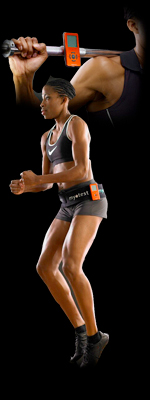
1. I’ll go ahead and lead off with what I hope is my only stupid decision for the week. Yes, it already occurred, halfway through Monday, thank you very much. A couple weeks ago a colleague of mine at Mason loaned me several fancy little devices called Myotests. These little guys look like iPods from about 4 years ago and provide some phenomenal testing feedback. You can run tests on the bench press, half-squat, several vertical jump variations, and something called “stiffness.” The Myotest provides feedback about each test with precision I’ve not been privy to before. It gives readings like Power (W and W/kg), Strength (N), Speed (cm/s), Ground Contact Time (ms), and stiffness (kN/m).
As is my tendency, I dove headfirst into the world of Myotest data. Before resurfacing I was reminded that the Snatch (especially the second pull) can supposedly generate more power than any other barbell movement. So, I decided to do some snatches – you know, for old time’s sake and to see if I’m capable of generating 3000W.
On Friday, I added a few hang snatches to the end of my lift to remember how they felt. The verdict: not too bad, definitely something to work on. Only thing worth noting: I could feel the stretch on my slightly internally rotated right shoulder. Whatever.
Now for the stupid part: Monday, I didn’t have a lift scheduled. On my off days I’ve been making a habit of doing something, really whatever strikes my fancy, to improve my general work capacity and conditioning. So, I decided to do more hang snatches – singles this time, because I’m thinking clearly. Well, long story short, I pulled something in my neck. I’m 99% sure it’s the upper part of my trapezius. Guess which side the pull occurred on… oh yeah, the right side. Should’ve seen this one coming.
So, what are the take home points in all this? 1. Myotests are pretty sweet, and, 2. When you’re training for a powerlifting meet that requires no overhead movements, it’s not advisable to throw in snatch singles on a whim.
2. Over the weekend I was contacted by a publication referencing an article I contributed to several years ago. I had all but forgotten about it, but was reminded that it’s referenced on about two-dozen other training sites. Here it is: Top Ten Reasons Heavy Weights Don’t Bulk Up the Female Athlete. It’s a pretty good read.
3. Finally, for my “No One Cares” tidbit of the day: Ryan and I discovered that adding a turbo charger to Toyota RAV4’s (like the one we have) is “a thing” in other countries. All kidding aside, you can jack these little guys up to produce between 300 to 500 hp! Check out the video below, if you’ve ever driven a RAV you know how amazing this is. We’re considering building ourselves the ultimate sleeper.
In my Half Squat test I generated 2440W, not bad considering I didn't hurt myself and it wasn't one of the fancy, technical, and purportedly superior Olypmic lifts. - Sarah
How Do You Get A Guy To Want You Back

Text Your Ex Back Free - Last week I was reminded that those of us who work at SAPT are in possession of some pretty special information: Over at Mason I was finishing up with the Throwers and needed to excuse myself to the restroom. No big deal, they w
How To Get My Ex Back, How To Get Your Ex BackHow Do You Get A Guy To Want You Back
free copy of text your ex back
How Do U Work At Getting Ur Ex Back When They Are Still Talking To U
how to get your ex back
getting back my ex boyfriend
how to get my ex back
How To Get My Ex Girlfriend Back
how to win your ex boyfriend back
Winning Back Your Girlfriend
Winning Back My Ex Girlfriend
love languages man
How To Get My Boyfriend Back
How To Make An Ex Want You Back
How To Get Back Your Ex
Text Your Ex Back
i want my girlfriend back
getting my ex boyfriend back
What Not To Text To Get An Ex Back
what is the best way to get back with your girlfriend that you just broke up with
ere all stretching and the session was wrapping up – the intern would keep an eye on things. But, to my HORROR upon return, I found the intern instructing the male throwers in the “fine points” of standing biceps curls. I’m sure you’re thinking: “What’s the big deal?” right? Well, it’s a big freaking deal and this is why…
What is shoulder impingement syndrome?
“Pain and dysfunction due to excessive overhead use or abnormal positioning of the shoulder during overhead throwing activities are common and may result from multiple etiologies, including impingement syndromes… Primary impingement has been attributed to abnormalities of the shape of the acromion and other static and dynamic causes… Secondary impingement is a similar entity but is due to an occult dynamic instability (usually anterior), which leads to symptoms similar to those seen in primary impingement.”
Essentially, what happens with overhead athletes and throwing athletes is that the tendons about the shoulder become inflamed from the crazy positions athletes put their arms in for the sake of a kill or an out or the butterfly stroke. Once the tendons become inflamed it requires lots of rest to allow the inflammation to go down. Most athletes do not get enough rest, especially in-season. So, let’s say we’ve got a volleyball player with biceps tendonitis, now we’ve got a situation where the biceps tendon is larger (due to the inflammation) thus not sliding within the shoulder the way it should. This poor sliding or impingement causes excessive wear and tear on the tendon and the joint in general.
What can make shoulder impingement worse?
So, the million-dollar answer – insert drum roll – DIRECT BICEPS TRAINING! Hopefully, I’ve already created some decent imagery of an inflamed tendon squeezed tightly into the shoulder capsule and beginning to show wear and tear. Now, imagine this same athlete with this same shoulder trying to get his pre-party pump on. He is innocently going to town on the biceps curls (because a good biceps pump is, after all, the key to a lady’s heart), but in reality he is effectively causing more inflammation in the tendon via the increased blood flow and direct work.
This additional, unnecessary volume is the culprit and can push a good shoulder into the danger zone of season-long pain and stiffness.
But, Sarah, how can I train my biceps, avoid shoulder pain, and still be a hit with the ladies?
It’s actually an easy and significantly more worthwhile way to spend your time: use compound pulling exercises. Think chin-ups, pull-ups, lat pull-down variations, any and all row variations, etc… These types of movements allow for intense training of the biceps and several other muscle groups. They also effectively allow your body to work in the way it was designed. There is generally no pain associated with these substitutions, however, if you give my suggestions a try and experience pain you should discontinue the movement immediately and try a different variation, angle, or exercise all together.
...Well, to finish my story: the intern clearly had no idea what the problem was and it turned out neither did one of our Mason GA’s. So, this post is for you, Adam and Matt.
These are the kind of details that put SAPT into a class all our own.
If you want to keep your head attached, never, ever add additional workload to my programs. Ever. It’s that important and, yes, it makes a difference. - Sarah
More SAPT triumphs...
Congrats to SAPT trainee, Big Joe V., for becoming the Northern Region 215lbs Wrestling Champion! There’s absolutely no compromise with this kid…it’s impossible to outwork him so don’t even try. Check-out the article and pictures HERE!!!
Did I mention he’ll be attending the University of Tennessee on a baseball scholarship next year?
Joe’s the monster in the blue and black singlet, below.
Get’uuuum Joe,
Chris
Quick yet brutal workout
It wasn't enough time for a proper warmup and a strength-oriented training session, so I decided to do something that would require very little time and give me my "dose of cardio." I hadn't conditioned in about 8 weeks (I was performing a rough weight gain experiment on myself), so this seemed to be what I needed.
If you think that running is the only way to "get your cardio" on, think again. Try this routine and you'll be gasping for breath within 6 minutes. I grabbed it from Ross Enamait when I was looking for something to do (that wasn't written by me), and it's called "Work Capacity 101."
Basically, start the clock and perform:
- 5 pullups
- 10 med ball slams
- 15 burpees**
- 20 jumping jacks
Continue until you're done (probably anywhere at the 60-90second mark) and rest until the 2-minute mark. Repeat for five to ten rounds, or a 10-20 minute routine.
A few notes:
1. If you can't do pullups (you'll want to be able to do 8-10 comfortably for the pullups in this routine to be appropriate), then perform an inverted row (on a barbell or TRX) to decrease difficulty.
2. If you don't have access to a medicine ball, perform an abdominal exercise of choice
3. The burpees are the most difficult portion of this routine by far. If they render you unable to complete the routine, then try elevating your hands, omitting the pushup portion of the burpee, or reducing the number of burpees from fifteen to ten.
Give it a shot! Be warned: it is WAY harder than it looks. After the fourth or fifth round you'll really be questioning your sanity. I filmed an example round that is located on the right of this webpage, or you can view it HERE.
**Burpees are as hard as you make them. Don't short-change yourself here. A true burpee is completed with a FULL pushup at the bottom (chest to floor) and a JUMP at the top. You can omit the pushup, but understand you are now doing a "squat thrust" or "up down," not a burpee.
P.S. I don't recommend doing something like this very often if increased strength and power are a primary training goal. But it can certainly be used periodically, or for those "cardio junkies" out there!
-Steve