A Tool for the Toolbox
An awesome aspect about being a strength coach is you get to watch great coaches do what they do best and at the same time be taught by them yourself. You have the pleasure of learning and then applying this knowledge gained to your athletes and you alike. The following deadlift refinement technique is not something I made up; again it’s something that I learned from the awesome coaches I’ve worked with and something I’ve been able to utilize with the athletes and my own training. Try this to fix up your deadlift technique… The volume is a little low for some reason (my apologies); better than last time though…
[vsw id="E44ocLkSOu0&list=UUKSYQ75Buogznl62rdbks2Q&index=1&feature=plcp" source="youtube" width="425" height="344" autoplay="no"]
A few supplementary notes…
- This is not something to go super heavy on. This is a tool to refine your deadlift technique.
- Keep the bar weight light but use bumper plates; as I mentioned in the video it was only 95lbs of bar weight.
- As far as band tension goes you shouldn’t be using anything more than a mini band.
- Use this during your warm-up or during your off days as a way to improve your form.
Also the below video is definitely worth checking out if you’re looking for some motivation before going to train. The video is of Jeremy Frey, a strength coach and powerlifter from EliteFTS. This guy is ridiculously smart when it comes to training and STRONG!
[vsw id="4WAkvOnZv7w&feature=player_embedded" source="youtube" width="425" height="344" autoplay="no"]

Straight Bar vs. Trap Bar Deadlifts, Part 1
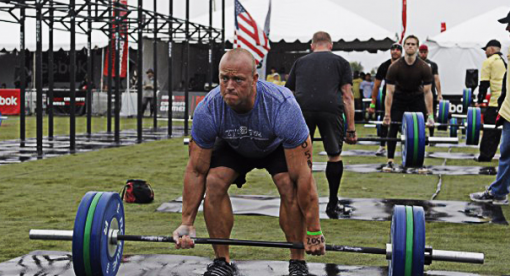 Which bar is more appropriate for your deadlift training goals?
“What’s your thought/preference on straight bar deadlifts vs. trap bar deadlifts?”
Which bar is more appropriate for your deadlift training goals?
“What’s your thought/preference on straight bar deadlifts vs. trap bar deadlifts?”
I hear this question constantly, but because both lifts closely resemble one another, and because both lifts are used so often, I can understand why it can be a confusing topic.
So, what exactly are the differences? Which of the two bars is easier to learn? Which variation will add more muscle mass? Which option will be place less stress on the low back? Which variation will provide a greater stimulus for the hips? Which bar would Wolverine and Batman choose, respectively? Hang tight, as I’m about to answer those questions and then some.
Continue Reading....
(Note: The above link takes you to my most recent OneResult article)
(Note to guy in above picture: Pack your neck FOR THE LOVE!!!)
From High School to College Baseball: Another Success Story & A RANT!
I received an email yesterday informing us that one of our long-time trainees, Kent, has decided to commit to New Mexico State University’s offer to play baseball.
AWESOME!
 Kent, and his younger brother Mitch, both committed to their training at SAPT about 2 years ago and take every repetition as if it might be their last chance to improve. That’s serious focus.
The result to this point? Kent gets to play D1 baseball while going to school and Mitch just made his high school’s varsity baseball team as a freshman… in my experience, that’s a pretty solid indicator of promising things to come.
Warning... I'm about to branch off into the promised rant:
Last week I read an opinion article from the NY Times called The Myth of the Student-Athlete. Feel free to read it… although, if you actually like college sports and understand how things really work, you will probably become angry on some level.
My level = enraged.
Gary Gutting is a professor of philosophy at Notre Dame and he attempts to rail the vast majority of college athletes and athletics.
Sadly, he is only really referring to a handful of rogue programs that jump the rails from time-to-time with major NCAA violations. But he is obviously too ignorant and inexperienced – in college athletics – to realize that. Instead, he accuses all college athletics of being, at their essence, worthless.
The truth of the situation?
Those of us who have worked within college athletics for years (it’s 7 years for me) and have taken graduate level classes in understanding how the NCAA works and how violations occur and are dealt with (yes, me again) understand how misguided his “opinion” really is.
There are numerous safety measures put in place in an attempt to keep athletics a positive experience for the student and protect them. Ask any coach how big the NCAA's volumes of rules and regulations have become over the years. In fact, sport coaches have to take and pass regular exams on NCAA regulations or else they can't coach. So, the idea that college athletics is all about money and exploitation is nonsense.
Having the opportunity to play college athletics at any level is a privilege.
College athletics teaches young adults how to balance a packed schedule in an environment where they must succeed (you’ve got to get a certain GPA to maintain the team’s good academic standing and you’ve got to contribute to the team’s successes). Upon graduation, college athletes exit their programs comfortable handling many “balls in the air” this translates well to the professional world.
Returning back to Kent, what has he already gained from athletics?
Extreme discipline as seen in his training and exceptional leadership skills. When he moves on next fall he will begin down a road that will be lined with great experiences, excellent training opportunities, and – the end goal – a higher education degree in whatever he chooses to pursue.
Good luck Kent!!!
An Outside Eye
This past weekend, my wife and I had the privilege of giving a presentation to a weight loss group at a local church in Fairfax. The group is made up of adults primarily in their 40s and 50s, and the majority of them haven't undergone a consistent resistance training plan in years (if ever). Needless to say, it was a rewarding experience to answer their questions and help guide them along, on top of the fact that it was a good chance for Kelsey and I to practice communicating some of the intricacies of exercise science in a SIMPLE manner. Anyway, one of the points we harped on was the power of having someone assess you and to guide you through exercise technique. This is true whether you're a grandmother or an elite athlete (or both?), by the way.
I say this because we've had professional athletes walk into the doors of SAPT that couldn't do a pushup or squat correctly. And if you are reading this, chances are high you are NOT a professional athlete, so yes: this especially applies to you, big guy.
I can't tell you how many times I coach someone - athletes and Joes/Janes alike - through a squat, seated row, pushup, plank, you name it, for the first time, and their immediate response is along the lines of:
"Ohhhh! THAT'S where I'm supposed to feel it?"
or
"Woah, I didn't realize how HARD this exercise is when I do it correctly."
I can't stress enough how important it is to do this. For the adults we were addressing at the church on Sunday, we suggested they do this in order to reduce the likelihood of injury during their exercise programs. For example, say we told the group they should immediately start doing planks every day in order to help alleviate/reduce their risk of back pain.
Because planks are good, right? Well....theoretically, yes. But what if you do them like this?
 In fact, this is why it can be so hard for me when someone (who has never had someone assess them before) tells me to just "tell them what to go do on their own in the gym."
We don't think twice before having someone show us how to scuba dive, shoot skeet, or ride a motorcycle, so why is weight training any different??
I think it's because the majority of people have been doing pushups and bicep curls in their bedrooms since age ten so we feel it'd be silly to ask for someone to show us how. I mean, how hard can it be to do a good squat, deadlift, and lunge?
I don't care if you're a bodybuilder, athlete, runner, weekend warrior, or are aging and simply trying to stave off diabetes and osteoporosis. Get assessed and have someone look at your form!!
Strength coaches aren't excluded from this, by the way. I can't tell you how many times I'll ask one of the SAPT coaches to step out of the office while I'm training to check out something I'm doing to ensure I'm remaining honest with myself. Heck, Kelsey and I drove up to Boston in October to have the staff at Cressey Performance assess us and coach us through all the major lifts.
You won't regret it.
Friday Musings 3/16/12: Training Athletes, Females Fear of Bulking Up, and Do Something Important Every day
 A couple things floating around my head....
1. Perhaps the easiest way to improve performance in any sport (outside of of sport-specific practice, of course), is to get stronger.
However, throughout the cycle of get stronger --> practice sport --> improve in sport --> get stronger --> practice sport --> improve even more at sport --> get stronger --> etc. etc. etc., you reach a point where diminishing returns begin to take place. It is at this pinnacle where it can be a waste of time, and even unsafe to continue adding weight to the bar. It is at this same moment where the athlete must begin to develop/work on other qualities to get where (s)he wants to be.
The key is to know when to make this shift.
2. Somewhat dovetailing off point #1....There is a difference between adding weight to the bar and actually getting stronger.
3. Everything in the strength & conditioning industry isn"t always black and white. Do you need to deadlift to improve in sport? Yes. Conversely, do you need to deadlift to improve in sport? No.
4. If you use a powerlifting-centric style of training athletes, careful of falling into the trap of treating the athletes like actual powerlifters. This can be tricky because, well, after all, the primary role of the strength coach is to get the athlete stronger, right? And the powerlifts (squat, bench, deadlift) are arguably the three best lifts from an efficiency standpoint: You can pack on large amounts of muscle and strength while keeping your quiver of exercises relatively small.
Nevertheless (and I may get hate mail for this), not all athletes necessarily need to do the powerlifts to get stronger. Guess what, they also are not powerlifters! So while certain techniques and methodologies can certainly be derived and extrapolated from one sport to another (ex. powerlifting --> baseball), remember that the athlete"s primary sport is not weight lifting.
In the baseball example, both the player and the strength coach must continue to draw the line between a baseball player that lifts and a lifter that happens to play baseball. This distinction will affect both the mindset and the overall outcome of the player in the weightroom and on the playing field.
Same goes for the O-lifts. Are the O-lifts great for developing power and improving rate of force development? Absolutely. But not all athletes need to olymipic lift to get faster or more explosive.
5. Pounding someone with information doesn"t seem to be the most effective method of inducing a lifestyle change in someone. For example, take a typical female who wants to lose some fat and improve body composition, yet is very concerned with getting "too casino bulky," or getting "huge like a man," should she undergo a weight lifting regimen.
The instinct of many trainers/men is to get frustrated, sigh, and barrage them with information such as "that won"t happen....you don"t understand the human endocrine (hormonal) system....you don"t get how IGF-1 and testosterone work, here are some scientific studies so I can prove my point, etc. etc. etc."
Guess what? That"s not what she is asking. She doesn"t care about studies or the science of training.
A great tip I picked up from Alwyn and Rachel Cosgrove is that the woman asking for advice/expressing concern wants to be heard. She wants to know her concerns were actually listened to and given a fair shot. So, you"re response could go something like this:
Step 1: Shut up and listen. Hear her out. You have two ears, two eyes, and one mouth. Use them in that order.
Step 2: Repeat back what she said (so she knows she was heard).
Step 3: Ask further questions (i.e. "What is too big?" "Define bulky to me. What does that look like?").
Step 4: Tell her you understand her concern and that you"re going to give her some advice/design an individualized plan (assuming you know how to do this) to get the specific results she wants.
The reality is she just wants to be assured you"re doing your best to give her the results she"s seeking after.
6. Here is a really cool broad jump. Perhaps SAPT should set up a similar setting in order to facilitate greater effort put forth by the athletes, no?
7. Over the past few weeks I have been goblet squatting, jumping, stirring-the-pot, and deadlifting every day of the week. As a result, honestly I can"t remember when I"ve felt this good in training. Must be some truth to the ol" adage of "If it"s important, do it every day" huh?
8. Speaking of which, the "if it"s important, do it every day" quote is typically applied to the training sphere. Do your mobility work. Do your stretching. Do your hill sprints. Train the glutes. Do your squatting. Every day.
However, I"ve found that it"s equally - if not more - important to apply it to your life outside the walls of the gym. Here are a few things on my list that, when I do them every day, only result in a more positive outlook and attitude on life:
- Praying
- Reading my Bible
- Telling my wife I love her
- Listing a few things I am thankful for
- Eating breakfast
- Enjoying a fresh cup of coffee
- Encouraging one of my athletes (ok, I guess that"s inside the gym, but you get the point)
- Spending some time in a room devoid of all electronics
When I make these things happen every day, the end result is going to be nothing BUT feeling life to its fullest. Corny maybe, but true.
9. This post was all over the place and I apologize. Just a reflection of my brain at the moment......
Have a great weekend everyone.
3 Tips to Improve Your Bench Press
I'll get straight to the point with this one. Everyone loves to bench press including myself but very few do it right. Why do something unless you're going to do it correctly? Try these simple tips to improve your bench. 1. If you don’t set up correctly your bench will suffer…
I’ll walk you through my set up; keep in mind you don’t have to do it exactly like this but I have had success with it and I feel I get tighter on the bench than most people. Start with your chest under the bar and set your feet, this becomes your first base of support (I choose to leave my heels on the ground). Leave your feet in that position as you slide your body through; while sliding through start to arch your thoracic spine and pull your shoulder blades back and down (retract and depress). Once you are in this position push your upper back and head into the bench while keeping your butt on the bench; these become your other base of support. Congratulations you now have a good set up and if you are doing it correctly you should feel extremely uncomfortable; almost cramping in your upper back it’s so tight. Do this even in your warm-ups, I don’t care if its 115lbs or 315lbs each set up should be the same.
[vsw id="qtn5tEqsjqE&list=UUKSYQ75Buogznl62rdbks2Q&index=1&feature=plcp" source="youtube" width="425" height="344" autoplay="no"]
2. Always have the intent to move the bar FAST!
I feel like this is a no brainer but I guess not. You need to go fast and if you’re not fast then at least try and go fast (that would be me). Having this intent to move fast during the CONCENTRIC portion (upward portion) is going to recruit higher threshold motor units allowing you to accelerate with more force thus getting you stronger. So your press should be nice and controlled on the way down, quick pause on the chest and BOOM! Lastly, if you are grinding out reps then you aren’t moving fast so you should oh I don’t know, DROP THE WEIGHT! I just wanna go fast!

3. Do upper back work….. All the time
I don’t care if it’s an upper body day or a lower body day, you should be doing some kind of upper back work every day. A strong back will help your bench press. It’s going to allow you to get tighter on the bench, control the eccentric better, and utilize your lats more. Right now my upper body days consist of two horizontal pulls (any type of row variation) ranging from 3-4 sets of 10-12 reps and my lower body days consist of a vertical pull (lat pull down, pull-ups, neutral grip pull-ups) and scapular retraction work (banded W’s or band pull-a-parts) usually in the 30-50 rep range and I break it up however I want depending on how I’m feeling that day.