Read This! Training Tips from a Toddler
A huge portion of my job boils down to this: teaching adolescents and adults alike how to move with the same precision and excitement that comes inborn for all of us, but that most of us lose over time. Forget about performance or a one-repetition squat maximum… I’m talking about re-teaching the basics of pushing and pulling. It sounds totally cliché, but watching my 2-year old daughter’s development across all platforms is truly a joy for me. I could, of course, talk endlessly about her cognitive development, but I’ll try to exhibit some self-control and keep this limited to the lessons we would all be well served to apply to ourselves in our physical training:
1. Focus: Last week Ryan and I picked up the kids from daycare and were walking home. As we crossed our neighborhood pool’s parking lot, Arabella suddenly shouted “FAST!” and took off running! I laughed to myself and thought how wonderful and meaningful that short exclamation was.
She wanted to run fast, got into the proper mindset, and sprinted. How simple this is! And yet, so often I have to coach athletes in the “how” of getting themselves into this same focused mindset.
2. Go through a full range of motion: Toddlers are notorious for having impeccable squatting form. Part of this is because they’re all built like power lifters (short legs, long torso, and the classic belly), but even after we lose that physique, full-ROM should be the RULE, not the EXCEPTION. You’ll be strong, stable, and have some pretty excellent mobility all around.

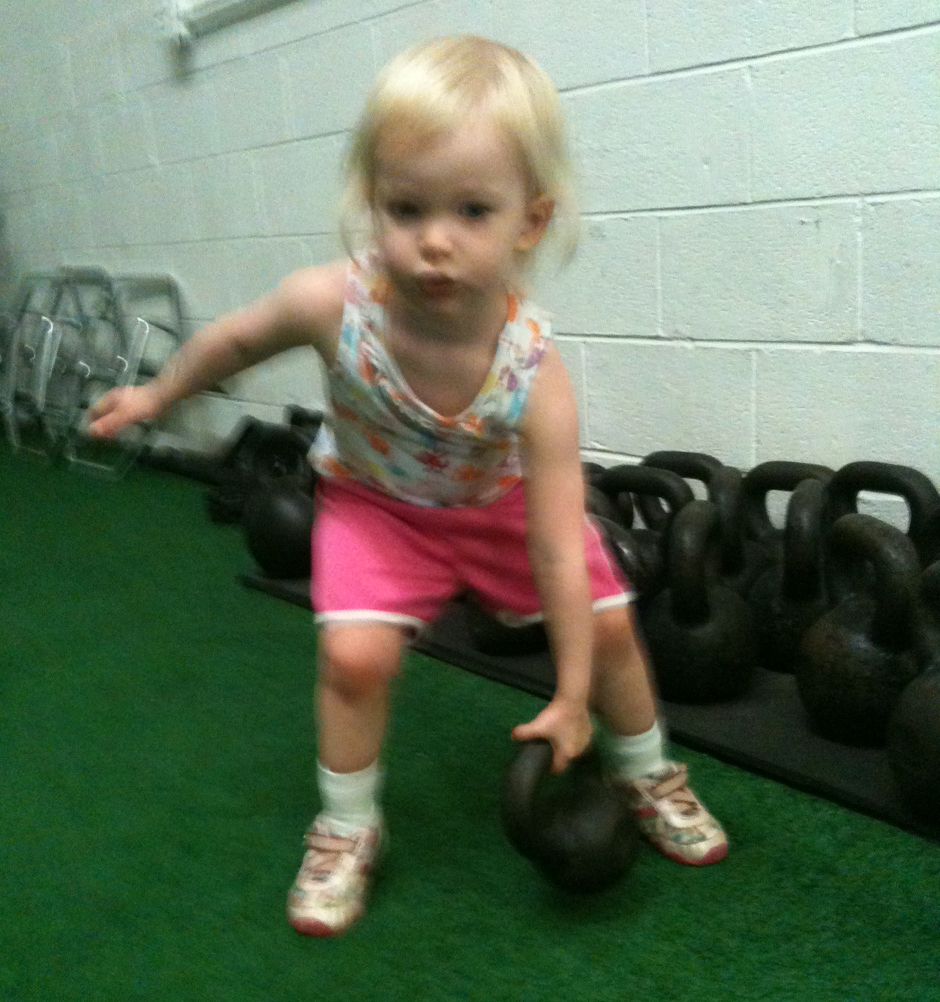
3. Pick-up heavy stuff: Arabella walked up to SAPT’s line of kettlebells on Sunday, grabbed a 10-pounder and carried it a few steps. It was definitely heavy for her, but she moved it a few feet and was satisfied.
4. Be athletic: Run, jump, kick, throw. Doing these things every once in a while is fun and inherently human.
5. Show enthusiasm for what you’re doing: Adults who pine all day about going to the gym at night are setting themselves up for failure. Accept that humans are meant to be active and strong. Once you do, maybe you’ll start looking forward to doing something other than being witness to your body wasting away.
The next time I squat, I’m considering yelling out “STRONG!” before the set – I may get a few looks, but I guarantee it would do me some good.
Parental Control
I am fortunate to work with a number of adolescent athletes ranging in age from 10-18. While the adolescent is always my primary client, the parents are often just as important. Parents often struggle with how to help their child maximize their potential, while still maintaining their number one priority, which is to be a parent. I often pass along this article written about Doc Rivers (Boston Celtics Head Coach) and how he has stayed away from coaching his son, Austin (10th pick of the 2012 NBA draft). In the article Coach Rivers said, “I’ve been great. I stay out of it, I give him advice about humility. Other than that ... go play basketball. The coaches will coach you and I’ll be your parent.” If one of the greatest coaches in the NBA can learn how to separate his role as a parent and his role as a coach, then every doctor, lawyer, and businessman/woman should strive to do the same with their children.
Every client I have ever worked with has had parents who show these three characteristics:
- Support: I have never worked with an adolescent client who doesn’t have parental support. The reason my phone rings from a parent is almost always a result of the parent’s desire to support their child. While the motives often vary, the common thread is always support.
- Challenge: Good parents almost always challenge their children to be better. A parent’s job is to teach their child morals, hard work, and to ensure that they don’t settle for anything but their best.
- Embarrass: No matter the age or environment, parents will always embarrass their children in one-way or another. It exists in every parent-child relationship and there’s no way around it. Embarrassment, intentional or not, is a part of being a parent.
With these three characteristics spelled out as “standards” amongst parents, it’s important to figure out which of them a parent should direct most of their attention to.
Support is one of the greatest gifts a parent can give a child, and that’s exactly what parents need to focus on when interacting with their adolescent athlete. Taking a supportive role and letting the coaches be in charge of challenging the child, will allow the child to enjoy their sport, learn from their sport, and give them the best opportunity to be successful. Coaches inherently are supposed to challenge, so as Doc said, “the coaches will coach, and I’ll be your parent.” So parents should make sure to support, coaches should make sure to challenge, and children will let the parent know they are embarrassing them. Trust me, I told my parents last night.
Are Your Getting the Most Out of Your Squat?
I recently bought the 3rd edition of Starting Strength by Mark Rippetoe. As I read through it I had a light bulb go on when reading the squat section more specifically when he refers to body positioning based on your chosen bar placement, high bar or low bar. Rip is a huge proponent of the low bar squat (I am as well) however a lot of people find this position extremely uncomfortable so they utilize a high bar, which is perfectly fine. In order to make your squat efficient as possible however, you need to make sure you are utilizing the proper leverages. Rip does a great job explaining just how to do this and what your body position should look like based on your bar placement. I decided to take a very little snippet from the book about this subject and talk about it a little more in hopes of helping your squat out. Please keep in mind this is all referring to a normal free squat with a straight bar, not variations there of (cambered bar, safety squat bar, etc.).
To kind of reiterate the point you can observe the pictures below to get a better feel for body position based on bar placement. For more in depth information I strongly recommend purchasing Starting Strength.
Is Direct Arm Work Necessary for Sculpted Arms?
Today we're going to step a bit away from the athletic performance side of things and touch a toe into the aesthetic department (or vanity, depending on who you ask).
A question that I'm continually asked, by females and males alike, is whether or not direct arm work is necessary to obtain a set of defined arms (for females) or bigger gunz (for males).
Before I continue, allow me to provide the Cliff Notes version of my answer: Direct arm work (or isolation exercises) will not be the difference maker in one's quest for tickets to the gun show. But it can have a time and place.
Moving on....When it comes to direct arm training, people tend to fall into two camps:
#1. "You don't need any direct arm work to develop a head-turning set of arms. All you need to do is squat and deadlift, and your biceps will grow."
#2. "You need to do copious volumes of direct arm training. One full day dedicated to biceps, another entire day for triceps, baby."
The answer, as usual, lies somewhere in the middle. While I'd love to say that #1 is true across the board (I personally find direct arm training quite boring), I'm not going to sit here and tell you that you all you need to do is squat to make your arms grow. This will hopefully be the case in heaven, but I'm afraid a bit more is needed for us earth-dwelling folk.
For the majority, a healthy dose of pulling and pressing heavy, vertically and horizontally, coupled with a sound nutrition regimen, is going to be all that is required during the first couple years of training to watch your arms develop. After you're consistent (three days on, thirty days off doesn't count), then I'd venture to say that a few sets of curls and pressdowns here and there won't hurt things.

After all, you're biceps are going to be involved in any "pulling" exercise (rows, pullups, pulldowns), and your triceps are going to be involved in any "pressing" exercise (pushups, bench press, military press, etc.).
Using a quick example, and at the risk of sounding extremely pompous and foolhardy, I've decided to use myself as a personal testimony to the value of foregoing direct arm training in favor of sticking to compound movements (presses, pulls, squats, deadlifts, and loaded carries). For over three yearsnow, I have performed zero dedicated isolation arm work during my training sessions. Zip. Zilch. Nadda.
Below is a picture I snapped just yesterday.
But before we get to that, you didn't think I could remain serious during a picture of myself flexing, did you? No. I tried, to be honest, but I couldn't take myself seriously giving an arm pose for the camera; you can peruse the innumerable Facebook profile pictures and Bodybuilding.com forums of the boy population to see some of those.
So I decided to spice it up a bit. Ladies and gentlemen, meet my Animagus form, Mr. Bananas. I only partially transformed to illustrate my point:

Now, before all the internet warriors jump in from the confines of their basement computers, let me be the first to admit that I don't consider my arms at all impressive. Are there countless individuals out there with bigger arms than me? Of course. Could my arms be "bigger" or "more defined" if I did include direct arm training into my programming? Probably.
My point that I haven't obsessed over direct arm training for well over a few years, but instead focused on simply training consistently: Pushing things around, pulling things around, carrying heavy objects to and fro on a daily basis, and eating accordingly in order to fuel these activities. And what do you know, my arms have still grown somewhat.
Which brings me to my central points:
Mindset, Priorities and Consistency
1. Mindset
You can walk in to any gym and immediately notice those who have a winning mindset vs. a losing mentality. Those with winning mindsets are training with conviction and purpose, attacking everything from their warm-ups to their working sets like they mean it.
Take those who train with conviction and have lazer-like focus during their ENTIRE time in the gym (no matter if they're doing something as simple as a band pullapart vs. something as complex as a clean+jerk), and compare them with those who lollygag through some curls to pump up before hitting the bars on Friday night, and I don't think I need to explain myself any further.
It's common knowledge that mindset is key with regards to relationships, handling finances, and one's profession; how you go about achieving results in the gym is no different.
2. Priorities
If one only has thirty minutes a day to dedicate to keeping themselves healthy, then obviously he or she should prioritize something like squats, deadlifts, or pullups before bicep curling, correct? You'd think this would be obvious, yes, but you'd be surprised (or maybe not) how many adults I've witnessed rushing into a commercial gym, clearly pressed for time, only to curl away in the mirror for twenty minutes before walking back out the door!
Look, I do recognize that I am biased, as I primarily work the athletic population, and the amount of direct arm work I give them is usually somewhere between 0-5% of their total training volume. (Keep in mind I'm NOT saying that athletes don't need to be doing direct arm work at all because it isn't "specific to their sport"; go ahead and slit the biceps tendon of a NFL running back and tell him to hold on tightly to the ball as he rushes upfield....)
But even if you're just someone who wants to look better: In the end, your choice of including or omitting isolation work for the arms isn't going to make or break your results. Whether you are male or female, prioritize the compound movements, and then treat direct arm work, if you get to it, as bonus material.
3. Consistency
Regarding consistency, you'll rarely notice any progress if you're spotty with your training sessions. The bodybuilders and gym rats who possess the largest and most defined arms did not arrive where they did because they've got the "perfect" or "secret" arm routine (or even steroids for that matter), but because they've been consistent day in and day out.
But what about.....
What about guys with longer arms that never seem to grow no matter what they do? A few sets of curls or tricep extensions at the end of your session could quite possibly help, but also note that there's a MUCH larger picture at hand (Hint: You need to eat more).
What about females that approach me, seeking to tone the backs of their arms? Sure, I may give them a few tricep pressdowns at the end of their session for the "feel" effect, but the results they end up obtaining primarily stem from their efforts in kitchen, and us helping them to focus on (and master) their rows, chinups, and pushups.
As an aside, I do recognize that genetics can play a big role here. For the males out there with long arms, or those of you that may be "skinny-fat ectomorphs," I usually give this recommendation: If you're going to do direct arm work, keep it to ten minutes or less at the end of your session. If and only if you have giving everything you have to the compound movements.
Heck, toss in a 60-second chinup, follow it up with 2 sets of 10-15 reps of EZ curls, and call it a day.
Anything over that won't necessary be doing you any good.
Closing Thoughts
1. When it comes to whether or not you should include direct arm training for better arm development, my answer is typically, "Ehhh, sure. But it's not going to be the deciding factor in your results (or lack thereof)."
2. Mindset, priorities, and consistency are the deciding factors for #1.
3. Remember: Everything you do has the potential to take away from the bang-for-your-buck exercises performed during the beginning of the training session. Your body only has a limited capacity to recover. Let the compound lifts - along with winning on the nutrition side of things - be the primary driving forces behind your tickets to the gun show.
4. Some of my reservations regarding direct arm training lie in the fact that I work with a very broad range of athletes and clientele. A lot of direct tricep work can utterly destroy "old man elbows," and too much direct bicep work for overhead athletes can wreck havoc on the shoulder. Also, I only have a limited time to work with those who train at SAPT (usually less time than that of your average gym rat) so I have to funnel out the things that don't provide the greatest return for investment. Direct arm training usually falls under that umbrella.
5. Yes, I'm an unregistered Animagus. Shhhh, don't tell anyone.
6. I apologize to those of you non-nerds who didn't understand #5.
Chronicles from the Intern Experience
At SAPT we've been pretty fortunate to have some wonderful interns since we began taking them only a couple years ago. One who completed his time with us in the spring, Tadashi, has now had a fairly complete look at athletic performance training from three separate sources. Here are his thoughts: I can now proclaim I have been an intern at three different strength and conditioning sites. While this accomplishment is a great addition to slap on my resume, I actually learned a thing or two in the process and gained a lot of experience. What’s special about my cumulative experience in particular is that I have had the chance to work in three distinctly different environments: A D1 school in a mid-major conference, a D1 school in a major conference, and SAPT (a privately owned training facility). Although these are all programs with similar goals of making people big, strong, fast, and athletic, I found that there are some pretty significant differences between the sites.
At the college level, both major and mid-major, time is always a critical factor. A common mantra in the collegiate field of strength and conditioning is “get in, get out.” There are typically multiple lifting groups per day so scheduling and timeliness are crucial. Also, the athletes have class, practice, meetings, homework, and oftentimes jobs, and they simply cannot afford to spend hours in the weight room every day. This means training sessions need to be quick and efficient. In a collegiate team setting there simply is not enough time to go from athlete to athlete and break down exercise technique in intricate detail. Instead, it becomes necessary to choose your battles and address faults that seem to occur across the board. It would be awesome to pull an athlete aside during squats and go over belly-breathing techniques because he/she isn’t bracing correctly, but in a collegiate setting the team might be on their next set and the athlete falls behind.
This was especially true at the major level because the absolute number of athletes was higher, resulting in a disadvantageous coach:athlete ratio per session. We are always maintaining supervision across the weight room floor and keeping a close eye on those we might feel are at a higher risk, such as those coming back from injury, but we can’t catch everything. For example, as I make sure an athlete with shoulder issues is performing dumbbell rows correctly, out of the corner of my eye I might see an athlete on the other side of the room pulling cleans from the floor with a rounded back (and I die a little inside…).
What I found with my experience in the private sector is that quality control and attention to detail become the priority over most other factors. With a better coach to client ratio and much higher standards in terms of execution of movement, very seldom do technique flaws go unnoticed and uncorrected. Well respected strength coaches like Mike Boyle have advised having only one “coaching intensive” movement (think squats/deadlifts/Olympic lifts) per training session, but at a facility like SAPT even a push-up position plank becomes coaching intensive.
I believe a lot of the differences boils down to the fact that in a collegiate setting we are training teams, whereas in the private sector we are training individuals. I feel that there is a level of responsibility for a collegiate athlete to keep up with the program laid out for the team, while in the private sector clients are paying for an individualized program fit for their personal needs. You’re a D1 athlete and your shoulder feels funky? Well, the team is bench pressing tomorrow so let’s hope you’re ready. You train at SAPT and your shoulder feels funky? Time to take a look at your program and see if we need to make some modifications.
There were many other differences I could talk about such as style of programming, exercise selection, testing methods, warm-ups, conditioning work, and so on, but these differences were more a result of the individual coaches’ preferences and not inherently due to the nature of the program (i.e. D1 major conference vs private sector). My experience with these three internships reinforced the fact that this field really isn’t black and white. When I have a question I turn to the experts, but what happens when the experts disagree? Olympic lifts? Linear periodization? Westside? Kettlebells? Barefoot training? Foam rolling? The beauty of having experience in multiple environments was that I could actually see these methods applied firsthand, and come to my own conclusion of what I thought was effective.
For those of you interested in strength and conditioning I highly recommend going out there and gaining some experience with many areas of the field. Whether your interest currently lies in working with elite level athletes, collegiate athletics, children and young athletes, strength sports, endurance sports, etc., jump on every opportunity to work with anyone. You will learn something from every experience, and you might even find your interests shift as you are exposed to different population groups and programs. Even an experience in what you feel might be a “bad” program will teach you what not to do, and will help mold you into a better professional.
Controlled Energy
With the NFL preseason underway and the MLB playoffs right around the corner it’s a great time to examine energy and how it impacts performance.
Energy levels can fluctuate depending on environment and situation, but the ability to control energy is essential for peak performance under pressure. Increased energy can especially help with tasks like tackling or legging out an infield hit. But that increased energy can also lead to tightening of muscles and cause tasks such as field goal kicking, throwing, and hitting seem much harder. Home court advantage, momentum, and crowd noise are playoff buzzwords that are seemingly beneficial for player performance, but an increased energy does not always lead to increased performance. The need to be calm and relaxed is evident in the three examples below.
A field goal kicker needs to be calm and collected so that they can kick in high-pressure situations. If they are not relaxed, even the simplest of tasks may seem difficult. Last year Baltimore Ravens Kicker Billy Cundiff missed a kick that would have helped his team go to Overtime and play for a chance to go to the Super Bowl.
The ability to control energy in pressure situations can often be the difference between making and missing a field goal.
Baseball pitchers normally strive to stay calm when they’re on the mound. When they are too energized, they have a tendency to lose focus and be unable to recover from missed pitches. On the mound, a pitcher needs to be able to stay relaxed and allow their arm to just “throw”. If they get too jacked up it may cause them to lose control over the strike zone and become overly aggressive. However, an increase in energy can also lead to throwing harder, so an increased energy certainly can be beneficial. Like field goal kicking and pitching, hitting a baseball often requires a lowering of energy and a relaxed state. Notice how a hitter tries to calm down before entering the batters box.
While raucous crowds, pregame speeches, and pressure situations can certainly dictate energy--none of those factors are actually in the athlete’s control. An athlete’s ability to control their energy and realize when to get pumped up and when to calm down is a huge key to performance.
The Yerkes and Dodson Inverted U theory suggests there is an optimal level of arousal an athlete needs for performance. It suggests that not enough energy leads to poor performance, but too much energy also leads to poor performance. It points out that energy is tied to finding optimal performance.
So how can you apply this information to your sport? Below are three ways to control energy.
Self-talk
Don’t take your own words for granted. You have the ability to get yourself energized or calm yourself down by simply using words. Before the game starts you should plan for when to be pumped up and when to be calm. Have key words ready to use at your disposal.
Music
By now you’ve seen an elite athlete tied to their headphones before they perform. Music has been synonymous with performance for a long time, but the choice of music is more important than actually using it. Once you figure out what type of energy you need, make sure to align your music with it.
Breathing Exercises
Breathing is your number one ally for controlling energy in the moment. Develop breathing patterns to use when you find yourself getting over energized and need to calm down. Watch an NBA player at the free throw line, a pitcher on the mound, and a hockey goalie during timeouts, and you’ll see them often controlling their breathing.