Simplicity vs. Complication
The health and fitness industry is notorious for making things more complicated than they need to be. I am guilty of it, you are guilty of it, and everyone you know is guilty of it, or at least has been at some point in time. I think it must be inherent in our nature as humans to find the most complicated solution possible.
Hence the logician, William of Ockham, creating the often-cited principle Occam's Razor in the 14th century, in order to help guide scientists in the development of theoretical models (the razor essentially states that "when you have two competing theories that make exactly the same predictions, the simpler one is the better"). But that's a story, and perhaps a long discussion, for another day.
The more I journey down the path of my own training, and help an increasing number of people journey down their own respective paths of physical training and preparation, the more I acutely understand the truth of Da Vinci's statement from the image at the top of this post.
Whether your goal is to get stronger, run faster, or lose bodyfat, the simplest solution is usually going to be the most effective. In the age of the internet, where you can pick from any multitude of websites and YouTube videos showcasing the latest and greatest plyometric drills, exercise gimmicks, and fancy schmancy exercises, it's tough to remember that simple is better.
Here are a few quick examples, giving first the problem (and a person's typical proposed solution) along with the simple solution that will be much more effective:
Problem: I want to put on more muscle on my legs. I'm going to do leg extensions, leg curls, walking lunges, static lunges, side lunges, stepback lunges, and then do supersets of each and make sure I do different leg exercises every time I do "leg day." Solution: Put a bar on your back. Now squat it.
Problem: I want to get stronger. I'll follow a conjugated periodization scheme for twelve weeks, and then enter undulated periodization for another month or two, cycling bands and chains in and out of my training. I'll also change up my exercises every week so my body never knows what's coming. Muscle confusion, baby. Solution: Pick a lift. Now put a little more weight on the bar each session.
Problem: I can't seem to lose any weight. Maybe I should try intermittent fasting, carb-cycling, do high intensity intervals every day, and switch up my workout one every other week. Solution: Eat more whole, unprocessed foods, and consume less garbage.
Problem: I missed the bench press max attempt I wanted. Was I failing to set my shoulder blades, use leg drive, breathe correctly, or set the bar path in the right direction? I must need to do it again focusing on one of those things, or is it something else I'm not doing? Solution: The weight's too heavy.
Problem: I want to improve my 1-mile time, become an elite-level Olympic lifter, do a powerlifting meet, and get absolutely shredded. Solution: How about pick just one. Then we'll get started.
Problem: I've hit a plateau in my training, I always feel so tired and can't seem to improve the weight I'm using on the bar, even though my partner is helping me do forced reps. Do I need a different periodization scheme, or should I order some specialty bars? Solution: Stop lifting to failure.
Problem: I've heard sandbag training is the secret for preparing for mixed martial arts. The ever-shifting sand challenges the core, consistently attacks different muscle groups from all angles as the bag moves around, and is really sport-specific. Solution:Uh, no.
Problem: I want to improve my squat, it just doesn't seem very good. I'll switch it up between speed-strength work, squats vs. bands, squats vs. chains, box squats, anderson squats from pins, and cycle the volume and intensity each week. Solution: Go into the gym. Squat. Do it again.
Problem: I'm a skinny guy and I can never seem to put on any weight. I really want to put on mass. Maybe I'm not following the right bodybuilding routine, or maybe I'm not doing enough exercises and total volume. Do I need to lift six days a week instead of five? Am I missing the magic chest exercise? Doing the wrong "split" routine? Solution: Pick a few barbells lifts and get better at them. Then go home and eat. Eat again. No seriously, eat more; you're not eating enough.*
Problem: I'm depressed. I need to see a psychiatrist, delve into my social and emotional past, look for triggers, shift my attention-focus, and perhaps read a few books on the matter and attend some support groups. Solution:Eat more bacon.
I'm certainly not implying that simple solutions are analogous to easy. No matter who you are, there comes a point where it's admittedly difficult to train with purpose day in and day out, to continue to push back at the iron on the days it doesn't seem to want to give anything to you, and to eat real foods when you're stressed, tired, and hungry.
But regardless of the situation, making things more complicated than they really are only going to suspend progress. Once you learn to keep things simple, and continue to keep your head up even when crap goes down, then you'll see success like you never have. You might be surprised. Simplicity is the ultimate sophistication.
*HINT: You're not eating enough.
Videos to Make Your Day Better
This week has been crazy busy both business and personally so I thought I would post some videos and showcase some of our clients and our student-athletes latest triumphs. We've got a 9 year old pushing a prowler, adults smoking a 300lbs deadlift, a female walking around with 150lbs in her hands like its her job, and finally an 810lbs prowler push! Enjoy my friends, I know I did. First here is our youngest athlete at SAPT, Sydney. This little girl is on a mission to be anything but little. She loves moving weight! Check our her Prowler Push.
Second is the infamous Lisa S. You may know her from her previous million pound PR's. Well this was her last max out attempt for a while so she went all out and got 300lbs! Another 25lbs PR!
Third is our resident female badass, Nancy. Nancy is going to be a freshman in college going in with a ROTC scholarship. It's safe to say she will be one of the strongest people there! Here is her 150lbs farmer walk!
And last but not least is Red, perhaps one of most tenured athletes at SAPT. Red is getting ready to head off to his freshman year at VMI to play baseball. But before he left I allowed him to put on as much weight on the Prowler as he wanted. He put 9 plates on EACH side, that's 810lbs!! It only took him 6 minutes to do.
As a side note I just want to say thank you to all of our athletes that are heading off to school. You all worked so hard and showed tremendous drive and heart every time you came in. I am truly blown away by your dedication and drive to be better than average. You guys are the reason I love my job and I am thankful to know you all. SAPT has become a second family to me and the appreciation you all have shown to all the coaches has been humbling. To steal a line from Robert Griffin III... SAPT we are, and SAPT we'll always be...

Deadlifts: Is It One Size Fits All?

The other day I found myself in discussion with a buddy of mine (he trains at a gym/training chain that shall remain unnamed), and the topic naturally steered toward moving heavy objects around. His tone of voice became quickly disgruntled as he told me:
"Yeah, I hate deadlifting. I love squatting though! But I utterly DESPISE deadlifts."
This obviously perked my interest, so I asked him to elaborate.
Friend: "Well, I just can't get down there and grab in a good position. It doesn't feel comfortable and my back always hurts when I do the lift. The instructors are yelling at me 'Hey, do this, do that, get your back flat' and I'm thinking to myself 'I know, I know!' but I physically can't do it since I'm so tall." (he's well over six feet tall)
Me: Ah, yeah, I know what you mean. I'm guessing you're pulling conventional style, with your feet roughly shoulder-width apart?"
Friend: "Yep."
Me: "Well, did the instructor ever have you try using a SUMO stance for your deadlifts?"
Friend: "......What's that?"
Me: "Where you put your feet out pretty wide, and then grip the bar with your hands inside your legs, as opposed to outside your legs. I find it's a bit easier for people with your type of build to get into a good deadlift position that way"
Friend: "Oh, no, they won't allow us to use any stance other than conventional. We're all forced to use the same stance."
Me: "Excuse me? I thought I just heard you say that they force you to pull conventional, and then they murder innocent little kittens."
Friend: "Yeah, that's 'cuz that is what I said."
Me: "So you have no other option? What about elevating the bar a bit to help you get into a more neutral spine position?"
Friend: "No. They don't let me do that. I have to pull from the floor. Conventional. And it hurts my back like crazy, especially when I have to perform 10 freaking reps for multiple rounds in a row."
I think it goes without saying that hearing this made me completely incensed. What's next, are we going to take young, beginner lifters and throw them under a 400lb barbell, telling them to 'just squat it'? Or do something else as equally useful as handing out free tickets to an all-you-can-eat poop buffet?
And this is why you continue to hear people spouting off that deadlifts are bad for your back. Of course deadlifts are bad for your back. If you're an idiot with them.
The very beauty of deadlifts is you can fit them to the individual, no matter the person!
Here's just the tip of the iceberg with options we have at our disposal, starting with the variation that initiated this entire discussion:
Conventional Deadlift

While conventional pulling arguably looksthe coolest, these require the most ankle mobility, thoracic (upper back) mobility, and hip flexion range of motion (ability to bend at the hips without compensating at the low back)in order to get into position safely. Conventional pulling should typically be reserved for those who've had fairly extensive practice with how to achieve and maintain a neutral spine under load, as this variation places the most sheer stress on the spine (bar is positioned furthest away from the body's center of gravity, compared to other deadlift variations).
SUMO Deadlift
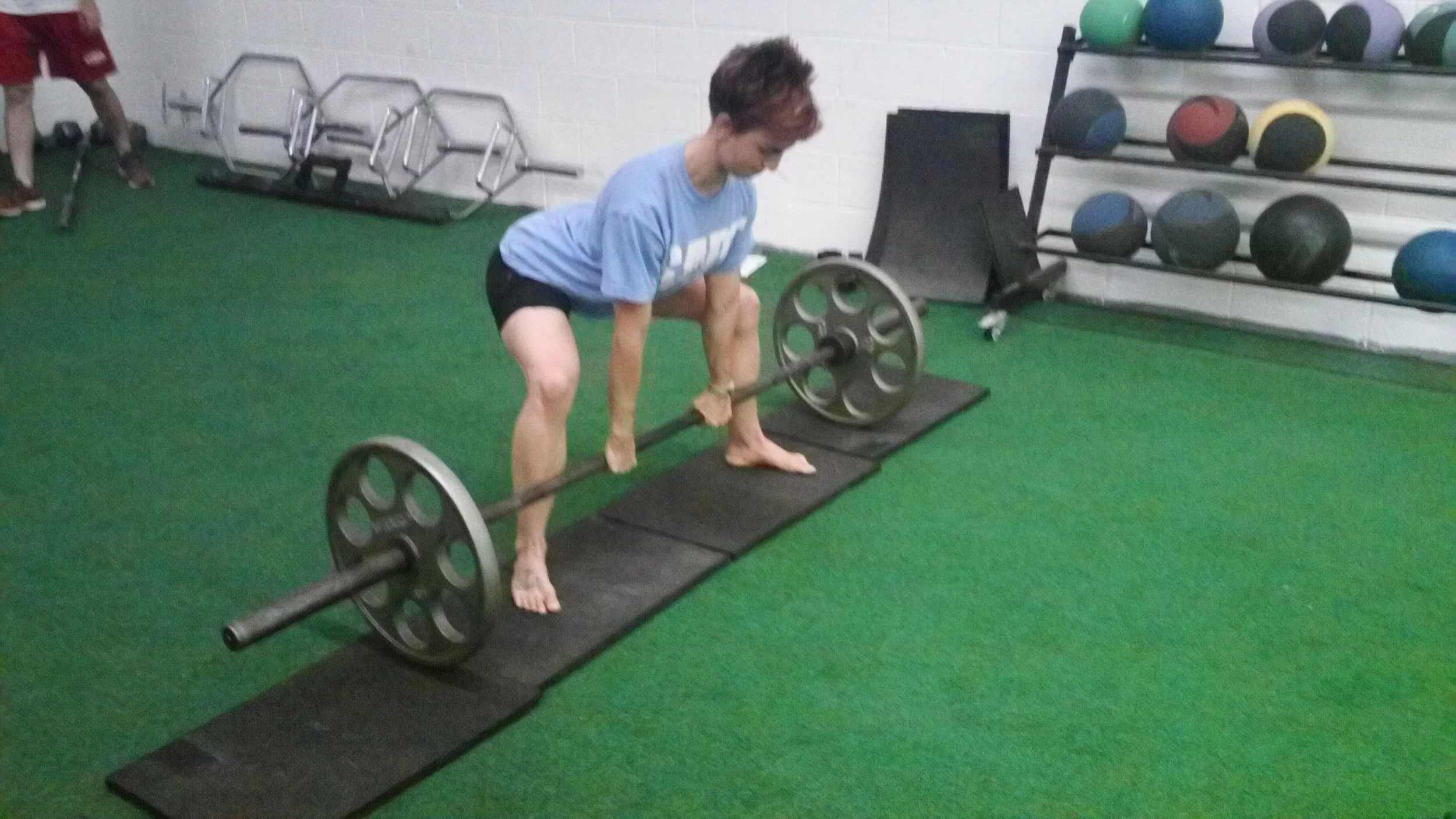
Taller individuals (such as our friend from the conversation above), and those with longer torsos are going to find this variation easier to utilize, as less mobility is required to execute the pull with a neutral spine. In addition, the total range of motion of the lift is decreased, meaning the distance the bar has to travel from start to finish is shortened.
SUMO pulling is the most common variation we will progress our athletes to after they have learned to deadlift with the trap bar.
(Note: The only caveat I'll note with SUMO pulling is that it can really beat up your hips if you use a super wide stance, and if you fail to intermittently cycle them in and out of your training.)
Trap Bar Deadlift

This variation is usually the easiest to for all people to "sit into" while keeping a safe and sound position. The high handle setting makes it so you don't have to dip down so low to grab the bar (thus less mobility is required), and the fact that you're positioned INSIDE the bar typically makes the lift easier to execute, given that the weights are lined up with your center of gravity.
This is usually the first barbell deadlift variation we use to teach our athletes and clientele at SAPT. After they have developed proficiency with the trap bar, we'll move on to the appropriate straight bar variation, depending on their body type and other morphological concerns.
Conventional Deadlift with Barbell Elevated

The beauty of this set-up is that you can adjust the height the barbell is elevated - using mats, bumper plates, or whatever - so that the lifter can utilize the straight bar but at a height that is appropriate for them as an individual.
Oftentimes, I find that someone may know what they're supposed to be doing (such as our friend above), and kinesthetically aware of where their body is in space, but they just can't physically get into a solid position when the barbell is on the ground. No worries! Elevate the bar just as high as necessary to get them into a neutral spine position (and no compensations elsewhere), and, as their mobility and stability improves, they can lower the height of the bar over time.
Kettlebell Deadlift: Conventional and SUMO


With our younger athletes, and sometimes with our adult clientele, we'll have them initiate the process of learning the deadlift by using kettlebells, as they may not ready to use a 45lb barbell, even with the luxury of 10lb bumper plates in order to get the bar at a proper height yet keeping the weight down.
These can be done either conventional or SUMO style, and the weight of the kettlebell will obviously be chosen depending on the person.
Stop Trying to Force Square Pegs Into Round Holes
As you can see, we virtually have an endless supply of deadlift variations to fit the lift to the individual, not the other way around. If someone can't pull conventional from the floor, why force it??? They can simply use another variation (or elevate the bar a bit) until their necessary qualities improve in order for them to pull from the ground safely.
Conventional deadlifting from the ground looks awesome and is "hard core," I get that. But I also don't see what's hard core about forcing someone into a position that perhaps they're just not ready for yet.
All deadlift variations are going to hammer the glutes, hamstrings, upper back; "pull" people into better posture, improve the structural integrity of their bone and soft tissue (Wolff's Law and Davis' Law), all the while teaching them to resist sheer forces and elevating their superhero status. Try not to get so caught up in what "all the cool kids do" and instead focus on the larger, and more important, picture at hand.
Thoughts on the Fitness Industry
You probably don't know this, but at 31 years old, I have already been in the fitness industry for 17 years. Yep, I got my start in the summer of 1995 at age 14. I was helping to clean and answer general questions (like, "where's the bathroom?") at my stepfather's gym in Bedford, VA. I continued helping during summers and breaks throughout high school. At this point I, sadly, thought weight training was limited to bodybuilders. I'm pretty sure my program back then was as strict dose of DB chest press, lat pulldown (yes, the behind the neck version was cycled in regularly), leg extensions, leg curls, biceps curls (the Preacher curl was my favorite, thank you very much!), and triceps pushdowns.
At Virginia Tech, I worked as a personal trainer in the Rec Sports Department. At this point, I had very proudly gained my first certification... it was ACE, of course! At Tech I got to work a few hours here and there helping fellow students move towards their goals. This was hands-down the best paying on-campus job, I was pretty proud of that, too, because it meant I only needed to work half the time to make the money I needed. Thankfully, my eyes were beginning to open to a variety of modes and methods of training, but just barely. I still felt like training/coaching was a very two-dimensional, black and white, type of job. Fortunately, I was getting a sinking feeling that programming might be waaaaay more detailed than I first thought.
After graduation, I worked at the 19th Street Gym in New York City. This place was pretty cool. After all, I was the ONLY female trainer there and ALL the male trainers were fitness models. Not a bad part-time gig. I was paid cash for my sessions. Even though my full-time job was a fancy office job in a prestigious design firm, it fell a bit short in the earnings department. I couldn't afford a gym membership, so I figured I'd fall back on my certification and kill the proverbial "two-birds with one stone" by earning extra income and a free gym membership. This was around the time when I read, of all things, Arnold Schwarzenegger's The New Encyclopedia of Modern Bodybuilding. I'm rolling my eyes at myself as I type this... Anyway, this book helped me embrace the importance of nutrition in the pursuit of performance and body composition changes.
From NYC, I became a full-time personal trainer at Life Time Fitness in Fairfax, VA. The pressure was on there. All us trainers were 100% commission. I quickly learned that I can survive virtually any situation and thrived under the sales-heavy position. Being the quick-study that I am, I managed to move to management (and a more secure paycheck) within about a year. My very first day of work here fell on a staff meeting, and I will never forget the massive disappointment I felt when the meeting finished and all we talked about were sales numbers. No discussion of training methods, client success stories, or anything related to our actual craft.
Around the time I secured a management position, I was offered the part-time strength and conditioning coach position at George Mason University. I jumped on the opportunity and fell in love with the work.
This newfound professional passion was unlike anything I had experienced since entering "the real world" and I made the decision to commute to Richmond daily to work as a GA in VCU's S&C department while working on my master's in Sports Administration.
Thankfully, my eyes were finally opened to the methods, ideas, and principles that we use today at SAPT.

So, it took me around 10-years in the fitness industry (3 full-time years) to finally find the guidance and mentorship that a young professional in the industry needs to really become good at their craft.
This makes me think there is something fundamentally wrong with the fitness industry. Why in the world did it take me so long to find this guidance?
Well, at this point and station in my career, I know the answer(s) and they don't paint a very good picture of the ever growing health/fitness industry:
1. Too much focus on sales in the private sector. Sadly, if you accidentally walk into a commercial gym, you'll probably be accosted by the money hungry trainers. Please forgive them though, it's management's fault. This focus on sales means that experienced trainers have little, if any, time or interest available to help mentor those just entering the workforce. Plus, even the experienced trainers have probably stunted their continuing education efforts and defaulted to refining the sales pitch. Now, don't get me wrong... you can't have a business without clients. So, SOMEONE has to do sales at some point, but respect should be given to the fact that strength coaches and trainers didn't spend tens of thousands of dollars on their education to feel like used car salesmen.
2. Poor pay in the public sector. I've seen job postings that state "master's degree required" for a position that pays just over $30,000. Are you kidding me? With low-pay like this, why would one be motivated to go the extra mile in personal/professional growth to continue to learn and share their expertise with a know-nothing coach or lowly intern?
3. Low barrier to entry. You - that's right, Y-O-U - could take a test online and earn a personal trainer certification practically overnight.
4. Poor skill training for bachelor's degree students. The only interns I've ever had that know how to teach the basic movements (squat, pushup, deadlift, pushup, plank, etc.) are all self-taught in terms of techique and coaching skill. For the most part, my 4th year interns still can't coach their way out of a wet paper bag when they arrive on day 1. Why is this a problem? Well, it perpetuates that lack of direction, skill, and technique of the vast majority of strength coaches and trainers. In many cases, it's the blind leading the blind in an internship situation. I used to coach with someone who taught the hang clean from a "break at the knees first" position, it made me want to bang my head against a wall. How could he not know how wrong that is? And yet he is now a Head Strength & Conditioning Coach at a D1 university.
5. Bizarre competitiveness between professionals. I assume this stems from a lack of confidence, but it truly is weird. The result is everyone thinks their method is so special that they don't want to share it with anyone. Again, a complete stoppage in the guidance needed for young coaches and trainers.
All of these points feed into a general poor perception by the public of fitness professionals.
To improve the public's perception of the health/fitness industry, those of us practicing must bite the bullet and strive to make progress in the areas of: reduced sales focus, improved pay and benefits, implementing a state licesening process, making year-long intensive internships mandatory for college students, and finally, we all need to get off our high-horses to work together not against eachother.
I know we have a fair number of readers who are strength coaches and trainers, so I hope you find this some worthwhile food for thought. If you have anything to add to the discussion, please consider posting in the comments!
Olympic Observations
The Olympics are a perfect time to observe how mentality impacts performance. Many Olympians train 4 years to compete for a matter of seconds. It’s the ultimate pressure cooker and other athlete’s can greatly benefit from watching.
This video does a great job of breaking down what previous Olympians did to prepare for Olympics.
When watching interviews take note of how many of them talk about their mental training and how it helped them perform. You don’t have to be the next Phelps, Douglas, or Bolt, but you certainly can learn from them.
Olympic Swimming Gold Medalist Dana Volmer said, “The top cap came off, I have never had that happen before. I thought about it, and maybe it kept my mind off my legs hurting or something. I don"t know. It"s just so exciting, the whole thing." Volmer also pointed out that dgfev online casino she made other mistakes during her world record-breaking race. Mistakes happen. Even when you think you need to be perfect. Don’t be afraid of them.
US Silver Medalist Archer Jacob Wukie covered himself in mosquitoes when he was younger in order to learn how to handle distractions and direct his attention to needed actions. While it’s certainly extreme, how are you learning how to be in control over your attention? Rather then making excuses for distractions learn how to deal with them.
Oscar Pistorius who has become a major story due to his use of prosthetic legs said, “My mother used to tell us, ‘Carl, put on your shoes, Oscar put on your prosthetic legs.’ So I grew up not thinking I had a disability and thinking I had different shoes.” You determine your own beliefs of yourself. Limits are for others to place on you, don’t put them on yourself.
Experience can come in many different ways. You don’t have to be at the Olympics to learn from them. Be a student of your craft!
Should Beginners Perform High Reps?
The other day, one of our interns, Jarrett, approached me shaking his head and wearing a tetchy expression on his face. I asked him what was up, and he proceeded to tell me about an incident that took place while he was out on the floor of a local gym (in which he works as a trainer).
Apparently, he witnessed a basketball coach instructing two girls on the bench press, and it was evident it was the girls' first time learning the movement. The coach had the girls banging out sets of 15 reps at a time, all the while their elbows flaring out to the sides and their bodies writhing and wiggling as they struggled to press the bar back up.
Jarrett's defensive instincts kicked in, and he quickly approached the coach to try and spare the poor girls' bodies and souls from being crushed to death. The conversation went something like this:
Jarrett: "Um, sorry for interrupting, but I don't personally recommend that you have the girls pressing the bar like that, with their elbows flared and all. It's pretty dangerous for the shoulder joint, and not to mention they'll be able to generate a lot more power by tucking the elbows slightly. I'd also recommend having them practice benching with much fewer than 15 reps at a time, as you can see their form quickly breaks down with the high reps and it's tough to learn a new movement that way."
Coach(looking clearly but briefly bemused before shrugging off what was said): "Uh, ok yeah, well, these girls aren't ready for that stuff yet. It's best to keep their elbows out for now and stick with the high reps since they're just beginners."
Jarrett: "Oh, okay I got it. So what you're saying is that the girls aren't ready for healthy shoulders, ingraining sound motor skills and enhancing their overall movement quality, since they're just beginners?"*
*He didn't actually say that (although a small part of me wishes he did), but fortunately was kind enough not to pick a fight and he just walked away. As the he was walking away, however, he heard the coach lower his voice and say (I kid you not) to the two girls, "You hear everything that guy just said? Yeah, he has no idea what he's talking about. Just ignore him"
Which brings me to the central point of this post:
Stop Programming High Reps For Beginners, FOR THE LOVE!!!!!
One of my biggest pet peeves (outside of stepping in something wet when in socks) has to be witnessing a lifting instructor take someone who's new to the weight room, and making them perform sets of 10-15 reps for everything they're learning.
Now, before I proceed any further, let me give full disclosure: I used to do the same thing when I first started out as a trainer. There, I said it. I, Steve Reed, have given high reps to beginners in an attempt to teach them various lifts.
And yes, if I could go back in time to when I worked with my first client, I'd give myself a hadoken straight to the face.
After all, it's the common (albeit unfortunate) practice taught by the majority of certification courses and exercise texts. Yet, as usual, there often exists a large gap between textbook theory and real-world application, and it's sad that it has taken this long (and still has a ways to go) for more "sound" teaching practices to permeate the educational sphere of trainers, strength coaches, and/or anyone simply walking someone through basic lifting instruction.
When the average person seeks out advice/information on how to "break in" to lifting weights, usually the first article or person they come across will tell them to do anywhere from ten to twenty reps on e.v.e.r.y.t.h.i.n.g. Squats, machine presses, deadlifts, bench press, banging head into wall. Fifteen reps for all.
It's sad, but true.
When teaching someone how to properly execute a complex lift - primarily the deadlift, squat, bench press, and I'll even throw the pushup into the mix - keep the reps AND the load low.
It's so much easier for someone to focus on correct technique when they only have to worry about 2-5 reps, as opposed to 10-20 reps, ESPECIALLY in something like a deadlift where there are so many "moving parts" for them to think about . Either they'll become too fatigued physically, or they'll simply lose attention mentally. It's unfair for a coach to ask them to do otherwise, to be honest.
For example, if the goal is to hit 30 total reps of a lift, I would recommend shying away from the common 3x10 protocol you'll see in virtually every beginner program. I'd rather have someone execute 10 sets of 3 reps, ensuring that each and every rep is perfect (or at least as perfect as it can be, considering they're learning something new), in order to reach the 30 total reps for that day.
Not to mention, they'll have a much greater frequency of exposure to the process of setting up and finishing the lift, practicing it ten separate times in one session as opposed to three.
On a side note: if you're worried about the fact that the load should still remain low even with lower reps, take heart in that a beginner will get stronger using a load as low as 30-40% of their one-repetition maximum. There's no need to rush things in that department.
And just to be clear, it's a bit of a different story if we're talking about accessory exercises like rows, split squats, or pulldowns. I think it'd be perfectly fine to accumulate more volume with these lifts, as the risk of injury is much lower, and it's typically easier to learn these movements more quickly.

Not to mention, you can easily do high reps with prowler/sled work, which is essentially a unilateral exercise for the legs, or even farmer carries for that matter, which are a "high rep" exercise for the core and shoulder girdle (keeping the midsection braced/stable, and the scapulae in a slightly upwardly rotated, adducted, and posteriorly tilted position).
Once a beginner can demonstrate proficiency with the movement pattern in question, then they have the green light to up the reps slightly, or (perhaps which I'd prefer) continue to keep the reps down on the compound lifts, but progress via a gradual increase in weight used.