SAPT Exercise of the Week: Double-Arm KB Farmer Walk with Towel

As soon as I completed my first-ever farmer carry, the exercise was indelibly cemented into my memory as an all-time favorite, and one that I privately vowed to use on a weekly basis both within my own training and in that of our athletes and clients at SAPT.
You'd be hard pressed to find to find a better exercise that simultaneously develops core and hip stability, grip strength, shoulder health, structural soundness of the musculoskeletal system, promotes fat loss and lean body mass gain, gets you "yolked," and takes the cake for overall conditioning.
Not to mention (and stealing a phrase from my friend Tony Gentilcore), a heavy set of farmer carries will make any woman within a two-block radius spontaneously conceive. How about that one, science?
And, with large thanks to Dan John and his article, The Secret of Loaded Carries, the farmer walk has grown in popularity and an increasing number of people are appreciating how valuable they are.
Perhaps my favorite aspect of loaded carries is that they are SCALABLE. You can literally use them with anyone, for virtually any training goal:
- An overweight client who's brand new to the weight room and seeking fat loss.
- A football player looking to pancake some unsuspecting soul on the opposing team.
- Wrestlers and MMA fighters desiring augmented grip strength and cardiovascular fitness.
- A powerlifter looking to improve his squat, bench, and deadlift.
- A fitness model preparing for a photo shoot, or college student fancying a sexy bod for the upcoming Beach Week.
- A mother or father simply preparing for "Life"; wanting to better prepare for the ability to get through a day of yard work without crippling back pain.
- And, while I have yet to find a specific research study on the matter, I'm convinced that a healthy dose of farmer carries, more than any other exercise modality, improves your sex life, along with making coffee taste even better than it already does.
I'm not kidding, you can use them for a-n-y-t-h-i-n-g. At SAPT we have 11-year olds carry 10lb kettlebells, practicing good posture and walking mechanics; some of our high school athletes carry upwards of 410lbs with the implements. You can see the video below for a boatload of kettlebell (or dumbbell) variations you can use as part of a warm-up or conditioning circuit:
And while I LOVE the farmer walk implements, which allow you to really ramp up the weight (and subsequently, superhero status), I realize that many of you reading train in a commercial gym, and don't have access to the wonderful world of farmer walk handles. Enter....
Double-Arm KB Farmer Walk with Towel
This exercise was invented by your fellow wizards at SAPT, when, upon opening the facility back in 2007, the power racks didn't arrive forfour freaking months due to the company being complete dunderheads delay in shipment. What appeared to be a curse quickly metamorphosed into a blessing, as it forced the coaches to be creative with exercise selection. The KB farmer walk with towel happened to be one of the offspring of this surge in forced creativity.
Here it is in action:
(Note: If your gym doesn't have very heavy kettlebells, you can stack weight plates on top of the KB, as shown in the video.)
I really like this exercise because you can do it nearly any gym, and while it will provide nearly all the benefits of farmer carries (listed in the beginning of this article), this particular variation really, and I mean really, hammers grip strength. You'll literally have to "unpeel" your fingers from your palms when you finish. Not to mention, these really make for fun competitions among the competitive crowd, to see who can go the heaviest and longest before allowing the towel to slip out of the hands.
In fact, even though we now have the luxury of implement handles at SAPT, we still use this variation with near reckless abandon in our athlete's programs.
I like to do these for 2-3 sets of 30-80yds. (If you train in a gym without much walking room, you can just walk back and forth in a 5-10yd square. Who cares if you look funny.)
Give it a shot and hope you enjoy.
Stuff You Should Read 8/31/12: Things I've Learned, The Difference Between Coaching Men vs. Women, and Sport Training for Jumpers and Sprinters
Before I get to the list, I have to show you the greatest thing I stumbled across this past month, thanks to Ryan:
If Bane says you should understand good squatting mechanics, then you should probably understand sound squatting mechanics. Case closed.
Alright, moving on to the list:
10 Things I've Learned: Ramblings From a Mathematically Challenged Fitness Coach - Alwyn Cosgrove
This article holds a special place in my heart as it was the FIRST article I ever read that helped bring me away from the stupid with regards to training people.
At the time of stumbling across the article, I was working as a personal trainer down at Virginia Tech. While yes, I was at least preaching the importance of squatting, progressive overload, and good technique, I was still following a very "Muscle & Fitness" approach to training: You know, attacking all the angles of each muscle group, omitting warm-ups, performing at least 40 total work sets during a session, tons of machine and leg press work, along with other equally useful things such as placing screen doors on submarines.
And no, I had no clue what a foam roller was, and yes, #26 and #28 on the list gave me a particularly well-deserved kick to the pants.
Upon reading this article, I immediately thought to myself, "What the....!!! Where have I been for the past couple years; hiding under a rock? What have I been wasting my time with reading?"
For those of you who haven't read it, I highly encourage you to click the link above.
Coaching Women and Coaching Men: Two Different Planets - Kelsey Reed
If you work in the coaching or training sector, in the weightroom or out on the field, it (hopefully) undoubtedly didn't take long for you to realize that teaching a male a skill versus teaching a female a skill can require particularly different approaches.
I thought Kelsey did an excellent job elucidating a few of the not-so-obvious differences between coaching men vs. women, with a few tips to boot.
Progression and Periodization for Elite Sprinters and Jumpers - Sarah Walls
This is an old(er) post from Sarah that I thought provided some awesome insight into training jumpers and sprinters. Considering that she is the strength & conditioning coach for the George Mason team (a consistently top team in America), this is written from someone who actually "walks the walk" of working with high level track athletes.
For those of you who enjoy a bit more of the "geeky" side of training, this will be right up your alley, as well.
Try Adding Some Humor to Your Day
As of late I have been trying to purge negativity from my life. I am a pretty fun loving guy and joke around a lot but I still feel that I often focus too much on the negative. Most of the time its things I have no control over or things that are 10-15 years in the future that I worry about, stupid I know. With all that said I had the pleasure of listening to Ron Culberson speak the other day; taken straight from his bio "Ron Culberson, is a speaker, author and humorist who helps staff and managers achieve success through the philosophy of Do it Well, Make it Fun." His whole message is to not take life so seriously, especially at work. You can still be extremely successful at your job and in life while not taking it so seriously or being negative. Take a look at the video to get a feel for what Ron's message is all about.
It was funny that at the same time I heard this speech was at the same time I decided to make this change of eliminating as much negativity as I can from my life. One thing that really rang true when listening to Ron speak was he told a story of when he was talking to a terminally ill patient. The patient said "Where does the time go?" His point in telling this story was that time just doesn't fly when your having fun, time flies in general. I don't know about you but that really hit home with me. Our time on this earth is extremely limited and I plan on working hard but be assured I'm going to have fun and joke around while I'm doing it. So enjoy yourself at work today, there is always a day to make the journey funnier.
These guys have the right idea...
SAPT College Baseball Training Testimonials: Red Dowdell, Ryan Dickt, & Kent Blackstone
A number of our athletes are headed off to compete in collegiate sports this year, and three of our baseball guys were kind enough to take a couple moments in order to provide some insight into how training at SAPT has helped them to prepare for the high level of competition they'll be facing this upcoming season. I should also note that what they didn't say on camera is that they are some of the hardest working athletes I know, giving it their 100% each and every single time they walked in the door. A good training program is nothing without the athlete following it through no matter what "life" throws at them outside the gym walls, so I tip my hat to these guys for consistently training with conviction and purpose, and setting a shining example to everyone who's fortunate enough to work alongside them.
Take it away fellas!
Red Dowdell - Virginia Military Institute
Position: Catcher High School (Senior) Honors: First-Team All-Met 2012, National District Player of the Year 2012
(Note: Below is Red hitting a big deadlift PR at the end of in-season training this past Spring)
Ryan Dickt - Patrick Henry Junior College
Position: Catcher High School (Senior) Honors: National District Player of the Year 2012, 2nd Team All-Region
(Note: Below is Ryan performing a ground-to-standing transitional movement drill in preparation for the upcoming baseball season.)
Kent Blackstone - New Mexico State University
Position: Shortstop High School (Senior) Honors: First-Team All Met 2012
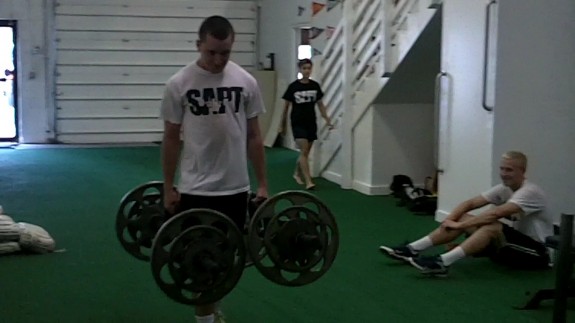
Best of luck to all you gentlemen this next year!
Read This! Training Tips from a Toddler
A huge portion of my job boils down to this: teaching adolescents and adults alike how to move with the same precision and excitement that comes inborn for all of us, but that most of us lose over time. Forget about performance or a one-repetition squat maximum… I’m talking about re-teaching the basics of pushing and pulling. It sounds totally cliché, but watching my 2-year old daughter’s development across all platforms is truly a joy for me. I could, of course, talk endlessly about her cognitive development, but I’ll try to exhibit some self-control and keep this limited to the lessons we would all be well served to apply to ourselves in our physical training:
1. Focus: Last week Ryan and I picked up the kids from daycare and were walking home. As we crossed our neighborhood pool’s parking lot, Arabella suddenly shouted “FAST!” and took off running! I laughed to myself and thought how wonderful and meaningful that short exclamation was.
She wanted to run fast, got into the proper mindset, and sprinted. How simple this is! And yet, so often I have to coach athletes in the “how” of getting themselves into this same focused mindset.
2. Go through a full range of motion: Toddlers are notorious for having impeccable squatting form. Part of this is because they’re all built like power lifters (short legs, long torso, and the classic belly), but even after we lose that physique, full-ROM should be the RULE, not the EXCEPTION. You’ll be strong, stable, and have some pretty excellent mobility all around.

3. Pick-up heavy stuff: Arabella walked up to SAPT’s line of kettlebells on Sunday, grabbed a 10-pounder and carried it a few steps. It was definitely heavy for her, but she moved it a few feet and was satisfied.
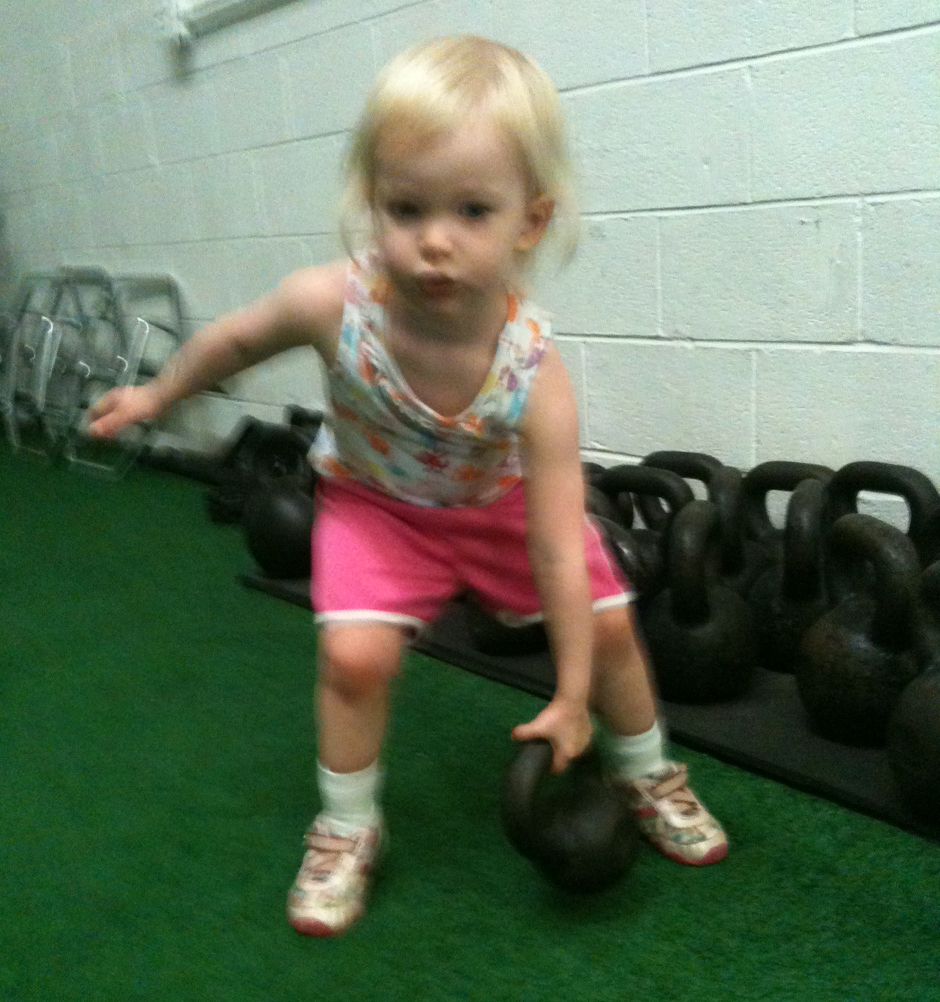
4. Be athletic: Run, jump, kick, throw. Doing these things every once in a while is fun and inherently human.
5. Show enthusiasm for what you’re doing: Adults who pine all day about going to the gym at night are setting themselves up for failure. Accept that humans are meant to be active and strong. Once you do, maybe you’ll start looking forward to doing something other than being witness to your body wasting away.
The next time I squat, I’m considering yelling out “STRONG!” before the set – I may get a few looks, but I guarantee it would do me some good.
Parental Control
I am fortunate to work with a number of adolescent athletes ranging in age from 10-18. While the adolescent is always my primary client, the parents are often just as important. Parents often struggle with how to help their child maximize their potential, while still maintaining their number one priority, which is to be a parent. I often pass along this article written about Doc Rivers (Boston Celtics Head Coach) and how he has stayed away from coaching his son, Austin (10th pick of the 2012 NBA draft). In the article Coach Rivers said, “I’ve been great. I stay out of it, I give him advice about humility. Other than that ... go play basketball. The coaches will coach you and I’ll be your parent.” If one of the greatest coaches in the NBA can learn how to separate his role as a parent and his role as a coach, then every doctor, lawyer, and businessman/woman should strive to do the same with their children.
Every client I have ever worked with has had parents who show these three characteristics:
- Support: I have never worked with an adolescent client who doesn’t have parental support. The reason my phone rings from a parent is almost always a result of the parent’s desire to support their child. While the motives often vary, the common thread is always support.
- Challenge: Good parents almost always challenge their children to be better. A parent’s job is to teach their child morals, hard work, and to ensure that they don’t settle for anything but their best.
- Embarrass: No matter the age or environment, parents will always embarrass their children in one-way or another. It exists in every parent-child relationship and there’s no way around it. Embarrassment, intentional or not, is a part of being a parent.
With these three characteristics spelled out as “standards” amongst parents, it’s important to figure out which of them a parent should direct most of their attention to.
Support is one of the greatest gifts a parent can give a child, and that’s exactly what parents need to focus on when interacting with their adolescent athlete. Taking a supportive role and letting the coaches be in charge of challenging the child, will allow the child to enjoy their sport, learn from their sport, and give them the best opportunity to be successful. Coaches inherently are supposed to challenge, so as Doc said, “the coaches will coach, and I’ll be your parent.” So parents should make sure to support, coaches should make sure to challenge, and children will let the parent know they are embarrassing them. Trust me, I told my parents last night.