Deadlift Troubleshooting Using the Coach's Eye
Here's a clip I recently threw together using the extremely handy application, Coach's Eye. Today we are going to analyze a recent deadlift session of one of our adult clients, Conrad, and explain how we were able to use this video footage to help him take his deadlift from "good" to "better than good."
More of these "Coach's Eye Analyses" will follow on SAPTstrength in the future, should you all find them enjoyable and/or useful.
SAPT Exercise of the Week: Single-leg RDL From a Deadstop
Who wants strong glutes and hamstrings? (Everyone should be raising their hands and jumping up enthusiastically. You'll jump even higher with strong glutes....)
How else do you think Mario jumps so high?
Enter the single-leg RDL (that's Romanian deadlift. Don't ask me why the Romanian's get their own deadlift variation. Apparently they jumped on the posterior chain training first.). Now, the SL RDL is a fabulous exercise to train all those posterior muscles, and never ceases to amaze me with it's ability to produce soreness, however, sometimes balance is a bit of an issue. Many times folks aren't ready for a full SL RDL, so a progression I like is adding in the deadstop portion.
The deadstop helps a) give a definite start/end point to the movement which I've found helps people focus a bit more if they know where they're going. And b) requires the glutes to really fire to initiate the movement (no stretch-shortening cycle going on up in here!) and I like that it teaches the sometimes-lazy glutes to turn on first. A lot of people, myself included, can have lack luster glute firing abilities and tend to rely on the hamstrings and adductor magnus (poor little guy, that's why he gets strained so much, he's doing the glutes' work!) to achieve hip extension. The deadstop slows the athlete down and allows one to really think about using those wonderful cheeks instead of just blowing through the exercise any ol' way.
"Turn on," Grock says. Grunt.
Take a look:
Coaching cues:
1. Fire your glutes! How? Start squeezing your cheeks (yup, both of 'em.) before beginning to stand up. Shove the heel deep into the ground as you stand.
2. Brace your midsection. If you don't, you're going to be all over the place, wobbling and wiggling in a manner most unbecoming to a serious trainee. In addition to preventing the wobbles, a tight midsection will prevent the non-working side's hip from rising up. So this exercise doubles as a core exercise (training the anti-rotation function). Fabulous no?
I can't get enough of this song; there may or may not be spontaneous wobbling going on in SAPT. But never during the SL RDL...
3. Move from the hip. Pretend it's a two-legged deadlift. HINGE baby!
4. Drive the non-working heel to the ceiling. This will ensure the the other glute stays tight and doesn't take a coffee break.
5. Keep the shoulders down and back, think about pulling your chest up towards the ceiling, to maintain a tight arch in the lower back and prevent slumping of the shoulders. We do enough of that slumpy-slump the rest of the day. We want a strong upper back so keep them blades tight!
6. Accept that you will be sore the following day. Sorry.
Q & A: High Intensity Continuous Training
Q: Hey Steve, I came across your post on HICT with step-ups, and I was wondering if you could answer some questions I have. I am 25-year old recreational athlete trying to improve my conditioning, mainly for basketball. 1. How do you use this type of training within a program? How many times per week? Do you use it in concert with other methods of conditioning as well? And do you perform this work separate from any other training, or before/after a strength session?
2. You mentioned doing HICT via a spin bike rather than step-ups, and I have seen Joel Jamieson and Mark McLaughlin also mention this. Do you use both methods, and if so, for what purposes would you choose one over the other? What are the differences?
Thank you in advance for any answers you may have. I am new to your site and look forward to exploring it more, keep up the good work.
(Note from Steve: For those unfamiliar with HICT step-ups, it is a conditioning protocol, probably invented by Satan, in which you load up your back with an extremely heavy weight vest or backpack and do step-ups for sets of 10-20 minutes at a time. Because of the high resistance yet long duration, it develops the oxidative capacity of the fast twitch muscle fibers. Brutal yet certainly effective.)
A: Good questions! With regards to Question #1, the answer is - as typical within the sphere of strength and conditioning - "it depends." Let's break down each of your subquestions one by one:
How do you use this type of training within a program?
It depends on where the athlete currently stands with regards to his or her schedule, external stressors (ex. how many times a week is he/she practicing or competing), internal stressors (Girlfriend just break up with them? In depression because no one "Liked" their recent Facebook status?), what their physical condition looks like, and their goals. Are they currently inseason or offseason, what other "qualities" do they need to work on; for example, do they currently need to improve strength or power output? How many days a week do they have to train? Can they train 2x/day on some days but not at all on others? Answers to all the above questions will affect how to employ HICT within the program!
To simplify things a bit: If your PRIMARY goal is to improve aerobic conditioning, then you should prioritize something like HICT in your weekly training structure. Here are four different ways I recommend setting it up, depending on your schedule:
Option 1 (two-a-day workouts) - Strength or power work in the AM, and then HICT in the PM
Option 2 - HICT as a standalone training session
Option 3 - Sport practice immediately followed by HICT. The HICT would act as a pseudo "active recovery" and restorative tactic.
Option 4 - HICT and strength training in the same session. HICT would go first because your priority is aerobic conditioning. (Note: If you're someone who has a lot of strength and power to gain, you would train those qualities FIRST in the session.)
How many times per week?
One to two times per week. Begin with 1x/week, assess tolerance and recovery, and gradually increase the frequency to 2x/week.
Do you use it in concert with other methods of conditioning as well?
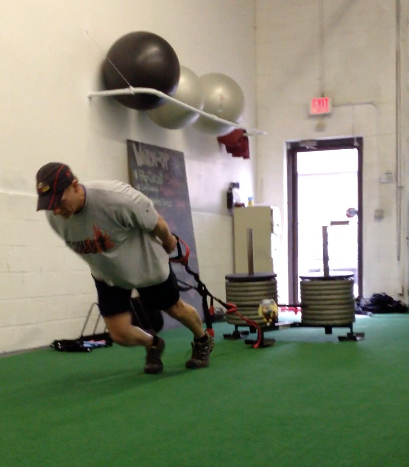
Yes, absolutely! While you certainly don't want to utilize everything and anything at the same time, something like HICT can certainly complement other conditioning modalities such as running or cardiac output circuits*.
To truly develop one's aerobic system, it takes more than just one or two haphazard sessions per week, or deciding to just "throw in" 10-20 minutes of aerobic training at the end of a resistance training session. I'd ensure you're undergoing some form of aerobic training 4-6 days a week, provided you remain prudent with the modalities and intensities you implement, of course.
However, don't neglect the fact that just playing basketball is aerobic training in nature! Thus, your pick-up games and competition games must be accounted for when analyzing your total volume of training in a given week.
*Note: These are actually one of my favorite methods of developing the aerobic energy system during the initial phases of training and/or during periods in which one has many competing demands outside the gym walls, as the risk of overreaching is extremely low.
And do you perform this work separate from any other training, or before/after a strength session?
While I touched on this a bit during the answer to your first question, let's expound a bit further here. The research is actually a bit mixed with regards to "mixing" aerobic training and strength training in the same session:
- This meta-analysis by Wilson et al. (2012) showed a loss in power when endurance training was trained concurrently with strength training, but no decline in VO2max when the endurance+strength group was compared to the endurance-only group.
- This paper by Want et al. (2011) concluded that endurance training immediately followed by strength training actually INCREASED mitochondrial growth compared to endurance-only training. (Mitochondrial growth will augment the muscles' oxidative capacity, thus improving one's endurance.)
- This paper by Hawley showed that conditioning before strength training blunts the anabolic effect of strength training, while conditioning after strength traning leads to greater amounts of inflammation and protein degradation.
(Note: Credit to Patrick Ward for pointing a couple of those out.)
While I obviously don't prefer to allow solely on research to dictate what I do and do not do with my athletes - after all, most research subjects are woefully untrained, along with the fact that many of the research protocols (ex. machine leg extensions for the "strength" exercise) are a far cry from what I use in the real world - it certainly still helps things to take a look at what goes on at the molecular level with human physiology.
So, what to do? Personally, I think it's ideal to separate the strength and endurance sessions completely - either by 8 hours or 24 hours - but this assumes that you have nearly every day of the week to train, and are able to fit in these sessions OUTSIDE of your practice and game schedule.
If you can't afford to split up the training sessions, then train FIRST what you want to prioritize, and then scale back the volume and intensity on the other goal. So if your goal is improved aerobic function, then do HICT first and follow it up with low volume strength training; for example, 2-3 exercises for 2-3 sets at 75-80% intensity. If your primary goal is strength, then attack your resistance training and follow that session up with HICT or a cardiac output circuit.
2. You mentioned doing HICT via a spin bike rather than step-ups.....Do you use both methods, and if so, for what purposes would you choose one over the other? What are the differences?
I primarily use step-ups with our athletes, but that is more a function of the fact that we don't have a spin bike in our facility. Not to mention, even if you do have a spin bike, it needs on the higher end of quality (ex. something you'd find in a good spin class) to be capable of cranking up the resistance so high that it's literally impossible to pedal quickly; you won't typically find these bikes sitting out in the cardio sections of gyms.
Here's a brief listing of the pros and cons of each:
Spin Bike
Pros - Less eccentric stress than a step-up, so theoretically less muscle soreness during the days following the HICT session; this also means a spin bike would probably be better suited for an active recovery and restorative tool compared to step-ups. No weight vest or heavy backpack required.
Cons - Requires access to a good spin bike. The "hunched" over position of biking forces a more flexed posture in general during the entire set: Kyphotic t-spine, shortened hip flexors, internal rotation of the shoulders, no hip extension achieved at any point (bad for glute function).
Step-Ups
Pros - No spin bike required. Achieve way more glute recruitment than on a bike, due to the glutes driving you up all the way to full hip extension at the top. Is much more of a total body workout than a spin bike as the bike will pretty much only hit the quads, but the step-ups will hammer the glutes, hamstrings, quads, not to mention the upper back+traps will be blasted during the weighted step-ups as these muscle groups have work like crazy to hold the weight vest or backpack in place.
Cons - More eccentric loading on the knees/legs when compared to a bike, so need to be more careful about where you fit them (step-ups) into the training week. Possibly worse for those with knee pain issues. Requires a heavy weight vest or large, heavy backpack.
Hope this helps! There is no doubt that HICT is certainly effective, but caution must be adhered to when planning and progressing it. Start on the low end of frequency and volume, and don't be in a rush to progress too fast too soon.
Grip, Dip, and RIP!
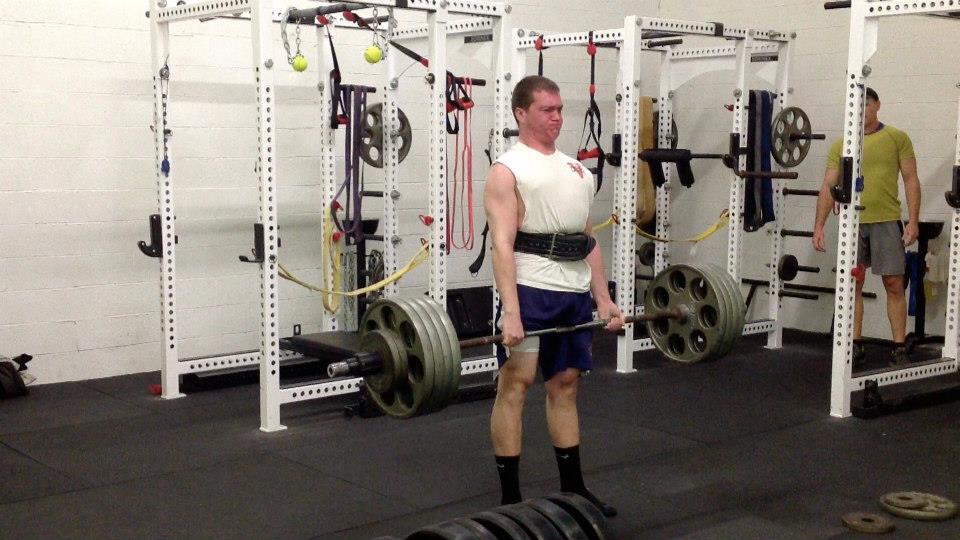
Obviously, we’re talking about DEADLIFTS! If you haven’t heard it before, “grip, dip and rip” typically refers to the set-up and execution of picking up heavy barbells off the ground. Grip- Grab the bar and squeeze it tight. Dip- Dip your hips down, get your back flat. RIP!- RIP that bar off the floor!
I’m a big fan of the phrase. It takes an extremely technical lift like the deadlift and boils it down to three simple words that happen to rhyme. Awesome. Of course, when teaching someone how to properly pick up heavy things, more effective cueing is going to be necessary. However, if you’ve been deadlifting for a while and your technique is in check, sometimes you need to stop obsessing over the MILLIONS of details involved in the technique and just RIP that bar off the ground and into lockout.
The Dip
Although each cue deserves a blog post of its own, what I want to talk about specifically is that crucial point between the grip and the rip. That moment immediately before you pull when you set your position can make or break your lift. So what really goes on in that short duration in your deadlift set-up?
Bracing and Setting Your Lower Back
The moment you set your hips into position is also the moment when you should be bracing as hard as you can through your abs. With your hips in place and your abs as tight as possible, you set your lower back into a neutral position to protect your spine from the high sheer and compressive forces you’re about to hit it with.
Applying Tension in the Hamstrings
Pulling your hips down into position while simultaneously flattening out your lower back will place a significant amount of tension on your hamstrings, which is a great thing to have happen right before your deadlift. By creating this pre-stretch, you will be able to take advantage of the stretch reflex that we humans so thoroughly enjoy. When the muscle spindles in your hamstrings are stimulated by the stretch they will freak out and wake up all the contractile units, who will all jump on-board the deadlifting train and say “alright boss, LET’S DO THIS!”
One thing to keep in mind regarding the pre-stretch on your hamstrings is that the longer you hold that stretched position the more the reflex potential will be diminished. Think about it in terms of another lift: what’s easier, a touch-and-go bench press or a bench press with a 3 second pause on your chest? So when you dip down into position on your deadlift and feel tight, PULL! Don’t hang out at the bottom for too long.
Setting Your Upper Back
Another key component in preparing for a nice deadlift is setting your upper back. This means shoulders down and back, sufficient t-spine extension, neck packed, and using your lats. During my “dip” on the deadlift, I also like to roll my shoulders from a shrugged position into a packed position while doing my best to extend through the t-spine. I also like to apply some external rotation torque on the bar with my hands because I feel like it helps me “turn on” my lats.
All of THAT in the Dip?!?
Yep, all of that happens in the dip. It’s a lot of detail, but as I mentioned earlier, don’t get caught up in trying to go down a HUGE technique checklist before every pull. Trust me, you’ll drive yourself crazy because you will always be able to find an aspect of the lift you didn’t do with absolute perfection. Just work on fixing a couple form issues at a time and keep on grippin’ dippin’ and rippin’!
Thriving vs. Surviving
Survive and advance has become the motto of the Men’s NCAA Basketball Tournament. However, I believe the teams that thrive, not survive, are the one’s that advance. Surviving suggests doing just enough to get by, while thriving suggests owning an opportunity and being better off because of the circumstances.
The term survivor is used to describe many who have made it through adversity: cancer survivors, Holocaust survivors, and sexual abuse survivors to name a few. While surviving is certainly the first step in overcoming adversity, perhaps thriving should be the focus. Allow me to explain.
He is considered one of the greatest hockey players of all time. In 1993 he had a streak with at least one goal in 12 consecutive games and was on pace to lead the league in points, when he was diagnosed with Hodgkin’s lymphoma cancer. He missed two months of play and his team struggled. However, on his final day of radiation he returned and scored a goal and an assist. Even while missing two months of play he ended up winning the scoring title by 12 points. Following his return, the team went on to win 17 straight games. He went on to play for a total of eight more years, while coming in and out of retirement. Today he is co-owner/chairman of the Pittsburgh Penguins, who have been one of the best organizations in sports during his ownership. Mario Lemieux is not just surviving. He is thriving.
In 1944, because he was Jewish, he was placed in a work camp in Auschwitz where he became inmate “A-7713”, which was tattooed on his left arm. He was separated from his mother and his youngest sister, who were killed in gas chambers, while his father was beaten to death at a work camp. After living in France he moved to the United States where he has written over 40 books (57 total in his life). In 1986 he received the Nobel Peach Prize. He has received the Congressional Gold Medal, The Presidential Medal of Freedom, and serves as a Professor at Boston University. He received an honorary knighthood in London. Elie Wiesel is not just surviving. He is thriving.
Starting at the age of nine she was molested by her cousin, uncle, and a family friend. The abuse eventually led her to run away at the age of 13. From there she went on to earn a full scholarship to Tennessee State University. Since then she became the host of her own TV show and became one of the premier interviewers in the world. She is an actress, producer, businesswomen, writer, philanthropist and publisher. She currently has her own TV network, magazine, and radio channel. Lastly, she is a billionaire and one of the most powerful women in the world. Oprah Winfrey is not just surviving. She is thriving.
These examples are not meant to minimize the tragedies that each experienced. All of them had to battle to get to this point in their lives. Yet their ability to thrive in the face of yesterday’s adversity allows each of them to be great today. The old saying, “what doesn’t kill me, makes me stronger”, certainly rings true for all of them. So, when your time comes and adversity hits, as it does for all who live, how will you react? Will you be satisfied with surviving and advancing or will you challenge yourself to thrive? Surviving isn’t always a choice, but thriving is.
Set/Rep Schemes: Is 3x10 King?
We received a question recently about set/rep schemes (for SAPT-ers, those first two columns on your program sheet) and I thought it would be a fabulous blog post. "What's the right formula for number of sets and number of reps for an exercise? I'm so used to hearing '3 sets of 10,' is that right or wrong?"
Excellent question, especially since the coaches at SAPT don't really program 3 sets of 10 on a regular basis. Hasn't this been a burning question on your mind? Of course it has, so let us dive in.
First, a brief history lesson. The famous "3 sets of 10" actually came out of the brains of two fellows named Dr. Thomas Delorme and Dr. Arthur Watkins. They were the first ones to develop a structured weight training protocol based on progressive overload. They wrote a paper (1948), and later a book (1950-ish), detailing their research findings. One quote I thought was rather lovely:
“The number of contractions per bout is arbitrarily set at ten. If fewer repetitive lifts were required, the resistance could be increased. Whether ten is the optimum number for rapid increase in strength has never been established in terms of criteria other than the empirical practice of weight-lifters. It is probable that the number closely approaches the optimum.”
See? 3 sets of 10 reps is not set in stone; it's just the numbers the good doctors worked with and recorded their results. You can read about it here, if you want.
Now, moving onto why we've expanded upon Drs. Delorme and Watkins' work. Subsequent research as led to insights on how muscles work and grow stronger. In the effort of remaning true to the KISS principle, I'll list a small snippet of the knowledge out there. Keep in mind that this is merely a scratch upon the surface of what goes on physiologically during weight training. (such as, energy systems used, hormonal responses and what types of conditions elicit the various physical responses of the body. It will blow your mind. Mine is continual blown up every time I read more about muscles. )
Ahem,
- As load increases, reps decrease and vice versa.
- As total exercise volume increases, intensity will decrease and vice versa.
- Muscles will adapt to the demands placed upon them (SAID principle).
So how does that help us coaches (and self-trained folks) determine set/reps. Well, as always, it depends.
If your goal is strength (which, by the way, it should be), you'll want to stick to lower rep ranges (1-5) with weights closer to your 1 rep max. I shall NOT be diving into percentages and what percentage matches with what rep scheme as I've found they're wildly different person to person. Generally, the closer you approach your 1 rep max, the less repetitions you can perform. As a coach, the exercises that stay in this range, typically, are the money-makers: squats, deadlifts, chin/pull ups, and presses.
If your goal is strength, which it should be, (no, this is not a typo. Strength is the KING of physical adaptations.) using the 6-8 rep range lends itself well to assistance lifts such as single-leg work, rows, pushups, anything-that's-not-your-main-lift, again, you can lift a heavier load for 6 reps than you can for 10, so... strength means picking up heavy things. This rep range affords a longer time under tension (meaning the muscles are working longer than say a 2 rep deadlift set), therefore building up their strength-endurance a bit instead of, say, a max-effort strength.
Now, this is not to say that you can't get stronger using the 3x10 protocol (assuming you're increasing the load), but it tends to only work for a little while, and it works best with beginners. In order for muscles to adapt to lifting heavy things, you have to impose that demand upon them by lifting heavy things. It would be more effecient to lift a lot of weight a few times than a little weigh a lot of times (this goes back to the energy system and hormonal response thing I mentioned earlier. This will be a future post... but for now, from a physiological standpoint, you'll get stronger faster lifting more weight a few times.)
Comic break.
Another reason, outside of the strength reasons, SAPT coaches use sets less than 10 is technique. We've found that having someone, especially a beginner, perform sets of 10 squats just ends up in fail. Form goes out the window as muscles get tired and attention wanders. There's a lot going on in the big lifts (chest up, butt back, toes up, on your heels, brace... etc) and it's difficult to keep it all in your head when you're first learning for extended sets. Thus, sets of 5, for our beginners, works out nicely. Our more experienced athletes stick with this rep range as they progress, well, because they're lifting heavier things.
Brain overload...
We do program sets of 10, but usually it's a corrective or mobility exercise, such as a facepull or wall slide, or sometimes we'll throw in some reverse crunches so our athlete's can "feel the burn."
In the end, we stick to the lower rep ranges to either practice technique (beginners) or elicit strength adaptations (experienced). As the smart Drs. said, the reptition number was arbitrarily set at 10. Later, research found that strong people lift heavy things a few times. The set/rep combinations are endless; train for strength, keep it simple, and have a fun workout!