Guest Post: Speed and Agility Development by Goose
So you want to run like this guy!
But you feel like this guy?
No need to freak out, here are a couple of tips to get you running lightning fast!
1. Conditioning
If you slack on your conditioning it doesn’t matter how fast you can run. You’ll be pooped out after one play and rock the bench for the rest of the game! Here are some suggestions, as well as a link, to get your conditioning game on par:
-Sled Workouts
-Track Workouts
Any conditioning work you do should be focused on maintaining a fast speed for a 15-30 seconds time span. A strong conditioning base is imperative as the game comprises of repeated quick all out bursts of speed for a long time. Keep this in mind when designing your workouts and the role rest plays in said workout.
2. Acceleration
Once your conditioning and strength training needs are met, now it’s time for the fun! Acceleration work should focus on improving your ability to reach your top speed as fast as possible. If you’re a running back, wide receiver, linebacker, or safety you’ll be more efficient at your job if you can reach top speed within 15-20 yards rather than 25-30 yards. Here are some suggestions on how to improve acceleration:
-Downhill Running (Use a slight downhill)
All three of these drills force quicker turn over (how fast your feet hit the ground) and/or exert high amounts of force on the ground. Both are the components needed to accelerate proficiently.
3. Believe in the process!
A lot of young athletes are really eager and fired up to improve but then get discouraged when it doesn’t come fast and easy. Improving your abilities is an everyday, 24/7, 365 day grind. If you are putting in the work on the field and in the weight room, plus staying diligent with flexibility and mobility work, then result will come. (Note from Kelsey: and EAT REAL FOOD!!!) Be patient, allow your body to do its thing, and trust in your coach’s plan!
Tackling Technique: How to (Safely) Pummel Your Opponent
Today's special guest post comes one of our athletes, Dumont, who's played Rugby professionally and currently coaches for the Washington Rugby Club. Given his past history and present involvement in Rugby, and the fact that the dude is a monster, it stands to reason that he knows a thing or two about pummeling an opponent. He graciously offered his expertise on tackling to share with everyone here on SAPTstrength. Here he provides many practical tips on not only executing an EFFECTIVE tackle, but also how to do so in a safe and concerted manner. Hit it Dumont!
The NFL combine is just days away, and many aspiring athletes will be jumping, running, and lifting in an attempt to impress potential employers. One skill that not showcased at the NFL Combine is tackling. Some could argue the tackle is a lost art in today’s NFL game. Yes, we see plenty of big hits each week, and as a result of those big hits, the NFL is attempting to regulate the tackle zone in an effort to protect its players. However, with the increase in big hits, what we are actually seeing as is many defenders forgetting the fundamentals and failing to finish the tackle. The result is we see a lot of missed tackles on Sunday, and a lot of needless injuries. The art of the proper form tackle has been lost.
What is a proper form tackle? A form tackle requires the tackler to use their entire body. Eyes, arms, shoulders, core, and legs are all engaged in an effort to bring a ball carrier to the ground in an efficient and safe (well as safe as a tackle can be) manner. While it may not result in the big “jacked up” highlight hit we’ve become accustomed to seeing on television, a form tackle will bring a ball carrier to the ground, and stop them in their tracks every time.
Before we break down the parts to making a tackle let’s point out the first step, take away a ball carrier’s space. The closer a tackler can get to the ball carrier the less opportunity they have to shake and get out of the way. Close the space to within a yard, of the ball carrier and now the tackler is in the tackle zone. Closing the space also allows the tackler to use their body like a coiled up spring that can explode into contact at the right moment.
Let’s break down the tackle into parts and make it easier to digest. The first part is the eyes. Before one can make a tackle, a player needs to spot their target, and know what they are aiming for. The tackler must remember to keep your eyes open and spot their target. This will also help to keep their head up. Keeping their head up is key not just so they can see, but also for safety. It keeps the back in a straight line and helps to protect the neck.
Two keys a tackler should remember when using their eyes:
- Keep them open- sounds simple but you’d be surprised at how easily they close just before impact
- Focus on the ball carrier’s core- they can move their legs, arms, and heads, but where their core goes, the entire body goes. Focusing on the core will lead to the tackle point.
The second part of the tackle is the arms and shoulders. Many people have different ideas of what to do with their arms when making a tackle. Often times tacklers start with their arms out wide and it looks like they are trying to bear hug their opponents. While this is effective in making a tackler look big and fierce, it’s actually inefficient when it comes to making the tackle and dangerous as it exposes the weaker muscles in the arm. When a tackler’s arms are out wide it creates “weak arms,” we teach ball carriers to run towards those open arms because it’s much easier for them to break through. By keeping the arms in tight and the hands above your elbows the tackler engages the shoulders and the arms creating a strong base to enter the tackle zone.
Here are the keys for the arms when making a tackle.
- Imagine creating a TV screen with your hands, and the ball carriers core is the show you want to watch.
The next part to the tackle equations is the legs. First we’ll focus on the feet. The lead foot is most important. Step towards the ball carrier using the lead foot. This brings the tacklers body with them, and allows them to use their entire body and keeps the body compact and coiled like a spring.
Keys to good footwork
- Step towards the ball carrier taking away their space
- Do not cross your feet
- Take short controlled steps not to overextend yourself.
Once the feet are in position, we need to focus on getting the rest of the legs into proper tackling position. This is done by bending at the knees, and creating a powerful base. By bending at the knees a tackler engages their legs and they are coiled and ready to explode. This will also keep the tackler low and allow them to attack the ball carriers core and legs. We do not want to tackle ball carriers up around the chest and arms, it’s too easy for them to break through when we get that high. Bending at the knees also gives the tackler the agility to move left, or right should the ball carrier change direction. Remember to keep your head up and your eyes open during all this.
So far we’ve covered a lot of stuff, so let’s take a moment and give a quick rundown of everything to make sure every is on the same page.
- Eyes Open
- Arms in tight, hands up
- Lead foot forward
- Bend at the knees
- Heads up
This puts an athlete into the perfect tackling position. To make contact the tackler wants to pick a side of the ball carrier’s body and attack that with their shoulder. The head should be placed on the side of the ball carrier’s body, not across it. This protects the tackler from being kneed or elbowed in the head, and reduces the possibility of injury. Using your lead foot step in, make contact with the shoulder.
A good rule to remember is “cheek-to-cheek.”
The next part of the tackle is the arms. We already have our arms in tight and our hands are up. Once the tackler makes contact with the shoulder we want to punch with the arms. Bring the arms up keeping them close and wrapping them around the ball carriers body, pulling the ball carrier in tight.
The final part is engaging the legs and drive forward. Once the tackler made contact with the shoulder and wrapped up the ball carrier with their arms, start pumping the legs. Drive forward and force the ball carrier to the ground. Use the ball carriers body as a pillow to land on. This will bring the ball carrier to the ground.
Form tackles are effective. The main key is putting the body into the correct position. Take away the ball carrier’s space, head up, eyes open, arms in, hands up, knees bent, then explode into the contact point, wrap the arms and drive the legs.
Thanks Dumont! Hopefully you all learned a li'l sumthin' sumthin' about tackling (safely and effectively... as opposed to just mindlessly throwing your body at your opponent). Proper technique will go a long way to both helping prevent injuries and winning games. And just for fun, here's a video of football vs. Rugby:
And if you want to smile: *Note* I love our soccer players! I just thought the video was funny.
Breathing Mechanics: Why Football Players Should Care
Breathing? Really? How could something as simple and common as breathing possibly affect football performance? If you're willing to spend about eight minutes to read this, you won't be sorry! Proper breathing mechanics are an aspect of sports performance that is a) largely ignored by a decent chunk of the athletic community (but is growing in exposure thanks to the PRI, Eric Cressey, Chalrie Weingrof, Kevin Neeld, Mike Robertson and a host of other smart coaches.) and b) are the 6 Degrees to Kevin Bacon of athletic movement. Everything connects back to breathing mechanics. Note- this is going to barely scratch the surface of all the breathing literature out there, so fitness nerds, don't get uptight about missing information. The point of this article is to explain the importance if breathing mechanics and provide some practical applications for coaches and players. If this post sparks your interest and you want to learn more, I recommend a search on the Posture Restoration Institute (from which I derived most of the information); all their articles are a good starting point.
A brief anatomy lesson is needed before we proceed.
The diaphragm is an umbrella shaped muscle and when it contracts, it pushes your organs down. This creates a large space in your lungs thus lowering the pressure. The one thing I remember from physics is that air moves from high pressure to low pressure. So, when there’s a lower pressure in your lungs, air whooshes in. (ha! And you that you sucked it in. Nope, it forces itself in. This blew my mind when I first learned the secrets of inhalation.)
Diaphragms are cool and important (understatement!) but breathing requires accessory muscles too. Our intercostals (rib muscles) and scalenes and sternocleidomastoids (neck muscles) contribute to the life-giving act of breathing. We need to use ALL THREE areas.
You can test yourself to see what area you tend to rely on most often based on if you get a cramp during exercise. For example, my neck (scalenes and SCM) is hyperactive during exercise and I get neck cramps during sprint work. Got a stitch in your side? Probably relying more on intercostals than your diaphragm.
Think of it like this: Harry Potter is the diaphragm, Hermione is the intercostals, and Ron is the neck muscles (mainly because Ron is so temperamental and is easily irritated, much like the scalenes).
As a coach or player, here's a quick test of breathing mechanics. Lye supine with your knees bent at 90 degrees against a wall. Place your hands just beneath your rib cage (this helps determine if the abdomen is expanding 360 degrees during inhalation). Take a DEEEEEEEP breath and exhale.
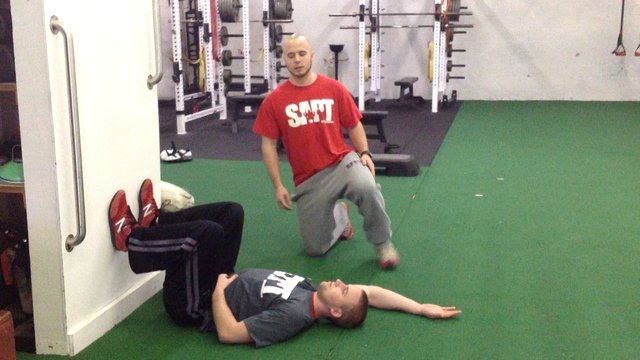
If an athlete is breathing properly we should see three things:
1. Circumferential expansion of the the abdomen (front and back)
2. Rib expansion (front and back too)
3. Li'l bit of apical (upper ribs) elevation. Note: too often THIS is where you'll see the breathing take place. You can tell because the shoulders will rise up towards the ears.
It's when one of these areas is impaired that we see dysfunction (pain/injuries) occur. Harry Potter is awesome but he would never have defeated Voldemort if he didn’t have Ron and Hermione.
1. Breathing affects EVERYTHING. The average person takes roughly 20,000 breaths per day. That's a LOT of contractions of the diaphragm. Aberrant breathing patterns will not only alter the ability of the diaphragm to function efficiently but it creates hyperactivity and hypertonicity (high tone/tension in the muscle) of the accessory muscles AND of muscles down the line (believe it or not, it can affect hip mobility!).
2. Think about the accessory muscles (and their neighbors): scalenes, SCM, levator scapulae, pec minor, trapezius... if those guys are tight and irritated, that will wreck havoc on cervical posture and shoulder mobility and function. Why do you care about that? If the cervical posture is whacked out (aka, your neck) those muscles are not going to function properly, it'll be harder to strengthen them in the way they need it and that puts you at a greater risk for concussions. Shoulder function/mobility is especially important for quarterbacks. If the shoulder isn't moving properly, say hello to rips, tears, and strains of the rotator cuff, bicep tendons, and labrums. Hooray.
3. All that tension spreads to the rest of the body. It increases the sympathetic state (flight or fight response) and thus not allowing the body to fully recover after workouts/practices/ games. This will eventually run down the athletes. The increased sympathetic state will increase anxiety, mess with sleep patterns, and can even decrease pain threshhold; all of these equal poopy workouts and even worse recovery.
Hopefully, after all that, I've convinced you that breathing patterns, make that PROPER breathing patterns, are extremely important and integral to athletic success. Again, if you truly want to improve performance, you should see a professional and get assessed and trained. (that was a shameless plug, I know, but it's true!)
But, run through 4 quick and simple things coaches and players can add to/be cognizant of to create a better breathing environment.
1. Posture Re-education:
Why? Three words: Zone of Apposition.
"Achieving the optimal ZOA really depends on the shape/orientation of your ribcage. If your lower anterior (front) ribcage tends to be elevated (as in picture on the left), it can alter the length-tension relationship of your diaphragm resulting in aberrant breathing pattern, lumbopelvic instability (hips and spine...BAD place for instability) and a cascade of movement dysfunctions." - Bill Hartman
Read about the Zone of Apposition on PRI's website.
2. Breathing Re-Education
As mentioned above in the "what you should see" part, we need to teach our athletes (and ourselves) how to
a) Achieve circumferential expansion. This does not mean just the belly sticking out during inhalation, but we need lateral expansion too (out to the sides and back of the body). A lot of people will "hollow" that is, draw in the belly and elevate the ribs and shoulders. This needs to stop. A drill like this will help.
b) Breathe with the abdomen and chest moving at the SAME TIME. The accessory muscles (notably the neck muscles) should be relaxed. Here's a video from Bill Hartman that encompasses both points:
c) Learn to get our ribs down with a neutral spine! Too often athletes have the mega arch (lordosis) in the lower back. This needs to stop! Compare the two pictures above, see how the lower portion of the ribcage is down on the "correct" picture? This is how we need to inhale and exhale. Exhalation should be active: the abs should be involved to help pull the ribs down.
3. Coaching Breathing
We need to teach athletes how to get to a neutral spine with the ribs down. The picture of the supine breathing above is a perfect drill for that. The floor gives feedback so the athlete can feel their spine and whether or not it's neutral. It's a great way to teach a "packed neck" too (meaning, no cranking on that neck into extension). The left hand can help monitor rib position to teach the athlete what "ribs down" feels like. THIS MUST HAPPEN FIRST before we expect them to move well during more strenuous exercise. Have your athletes spend a few minutes before training breathing in proper position.
4. Breathing drills
Breathing "reps" should be 3-4 sec inhale through the nose, a 5-8 sec exhale through pursed lips with a 1-2 sec hold. A great drill is the supine 90/90 position from above. It's a low level drill that will help the athlete be successful. Here's another example:
And this one, especially for those who live in a more "extended" posture:
There are more advanced drills, but these should be enough to get your athletes rolling.
So to recap:
Breathing mechanics are important. It affects all aspects of athletic performance. Breath well.
Re-educate posture and patterns.
Breathing is important.
Position Specific Drills: Defense
This Blog Post is Brought To You By: Goose, Man of Many Talents
Position Specific Training: Defense
When training a football defensive player, the 5 primary aspects of focus are: strength, explosiveness, footwork/agility, and reactiveness.
Strength is Part 1, this is where you lay the foundation. Building an elite athletes is analogous to building a house: you can't do without a strong, solid foundation. Therefore, strength is the foundation upon which you develop explosiveness, agility, and reactiveness. The athlete must be strong enough to: move their bodyweight effectively in all 3 planes of motion - aka frontal, transverse, and sagittal for you kinesiology majors out there - and manhandle and tackle an offensive player. Staple lower body strength exercises all athletes should do are squats, deadlifts, and lunge variations (just ensure you fit the variation of said movements to the individual). Pair these with upper body strength builders such as the bench press, pullup, overhead press, and rowing variations, and you're well on your way toward success. When performed properly in an intelligently designed strength program, these will get the most meat the bones of your athletes and set them on the road to becoming behemoths!
Strength training turns boys into men!
Explosiveness is Part 2. This is when the application of strength translates into moving faster and jumping higher. "Explosiveness" (the coveted athletic attribute) entails exerting a high amount of force really fast, as in split-seconds fast. To train this, perform exercises which force you (or your athletes) to move fast. This is where plyometrics and Olympic lifts come in!Plyometric exercises such as cone/hurdle hops, box jumps, vertical/broad jumps force you to exert high amounts of force in milliseconds.
**Word of Caution!!!** Olympic lifts are great for developing explosiveness, HOWEVER they are extremely technical; so technical they have their own sport! They are only to be done under the supervision of an experienced coach who can properly teach/progress them to maximize gains and reduce injury risk*. (*Note from Kelsey: and athletes should demonstrate proficient strength and technique in the squat and deadlift. The Oly-lifts should be reserved for strong, experienced athletes, aka, not the average high school athlete.)
Working on explosiveness is critical for all defensive positions. Defensive ends/tackles have to be explosive to get a jump on the offensive line to tackle the running back or sack the QB. Meanwhile, linebackers, corner backs, and safeties must be able to jump higher than receiver in order to break up or intercept passes.
Agility and Footwork are part 3. Here's where the foundation analogy starts to make more sense: the application of strength and explosiveness equates to improved speed and change of direction. Agility and footwork go hand in hand like peanut butter and jelly! You need to know how and where to place your feet, relative to your body, in order to avoid injury and effectively change direction. If you try to change direction and your step is too short, too long, or at the wrong angle you are putting your ankles, knees, and hips in a disadvantageous (and potentially injurious) position. A great way to start working on foot position and running technique is to spend a few minutes during the first portion of a training session on agility ladder drills, for lateral, diagonal, and change-of-direction work. Once you become proficient at the ladder drills, you can progress to cone drills on turf or grass where you work on changing directions in game-like scenarios.
Last but not least we have Reactiveness, whichis the culmination of all four qualities. Everything a defensive player does involves reaction! They react to the snap, react to the QB, react to the runner or the receiver, and they react to grab a fumble. You need to be strong and explosive to move your body fast and you need agility/footwork to react to the play and make something happen. A couple of training ideas would be:
-Reactive starts to a whistle
-Reaction ball training
-Reacting to the QB drill
-Sprint shuffle cone drills
-Cone agility box drill
Training doesn't have to complicated or use fancy equipment or techniques. Focus on strength first, then the subsequent qualities and your team will be unstoppable!
The most fun/dangerous reaction drills ever!
Concussion Prevention
What’s the point of making your entire body bulletproof with your perfect training regimen if you’re just going to sit the bench because of a concussion? I’ve seen a great deal of fantastic athletes brought down by a simple bonk on the head. Football is the most notorious of this conundrum and organizations such as high school leagues, the NCAA, and even the NFL are implementing precautionary measures to limit the amount of brain cells killed each year by concussions. With that being said, these organizations have taken some mighty (and some questionable) steps for the protection of their athletes. In today’s post, I’m going to shed some light on a few ways that you can help to protect yourself.
1. LEARN how to tackle. Knowing how to tackle corretly is one of the most fundamental parts of football. It happens almost every play. Yet not that much time is spent on technique drills. By technique drills, I’m not talking about hitting sleds or dummies, I’m talking about taking the time to teach positioning and mechanics. Take the time to learn step by step movements on get yourself low, wrap up, use your hips and drive. It’s a skill and technique should be practiced even in the off-season.
2. Do Shrugs. This one’s simple. Shrug variations are great for building some stability in your neck and keeping your head from bouncing around. Plus, they help you to look like Bane and that’s a win-win.
3. Strengthen your neck CORRECTLY. There are many, “neck strengthening exercises” out there that consist of nodding against a machine or weight attached to your head. These are extremely questionable and I can’t honestly recommend them. If you want to protect your noggin’ from concussions then you need to train your neck to RESIST MOVEMENT, not causemovement. Plus, it’s an old rule of thumb that every time you load active cervical extension (tilting your neck upwards), you kill a puppy. The best way to correctly complete this task is to perform manual resistance as in the photo below. Keep in mind that the neck is comprised of a plethora of tiny muscles and does not need a lot of force to get a training effect.
4. Don’t rely heavily on your pads. I truly believe that football would have a lot less injuries if players weren’t strapped to the teeth with force-absorbing equipment. It gives the athlete a false sense of invincibility and leads to people just throwing their bodies into the opponent. This creates bad habits and reinforces poor tackling technique.
Femoroacetabular Impingement and Football Kickers. "That's Why My Hip Hurts!"
Femoroacetabular impingement (FAI) syndrome has become more widely recognized thanks to folks such as Kevin Neeld, Eric Cressey, Mike Reinold, and a plethora of other smart coaches. FAI is a common* syndrome/injury in athletics and football kickers are especially susceptible due to the nature of the violent hip flexion during the kick off/punt. At the end of the article I'll put some links for more information regarding testing for FAI, research regarding FAI, and other resources. The last two posts have been marathon length, so we'll keep today short and to the point. What is FAI?
FAI is essentially:
Femoroacetabular impingement or FAI is a condition of too much friction in the hip joint. Basically, the ball (femoral head) and socket (acetabulum) rub abnormally creating damage to the hip joint. The damage can occur to the articular cartilage (smooth white surface of the ball or socket) or the labral cartilage (soft tissue bumper of the socket).
from www.hipfai.com. Athletes that participate in activities that include repetitive hip flexion and internal rotation or folks who have super crappy mobility in their hips are at a higher risk of developing hip issues. Also, athletes who are constantly in a state of anterior pelvic tilt (aka: nearly every one of them) are also primed for some impingement.
Now, look at a football kick off. Check out the crazy hip flexion and internal rotation (when his leg crosses over the midline of his body around the :29-:31 mark).
Can you see how a kicker might develop a problem? Especially if they're not a physically STRONG kicker?
Just so you know, FAI comes in three flavors, none of which include chocolate or vanilla:
CAM- bony overgrowth on the femoral head (ball)
Pincer- body overgrown on the acetabulum (on the socket on the pelvic bone)
Mixed- a lovely combination of both.
How do I spot FAI?
IMPORTANT: Remember, unless you're a doctor, you CANNOT DIAGNOSE. The following are merely indicators that something is amiss. A visit to the doctor and possibly the Wonder Machine (MRI) will be the only sure way to diagnose any pathology.
Now, as a coach/player it's important to be aware of FAI and be on the look out for the symptoms. FAI will most likely manifest on the kicking leg simply because it is subject to that the crazy-hip-flexion. Bilateral FAI is found more often in sports with bilateral hip flexion such as hockey or powerlifting. However, this doesn't mean that both sides can't be affected, so be on the vigilant!
There are two simple tests that you can do yourself (though I STRONGLY recommend you see a professional..cough, cough.)
One is the Faber Test.
The other is a supine hip flexion with internal rotation of the femur.
If this lights you up, and you're also experiencing the symptoms below, you should probably high tail it to a person with the initials, "M.D." after there name.
A few other symptoms that as either a coach or a player you should be on the watch for (and probably perform the aforementioned tests):
1. Pain with squatting below 90 degrees. Speaking from experience, it feels "pinchy" in the front of the hip, just a smidge medial (inside) of the pelvic bone.
2. Pain with internal rotation and hip flexion. For example, getting into a car leading with the affected leg (one has to flex the hip to sit and internally rotate the hip to slide into the car).
3. Another potential, but not always present, is a history of repeated sports hernias or groin pulls.
4. As a coach, if you're watching a player squat, if one hip seems to drop more than the other. The hip that DOESN'T go as low, will be the affected hip. The player will also weight shift towards the affected side as they stand up from the bottom of the squat.
Don't be stupid and keep training through this pain (again, I speak from experience). Some of the associated symptoms/pathologies of FAI include: cartilage damage, labral tears, (the labrum helps keep the hip stabilized. It's really important.) early on-set osteoarthritis of the hip, sports hernias, and low back pain.
Speaking as someone who has bilateral FAI (and the labral tears), it sucks. Don't be a hero, go to the doc if you're experiencing these symptoms.
What are the Implications of FAI?
An athlete the has impingement of their hip will have limited hip flexion range of motion (ROM) on the affected side. What does this mean for a football kicker?
- No more squatting. Think about it: 1) hip flexion ROM is going to be limited on one side. 2) If you're bilaterally loaded, as in a squat, one hip will drop lower than the other, and if the hips can't move independently, as they could in a lunge, you're going to impose some wonky forces on the spine. 4) Wonky forces on the spine eventually lead to injuries and pain. Not the best game plan. (You could get away with squatting above 90 degrees, but no sense in playing with tigers if you don't have to.)
- There's a study found here that looked at hip flexor strength a group of people with diagnosed FAI. The study found that those with FAI had weaker hip flexors than the controls. (I can personally attest this is true.) Whether the people had FAI because their hip flexors were weak, or the hip flexors became weak with FAI onset, doesn't matter for this discussion. What does matter is that the HIP FLEXORS ARE WEAK! Now, in a football kicker, what's the main group of muscles used to kick? HIP FLEXORS! Do you see a problem? If a coach is oblivious to this, yelling at a kicker to kick harder isn't going to do much. Also, without proper training (perhaps some focused work for the hip flexors such as SL marches or hanging leg raises), other muscles are going to take over for the lack luster hip flexors and then you have a whole new set of problems.
- Hip dominant exercises (deadlifts, RDLs, glute bridges, and swings) and single leg work (split squats, step back lunge variations, step ups (as long as the hip stays >90 degrees), and single leg RDLs) must be the bulk of lower body work. All of these tend to keep the hip out of excessive hip flexion + internal rotation. They also hammer the glutes, which will help keep the femur from gliding forward in the socket and causing more ruckus in the pelvic region. Food for thought: I've personally found that walking lunges/forward lunges tend to make my hip ache as do back-and-feet elevate glute bridges.
- As far as corrective work goes, hammer hip stabilization and anterior core. Low level glute work such as double- and single leg glute bridges, monster walks, and bowler squats will challenge the smaller stabilizers of the hip. This in turn will keep the femoral head from gliding around and causing more damage. Anterior core is necessary to, hopefully, control anterior pelvic tilt (which most athletes sit in anyway) and even, possibly, pull the pelvis a little posteriorly. This will, again, keep those bony overgrowths from grinding on each other. Here's a great video by my better half on anterior core progressions.
Another note: I've found that single leg anterior core exercises (such as a single leg plank) bother my hips. Be mindful and if it hurts, don't do it.
Wow, so I broke my promise of writing a lengthy post. However, this is an EXTREMELY important issue that many kickers are faced with (we've had one walk through our doors, not to mention the other handful of other athletes from a range of sports).
*Just chew on this; a recent study of asymptomatic people found that of the 215 male hips (108 patients) analyzed, a total of 30 hips (13.95%) were defined as pathological, 32 (14.88%) as borderline and 153 (71.16%) as normal. That means potentially 1 in every 3-4 males have some sort of underling hip "thing" going on. (thanks Kevin Neeld!) That's a lot.
As promised here are some links for more information:
Post on Mike Reinold's site with more in-depth diagnoses.
Kevin Neeld has a bunch: 1, 2, and 3 (and the one linked above)
And Tony Gentilcore, who does a fantastic job communicating a complex topic to the lay population, while adding some humor to boot.
Whew!