Injury Prevention Tips
When people talk shop about performance training, they rarely want to broach the ever-so-sexy topic of injury prevention. It’s a subject that can goes hand and hand with maximizing performance, but seems to be the red-headed stepchild of the training family. However as the level of competition grows, so does the likelihood of that stepchild hitting you where it hurts for ignoring it for so long.
With that being said, I’m going to give you 5 tips that will help you keep your health meter full throughout the season.
1. Don’t Be Stupid.
I think this goes without saying, but the internet has warped my perception of what man-kind is capable of when left to their own vices during training. Things that I would classify as stupid and could possibly cause injury:
-Replicating sport-specific movements under load to help with, “speed.” (i.e. pulling on a cable column like you’re throwing a baseball)
-Plyometric drills to fatigue
-Use of ankle weights in running/agility drills
-Going to a Justin Bieber concert
-Or any of these:
http://youtu.be/6VqbWAG3qmk
2. Avoid Overtraining.
I’m not going to beat a dead horse as Kelsey has already did an awesome job covering this subject here and here.
3. Recovery Work
A big reason that a lot of athletes end up with a trashed body by the end of their season is that they neglect their recovery work. This does not mean that they aren’t resting, it means that they are not recovering their movement. Throwing 9 innings or playing a weekend-long volleyball tournament is going to result in A LOT of repetitive movements that may cause some asymmetries or loss of joint function. Having a, “shake out” session of just general movement and mobility to try and rescind those deficits can keep your body out of harm's way.
It doesn’t have to be a complicated workout. It can merely be comprised of breathing drills, soft tissue work, some mobility drills and a few crawl variations. Ensure there are NO SPORT SPECIFIC MOVEMENTS. The purpose of this recovery session is to give your body a very general stimulus that will maintain joint and subsystem function. This will help to “reset” your body and mind to prevent negative adaptations from competing.
4. Breath
I could argue that one of the major factors in a plethora of injuries is having poor breathing patterns, but I’m sure no one is really interested in listening to me nerd out. What you do need to know is that the diaphragm is a very important muscle for your core. And I definitely shouldn’t need to explain the importance of your core. If you aren’t utilizing it correctly, you aren’t going to be able to move correctly. Do all the thoracic mobility or hip mobility drills you want, if your core sucks, then everything else will too.

During competition, you’re going to see a lot of athletes with auxiliary breathing patterns (breathing through their chests and necks) and this is ok when you are being taxed and really pushing it. BUT, if this becomes your primary method of breathing, even when at rest, then we’ve got some issues. This is usually the case for in-season athletes as they are constantly competing or keeping up their conditioning. So it is highly imperative that an intervention is implemented to prevent auxiliary breathing from becoming the dominant breathing pattern. One exercise that I like for this is below. I’d recommend trying to do it 1-2x a day, especially for in-season athletes.
https://vimeo.com/83616081
5. Warm Up Appropriately
People skip warm-ups waaaaay too much, and if they don’t skip it, they half-ass it. The warm up is an integral part of the workout or competition that should prep the individual for movement. Not only is it working on mobility, and (if it’s a good warm up) activation of dormant muscles, but it even has important physiological effects. As your body becomes warm, blood viscosity decreases, allowing for it to flow more efficiently to the muscles being taxed. The warm up serves to elevate your body temperature without over-taxing your muscles so that when in competition, your body is primed for response.
The warm up also allows for the athlete to prepare themselves mentally. They should be psychologically switching from John Doe, Junior at Belmont High, to John Doe, Czar of PR’s. The warm up is when the athletes should leave their worries of day-to-day life and only concentrate on the task at hand.
Start applying these 5 tips to your training regimen and you’ll see that that red-headed stepchild can actually offer a lot on the performance side as well.
Why Train In-Season?: Strength and Power Gains
Hopefully by now, you've read about the signs and reversal of overtraining. Now let's look at why and how to train intelligently in-season. A well-designed in-season program should a) prevent overtraining and b) improve strength and power (for younger/inexperienced athletes) or maintain strength and power (older/more experienced lifters).
First off, why even bother training during the season?
1. Athletes will be stronger at the end of the season (arguably the most important part) than they were at the beginning (and stronger than their non-training competition).
2. Off-season training gains will be much easier to acquire. The first 4 weeks or so of off-season training won't be "playing catch-up" from all the strength lost during a long season bereft of iron.
I know that most high school (at least in the uber-competitive Northern VA region) teams require in-season training for their athletes. Excellent! However, many coaches miss the mark with the goal of the in-season training program. (Remember that whole "over training" thing?) Coaches need to keep in mind the stress of practice, games, and conditioning sessions when designing their team's training in the weight room. 2x/week with 40-60 minute lifts should be about right for most sports. Coaches have to hit the "sweet spot" of just enough intensity to illicit strength gains, but not TOO much that it inhibits recovery and negatively affects performance.
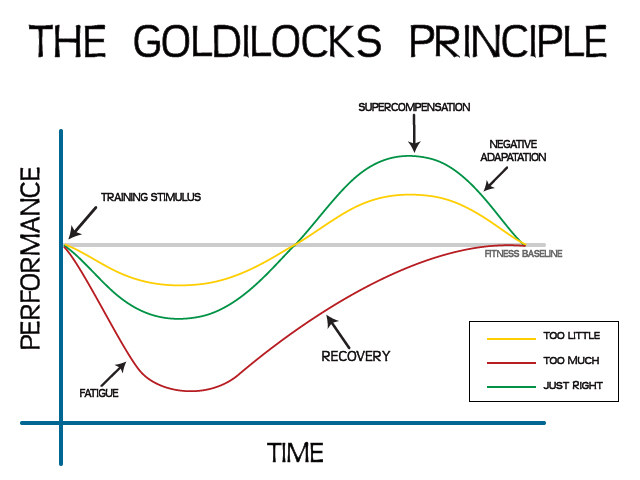
The weight training portion of the in-season program should not take away from the technical practices and sport specific. Here are a couple of things to keep in mind about the program, it should:
1. Lower volume, higher intensity-- this looks like working up to 1-2 top sets of the big lifts (squat or deadlift or Olympic lift), while maintaining 3-4 sets of accessory work. The rep range for the big lifts should be between 3-5 reps, varied throughout the season. The total reps for accessory work will vary depending on the exercise, but staying within 18-25 total reps (for harder work) is a stellar range. Burn outs aren't necessary.
2. Focused on compound lifts and total body workouts-- Compound lifts offer more bang-for-your buck with limited time in the weight room. Total body workouts ensure that the big muscles are hit frequently enough to create an adaptive response, but spread out the stress enough to allow for recovery. Note: the volume for the compound lifts must be low seeing as they are the most neurally intensive. If an athlete can't recover neurally, that can lead to decreased performance at best, injuries at worst.
3. Minimize soreness/injury-- Negatives are cool, but they also cause a lot of soreness. If the players are expected to improve on the technical side of their sport (aka, in practice) being too sore to perform well defeats the purpose doesn't it? Another aspect is changing exercises or progressing too quickly throughout the program. The athletes should have time to learn and improve on exercises before changing them just for the sake of changing them. Usually new exercises leave behind the present of soreness too, so allowing for adaptation minimizes that.
4. Realizing the different demands and stresses based on position -- For example, quarterbacks and linemen have very different stresses/demands. Catchers and pitches, midfields and goalies, sprinters and throwers; each sport has specific metabolic and strength demands and within each sport, the various positions have their unique needs too. A coach must take into account both sides for each of their positional players.
5. Must be adaptable --- This is more for the experienced and older athletes who's strength "tank" is more full than the younger kids. The program must be adaptable for the days when the athlete(s) is just beat down and needs to recover. Taking down the weight or omitting an exercise or two is a good way to allow for recovery without missing a training session.
A lot to think about huh? As a coach, I encourage you to ask yourself if you're keeping these in mind as you take your players through their training. Athletes: I encourage you to examine what your coach is doing; does it seem safe, logical, and beneficial based on the criteria listed above? If not, talk to your coach about your concerns or (shameless plug here, sorry), come see us.
Overtraining Part 2: Correcting and Avoiding Future Poopiness
In the last post, we went over some symptoms of overtraining. If you found yourself nodding along in agreement (ESPECIALLY, coaches, if you noticed those symptoms in your athletes!), then today’s post is certainly for you. If you didn’t, well, it’s still beneficial to read this to ensure you, or your athletes, don’t end up nodding in agreement in the future.
Just so we’re clear, overtraining is, loosely defined, as an accumulation of stress (both training and non-training) that leads to decreases in performance as well as mental and physical symptoms that can take months to recover from. Read that last bit again, M.O.N.T.H.S. Just because you take a couple days off does NOT mean the body is ready to go again. The time it takes to recover from and return to normal performance will depend on how far into the realm of overtraining you’ve managed to push yourself.
Let’s talk about recovery strategies. Of the many symptoms that can appear, chronic inflammation seems to be a biggie. Whether that’s inflammation of your joints, ligaments, tendons, or muscles, doesn’t matter; too much inflammation compromises your ability to function. (A little inflammation is ok as it jumpstarts the recovery process.) Just as you create a training plan, healing after overtraining requires a recovery plan.
Step 1: Seek to reduce inflammation. How?
- Get plenty of sleep. Your body restores itself during the night. It releases anabolic hormones (building hormones) such as growth hormone (clever name) and the reduction of catabolic (breaking down) hormones such as cortisol. Since increased levels of coritsol are part of the overtrained symptom list, it would be a good thing to get those levels under control! Teenagers: I know it's cool to stay up late, but seriously, get your butts in bed! Not only are you growing (which requires sleep) but the sport season entails enough physical stress that if you don't sleep enough (8-10 solid hours), your body will be pissed off pretty darn quick.
- Eat whole foods. Particularly load up on vegetables (such as dark greens) and fruits (like berries) that are rich in antioxidants and anti-inflammatory compounds. Solid protein sources like fatty fish, chicken breast, and lean beef (grass-fed if you can get it) will not only help provide the much-needed protein for muscle rebuilding but also will supply healthy fats that also help reduce inflammation. Speaking of fats, adding coconut milk/oil to smoothies as an excellent way to ingest some delightful anti-inflammatory fats.
- Drink lots of water. (not Gatorade or powerade or any other -ade.) Water helps the body flush toxins, damaged tissues/cells, and keeps the body’s systems running smoothly. Water also lubricates your joints, which if they’re beat up already, the extra hydration will help them feel better and repair more quickly. A good goal is half your body weight in ounces.
Step 2: Take a week off
You’re muscles are not going shrivel up, lose your skill/speed, nor will your body swell up with fat. Take 5-7 days and just rejuvenate. Go for a couple walks, do mobility circuits, play a pick-up basketball game… do something that’s NOT your normal training routine and just let your body rest. Remember, the further you wade into the murky waters of overtraining, the longer it will take to slog your way out. During the sports season, this isn't always an option. In that case, coaches, give your players a couple of "easy" practices/workouts with the goal of getting the blood flowing, but not destroying the athletes. They should walk away feeling better than when they started. Building in an "easy" practice each week would go a long way in preventing overtraining.
Step 3: Learn from your mistakes.
While you’re taking your break, examine what pushed you over the edge. Was it the volume or intensity too high (or both?), too many days without rest? Was your mileage too high? Were you were stressed out at work/school, not sleeping enough, or maybe you weren’t eating enough or the right foods to support your activity. Are there external factors you’re missing? For instance, I’ve learned that I cannot train too hard (outdoors especially) during allergy season. Even if I'm inside, I just can’t get enough oxygen in my system to support intense training (lifting or sprinting). Therefore, I limit my outdoor sprints, ensure I take longer rest breaks between sets, and make sure I take medication during the peak of the spring and summer.
Step 4: Recalculate and execute
When you’re ready to come back, don’t be a ninny and do exactly what you were doing that got you into this mess in the first place. Hopefully, you learned from your mistake and you’ll make the necessary changes to avoid overtraining in the first place. Here, let’s learn from my mistake:
I overtrained; and I mean, I really overtrained. I had all the symptoms (mental and physical) for months and months. I was a walking ball of inflammation, every joint hurt, I was exhausted mentally and physically (and, decided to make up for my exhaustion by pushing myself even harder.) I ignored all the warning signs. This intentional stupidity led to my now permanent injuries (torn labrums in both hips, one collapsed disc in my spine, and two bulging discs). The body is pretty resilient, but it can only take so much. I ended up taking four months off, completely, from any activity beyond long walks. (that sucked by the way). When I did come back, I had to ease into it. Very. Very. Slowly. Even then, I think I pushed it a bit too much. It took me almost 2 years to return to my normal physical and mental state. (Well, outside of the permanent injuries. Those I just work around now.) Learn from my mistake. Overtraining is not something to poo-poo as "weakness" or "just being tired." It's real and can have damaging, lasting effects.
So how can we avoid overtraining? Here are simple strategies:
1. Eat enough and the right foods to support your activities.
2. Take rest days. Listen to your body. If you need to rest, rest. If you need to scale back your workout, do so.
3. Keep workouts on the shorter side. Don’t do marathon weight lifting sessions. Keep it to 1-1.5 hours. Max. Sprint sessions shouldn’t exceed 15-20 minutes. (if you're in-season, weight lifting sessions should be 45 min-1 hour MAX, with lower volume than out-of-season)
4. Sleep. High quality sleep should be a priority in your life. If it isn’t, you need to change that.
5. Stay on top of your SMR and mobility work. I wrote about SMR here and here.
6. Train towards specific goals. You can’t be a marathon runner and a power lifter. Pick one to three goals (that don’t conflict with each other) and train towards them. You can’t do everything at once.
Armed with the knowledge of overtraining prevention, rest, recover, and continue in greatness!
Overtraining Part 1: Symptoms
This month's theme is in-season training since the spring sports are starting up. All the practices, games, and tournaments start to add up to over time, not to mention any weight room sessions the coachs' require of their athletes. Lack of proper awareness and management of physical stressors can lead, very quickly in some cases, to overtraining... which leads to poor performance, lost games, increase risk of injury, and a rather unpleasant season.
The subject of overtraining is a vast one and we won't be able to cover all the aspects that contribute, but by the end of this two part series, you should have a decent grasp on what overtraining is and how to avoid it. Today's post will be about recognizing the symptoms of overtraining while next post will offer techniques and training advice to avoid the dreaded state of overtrained-ness. (Yes, I made that word up.) Li'l food for thought: quite often the strength and conditioning aspect of in-season training is the cornerstone of maintaing the health of the athlete. Too much, and the athlete breaks, but administered intelligently, a strength program can restore an athlete's body and enhance overall performance. Right, let's dive in!
Who doesn’t like a good work out? Who doesn’t like to train hard, pwn some weight (or mileage if you’re a distance person), and accomplish the physical goals you’ve set for yourself? Every work out leave you gasping, dead-tired, and wiped out, otherwise it doesn't count, right? (read the truth to that fallacy here)
We all want a to feel like you've conquered something, I know I do!
However, sadly, there can be too much of a good thing. We may be superheroes in our minds, but sometimes our bodies see it differently. Outside of the genetic freaks out there who can hit their training hard day after day (I’m a bit envious…), most of us will reach a point where we enter the realm of overtraining. I should note, that for many competitive athletes (college, elite, and professional levels) there is a constant state of overtraining, but it’s closely monitored. But, this post is designed for the rest of us.
Now, everyone is different and not everyone will experience every symptom or perhaps experience it in varying degrees depending on training age, other life factors, and type of training. These are merely general symptoms that both athletes and coaches should keep a sharp eye out for.
Symptoms:
1. Repeated failure to complete/recover in a normal workout- I’m not talking about a failed rep attempt or performing an exercise to failure. This is a routine training session that you’re dragging through and you either can’t finish it or your recovery time between sets is way longer than usual. For distance trainees, this may manifest as slower pace, your normal milage seems way harder than usual, or your heart rate is higher than usual during your workout. Coaches: are you players dragging, taking longer breaks, or just looking sluggish? Especially if this is unusual behavior, they're not being lazy; it might be they've reached stress levels that exceed their abilities to recover.
2. Lifters/power athletes (baseball, football, soccer, non-distance track, and nearly all field sports): inability to relax or sleep well at night- Overtraining in power athletes or lifters results in an overactive sympathetic nervous response (the “fight or flight” system). If you’re restless (when you’re supposed to be resting), unable to sleep well, have an elevated resting heart rate, or have an inability to focus (even during training or practice), those are signs that your sympathetic nervous system is on overdrive. It’s your body’s response to being in a constantly stressful situation, like training, that it just stays in the sympathetic state.
3. Endurance athletes (distance runners, swimmers, and bikers): fatigue, sluggish, and weak feeling- Endurance athletes experience parasympathetic overdrive (the “rest and digest” system). Symptoms include elevated cortisol (a stress hormone that isn’t bad, but shouldn’t be at chronically high levels), decreased testosterone levels (more noticeable in males), increase fat storage or inability to lose fat, or chronic fatigue (mental and physical).
4. Body composition shifts away from leanness- Despite training hard and eating well, you’re either not able to lose body fat, or worse, you start to gain what you previously lost. Overtrained individuals typically have elevated cortisol levels (for both kinds of athletes). Cortisol, among other things, increases insulin resistance which, when this is the chronic metabolic state, promotes fat storage and inhibits fat loss.
5. Sore/painful joints, bones, or limbs- Does the thought of walking up stairs make you groan with the anticipated creaky achy-ness you’re about to experience? If so, you’re probably over training. Whether it be with weights or endurance training, you’re body is taking a beating and if it doesn’t have adequate recovery time, that’s when tendiosis, tendoitis, bursitis, and all the other -itis-es start to set in. The joints, muscles, tendons, and ligaments are chronicallyinflamed and that equals pain. Maybe it’s not pain (yet) but your muscles feel heavy and achy. It might be a good time to rethink you’re training routine…
6. Getting sick more often- Maybe not the flu, but perhaps the sniffles, a sore throat, or a fever here and there; these are signs your immune system is depressed. This can be a sneaky one especially if you eat right (as in lots of kale), sleep enough, and drink plenty of water (I’m doing all the right things! Why am I sick??). Training is a stress on the system and any hard training session will depress the immune system for a bit afterwards. Not a big deal if you’re able to recover after each training session… but if you’re overtraining, the body never gets it's much-needed recovery time. Hence, a chronically depressed immune system… and that’s why you have a cold for the 8th time in two months.
7. You feel like garbage- You know the feeling: run down, sluggish, not excited to train… NOOOOO!!!!! Training regularly, along with eating well and sleeping enough, should make you feel great. However, if you feel like crap… something is wrong.
Those are some of the basic signs of overtraining. There are more, especially as an athlete drifts further and further down the path of fatigue, but these are the initial warning signs the body gives to tell you to stop what you’re doing or bad things will happen.
Next time, we’ll discuss ways to prevent and treat overtraining.
March Madness: In-Season Training
Ah, the spring! (well, it would be if it wasn't snowing so much here in D.C.!) This means that the spring sports are ramping up. Schedules get tighter, days get longer, and the body takes a beating.
This month SAPT is going to provide stellar reasons why every athlete should continue their strength training in-season. Some of these include (but are not limited to):
- Prevention of strength and power decreases (both of which are rather important, especially during the end of the season during the play-offs. No good to be weak and slow!)
- Increase strength and power (see above reason)
- Prevention of over-use injuries. (How many times did you throw that ball today?)
- Mental breaks (ah, brain can relax.)
All that plus a super special guest post JUST for coaches.
Check back later this week as we get rolling into a healthy, strong, and successful season!
Guest Post: Speed and Agility Development by Goose
So you want to run like this guy!
But you feel like this guy?
No need to freak out, here are a couple of tips to get you running lightning fast!
1. Conditioning
If you slack on your conditioning it doesn’t matter how fast you can run. You’ll be pooped out after one play and rock the bench for the rest of the game! Here are some suggestions, as well as a link, to get your conditioning game on par:
-Sled Workouts
-Track Workouts
Any conditioning work you do should be focused on maintaining a fast speed for a 15-30 seconds time span. A strong conditioning base is imperative as the game comprises of repeated quick all out bursts of speed for a long time. Keep this in mind when designing your workouts and the role rest plays in said workout.
2. Acceleration
Once your conditioning and strength training needs are met, now it’s time for the fun! Acceleration work should focus on improving your ability to reach your top speed as fast as possible. If you’re a running back, wide receiver, linebacker, or safety you’ll be more efficient at your job if you can reach top speed within 15-20 yards rather than 25-30 yards. Here are some suggestions on how to improve acceleration:
-Downhill Running (Use a slight downhill)
All three of these drills force quicker turn over (how fast your feet hit the ground) and/or exert high amounts of force on the ground. Both are the components needed to accelerate proficiently.
3. Believe in the process!
A lot of young athletes are really eager and fired up to improve but then get discouraged when it doesn’t come fast and easy. Improving your abilities is an everyday, 24/7, 365 day grind. If you are putting in the work on the field and in the weight room, plus staying diligent with flexibility and mobility work, then result will come. (Note from Kelsey: and EAT REAL FOOD!!!) Be patient, allow your body to do its thing, and trust in your coach’s plan!