Strength Training for Youths: Pre-Puberty
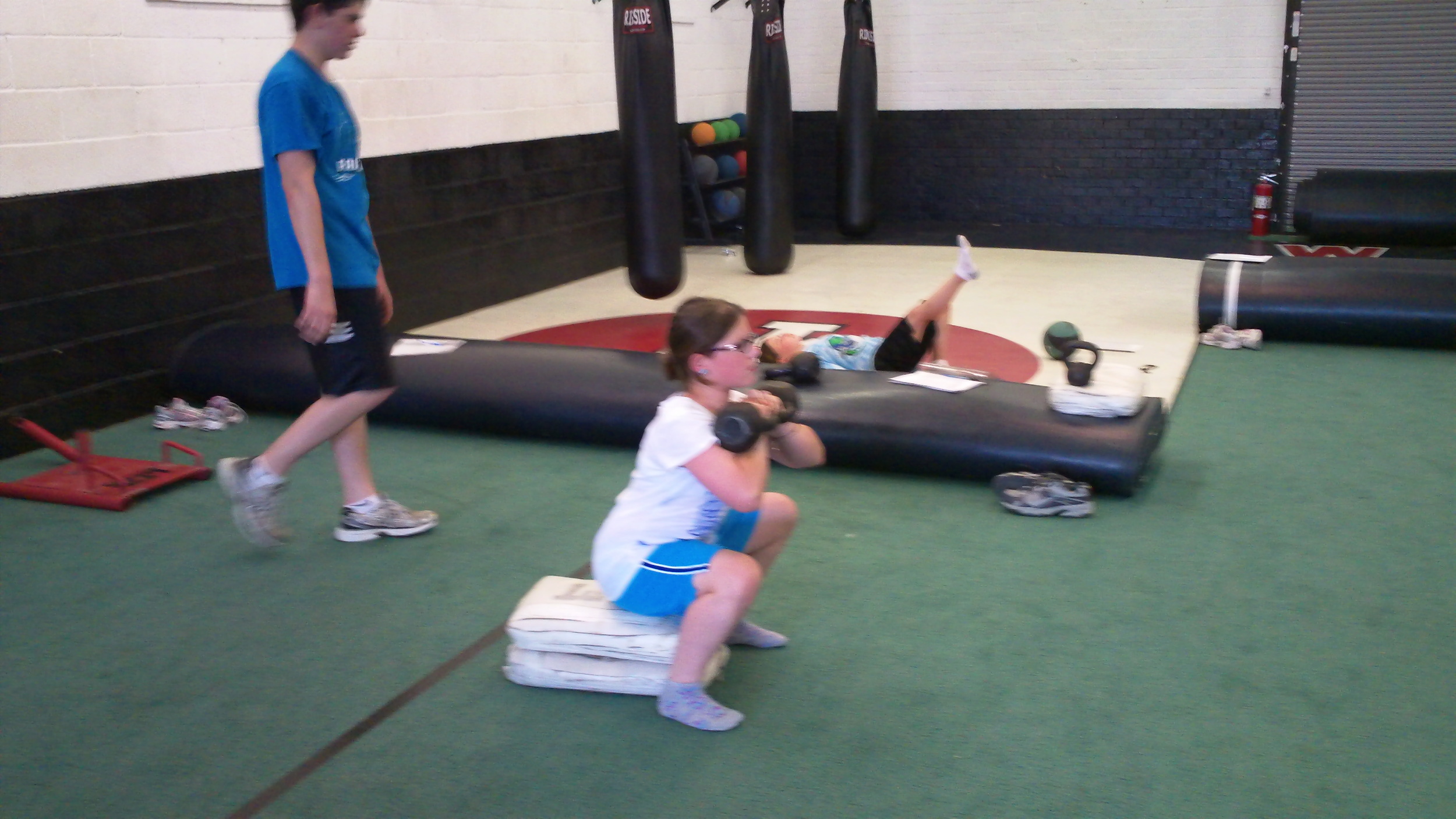
Last week's post listed persuasive (I think so anyway) reasons why kids should enroll in a strength training program. In that post is also a definition of a smart, sound training program. If you can't remember, here's the refresher; it involves none of the max effort, grunting/screaming/shouting version that, unfortunately, is the stereotype of our industry. Parents: NOT ALL TRAINING PROGRAMS ARE CREATED EQUAL!!!
Matter of fact, if you find your 9 year-old doing the same workout as your 16 year-old, something is dreadfully amiss. This post and the next will shed light on the differences that you should see between age groups, broadly, pre-puberty and post-puberty. Now, one thing to keep in mind as you read, these are general guidelines that apply to most of the population. There will be some puberty-stricken kids that are not prepared to train like their peers (meaning, they will be regressed considerably) and there will be some young kiddos who's physical development far exceeds their peers (though it does NOT mean they're ready for large loads; instead they'll have more advanced bodyweight and tempo variations.).
Right, let's hop in.
According to the American Pediatric Association, puberty starts between 8-13 for girls, and 10-14 for boys. For today's discussion, let's assume 15 years is the game changer in physical development. In my experience, kids under 15 still are pretty goofy and often don't have the muscular development that a 15 or 16 year old will (boy or girl). Between 8-15 a LOT of growth happens (and beyond for most boys, but we'll ignore that for now). That segues nicely into my first point:
Strength to weight ratio is a key factor to keep in mind while programming for younger kids. As I mentioned in the prior post, kids grow rapidly and without strength training, their muscle power will be left in the dust. Inadequate muscular strength will force kids to rely on their passive restraints during athletic movement. For example: a baseball pitch (or throw) will require strength in the lower body to produce rotation power, strength in the upper back and rotator cuff to maintain scapular and humeral (shoulder blade and upper arm bone) stability, and a strong core to transfer the power from lower to upper body.
This means, Jonny's shoulder and elbow ligaments are going to take a beating if he's throwing with weak muscles.
Another example: changing direction on a soccer field. The athlete must be strong enough to decelerate herself and then accelerate in a new direction. What happens if her hamstrings, glutes, quads, and core aren't strong enough to stop the motion, stabilize her joints, and reapply force in a new direction? (and this just her body weight, mind you, no external load) Strained (at best) knee ligaments, which typically manifests as the nefarious "knee pain," or, at worst, torn ligaments (good-bye ACL...).
A strength training program for a young athlete that uses heavy weights will only continue to teach the athlete to rely on passive restraints. Why? The athlete is already at a disadvantage by way of rapid growth (the strength:weight ratio is already out-of-whack). Therefore, exercises that utilize body weight or very low weights will avoid overloading the muscles and teach the athlete how to actually use their muscle mass.
The next point is tandem- teaching motor control and body awareness to younger athletes will improve their performance quickly. Kids need to understand MOVEMENTS before they can be expected to load those movements. Focusing on technique is crucial during this growing stage as their adjusting to their new bodies. Teaching kids how to use their hips (instead of their knees or lower back) in a squatting, deadlifting, and rotational pattern will benefit them immensely. Drills that include cross body movements (such as rolls and crawls, meaning left and right side have to coordinate) build "movement" bridges across the two hemispheres of the brain. A coordinated brain means a coordinated body.
Balance drills, such as standing on one foot while performing a medicine ball toss, are excellent in training the vestibular systems (inner ear) as well as teaching the brain to understand the feedback being sent by the foot.
The third point, is key. It must be FUN! Older kids often have the maturity to focus. Younger kids... it's debatable. Some kids are rock stars and can focus better than most adults, however, those athletes are few and far between. Most kids between 8-13 have shorter attention spans and lower stamina than their teenage counterparts. Therefore, we try to make the drills as fun as possible, while still teaching them technique and increasing strength. It's like hiding cauliflower in mac-n-cheese. Hide the good stuff with the delicious stuff. Un-fun sessions lead to unmotivated and easily-distracted athletes... which we all know will not advance their potential at all.
To sum it all up:
1. Focus on increasing strength:weight ratio utilizing body weight/light weight variations to teach young athletes to use their muscles.
2. Incorporate coordination and body awareness drills to TEACH MOVEMENT!
3. Keep the program fun!
Strength Training for Youths: It's Really, Really, REALLY Important
At SAPT, the bulk of our population is 13-18 years old; we have a handful of 9-11 year-olds (though that population is growing quickly) and then college age through the adult spectrum. A lot of parents carry misgivings about weight/strength training for kids under 18, a biggie is "it will stunt their growth." Poo-poo on that! What do you think running around a playground is? Physics, that's what is is: loads and forces acting on the body (just like strength training) except playgrounds are much less planned, controlled, and monitored (I have the scars to prove it).
This month we're going to delve into training for youths, even babies and toddlers too, and WHY IT'S REALLY REALLY IMPORTANT for their growth and development.
Today we're will just be an overview of the benefits of strength training for kids whilst the the following posts will illuminate a bit more details of various aspects of training and their importance for childhood development.
Before we jump in, I want to define what I mean by "weight training." I don't mean slapping a barbell on a kid's back or demanding max effort on all exercises. At SAPT, we take the "cook 'em slow" approach where we start with body weight and maybe utilize some light weights (depending on the kid's age and experience level. ALL of our athletes over 15 start squatting with either 10 or 15lbs. I don't care how "experienced they are.) and then we S.L.O.W.L.Y progress them over months and months. We won't even approach a kid's "max" effort level until they're closer to 17-18, and even then, it's only if they've been training with us for multiple years. We use the least amount of stimulus to invoke an adaptation. That, my friends, is how an athlete improves and stays healthy. None of this don't-stop-till-you-drop nonsense.

The following points are in no particular order, rather, this is the way my brain spat them out. They're all equally beneficial and should be coveted by parents for their children.
1. Bone development: Bones grow stronger when stress is applied. Obviously if the stress greatly exceeds what the bone can handle, it will break, but when applied systematically and progressively, the bones will adapt to the stress and become stronger. There's a pretty sweet physicological process seen here:

This is a most-desired process in young kids and teenagers as their bones have not fully ossified (hardened) yet in some places. Progressions from body weight exercises (utilizing isometric holds and negatives to increase the tension without overloading the kid with weight), to light weights, to more challenging weights when the athlete is ready, is a safe and effective way to help kids develop strong bones.
2. Improve kinesthetic awareness and muscular control: The body is pretty complex with lots of moving parts. As kids grow, they develop better control over the force production of muscles (notice how babies tend to wave they're arms and legs around? They're learning how to control the muscles.) and start to learn where their body is in space. Broadly, this is called motor learning and each person has a motor pattern map, if you will. Think of the map as a topographical kind that show hills and valleys and other such features.
A movement map is much the same, instead of hills and valleys, various movement patterns speckle the landscape. Now, I'm going to mix metaphors so stay with me on this one: the movement patterns are similar to computer programs. The brain knows what muscles need to fire for which movements and the forces needed, i.e. throwing a ball overhead, and thus the movement is achieved.
In order to have a successful athlete (or human being for that matter), the movement map must be rich and full of a variety of movement patterns. This way, as the body goes through life, the brain already knows how the body should respond. For example, let's say a kid learns how to throw a ball. The basic program of throwing an object overhead is there. From that program, the brain can easily learn how to throw a baseball or a football because that basic pattern is in place. Taken a step further, the brain could also learn how to perform a tennis serve, since it's the same overhead motion. So a kid who never learns that over head pattern of throwing a ball, will have a tougher time learning overhead motions as they grow.
Side note: "throw like a girl" is a phrase that annoys me. It's not our gender's fault that most** of us aren't taught from a young age like a lot of boys to throw over hand. In conjunction with that, Eric Cressey wrote a cool article about the bony development of shoulders that are exposed to overhead throwing during the ages of 8-13. READ ME, seriously. So there you go, the neurological and physical influence movements have on kids.
Ok, have you drifted off to Facebook yet? No? Good, this is more informative anyway. Weight training (and all the many, many movements that encompasses like rolls, crawls, and the more traditional movements) exposes young athletes to lots and lots of new movements and force production needs. They develop muscular control through the deceleration and acceleration phases of movements as well as how much force the muscles need to generate to create movements. All this enriches their movement maps and sets them up to be successful athletic learners.
3. Maintaining a good strength-to-weight ratio: Kids grow rather quickly. As such, then need to train in a way to increase their muscular strength to go with that growing body. Ever notice how teenagers can be fairly awkward (physically, that is) when they're in the middle of a growth spurt? That's because their muscles haven't caught up to the new length of limbs. Strength training will not only improve muscular control but also teach the brain how to direct the muscles accordingly as they grow. (See Point Number 2 above). It's similar to Milo of Croton carrying a calf up a mountain every day until it was a fully grown ox. What a deliciously ancient example of progressive overload and subsequent adaptation!
4. Strong athletes win: Maybe not the game every time, but athletes that are strong are less susceptible to overuse injuries (due to stronger tendons and ligaments), recover more quickly when injuries do occur, and they are able to adapt to game-time situations (thanks to their rich motor pattern map).
I could continue, but this post is already much longer than I intended it to be. This should convince you that a strength training program designed by responsible, knowledgeable, and maybe a little weird, coaches are exactly what young athletes need to promote growth and successful long term development.
**My dad taught me how to throw and catch a baseball, football, and frisbee. His foresight prevented me from "throwing like a girl." Thanks, Dad!
Strength Training For Referees: The Other Side of Athletics
Lift. Heavy. Things. That's a shocker, right?
But seriously, strength training regularly is exactly what refs and umpires need to stay in tip-top shape and last through the last second of the game. Weak referees tire, fall behind, and are not a metaphoric coursing river.
The physical demands of referees, at least the ones who run around with the athletes, do not deviate much from what is required of the athletes themselves. And those judges/refs who don'trun around, you should still lift heavy things as a general rule for conquering life. The basis of all movements (including standing during a whole match) is strength. Does your back get achey towards the end of the match? Prevention lies in the iron:
Granted, as the one observing the game, instead of playing, skill practice is not necessary. Being strong is. Can I say that enough in this post? Being strong is a necessary component to all aspects of athletics (and, really, life).Thus, weight training is vital to maintaining a healthy referee.
The beauty of strength training is that it doesn't have to be complicated; consider too that since you're not on a rigorous sport schedule (i.e. practices), your training can be rather minimal while still providing the stimulus needed to gain strength.
Let's say you have 2 days a week to strength train. What do you do? I recommend a full body workout on each day. Dan John presented a framework for training programs. I love it; it’s simple, quick and easy to remember.
Hip hinge (deadlift variation, glute bridge variation or swings)
Squat variation (goblet, barbell, bodyweight)
A Pull (such as a horizontal row variation or a pull/chin up)
A Press (i.e. push-up, bench press, overhead press etc)
Loaded Carry (Farmer Walk variation)
That will hit just about everything and you needn't spend hours in the gym. Hit a total of 25-30 reps of the main movement of the day (such as a 5x5, 5x6, or 4x8 set/rep scheme) and around that same total for the other assistance work. This allow for enough volume to actually have an effect and not too much so that you're overloaded.
Or, if you have 3 days at your disposal, you might want to do a lower, upper, and total body day. Keep the total number of exercises between 4 and 6, with the same 25-30 rep goals.
On the more shallow side, out-of-shape referees tend to draw criticism and heckling. No one wants that.
I know this is a brief post, but it's very simple and I don't want to overcomplicate things. And, frankly, if you're a referee, umpire, or judge, you were probably an athlete yourself and you understand the importance of maintaining strength; I don't want to belabor the the point and insult your intelligence.
Pick up heavy things. Swing Big Bells. And do Chin Ups.
Conditioning Strategies for Field Refs (Including Basketball and Hockey Refs)
If you're a referee for any of the field sports (football, soccer, rugby, field hockey, lacrosse, basketball, and ice hockey.. etc) you're well aware that there is a fair amount of jogging, sprinting, backpedalling, and dodging players throughout the course of a game/match.
Here's some fun facts for you:
1. Elite level soccer refs, head and assistants, run on the average roughly 10km and 7km, respectively per match. Not only that, but of that total distance, roughly 2km and 1km (respectively) is sprinting. That's a lot of sprinting!
2. In that same study of soccer refs, researchers found that main refs work at about 85% of max heart rate and assistants work in the 77% range. Again, that's a pretty high demand on the cardiovascular system.
3. High level rugby referees were found to have a 2:1 work to rest ratio of sprints to jogs/stationary, for a full 90 match. That is NOT a lot of rest between plays!
I imagine that from those studies we can extrapolate physical demands would be similar for football, lacrosse, and field hockey, and ice hockey. I would even venture so far as to say that the metabolic demands of a high-level basketball ref would be close, despite having less distance to travel from one goal to another. To quote the official Hockey Officiating Handbook:
A good official needs to be in excellent physical condition. Whereas players may skate a one-minute shift and then rest for a couple of minutes, the official is called upon to skate the entire game. An official deemed to be overweight and not in shape will have a difficult time keeping up with the play and will oftentimes be out of position.
Granted, the aforementioned stats were found in elite level referees, and I imagine the physical demands diminish proportionally to the level of sport (elite, college, high school and so on.) HOwever, the quote from the hockey handbook, I think, applies for any sporting referee. Think about it: the players are typically younger, have more time to train/recover (they may not have a second job, demands of raising/supporting a family etc.), and they have the goal of winning (which could, especially in a close game, overrule any fatigue).
I would also argue that the ability to maintain a high output throughout the game, especially towards then end when the points becomes more crucial, is essential to being a successful referee.
So, with all this information, what is the most efficient way to train? Here's how I would break it down:
Off-Season:
2-3 days of pure strength training
2 days of conditioning
In-Season:
2 days of pure strength
1-2 days of conditioning (the second day really should be more of a "bonus" day, if a game gets cancelled or something)
Since today's post is about the conditioning aspect, we'll focus on that (the strength portions will be later on). However, I DO want to point out that the strength training does NOT diminish during the season. Strength is the basis of all athleticism, including being a referee. The conditioning sessions drop in-season as actually reffing games will maintain aerobic conditioning.
Once again, that is if you're a consistent reader of this blog, I'm going to direct you to the Energy Systems post I wrote a while back. Why? Because it's important to understand, that's why. Most referees will have the same metabolic demands as a power athlete, that is, they'll be required to have intermittent high-intensity sprints with periods of jogging and/or complete rest. If you don't understand that having a solid aerobic base and how to build it efficiently, you can do all the sprint-repeats you want, but you're not going to get much better at recovering between those sprints without a
Energy Systems (READ ME)
Here are some great options for building the aerobic base:
High Intensity Continuous Training (explained here and here)- This is a great option as the impact is pretty low, so cranky joints shouldn't complain.
Rectangle Runs- Sprint the length of a field (start at roughly 70% and work up to 85% -90% over the course of several sessions). Walk the end lines. 1 rep = sideline sprint + end line walk. Start off with 6-8 reps (depending on your current level of conditioning) and work up to 10-12 reps per session. During the first couple of sessions, make sure your heart rate gets back below 150 beats per minute. As you progress, you'll notice that your heart rate will drop sooner during the rest periods. This bit is important because a) it helps build the aerobic base via recovery and b) allows for full force production during the sprint, thus improving your strength.
If you're really snazzy, you can practice sprinting with your head facing the inside of the field, as you would during a game.
Shuttle Runs - These will help improve change-of-direction and acceleration. The possibilities are endless with the reps and distances and rest periods. Again, to help work on the aerobic base and improve sprint capacity, let your heart rate recover to under 150 bpm between shuttles. Working without full recovery will eke you into the glycolytic state during the sprints and, as we all know, glycolytic power poops out pretty quickly over the course of a lengthy training session/game.
Hill Sprints - Find a menacing hill. Run up. Walk down. Repeat anywhere from 8-15 times. It's a pretty simple one.
Circuit Training- Here's an alternative to actual running for those poopy-weather days. I wrote about it here.
Ok referees, there's now no excuse for NOT training your cardiovascular system to attain tip-top physical condition. Get movin'!
Refs, Umpires, and Judges, Oh My! Performance Training is Not Just for Athletes
If you could discern from the somewhat cryptic title, this month's theme will be athletic performance training for referees, umpires, and judges of sporting events. These brave men and women, dashing and dodging players, balls, and sticks, also require performance training that is equal to that of the players that watch. For example, did you know that a study of English Premier League soccer (football, really for everyone else in the world besides Americans) refs ran an average of 9.5 km (that's 5.9 miles) in one game?!
Not to mention the facts that refs are typically 10-15 years older than the players and they're running that distance while looking sideways.
And let's not forget the hazards of being a ref:
And this:
It's a tough job being on the authoratative side of sports. SAPT is here to help out! Stay tuned this month as we explore various aspects of training for referees, umpires, and judges.
Mental Break from Sport
Today's post comes to you from our Zen-Master Intern, Myron Tan. Myron knows a thing or two about balancing life; you can find him practicing his yoga moves after a heavy Oly-lift session. Take it away Myron! Why do athletes need a mental break from their sport? It can help prevent the following: boredom and lack of motivation to practice/compete, mental fatigue, and combat the pressure in competition. Those three things will, if left unchecked, ultimately lead to decreased performance and burnout. We're going to delve a bit deeper into each reason and by the end should convince you of the importance of mental breaks.
1) Boredom/Lack of Motivation
More is not necessarily always better. For example, if an athlete reaps the benefits of practicing 3 days a week for 6 months, practicing 6 days a week for 12 months is not twice as beneficial. One of the defining characteristics of an athlete approaching burn-out is the loss of enjoyment in the activity. This extends from youth sports all the way to the professional ranks.
When participating in your sport is no longer enjoyable, that is a warning sign that you need a mental break from it. When an athlete is overcome with the demands of their sport… enthusiasm and passion for the activity suddenly disappear. This is commonplace especially in youth sports because of the “more is better” mentality that sport coaches and parents often have.
Do you loath going to practice? Are competitions that were once exciting and challenging, suddenly feel like a chore?
Athletes, parents, and coaches need to always be mindful of the fun factor when it comes to the in-season. Performance and success on the field are not mutually exclusive from enjoyment.
After every practice or game, we need to aim for our athletes to ask “When do I get to do this again?” instead of “When will this be over?”
2) Mental fatigue
We would never run our bodies to the ground to the point of failure. (note from Kelsey: At least we shouldn’t.) Our psychological well-being is just as important and deserves equal care. When an athlete is overcome with the monotony and increased time demands of their sport, mental fatigue can occur. This will exhibit itself as a temporary inability to maintain optimal cognitive performance. If an athlete is not all there mentally it will negatively transfer to their ability on the field.
Correct periodization in strength and conditioning during the season will not only maintain strength, power and agility, but help decrease the risk of injury. In addition, this off-the-field time will provide a much needed mental break from an athlete’s sport.
This will take an athlete’s mind off their sport and introduce balance into their life by not being too neurotic or overly focused in any one facet.
3) Pressure
One of the key elements that lead to athlete burnout is feeling too much pressure. There’s no question that competition is good and can contribute to creating a motivated athlete. Pressure can come from competition and the people we’re surrounded with. A desire to win creates pressure. Expectations from teammates, parents, and coaches create pressure. Pressure is critical to driving the competitive engine.
However, if you are constantly under extreme pressure from yourself, coaches, or parents, this will lead you down a bad road; down a road where you never get to relax and unwind. A road where this pressure can drain the enjoyment out of your sport.
Just like how having adequate rest periods between sets is important, having adequate mental breaks from your sport is vital to long-term success.
To wrap that all up, balance is key to everything we do in life, and this is certainly true of participating in sports.
Entering a long season is like entering battle. We must be ready for the long-haul and continue to have the mental fortitude to deal with the stressors and challenges along the way.
Think of your mind as your weapon, sharp or dull. A sharp weapon will demolish the competition; but if the weapon loses its edge, you will continue to strike your enemies with a dull axe and accomplish nothing.
Remember, mental rest is part of your training as an athlete and part of our work as sport and strength coaches. If you don’t take time to “sharpen your axe,” to rest your mind and body giving them time to recharge, then you will become increasing less efficient and DULL.
You can accomplish this by maintaining balance in your sport and prioritizing enjoyment. Utilize a resistance training program that is conducive to a successful in-season.
You have my permission to take a mental break from your sport; and my approval to reap the physical and mental benefits of in-season lifting.