
Conditioning for Volleyball; How to do it WITHOUT killing verticals
It never ceases to amaze me how often I see volleyball coaches running their athletes through, "old school," conditioning while in season. They then go on to wonder why their athletes are hurting their knees, why verticals aren't improving and what can be done to remedy these issues. Often times the thought is to add something to the program as more is better and hard work makes improvement, right? Wrong. More is just more and hard work only leads to improvement when it is applied correctly. It seems extremely popular for coaches to implement P90X style conditioning in which their athletes do repeated vertical jumps or burpees to fatigue while throwing in sprints, pushups, crunches and whatever else. The common thought is, "it's hard, leaves the athletes gassed and contains sport-specific movements, so it must work!" This may seem sport-specific because it contains jumping, but it actually couldn't be further from what they need while in season. This is because the actual energy system demands in these types of situations are far from actual volleyball. Expecting them to respond positively with respects to their sport from jumps, agilities, suicides while fatigued or in a heavily aerobic state violates the SAID principle.
The SAIDPrinciple and Energy Systems
Specific Adaptation to Imposed Demand. That is one of the golden rules of training. It does not entirely mean that if you just keep jumping you will get better at jumping. What it does mean is that if you keep jumping with certain muscle fibers, at a certain pace, with certain recovery, you will become better at jumping a certain way. That "way" is all determined by the mechanics of the jump and the energy system(click to get a good background on the energy systems) the athlete is tapping into while they jump. Performing jumps while fatigued and in a heavily aerobic(breathing hard) state means that you are training yourself to jump better in those conditions. This often times results in having altered mechanics, relying heavily on ligamentous and structural stability(rather than muscular) to jump as well as recruiting more slow twitch fibers in the pattern than fast twitch. Jumping like this can greatly increase the risk of knee injuries as you can see below..
When our bodies enter into a largely aerobic state, they limit the amount of fast twitch fiber recruitment. This is because our fast twitch fibers are largely glycolitic which means that they're fueled anaerobically. You can read up more on the energy systems HERE. In short, the anaerobic systems are your body's first choice for fuel. It is rapidly prepared for use and requires no oxygen. When you run out of the creatine phosphate(10 seconds of activity), your body starts trying to convert the glycogen into ATP. This causes a byproduct of lactate and hydrogen. If you are expending energy at a rate faster than what your body can shuttle out these byproducts, you start to develop fatigue and that, "burning" sensation in those muscles. These byproducts are shuttled to the slow twitch fibers that can actually metabolize them with the use of oxygen into more energy. The increase in oxygen for metabolism results in heavier breathing.
So as you can see, the fast twitch fibers run out of energy pretty quickly. The slow twitch fibers can go all day. The more you train these fibers in specific movements, the more dominant they will be in recruitment strategies. So if you're jumping while in an aerobic dominant state, you're training yourself to use more slow twitch and less fast twitch when you jump.
The energy systems are not black and white. We are constantly using all of them at the same time, but there is generally one dominant one. It is normal to have an increase in breathing or feel some work in your legs during jumping. However, I would argue that doing what should be explosive style movements to glycolitic fatigue in a sport that has almost no aerobic element is extremely counter-productive to maintaining power-production and general orthopedic health.
What they need:
First, I'd like to point out that a quick google search reveals that there are no time-motion studies to be found on volleyball(or at least when I was looking). A time-motion analyses is a group of collected data taken during sporting events to tell you the average of: type of movement, intensity of movement, it's duration, frequency and amount of rest between bouts for that particular sport. This way strength and conditioning professionals can take a more objective look at what an athlete actually needs. The fact that there are none to be found on volleyball, in my mind, just goes to show that the aerobic conditioninglevel is insignificant when compared to other variables. It's for that reason that more emphasis should be focused on mechanics, maximal power output, and strength. Now with that being said, there is still a small aerobic component that could potentially limit an athletes' jumping ability at the end of a long game, but it needs to be addressed properly, without taking away from the aforementioned traits.
Researchers analyzed a German female beach volleyball team and found that in one hour of play, an athlete takes about 85 jumps on average. Another study followed a mens' beach volleyball team and found that they take an average of 145 maximal jumps during the course of play in a game. That same study noted that about 27% of the jumps were due to blocking. Though beach volleyball and indoor volleyball are two different beasts, what we can conclude from this is that since beach volleyball has 1/3 of the players and is much more active, that indoor volleyball requires even less total work output. This does however give us a, "line in the sand," to know how much work capacity they need. If you focus on giving them more capacity than what they need, then you run the risk of pulling from other training variables such as explosiveness.
Knowing the numbers above I would estimate that prepping an athlete to take 80-110 jumps(being liberal) in a game should suffice for most levels and positions. So they ideally need to be able to perform that many jumps over the period of a 60-90 minutes, without losing much "umph". Throw in the constant shuffling and repositioning and you could argue that there is an aerobic demand, but due to the amount of time between plays and the, "clusters" of movement, I would argue that it is minimal when compared to the demand on the creatine-phosphate system. You rarely see an indoor volleyball player panting or having a build up of lactic acid during a game. The main role of the aerobic system for these athletes should be to help adequately replenish the glycolitic system.
To address this, you want to try to improve the aerobic capabilities of the fast twitch fibers without giving the slow twitch fibers much stimulus. Doing this must be carefully programmed so as to not interfere with maximal power output. My favorite method for this is ballistic style conditioning. The only prerequisites for this method is that the athlete has a decent strength base, so that we know the tissues won't negatively respond to the impact, and proper jumping mechanics. If the athlete is lagging in those two areas then they are much better off focusing on those aspects than worrying about their conditioning.
Enter Ballistic style conditioning
Not only does it sound hard-core, it's pretty easy to implement, is extremely effective and is probably the most specific conditioning method for volleyball players. It is a form of interval training that is set to the individuals ability every time it is performed.
To implement this method, you need a point in which the athlete(s) can measure jump height on each of their reps. What I recommend doing is adjusting the nethigher so that they can't get one hand over when jumping(if possible) or using some other object(like a basketball hoop) for them to consistently touch when they jump. The athletes will first see how high they can get by jumping uptouching a spot on the net/object and will be instructed to mark and remember that spot. You can use tags or stickers if you don't trust them to remember.
You then pick an interval depending on the need, position, time of year and conditioning level of the athlete(s). I recommend 5-15 seconds on and 20-35 seconds off. When you start the interval the athlete(s) will jump and touch their individual spots repeatedly until the rest period starts. During the rest period, the athlete still does slight movements such as sidesteps in place. Just enough to keep the blood flow going. Then returns back to jumping when the rest ends. This is repeated UNTIL THE ATHLETE MISSES THEIR MARK, which signifies fatigue of the fast twitch fibers. At that point, the athlete stops and gets a gull recovery of 3-6 minutes so that the glycolitic system can recover. This constitutes as one set. I'd recommend doing anywhere from 1 to 3 sets depending on the situation and frequency of implementation. The training effect will make it so that the fibers can recover faster in between bouts so that they can generate near maximal forces even towards the end of the game.
This method should be used and completed before the season starts so that the training effect can be utilized in practice. So long as they are continuously practicing and playing in game-like situations, the effects should last. It will actually allow you to get in more maximal power work too, which is what you should be doing while in-season. Performing circuit-style conditioning or anything that pushes the athlete into 60-90 seconds or more of intense activity will start to diminish this affect.
Give this a try with your team next year. Get them working early so that they can get a good wave of ballistics in before their season starts and then continue to work on their maximal power and skills from there. If your team isn't ready for ballistics conditioning then working on jumping mechanics and a solid strength base will still improve their endurance on the court as well as improving their vertical.
SAPT MailBag: The Path to SwoleCity
SAPT MailbagQ: I’m 6’1 and I weigh 160 lbs soaking wet. My goal is to get to 200 lbs by June. I work out 5 days a week. Monday & Wednesday belong to the Lower Body; leg press all day, then burn it out with hamstring curls and leg extensions. Calf raises if I took my pre-workout. I do upper body on Tuesday and Thursday. I run on Fridays. I start out with chest flys, then I grab a squat rack and knock out 4 or 5 sets of bicep curls. I’ll finish up with some lateral raises, tricep extensions and lat pulldowns. I take mass gainer before and after my workouts, but the scale hasn’t moved at all! Tell me the secret to getting ripped!
- Drew C, NY.
Drew… first of all, thanks for your question. Second of all, I’m sorry to hear about your lack of success thus far in the mass-gaining department. Luckily for you, I’m about to drop a knowledge bomb that is bound to get you moving in the right direction. Relax, take a seat, and get ready to learn.
Expectations
It’s great to have goals. Goal setting is a vital skill to possess, and it’s the first step you need to take in order to actually accomplish anything of significance. Not only that, but you’ve also put together some semblance of a plan on how to achieve your goal. That’s fantastic, but let’s take a minute to examine your goal and see how feasible it actually is.
By my count, we have about 18 weeks until the beginning of June. This means you’ll need to gain around 2.2 pounds per week to achieve your goal. When gaining mass, putting on 1-2 pounds per week is considered excellent progress. Remember, our goal is to put on lean muscle mass. Sure you could sit on the couch, drink a gallon of milk a day and eat oreos until you develop a mild case of type-II diabetes. You’ll have no problem ballooning up to 200 pounds, but how much of that weight do you think will be muscle, and how much do you think will be oreo?
Patience is key. The mass gaining process is a journey, and there’s no point in gaining weight if it doesn’t make you stronger, healthier, and manlier. A more achievable goal would be to put on 25-30 pounds by June, or extend our deadline to the end of July. With either of these strategies, we would only need to be gaining 1.5 pounds per week. A much more attainable feat that gives you a greater chance to succeed, and allows you to maximize how much muscle you will gain, while simultaneously limiting excess fat accumulation.
Diet
As convenient as mass-gaining shakes are, they aren’t magical. You may be drinking upwards of 2 mass-gaining shakes a day, but if you’re not in a calorie surplus, you’re only spinning your wheels. Hire a nutrition coach. Make an appointment for a consultation with our very own Coach Kelsey Reed, mass gaining extraordinaire. She’ll point you in the right direction, show you how to truly understand nutrition, and book you a one-way ticket to swole-city.
Most experts agree that you’ll gain about .5-1 pound of fat for every pound of muscle that you put on. Making sure to properly manipulate your food intake is vital to gaining muscle in the most efficient and effective manner. Shoot for around 1.5-2.0 g/kg of protein a day, and try to hit about a 10-15% calorie surplus. Understand that more is not always better, and it is accuracy and consistency that really matter. Examine.com, and Precision Nutrition are fantastic resources for all things diet-related. The web is wonderful place. Take advantage of it.
Exercise Selection
The average person interested in bulking up will google “workouts for getting yolked,” grab the first routine that pops up, and repeat it over and over again until they develop an over-use injury or get bored. Oftentimes, these routines are loaded with isolation exercises. They’ll consist of a chest isolation movement, a back isolation movement, a shoulder exercise, three more for your arms, and core circuit. The program will have you going to the gym 5, sometimes even 6, days a week. I’m here to let you in on a little secret...
You don’t need to be lifting 5 or 6 days a week. You’re wasting your time isolating muscles. Ditch them and start performing multi-joint, compound movements with heavy weight. Bench press, overhead press, squat, deadlift, row, perform chin-ups and push-ups until you can knock them out in your sleep. These are the “bang-for-your-buck” exercises. These are the exercises that will allow you to gradually add weight to the bar over time. They allow you to use greater loads and utilize more muscle mass, which in turn releases more growth hormone, more testosterone, enhances bone density, strength, and power.
https://www.youtube.com/watch?v=TdbTxbQQWaY
Conditioning
Believe it or not, your run on Friday is probably working against you. Long, steady state cardio is exactly the kind of thing that you want to avoid when your goal is to put on size. Instead, try higher intensity methods of conditioning. Perform hill sprints, prowler sprints, loaded carry variations, crawl variations, medicine ball slams, etc. High-intensity conditioning work and resistance training have a synergistic effect upon each other. Sprints, slams, and loaded carries, just like heavy barbell work, is going to seriously jack up your hormone production, and leave you gassed and weak-kneed.
https://www.youtube.com/watch?v=Z0-jd8418FU
Conclusion
Follow the above recommendations and you’ll be well on your way to gaining a respectable amount of size. Remember, individual differences will also play a huge role. Genetics are the cold, hard reality, and some of us (myself included) just aren’t as genetically gifted as others. Work with what you’ve got. Learn the how to lift with PROPER technique before you use heavy loads. We can help you with this. Book an appointment for a consultation with one of our coaches today and you won't regret it. We excel at teaching proper lifting technique, and progress our clients intelligently, systematically, and consistently. We absolutely love this stuff, and have been turning average Joes into superheros since 2007.
Use the Deadlift to Bring Your Jumping Skills to Life
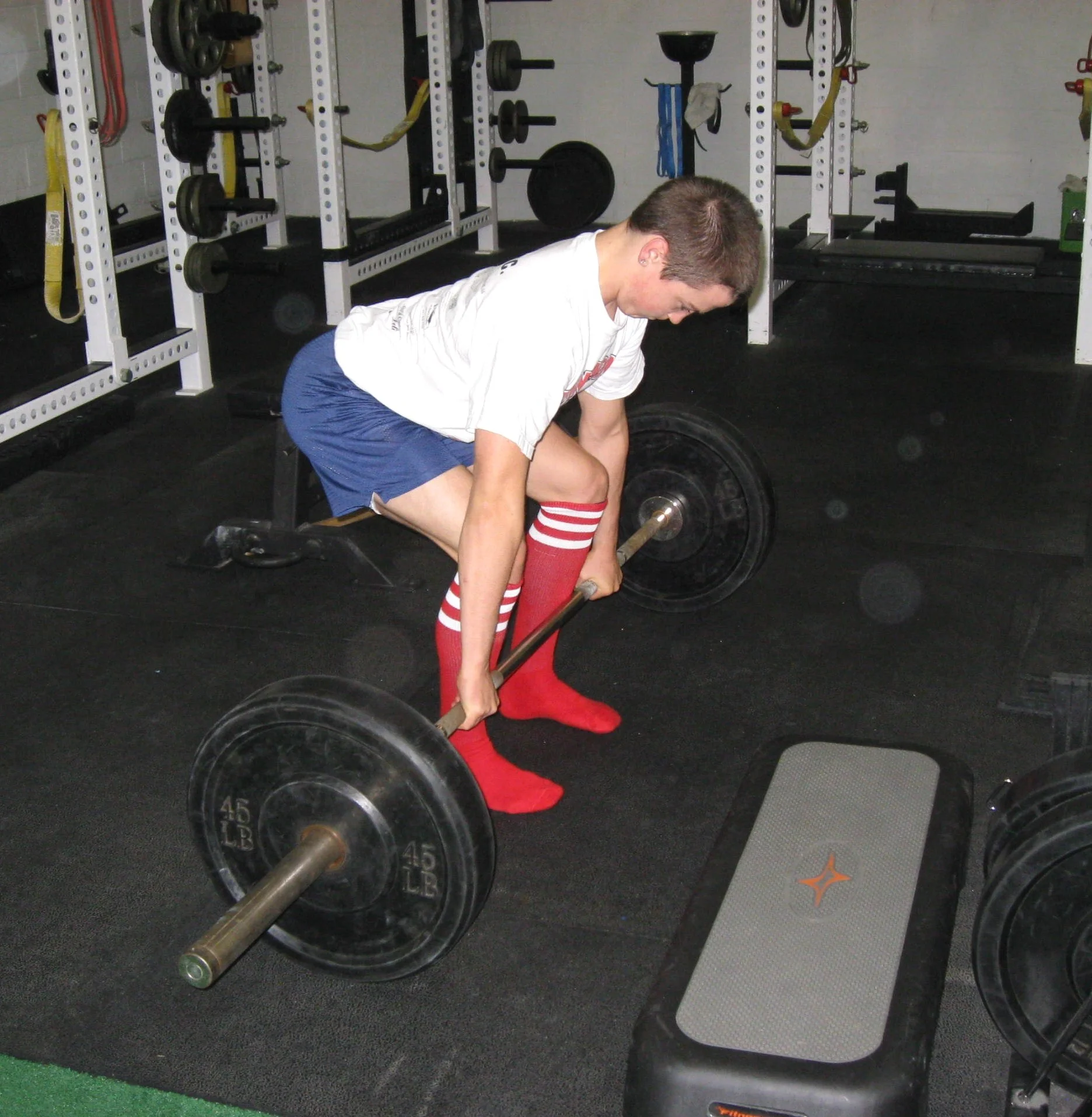
The deadlift has long been associated with strength and power and an exercise frequently prescribed and executed by the wonderful athletes here at SAPT. A recent study in the Journal of Strength and Conditioning Research examined this exercise and discovered illuminating data to further validate the positive effects this exercise has on athletic performance.
The primary purpose of the study was to examine what effect 10 weeks of deadlift training would have on rate of force development (RFD), rate of torque development (RTD), and vertical jump performance.
RFD, a person’s ability to rapidly create force, is paramount to success in sports performance. A higher RFD produces much quicker and more explosive movements. In the weight room this equates to being able to move a barbell or implement with a given load at a faster rate. On the field or court the results will be noticed in laser quick cutting and lightning fast running.
The study consisted of 18 people who completed 5 sets of 5 reps on the deadlift twice per week for 10 weeks. Utilizing pre- and post- vertical jump test results, the authors found a 7.4% increase in vertical jump height. To put that in a real world measure, it would be similar to adding about 1.75 inches to a 25in. vertical jump. Not a massive increase but certainly enough to get you closer to the ball in most cases. The study also noted marked improvements in RTD for the major lower extremity muscles groups.
The results of this study give hope to jumping athletes looking to take their athletic prowess to the next level. I feel Dan John said it best in the book Easy Strength, "If you aren't deadlifting, you aren't training."
Get Smarter Today! Strength Training for Your Brain
We haven't done a post like this in a while and I thought I'd start the practice back up again. There are a plethora of smart people out there, most of whom we learn from, so I figured our readers could too! 5 Steps to Managing Large Groups- Sarah Walls
Did you all know that Sarah, founder and owner of SAPT, also founded and owns a second company? For those who don't know, it's called Concentric Brain and it's a software solution for fitness professionals. It makes the program writing process faster, and believe you me, anything that helps with that is gold. They have a blog so check out the link above (as well as the other posts.... it's also where Steve Reed has transferred his splendid writing skills).
Fix Your Knees, Get Bigger & Stronger- Tony Gentilcore
Tony is a great coach, not only because he's a pretty smart dude, but he walks the walk. He trains hard and knows what it's like to train around pain. If you have knee pain, this is the article for you!
What Happens to Your Body During a Cleanse - Thorin Klosowski
Aside from having a spectacular name, Thorin does a fine job of debunking the detoxing junk that is spewed forth from every direction. If you feel like your body needs a cleanse, read this first, then go eat some vegetables. Your body will thank you.
How Flip-Flops Change Your Feet- Katy Bowman
Katy is a biomechanist and blows my mind every time I read a post of hers. This one has less nerd-speak than some of the others and illuminates why flip flops are, well, not the best footware choice. I highly recommend perusing the rest of her site, but I'll send this post your way to whet your appetite!
These should keep you occupied until next week!
Teaching and Improving the Vertical Jump- Strength and Power
Last week's post was all about the technique side of improving the vertical jump. Today will entail multiple videos (for those of you who don't want to read on a Monday morning) of different drills and exercises that help improve strength and power for purpose of gettin' dem ups.
The following are SAPT's go-to exercises for all of our volleyball and basketball players for improving their vertical. We have two goals:
1. Increase force output- that is, the amount of force applied to the ground. The greater the force, the greater the jump height (it's physics).
2. Increase rate of force development- as we've discussed before, how fast can an athlete apply force to the ground. The faster she can hit peak force output, the higher she'll jump (more physics).
Goblet/Barbell Squats:
Why- Squats, both goblet and barbell, increase strength/power in the hamstrings, glutes, and quads- more notably the backside muscles- all of which are the primary jumpers. An article in the Journal of Strength and Conditioning Research found that deep squatting (below parallel) was beneficial in both strength and power development. I find it interesting that partial squats actually decreased strength and power...
Deadlifts:
Why- Again, posterior chain development but also, look at the hip angle. The hip hinge of the deadlift is very similar to the hip hinge needed in the vertical jump. Not only that, we can toy around with the reps/sets/weights to either train for strength or for speed (i.e. increasing the rate of force development) both of which contribute to more air time. Above is conventional style deadlift, but sumo works too. Incidentally, I've noticed that most of our volleyball players sit into conventional more comfortably.
Kettlebell Swings:
Why- Kettlebell swings are a delightful (well, I think they're delightful) and effective way to improve power production. The Olympic lifts are touted as the best power production exercises, but I think the risk-reward ratio is skewed in the "risk's" favor for the O-lifts- mostly because they're extremely technical lifts that take a large investment of time to see the benefit. Kettlebell swings are, by comparison, fairly easy to teach and we can milk the swing for a long time to continue to increase strength and power.
Split Squat/Lunge variations:
Why- While I know that vertical jump is a bilateral movement and if I were training athletes ONLY for vertical jump tests (which are very controlled) then I would certainly prioritize squats/deadlift. However, the vast majority of the time the context these athletes will jump in, games/practice, the vertical jump will have a variety of take-off stances. Therefore, they need to be strong in a split-stance. Unilateral training also evens out imbalances and improves stabilization. Unstable athletes don't jump high.
I really, really like Bulgarian Split squats (second video)because of the extra stretch on the glute muscles of the front leg which ilicits a higher growth response. And they're hard.
Split Stance Vertical Jumps*:
Why- Speaking of split stance, we can specifically train the jump technique with this drill. I only move athletes to this drill when they've mastered the basic vertical jump technique. I like this drill a lot as it mimics what a lot of game-time scenarios will actually be, especially for outside hitters and basketball players going up for a rebound.
Vertical Jump with 180 Degree Turn:
Why- Vestibular training! How often, in a game or practice, does an athlete have to turn and jump? I'd wager the scientific measure of "a lot." While an athlete may not do the 180 in the air, the change in direction does stimulate the vestibular system and teach the athlete to orient him/herself faster.
Seated Vertical Jump:
Why- The seated part takes out most of the benefit of the countermovement (the arm swing and sitting back) which challenges the athlete to generate more force/power from the legs to achieve any semblance of height. It's a way to challenge the lower body without adding weights to the athlete.
Depth Drop to Vertical Jump:
Why- This taps into the reactive component of jumping. It helps increase rate of force development, but also trains the reaction of the athlete. Athletes will often have to jump multiple times in a row without much respite, so training their ability to rebound upon landing is advantageous.
There we have it! This should be enough to jump-start (pun totally intended) improving your/your athletes' vertical jump.
* In case you were wondering what I was listening to, it was Nightmare Before Christmas Revisited. Yes, it is awesome.
What You Need to Know About Training While Sick
It’s flu season! And with flu seasons comes the age old dilemma of figuring out if you’re too sick to train. Every trainer can attest to the dozens of emails and texts that we receive stating, “I’m kinda sick, should I still come in?” Just like every other answer we give you about training, it depends. Are you contagious? Fever? Just a cough?
The last thing you want is to make yourself worst or lessen your recovery, but the thought of missing out on all the gainz is just as maddening as the tickle in your throat! This dilemma is sure to be even more prevalentthis year considering the fact that the flu shot has missed its mark and is only 23% effective.
"Listen to your body"
Yes, I just dropped that cliché line. But honestly, it’s true. If you’re feeling unmotivated and weak from your illness, then pushing through it is not a great idea. It’s important not to mistake motivation for stupidity. Forcing one intense session while still recovering can prolong your recovery and keep you from getting back to positive training effect sooner.
The main symptoms that will excuse you from trying to get your gainz on are generally:
- If it’s anything below the neck(chest congestion/bronchitis, diarrhea/stomach issues)
- If you’re contagious…. Seriously, if you come in and get me sick, you’re getting backflips to failure in your next program
- Fever
- Wide-spread muscle aches (has potential to create compensations in your movements and cause an ineffective session)
Obviously if it’s just a runny nose or just some minor signs, get over yourself. You may need to scale the intensity, butexercise should actually help your condition. In fact there are several studies that have linked cardiorespiratory exercise to significantly reduce the likelihood of upper respiratory infections aka the common cold.
Strength training will also help to stimulate the immune system, however it’s recommended that intensities stay conservative. Higher intensity lifts can take more of a toll on the CNS and result in temporary immunodepression. This is no bueno if you’re currently fighting off an illness and could make it easy pickings for the bacteria. It’s for that reason that it’s usually a smarter idea to have a speed day or stick to about 80% effort.
With all of this being said, even if you’re too sick to train, you’re not too sick to move. Be sure to get your rest, but staying in bed all day may actually limit your recovery. The reason for this lies in your lymph.
We’re used to hearing about how important it is to get the proper nutrients and to stay hydrated while we’re sick, but not much is mentioned beyond that. When you have a fever or when you’re fighting off illness, your cellular metabolism increases. This is why the extra hydration and nutrients are key. With the increased metabolism, comes increased biproducts and waste. The lymphatic system serves to help clear this waste as well as extra fluids, nutrients and infectious material/bacteria to the closest lymph node where white blood cells do their thing to clean everything up.
The way lymph (and the bacteria, waste, fats and fluids that it carries) is transported through the bodies is through capillaries similar to veins. Unlike arteries who use the pressure created by the heart to shoot blood forward, lymph capillaries and veins rely on muscular stimulation for transportation. Their structure prevents any back-flow so that when tension is put on the segment, the fluid can only move forward. Without surrounding muscular stimulation, there is very little movement.

The lymph already doubles blood in volume within the human body, but during illness there may be even more. Ideally it serves to move that much more waste and infectious materials to the lymph nodes, but when the individual remains bed-ridden it’s all for naught. This just pulls more of the hydration from the blood and can result in lymphatic congestion when one is extra sloth-like. Without the muscular stimulus to push the lymph through its capillaries, the infectious materials, pus(gross, right?) and bacteria just pool instead. This is VERY counterproductive to getting back to health.
By giving your body certain conservative movements, you can actually help to expedite your recovery process through draining the congested lymph structures. All while helping to maintain joint mobility and peace of mind.
Movements to do while laid up
1. Bounce
Yup, bouncing up and down. It sounds silly, but it actually helps to move the lymh through the entire body. Because the body goes from a moment of weightlessness to almost double within seconds the body’s tissues go from no pressure to a lot of pressure back to back. This creates a pump-like stimulus on the tissues and helps with lymph and venous return to help clear out the congestion. It also doesn’t need to be as weird as it sounds, if you’re healthy enough you can jump rump or do jumping jacks. If you’re pretty ill you can just sit there and bounce on your bed. Or you can even do whatever this is:
2. Foam Roll
Foam rolling is rarely a bad thing. This too can help to serve as excess pressure on the tissue to improve lymph flow. It also is just good for general soft tissue health. You can increase its effectiveness on your illness if you focusing on rolling centripetally(towards your heart). This will just help to ensure more of the fluids are moved towards their respective lymph nodes and eventually back to the thoracic duct.
3. Movement Flows
Just doing light movement flows can make a world of difference in the way you feel. Again the activation will help move some fluids around, but it’ll also just help you to work on mobility, stimulate your parasympathetic nervous system and just give you some quality patterning work.
https://www.youtube.com/watch?v=-SdYZk-YYJY
4. Balloon/straw breathing
There are hundreds of breathing drill variations, but choosing one that focuses on thoracic expansion and active exhalation can be extremely beneficial when you’re recovering from a flu or cold. The thoracic duct(think end of the line for lymph) sits in the thoracic cavity, obviously. By focusing on a breathing drill with these characteristics, you can create the pumping mechanism once again, but right where the lymph delivers the excess nutrients it picked up right back to the blood. It also assists in getting a good stretch out of your intercostals, which are probably pretty tight from all the coughing you’ve been doing.
https://www.youtube.com/watch?v=PfgBGJY4VEw
So stop being a bum and get out of your bed so that you can get back under the bar or on the field that much faster. Utilizing these movements within reason as well as covering your rest, hydration and diet can dramatically shorten the amount of time you're out.