Open Letter to the NSCA From A Disappointed Coach
Dear National Strength and Conditioning Association, I am a female strength coach. I have been a Certified Strength and Conditioning Specialist (CSCS) for 5 years. As a fresh-out-of-college kinesiolgy major, I couldn't wait to earn my CSCS; after all, it is the gold-standard of strength certifications. I was so very proud when I passed the test and added those four letters to my email signature. Once I earned them, I stepped into the world of the strength industry.
I discovered that there are many beast women out there, and many of them are strength coaches too. Molly Galbraith, Nia Shanks, Naghar Fonooni, Jen Sinkler, all the ladies over at Breaking Muscle... the list goes on and on. These are all intelligent, strong women who pick up heavy things. They are amazing coaches and I am continually encouraged by what these coaches do for the strength industry (not just for women, but the industry as a whole).
I'd like to think that I have at least a small impact on the industry as well here in northern Virginia with SAPT. I may not be as influential (in the broader sense of the term) as the aforementioned coaches, but I am proud to be a compatriot in the industry and relish telling people I am a "strength coach."
I recently recertified this past December. I received my certificate in the mail and, after opening it, I experienced shock, disgust, dismay, and fury. THIS is the cover picture of the NSCA flyer, congratulating me on my certification:

I don't swear often, but I think the occasion warrants it.
What the hell NSCA?
First, she's holding 5lb dumbbells- really? My 50-year old ladies press more than that! Secondly, how come it's the guy coaching her? Thirdly, why is he standing so close to her? Does she really need a spot with those super heavy dumbbells. Heavens forbid she hurt herself with dumbbells that weight less than my cat!
I mean, really NSCA? Of ALL the pictures of strength training out there you chose this?! You're in an wonderful position rise above a silly women's fitness magazine, yet you placed your organization on that level with this image. You are supposed to tell your members that strength is desirable, encouraged, and prized. You should be the antithesis to the general media's portrayal on women's fitness. You should proudly display photos of women AND men performing feats of athletic prowess. How about a picture of an athlete and coach that actually display what strength coaches do- like coaching a heavy squat, or a power clean, or sprints?
Or something like this?
Or this, from my alma mater:
Why did you choose a picture that perpetuates the subliminal message that women shouldn't lift more than 5lbs? Why are you demeaning the hundreds of female strength coaches out there by your ridiculous photo? As the colloquial expression goes, "Do you even lift?"
NSCA, please stop insulting us.
In Iron,
Your CSCS in Virginia
Good Reads for the Weekend
Last week, I had the pleasure of spending a majority of my time sitting on my butt, out with a fever. With all of this down-time, it gave me the chance to catch up on some much needed internet scouring for good information. Since it's Saturday, and I know a lot of you will have some down time this weekend, what better way to spend it than reading up on some of the highlights of what I found? 1. Bojan Kostevski has a tremendous article on Intermittent Fasting that may not necessarily be anything new, but it's VERY informative. In it he clearly discusses what the data from his extensive research has laid out and puts it in a way that's easy to understand. I personally have begun to play around with IF and found this article extremely helpful to confirm my current methods and really see the pro's and con's of fasting. You can read Bojan's article and study here: The Effects of Intermittent Fasting on Human and Animal Health
2. My buddy Brandon LaVack of LaVack Fitness has recently upped his blogging game, causing me to snoop around his site. I found this amazing article on running injuries and the influence that your shoes and diversity of movement can have on them. Brandon is the go-to guy for lowering your running times and preparing your body to fight crime as the Flash. Any information that he gives on the subject is extremely valuable. You can read his article here: Shoe Implications for Injury Reduction in Running
3. Dr. Kathy Dooley has done it again. If you don't follow her, I highly recommend you start. She puts out a daily, QUALITY blog that ranges from topics on movement, anatomy, pathology, motivation and just being a better person. With her background as a chiropractor and anatomist and her passion for movement and training, she brings a lot to the table. One of my favorite articles that she has done is, "Why Your Group Class Failed You." It's music to a trainer's ears and is exactly why we run things the way we do at SAPT. You can read the article here: Why Your Group Class Has Failed You

4. I hate Jilian Michaels. I love Dean Somerset. So an article by Dean on how Jilian sucks was right up my alley. He brings up great points that I think we as an industry need to get behind to fix so that our field can have more clarity for the general public. Only then will the trainers who go above and beyond start to be recognized for their practice rather than the idiots who are screwing people up and getting paid for it. You can find his article here: How Do You Tell Who Is The Expert.
5. I am also a huge fan of Bret Contreras and all that he does for the field. Especially when he is calling out the idiots who are holding us back, which he does in the following article. In it he calls for a debate with a self-proclaimed functional guru who has been slandering others' training tactics with his own pseudo-sience. This is less of an informative read and more of an, "Oh no he didn't." But I still think that you can take some great info from it. You can read all about it here.
6. Lastly, is an article from Charles Poliquin. If you don't know who he is, then you should just spend the next hour reading stuff on his site, it's all gold. He recently put out an article on the current state of mens' hormones. A surprising amount of health issues exist due to the negative impact our daily life has on our endocrine system. A large amount of Coach Poliquin's work has been on undoing that damage. This most certainly isn't is most in-depth article on the subject, but I think it's a good wake-up call for many men. You can read more about it here: The Testosterone/Estrogen Balance In Men
Yoga!
I woke up this morning at 5:30AM. “Why?” you might ask… Well, I attended a morning yoga class at Local Motion Studio. “Yoga?” you might ask… Yes. Yoga.
As a strength and conditioning coach, I am frequently asked what I think about yoga, or Crossfit, or P90x/Insanity. Now, I’m not going to dive too heavily into what I think about Crossfit or the other two “training” systems, but I will discuss the benefit and limitations of yoga.
Here are my short answers as far as Crossfit and P90x/Insanity go…
- Crossfit is a sport, and you should treat your WODs as sport-specific practice, to be supplemented by traditional strength and conditioning work.
- P90x/Insanity… Stop wasting your time. Of course you’ll see improvements when you first start these systems. That’s the beauty of being a novice. Any new stimulus will result in adaptation, BUT it’s not sustainable, it’s not intelligent training, and it’s more likely then not going to hurt you at some point in time. (Read this: https://www.t-nation.com/training/p90x-and-muscle-confusion-the-truth)
Now, let’s get to the meat and potatoes….
To be clear: I am a novice when it comes to yoga. I am aware that there are different forms and variations, but I do not know the difference between them. I do, however, have a decent understanding of biomechanics, joint positioning, physiological adaptations to stress, and exercise technique. My job is to know these things, so I continue to study and learn various methods, techniques, and theories that relate to strength and conditioning. Yoga is typically marketed to women as the panceas of health, I’m simply here to present an objective look at the practice.
Individual Differences
Everyone is different. We all have various injuries that limit us in some way, shape or form. These injuries may be serious enough to contraindicate certain joint positions. We all possess different limb lengths, which vary in proportion to the rest of our body, and force us to apply subtle alterations in our movements. This is why, in a gym setting, it’s important to understand biomechanical differences, and use different techniques to take advantage of the individual’s unique attributes. (Here’s a great article by Greg Nuckels on the topic: Deadlift Technique. Also, be sure to check out the video below discussing limb proportions and how they affect the squat pattern.)
https://www.youtube.com/watch?v=Av3LO2GwpAk
In the same vein, it’s important that yogis are careful with the postures and positions that they chose when leading a class full of diverse human beings. It’s important that they preface their class by explaining that all postures can be modified based on the individual, and to never push a position too far. Renee Miller, my instructor this morning, did just that. She made the modifications of each position very clear, and insisted that we listen to our bodies while flowing through this morning's routine.
The Benefits
I am not anti-yoga. I simply have an opinion regarding what it’s useful for, and what it ISN’T useful for. Yoga is a great way to get people off the couch and moving. The practice engages millions of people world-wide, and I know quite a few people who swear by it and the positive benefits it has provided them. Obviously, I am a huge proponent of physical activity. If someone happens to enjoy practicing yoga, it isn’t causing them harm, and they find success incorporating it into their daily life, more power to them. Go for it. Keep it up, and use yoga as your modality for staying active and healthy.
Most forms of yoga, that I am aware of, are very low-stress. There are exceptions; for instance, inversion yoga incorporates a ton of hand/head/forearm-stand work. This will provide a decent stimulus towards building shoulder, arm, and core strength, but it still cannot be considered high intensity exercise in the same way that performing multiple sets of heavy squats and 100 meter sprint repeats are.
This point holds even more water when you become proficient at these movements. Proficiency leads to efficiency, which leads to less energy expended for the same amount of work. Due to the fact that yoga is very low-intensity in nature, it lends itself to being a fantastic tool for active recovery days. Moving through various postures and engaging your muscles through their full range-of-motion is going to promote blood flow throughout your tissues, which helps clear out the metabolic byproducts produced from higher intensity activity and promote tissue recovery.
This one may be the most obvious, but practicing yoga can also help improve flexibility. A ton of the postures that are utilized in yoga revolve around stretching, so obviously this is going to help with your overall general flexibility. HOWEVER, it’s important to understand why certain structures are tight, and why some of your muscles are inflexible. This article by coach Kelsey gives a fantastic introduction to your hamstrings, why they’re tight, and what you can do to fix them. Yes, stretching is a part of the equation, but it’s only one variable. A yogi in-tune with neural tension understands these concepts, and should apply activation work following the stretching movements to reinforce proper joint centration.
The Limitations
Yoga isn’t going to produce the strength improvements that many people are looking for. It’s just that simple. Improvements in strength and hypertrophy require progressive overload, and in yoga, you can only progress things so far. Since you are working with bodyweight, technically, you will need to gain weight in order to make a certain posture more challenging. Assuming this weight gain is fat, this is obviously counter-productive to why you’re engaging in physical activity in the first place. Resistance training provides a much more efficient and long-term solution to building strength. You can always add more weight to the bar.
Yoga isn’t going to be the modality that fosters improvements in power production, or rate of force development. I really can’t think of a single way to improve power using yoga. Please, if someone has a method, I would love to hear it.
Yoga alone isn’t going to prepare you for high-level sports. You need speed, you need strength, and you need power to succeed in sports at a high level. The ability to stand on your hand, or contort yourself into the shape of a pretzel is not going to help you tackle that 200 lb running back barreling down at you full speed.
In Conclusion
I hope that you don’t feel that I am bashing yoga, because that was not my intention whatsoever. The intent of this article was simply to help point out the positives, and the negatives, that are the reality of the practice. I will dive into how to incorporate yoga into your weekly routine in a future article, but I’ll leave you with this for now: Do your best to never look at any form of exercise with the idea that it can be either “good” or “bad” for you. What is good for you might be really, really bad for me. There are always exceptions, and there are (almost) always instances where a modality is wildly appropriate.
Band Resisted Lateral Walks
For the lateral athlete such as a short stop or defended who primarily moves in a lateral or side to side manner it is important to strengthen these patterns to help the athlete move more efficiently. One exercise I like to help develop the hip abductors would be the Band Resisted Lateral Walks. It's an incredibly easy to set up as you just have to step into a band and because the band is around the back of your neck it serves as a constant reminder to keep your head and torso upright throughout the exercise..Here are a few quick cues to help get the most out of this exercise:
- Keep your chest up. Stabilize against the band which is working to pull you down. If someone was looking at you they should have no issue seeing the design on your shirt
- Your working leg will be the leg opposite the direction you are moving. For example push with your right leg when moving to the left and focus directing yourself across the ground as opposed to moving vertically
- Focus on staying low throughout the movement
http://youtu.be/0A44Oy2Jaoo
Concussions- How Can We Protect Our Athletes
The Washington Post ran a great article a few weeks back on Concussion Rates in Female Athletes. Spoiler alert: women/girls suffer a higher rate of concussions than their male counterparts. The main push of the article is the need for a greater awareness. The NFL concussion hooplah brought concussions in sports, particularly football, to the forefront and calls for better equipment and stricter safety standards. Unfortunately, the laser-focus on football has yet to encompass other sports such as lacrosse, soccer, rugby, and cheerleading.
The Journal of Athletic Training found in a study that looked at 15 NCAA sports across 16 years. The majority of the injuries reported were ankle related (which is not surprising) but the second highest were concussions- particularly in women. This Table is a great snap shot of concussion rates in NCAA sports. Take note that in all the sports that involve both genders, the women have higher incidences of concussions!!
If these rates are pretty high in NCAA athletes- who are arguably stronger and more skilled than the younger teenage athletes- imagine what the concussion rate is amongst our middle- and high school athletes!
The WP article postulates on both the reasons for the increase rate and what we can do about it. I don't know much about the rules of the various sports so I cannot offer a valid opinion in that department. I, too, agree that we need to have prominent female athletes to advocate for awareness and change to the system. As a strength coach, I can speak to the area of strength training. To quote the article:
The greatest attention has been directed to their head and neck size and musculature; researchers speculate that girls have smaller, weaker necks than boys, making their heads more susceptible to trauma.
Being weaker stinks, doesn't it? (They blame our higher rate of ACL tears on this too.) Now, naturally we don't have as much of that awesome muscle-building hormone testosterone nor are we encouraged to be strong. This is a risk factor we can reduce dramatically. Doesn't it seem obvious that providing strength training opportunities for females, both for school and club sports, would be a no-brainer (no pun intended)? We can't help it if we're smaller but wecancounteract it if we're stronger.
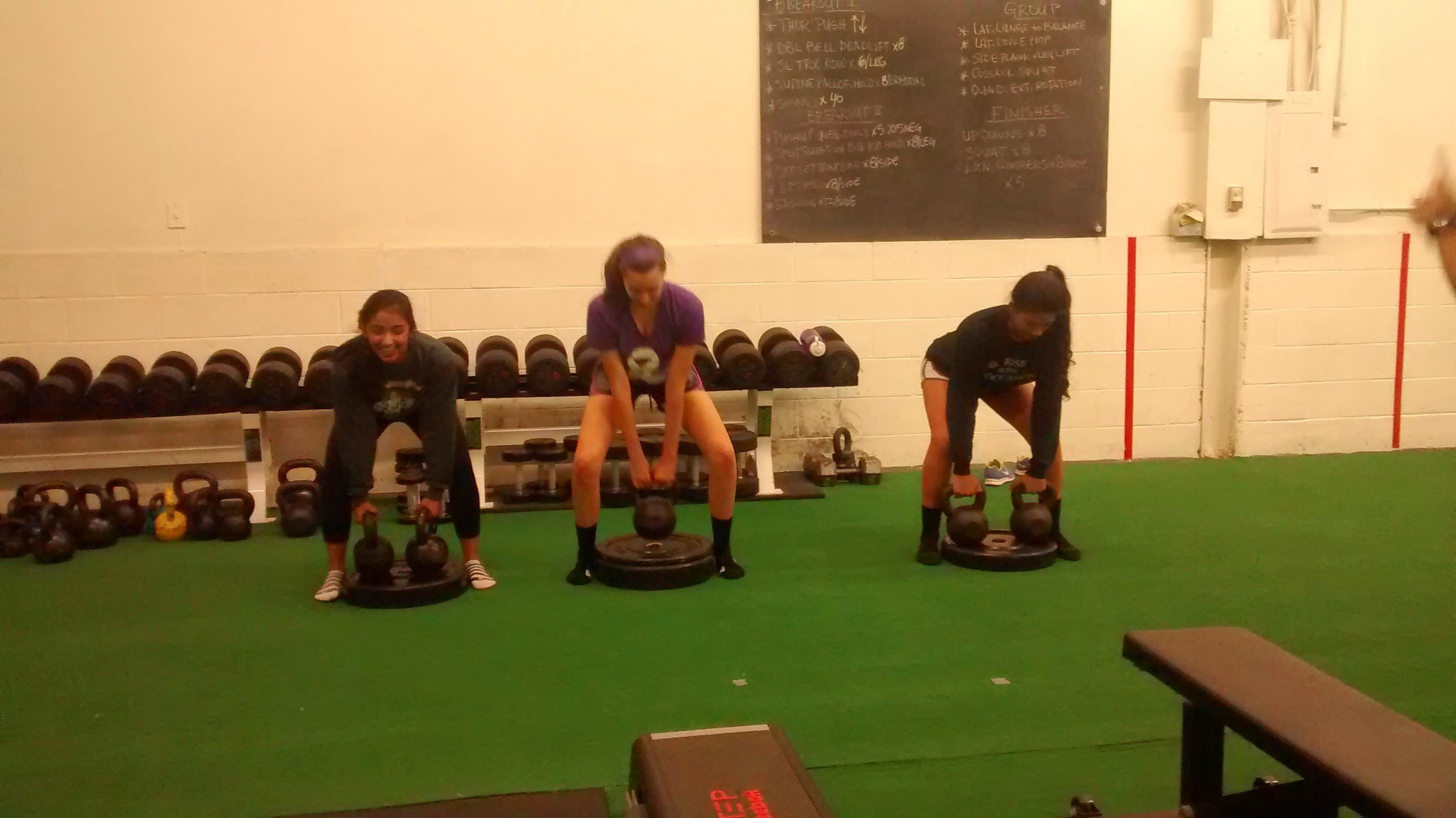
As coaches, we need to be aware of this information and freakin' do something about it. If your athletes aren't strength training, they're only getting weaker as the season progresses. This increases their risk of sustaining an injury and increases their recovery time. If you don't have access to a facility, ask us- we can help!! We can come to you. We also have a distance training option: we can send you the programs to incorporate with your teams. Our passion is to make athletes stronger and prevent injuries such as concussions.
For example, a while back I wrote up two training circuits for one of my volleyball players who had two concussions in a row. Note: A "chin tuck" is pulling the neck into a neutral position by pulling the chin back as if you're making a surprise face.
Circuit A:
1. 4-way neck ISO holds, lying on ground*
- Supine neck flexion x 10 with :03 hold
- Lateral neck flexion, left and right side x10/side, :03 hold
- Prone neck extension x 10, hold :03
2. DA Band Row x 8, hold :02
3. Scapular Wall slides, head against wall x 12, hold :01
4. Quarduped Chin Tuck and hold x 8, hold :02
5. Side Plank with chin tuck x :30/side
6. DA Farmer walk x :30-:60
Repeat 3-5 times through
Circuit B
- Towelor Band-Resisted 4-way Neck ISO holds, forward, back, left, and right x 10 each :03 hold
- Facepulls with external rotation x 10
- 3 Pt Row, ensure chin is tucked, x 8/side, hold :01
- Banded Ws x 12
- PUPP with chin tuckx :30-:60
- SA Farmer walk x :30-:60/side
Repeat 3-5 times through
* As neck is strength improves, increase ISO hold to :05, then :10.
Incorporating drills such as this, even if it's only in the warm-ups, would go a long way to strengthening necks. Also, Jarrett wrote a great article on concussion prevention techniques that are more generalized.
Bottom line: GET. STRONGER. Strong people are harder to kill and are more useful in general. And seriously, ask us, we can help.
Quick Thoughts on Chewing Gum While Training
Recent research within the field of human movement has put more of an emphasis on the temperomandibular joint and its global affects to the body. Elite athletes have started utlizing neuromuscular dentistry to create mouth-pieces to hold their jaw in the precise spot to hold the jaw for maximal power output, performance and repeated maximal efforts. Studies have also shown that the extra stabilization provided to the TMJ of any mouthgaurd can actually decrease the likelihood of concussions. And of course, I can't forget the recent articles that have talked about the muscles of the jaw and their relating to posture, neck stability/position and weight shift patterns.
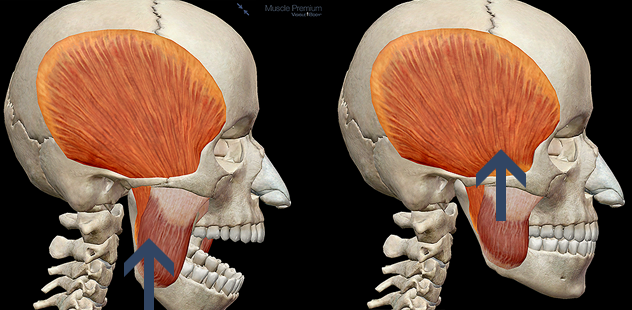
With all this hub-bub buzzing around, I think it's important, as a coach, to take a look at the information and apply it. My main thought was, "how does gum affect this?" I know this sounds silly, but the evidence is there..
Chewing gum creates a dynamic position of the jaw, always moving and never symmetrical as the gum stays to one side. This can not only create a fixation that, after enough repetition, it may have an impact on neuromuscular control. It can also inhibit certain cervical stabilizers to engage during the movement. Of course most people are going to chomp down and clench that trident as they pick up heavy things, but even this can cause the TMJ to be slightly out of position and possibly affect the head position and recruitment of stabilizers within the frontal plane. And as the information from the neuromuscular dentists has told us, this can impede training.
Though this may seem like a minor detail, it's a detail that you can control in your weight room. With TMJD on the rise in the general population, I think separating any jaw fixations from our training is a detail that we can't just ignore. Some people may claim that gum actually helps their training, but for these people, I would argue that they probably have some compensatory patterns that the clenching is feeding. I'd be willing to bet that these are the same folks that grind their teeth at night and get tension headaches near the tempal.