Wave Loading for Strength and Other Awesome Gainz Part 1
As promised from last week's post, I planned on discussing some of the strength methods I used in programming for Amanda's powerlifting meet. If you're looking to get stronger, bigger, and fast, wave loading will rock your world!
We're going to jump right into the meat and potatoes.
What IS Wave Loading?
Simply it is a fluctuation of volume and intensity (i.e. number of reps and load used) from set to set during an training session. Key point: volume and intensity have an inverse relationship; as volume decreases, intensity should increase. So if I'm performing 5 reps, I should use a lower weight than if I were to perform 3 reps.
Standard sets, by contrast, use the same weight across the board. For example, I perform 3x5 squats for 100lbs for all three of my sets- those are standard sets. This will make more sense as we go along.
What are the benefits of wave loading?
Wave loading exposes the body to higher weights more frequently, which is more specific to strength building (think progressive overload). Depending on how it's utilized, wave loading can be used to increase strength, increase muscle size, or increase muscle speed. Pretty versatile, no?Not only that, but it creates neural dis-inhibition.
Whoa, Kelsey, what does that mean?
An easy way to think about it is you're tricking your body into using heavier loads, more reps at a given load, or moving the same load faster. The nervous system puts on the "brakes" on the muscular system, for good reasons often, but sometimes, the muscles need to tell the nervous system that, "Hey brain, we got this." Wave loading helps the muscles communicate this.
Another analogy: let's say you go to the pool on a super-hot summer day. That water will seem chilly when you first dip your foot in, then your leg, then up to your hips, (good gracious, it's cold!), until finally you dunk your head under the water. Once you do that, the water seems fine. You just had to tell your nervous system to adjust to the perfectly-fine temperature. Wave loading is like that: it tells the brain that the muscles can in fact more that weight and it can ease up on the brakes.
Wave Loading Methods
To avoid a marathon post, I have just two methods for today and we'll go over the third on Friday.
Single Wave Loading
- 3-5 sets
- Know that if you go from high--> low reps it will be more for muscle strength; from low --> high reps is more to muscle size.
- Any reps over 6 reps, and you'll want to make jumps of 2 reps (i.e. 8 to 10). Any reps under 5, will typically be 1 rep jumps (i.e. 2 to 3). However, these two points are by no means set in stone: I personally love 5, 3, 1.
Sample sets/reps:
3 sets, 6, 4, 2 reps (strength emphasis)
1x6 @ 100lbs
1x4 @ 110 lbs
1x2 @ 120lbs
4 sets, 1, 3, 5, 7 reps (muscle size emphasis)
1x1 @ 225
1x3 @ 215
1x5 @ 200
1x7 @ 185
Multiple Wave Loading
- 2 waves; rarely exceed 3
- Usually it's a decrease in reps
- Usually performed with less than 6 reps
- 1-3 rep jumps
- Less change in reps = less change in weights
- 2nd wave is usually done at a high load than the 1st wave
- Best used for intermediate and advanced
Sample:
5, 4, 3, 5, 4, 3
5 @ 200
4 @ 210
3 @ 215
5 @ 205
4 @ 215
3 @ 225
3, 2, 1, 3, 2, 1-- for a more advanced trainee
3 @ 275
2 @ 285
1 @ 295
3 @ 285
2 @ 295
1 @ 305
Closing thoughts (for now)
Respect the low reps! Don't max out on every session, or really, even come close. You should be moving heavy weights, but not so heavy that your form breaks down on your 3 set.
Rest a bit longer between sets than you would normally: 3-5 minutes is about right.
If you use the multiple wave method, decrease your accessory work as the volume on your main lift will be pretty high.
Check back in on Friday and we'll continue the Wave Loading knowledge!
It's Not Just About the Pills- Doctors Learn More About Culinary Medicine
I heard a great story on NPR the other day about doctors attending culinary medicine classes at Tulane. You can hear it HERE.
I have several friends who are/were in med school and they said the amount of information regarding nutrition was abysmal. Granted, med school is like drinking from a firehose: doctors have to absorb and regurgitate an obscene amount of information. This isn't a jab at the smart men and women who apply themselves to the medical field.
The opening line of the story sums it up well:
“When it comes to premature death and disease, what we eat ranks as the single most important factor, according to a study in JAMA, the Journal of the American Medical Association. Yet few doctors say they feel properly trained to dispense dietary advice. ”
The fault, in my non-med school opinion, lies with the curriculum taught at most (if not all) med schools; particularly, as the NPR story points out, because there is a "tsunami of obesity and diabetes" in which food can be either the medicine or the poison.
As a non-medical professional who works in the health field, my training primarily is in performance and nutrition. I whole-heartedly agree that doctors need more training in those realms. I'm certainly not a silly person who eschews modern medicine, but I do believe if there was more education regarding the impact that diet had on health, we would see a decrease in chronic disease as doctors would feel more comfortable addressing that aspect of patients' lives instead of prescribing medications. I've worked with and helped numerous people feel marvelous just by tweaking their diet. If you haven't read The Ron Reed Project, you should. (Note: the point of the article was to show his fat-loss accomplishment, but his cholesterol went down, his glucose numbers were great, and all the other blood markers that doctors check passed with flying colors.)
I've mentioned it before, my husband and I both have Lyme disease and have been in treatment for nearly a year now. Yes, we're both taking the pertinent medications to support our bodies and fight those pesky bacteria, but do you know what the first thing our doctor did? She looked at our diets, exercise habits, and sleep habits. We both had dietary changes to make to better support our battle-exhausted immune systems (and she commended us on our exercise habits- our profession calls for no less!). While those changes weren't a magic bullet, I do believe that they helped reduce the overall stress load and allow our bodies to fight more efficiently along with the medications.
I think it's fantastic that Drs. Oyola and Maker-Clark are heading up this pilot program; step by step and hopefully we'll see a shift in the medical education community! Next task will be education doctors in the benefits of strength and conditioning...
SAPT Summer Updates!
I hope your Thursday has been as busy as ours! The summer is in full swing here at SAPT and there's no sign of us slowing down anytime soon! Below are some of our highlights thus far.
- We just finished the first week of our new group fitness class, Happy Hour! The class is fast-paced and guaranteed to help you lose fat and work towards that rockin' body you've always wanted! Open to adults of all ability levels, we've structured the class to provide exercise variations for everyone and your first class is FREE! Individualization en masse! George Kalantzis, Cressey Performance's Group Fitness Instructor, just put out a fantastic blog post geared towards creating effective fitness classes. Check it out here.
- I'm not sure if you've heard, but we've infiltrated McLean! We're working out of Cypress Fitness and helping folks just like you get bigger, faster, and stronger! We've already served 26 sessions this week, more than doubling our week 1 numbers at our old Tysons facility. What are YOU waiting for? Book your evaluation today!
- The end of the spring sports season brought great performances out of some SAPT athletes. I've gotta give a huge shout out to Madison Pitcher Brian Eckert for helping his team with the 6A State Title. Also huge props to All-Met and two-time state Player of the Year Mitch Blackstone, as well as golf-standout Shannon Brooks on their amazing seasons! Brian will be pitching at Radford next year, Mitch will be catching at Cornell, and Shannon will be a Lady Volunteer down in Knoxville Tennessee!
- Mark your calendars for our 1st Ever Client Appreciation Barbeque! We'll be grillin' n chillin' at Providence Park Pavilion on July 25th from 1:00PM-5:00PM. We'll be celebrating our amazing clients and our 8 year anniversary at the same time. We'd love for YOU to come! Contact Coach Charlie at Charlie@saptstrength.com for more details!
Narrow-Stance Sumo Deadlift Form
One of the things that I find my distance clients tend to have trouble with is getting their deadlift form down without the help of a coach. Obviously you can never replace the feedback from a live coaching session, but if you stay objective about what you're doing, you can still have a pretty pull. Check out the video below as I delve into what I mainly look for when narrow-stance sumo pulling and common faults that I usually see.
P.S. Sorry for the vertical screen. Blame the camera man.
Decompressive Roll Progressions
Are you or your athletes stuck in a stat of extension in the lumbar spine? Then you may be a good candidate for decompressive roll variations to help allow better core. Check 'em out!
The Valsalva Maneuver and Shearing Forces
Yesterday one of my softball girls was deadlifting. She came up to me mid-session and told me that everything felt fine on the way up, but things were feeling real wonky on the way down.
I walked over to take a look at her form and see what was going on. To the untrained eye, her deadlift was on point. She was pulling sumo-style, with her knees set up right above her ankles. She was taking a deep breathe, bracing, and keeping the bar close to her body on the way up and on the way down. She wasn't squatting the weight and was actually performing a fantastic hip hinge and using her posterior chain to lift the weight. If everything was right, why did it feel so wrong?
This girl was pretty strong. She's been training with us for quite a while and was no stranger to deadlifts, but she was just coming back from her season and hadn't been as consistent with her strength work. With that comes some rustiness. I noticed she was exhaling pretty forcefully at the top of her lift. Essentially, she was losing the brace she was working so hard to attain at the beginning of the lift.
I told her everything looked great, but that she needed to pay attention to her breathing and wait until the weight was safely on the ground before she exhaled. She took the advice to heart, and badda-bing-badda-bang, everything felt good again. The Valsalva Maneuver at it's finest.
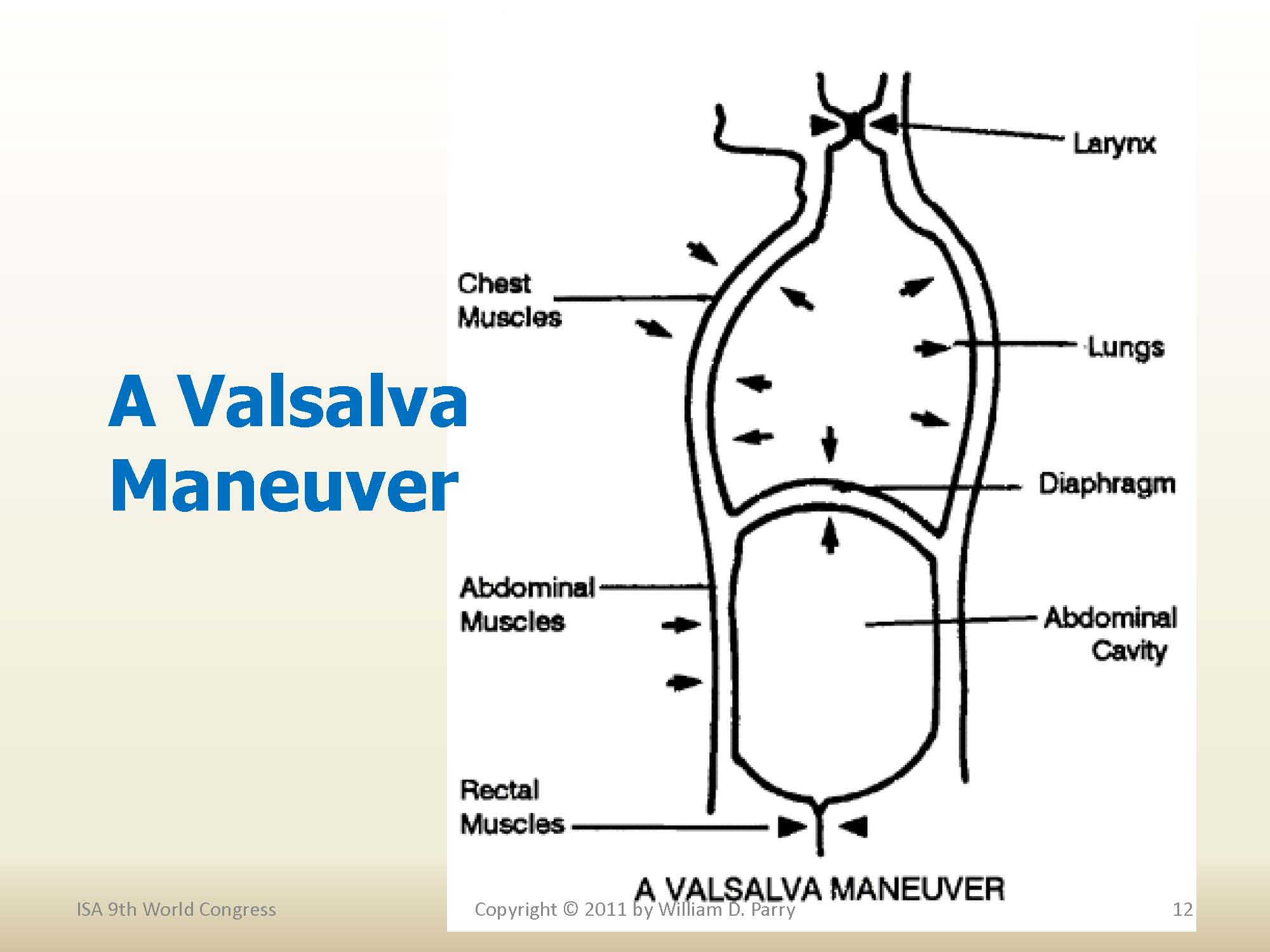
The Valsalva Maneuver
The Valsalva Maneuver is a technique that should be employed for most of the compound, multi-joint movements, especially heavy squats and deadlifts. This technique entails filling your lungs with air, which creates a large amount of intra-abdominal pressure, and holding it while performing the lift. It's an incredibly important concept to master and we include bracing drills early on in our clients programs to help teach this. Performed properly, it should also feel like you're constipated and you're trying to push it all out the bottom end. It's always entertaining teaching the valsalva maneuver to a new client after I've had lunch, as it usually includes an unexpected fart or two...
During squats and deadlifts, the force of the weight and gravity is constantly trying to rip you apart. The goal of strength training is to resist these forces and make you a more resilient human being. There are a total of 76 joints in your spine and pelvis, the skeletal core of your body that craves stability if you are to perform optimally, which experience a mix of compressive and shearing forces while under load. These shearing forces were the king of the show in yesterday's deadlift session.

As you can see from the depiction above, shearing forces are forces that act on a joint parallel to the joint surface and attempt to cause the joint to slide out of position. The valsalva maneuver counteracts these shearing forces by exerting pressure on the joints to resist displacement. Our athlete in the above scenario was achieving a nice, tight brace at the beginning of the lift, but was expelling all her air at the top, losing this spinal stability and allowing the shearing forces to take over on the way down. By cuing her to hold her brace, she was able to maintain this intra-abdominal pressure, thus maintaining spinal stability throughout the movement.
Keep this in mind the next time you experience back funkiness while performing your deadlifts. Are you bracing? Are you maintaining that brace throughout the entire movement? As usual, the devil is in the details.