WOW: Week of Workouts 2/27/18
Love the barbell? This Week of Workouts is for you!
WOW: Meathead Edition
Just kidding, barbells do not equal bulk or somehow indicate lack of intelligence. The below week of workouts is appropriate for someone already well versed in barbell use. Have fun!


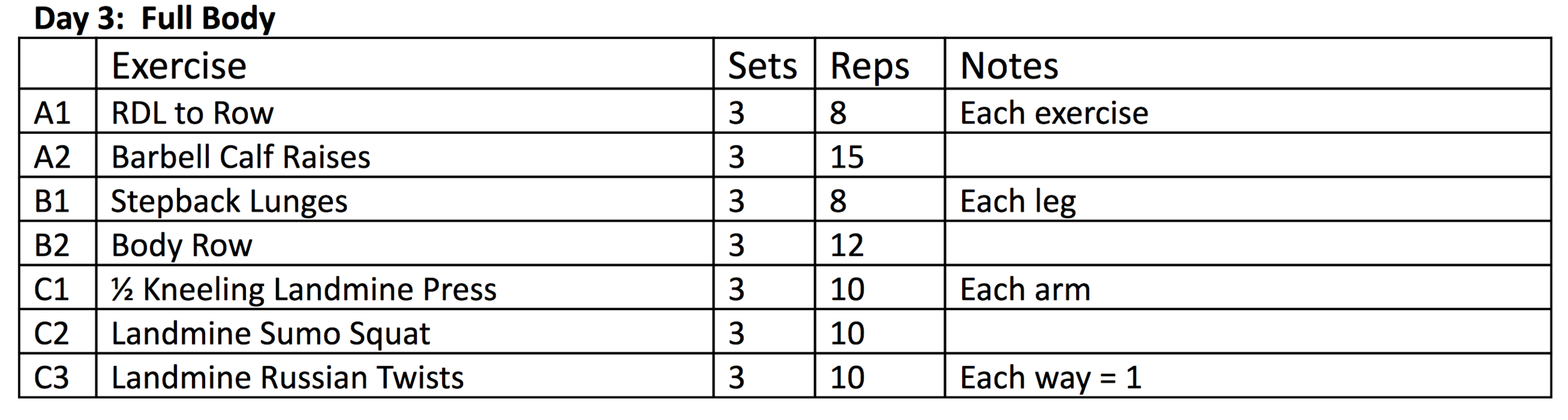
Here is week 3 of the 8-week conditioning program. If you are interested it giving this a try, head on back to Week 1 to get started!


Enjoy and let us know if you have any questions or need a form check!
WOW: Week of Workouts 2/20/18
Check out a week of Push/Pull style training, plus, your second week of conditioning.
Here's the new week of workouts. This week's strength training is focused on a Push/Pull style template.
Push/Pull is utilized by everyone from athletes to body builders and can even be found in a rehab setting. It's popularity is due, mainly, because of how efficient it makes the training session. Another great byproduct of the pairing of exercises is an improvement in general fitness.
Using a push-pull style will allow you to perform exercises in the same set without making the muscles too fatigued. For example, a bicep curl (pull) and a tricep extension (push) would be paired together to maximize the repetitions and muscular time under tension, without exhausting one muscle or the other.
Without further delay...


This week's conditioning is going to be done on a field or track and you will need a stopwatch and markers for each day. This week we will be adding more plyometric work in in the form of heiden and broad jumps.

This is a tough week! If you finish up and realize you're in need of some Movement Therapy, please check out SAPT coaching alum Jarrett Brumett! Jarrett will be in at SAPT this Saturday offering one-on-one sessions. Jarrett has been described as a miracle worker by many (I'm serious) and can often find mechanisms of injury or pain when all others have failed. If this describes you, please reach out to him!

Enjoy and let us know if you have any questions or need a form check!
WOW: Week of Workouts 2/13/18
At-home strength training and fitness conditioning for all!
Today we have started a project I've been wanting to get going for awhile now: giving away free training programs!
Here is the first installment...
This week's topic for strength work is an at home program. Having a tight schedule can make it tough to find time to go to the gym, so why not bring the gym to you? I do this all the time! All of the exercises in this series can be done with little to no equipment and should not take very long.


This week of conditioning should be done on a field or track after the warm up and finished with the cool down. These workouts can be for anyone, but we would especially encourage those participating in sports to try these to find a new way to stay in shape!
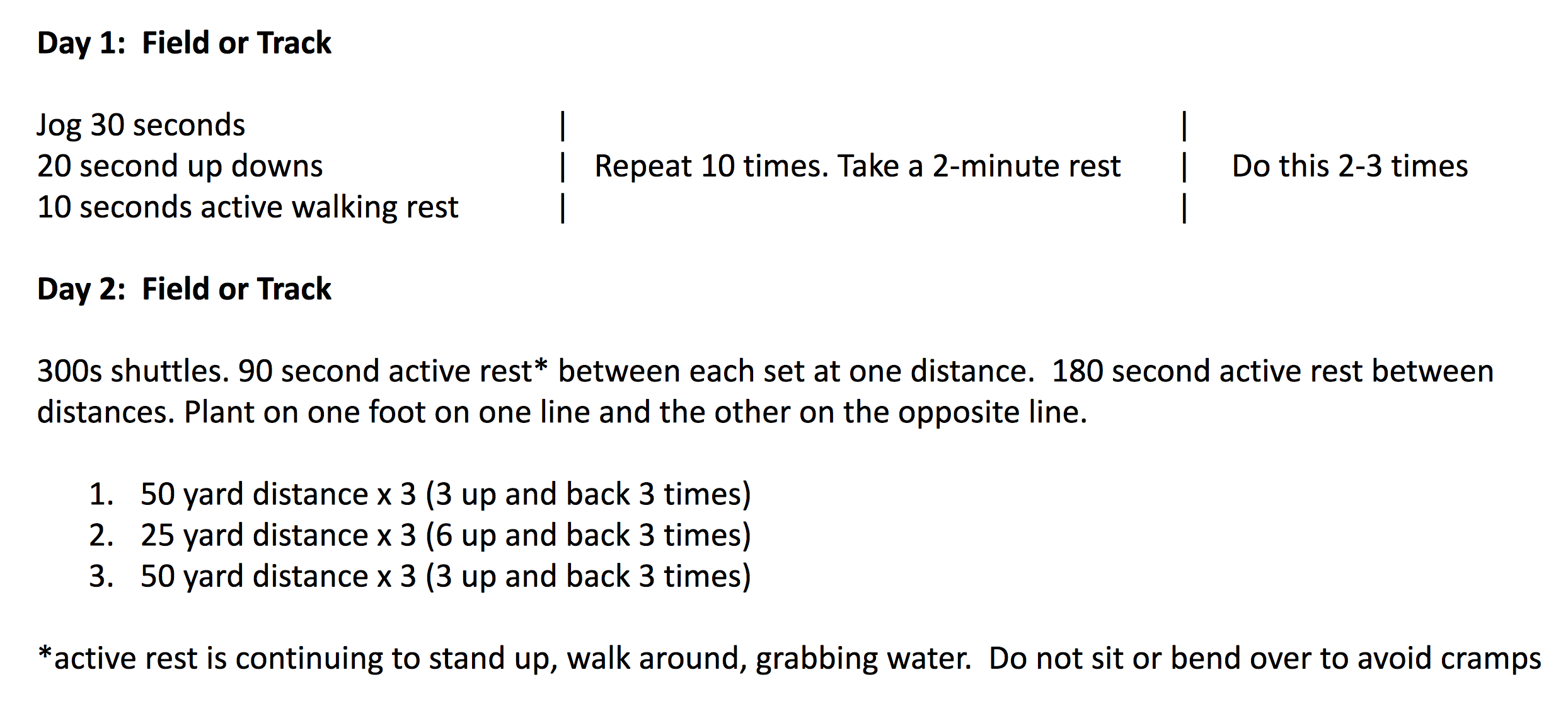
That's it! Have fun and please reach out to let us know if you have questions on form or if we can help in any other way.
Too Young to Train? When should children begin structured performance training?
Tips on getting young children off to a successful start in their formalized performance training.
When should my child...? Is my child ready to...? I'd like my child to work on...
Those are some common lead-ins to the ultimate idea of: "My kid is pretty young (6-9 years old) and I am seeing a need for some formalized performance training. Am I crazy? Can you do this? Is it safe?" Are sometimes the follow-ups.
Yes, children in that age range can absolutely start a structured performance training plan. It is safe. However, unless your child has a real need or is super motivated for structured training, I would encourage you to try gymnastics, parkour, or other sports before committing to a performance plan.
What and who should you look for?
Look for a facility that specializes in training for children under age 10 or 11. And look for staff members and coaches who have lots of experience working with young children.
Look for a big emphasis on fun, guided discovery, and inquire about how the structure changes from age 6 up to age 10 or so.
Generally, females aged 7-8 are ready to start as they have the mental focus and body control for a full training session. For boys, usually it's age 8-9 when they are ready.
The sessions do not need to be a full hour - probably around 45-min is ideal. Because this is not a sport with breaks for talking about strategy and technique, the sessions can be very tiring because they are so focused.
Here is a sample template that can be used for any young child (scaled appropriately):

Sample performance training template for 6-9 year old children.
With some common sense applied to these sessions (mostly remembering the trainee is a very young child), they will be fun and productive for everyone.

Top 5 Reasons Injury is an Opportunity
Coach Sarah Walls gives her Top 5 reasons injury is an opportunity for athletes.
No athlete ever wants to be injured. But hey, it happens! Once you get past the initial pain and frustration, you'll notice there are huge opportunities that any injury provides. If approached with a positive mindset - one that searches for “the silver lining” - the athlete can exit the recovery process healthier, stronger, fitter, and faster than ever.
Let’s take a look at the top 5 massive reasons injury is an opportunity:
- Get Bullet-Proof! Well, not literally. But improving an athlete’s injury risk profile is a nice benefit to the time off from regular training. For example, let’s say the injury is a lower-back strain. But in this same athlete, there is also a history of weakness in the hips. That means that the injury is a great time to get Bullet-Proof by addressing the weakness alongside the injury. Hint: most injuries are, eventually, traced back to these weak links.
- Physical capacities. This is a chance to reset and spend time working on some base level physical capacities like aerobic fitness, total body strength, and overall improvement in physical preparedness.
- Movement efficiency. Most athletes could use fine-tuning, if not complete overhaul, on things like jumping mechanics, change of direction efficiency, bat swing, shot mechanics, etc. An injury is a great time to rebuild mechanically in areas of need. There is no pressure to perform these skills live, so the ability to practice technique over and over can be extremely productive and refreshing.
- Psychological and emotional resiliency. I’ve found that when things are NOT going my way that seems to be the best time to see what my current ability is to handle stress. In this case, the injury again affords the athlete time to work on themselves psychologically. This can be with the direct help of a sports psychologist or mental coach or through the learned discipline that comes from showing up to rehab and reconditioning every day only to be challenged and frustrated during the grueling process that IS coming back from injury.
- Tactical awareness. Take out your play book, fire up YouTube, keep ESPN on, watch practices, etc. Get better at the tactical driven aspects to your sport.
For the hurt athlete, injury should never be viewed as a time to relax and check out. Even if you are a recreational athlete at the middle or high school levels, any injury is serious business that can affect your health for many years to come (or even a lifetime).
Instead of taking a mental and physical vacation, I recommend viewing injury as a brief timeout from regular training and competition and use it to stay focused and double-down on your efforts to improve every aspect of your performance. Then watch as it translates into a fantastic “next season” and shows up positively in other areas of life, too.

Thank you to the book High-Performance Training for Sports for the inspiration and guidance on writing this post.

Wrestling: What NOT to Do in Pre-Season
Wrestling season is right around the corner. Are you doing any of these "don'ts"? Learn some best practices for a successful wrestling pre-season.
This is a guest post by Hunter Hautz. Hunter is a coach intern at SAPT with an extensive background as a wrestler.
Ah, wrestling. The start of the season is just around the corner. All the high school and college athletes have been plugging away with lifting and conditioning and are preparing for live drilling that will start soon.
Whenever I think of pre-season for wrestling, I remember feeling the same way for every single
one: TIRED. We always trained too much during this time, never really knowing what we were
doing, just doing as much as we could to get ready - always operating under the guide of MORE IS BETTER.
We know better now, much better. More is NOT better. In fact "more" only for the sake of itself, can be very destructive. My most successful came after not falling into that trap and when I started learning how to work smarter, not harder.
With that in mind, here are a few tips for to optimize success during pre-season preparation to keep you or your wrestler strong and healthy.
1. Setting Priorities
The most important things to focus on at this point are your wrestling skills. Let me repeat that in
case you’re like me and got slammed on your head too many times. THE MOST IMPORTANT
THINGS TO FOCUS ON CLOSE TO AND DURING THE SEASON ARE YOUR SKILLS. Don’t
forget your goal for all of your training is to become a better wrestler. This means that the most
important thing to focus on is…….. Wrestling.
2. Start Losing Weight Early
If you’re a high school wrestler and are 15 pounds or more over your desired
weight class and don’t have much fat on you, move up a weight class. If you want to move down
a weight class, and are in a healthier range (5-15 pounds max), you need to start losing that
weight starting during the summer. Eating a little less and losing as much bodyfat as you can
will make you a lot healthier and happier come time for the season to start. Planning that far
ahead means you will have to cut much less weight, if any at all when the matches start.
3. Cut Weight Smarter
Ideally there would be no need for cutting weight in wrestling, as it decreases performance and
increases injury risk. However, for now it is a part of the sport so we want to make it safe as
possible for the athletes. I will say again, if you are over your weight class by more than 10-15
pounds, just move up a weight class. Losing more than this will affect your health, if
not now than later - as in my case.

If you are in a “healthier” range, the safest and easiest way to cut is to use water-loading and sodium management. This method doesn’t require any extra training, which when done in a dehydrated state can cause more damage to the body and there is a potentially higher risk for injury.
A sample template for dropping weight via water loading would be 5 days in length and would vary slightly depending on whether the match was during the week or a weekend tournament. Five days out from a match, the wrestler will start drinking 1.5-2 gallons of water a day depending
on their weight. This is done 5, 4, and 3 days out from the match. Two days out they drink half of
the amount from days 5, 4, and 3.
The day before they will just sip a little bit of water throughout the day, to drop the final ounces of weight before weigh-ins in the morning. Sodium would be limited the last 3 days before so as to not retain water. After weigh-ins have the athlete drink a sports drink or electrolyte replacement drink to help rehydrate the water they lost from their cut. After the initial 32-
48oz of a sports/electrolyte type drink they can switch to a 1:1 mixture of this and water so as to
not upset their stomach and cause too much bloating.
4. Don’t stop training
Some wrestlers stop lifting close to and during the season because they don’t want to get
injured or are too lazy because practice is so hard. This is almost just as dangerous as
training too much. All the strength and conditioning that was gained during the offseason that can help prevent injuries will be lost very quickly if training isn’t maintained.
The great thing about this is that maintaining strength, conditioning, power etc. is much easier once you already have it, than it was to build in the first place. Training 2-3 times per week at a lower intensity and volume will help the athlete hold onto the improvements made during the offseason and let that work transfer over into the postseason.
Common Sense
Just because wrestling is insanely hard, does not mean the sport gets a pass to foster poor decision making and the development of damaging habits. Keep your head on straight while you are training and if it doesn't feel like a solid decision, it probably isn't, so change course a bit.