Avoid Fatigue, Improve Your Sleep, & Manage Body Weight
By being aware of two things – 1. That your body has a pH, and, 2. That you should be striving to achieve pH balance – will help your body to avoid and manage stress more effectively while helping you to stay full of energy, have restful nights sleep, and manage your weight.When an acidic environment is sustained in the body (via diet and external stressors), health is affected as deep as the cellular level. Once this becomes the “norm” for your body, daily fatigue will exist. And because an acidic environment is a stressor in and of itself, cortisol levels will then rise and that will impair sleep patterns… so, now you’re fatigued from a poor diet and can’t even get a good night’s sleep. And if all this weren’t enough reasons to make a change, here’s the long-term bad news: acidic diets/bodily environments play a huge roll in America’s obesity problem AND will basically open the door and usher in disease into your body!
What should you do to improve your body’s pH profile? Take a look at this chart and start eating lots of foods from the alkaline-forming columns while making an effort to minimize/reduce/balance-out the acid-forming columns.
Highly Alkaline-Forming
Alkaline-Forming
Neutral
Slightly Acid-Forming
Highly Acid-Forming
Asparagus
Squash
Flax seed
Adzuki beans
Commercial breakfast cereal
Beets
Sweet potatoes
Hemp seed
Black beans
Pasta
Bell peppers
Amaranth
White chia seed
Black-eyed peas
Refined wheat flour
Broccoli
Buckwheat
Coconut oil
Chickpeas
White rice
Carrots
Millet
Macadamia nuts
Lentils
Beef
Cauliflower
Quinoa
Walnuts
Pumpkin seeds
Pork
Celery
Wild rice
Buckwheat flour
Sunflower seeds
Poultry
Chicory
Sesame
Agave Nectar
Brown rice
Shellfish
Cucumbers
Apples
Dried Herbs
Oats
Butter
Dill
Avocados
Miso paste
Spelt
Cheese (all types)
Dulse
Bananas
Spices
Chickpea flour
Cream
Green beans
Berries
Hemp flour
Milk, pasteurized
Leeks
Cantaloupe
Cold-water fish
Artificial sweeteners
Mixed Greens
Cherries
Venison
White sugar
Onion
Dates, Figs
Wild game
Candy
Parsley
Grapes
Milk, raw, unprocessed
Coffee
Peas
Nectarines
Synthetic multivitamins
Margarine
Sea Vegetables
Oranges
Peanuts (roasted)
Zucchini
Peaches
Prescription drugs
Stevia
Pears
Soft drinks
Gingerroot
Persimmons
Soy protein isolate
Green tea
Pineapple
Whey protein isolate
Fresh herbs
Pomegranates
Rooibos
Flax Oil
Yerba mate
Hemp Oil
Pumpkin Seeds
Almonds
Coconut
Peaches
I’ll leave you with a bit of – as a professor of mine always said – “Cocktail Trivia” - Did you know that it is impossible for cancer to form in an alkaline environment? Think about it.
Friday Distractions
I found some great reads this week about everything from how training changes your genetics to why you shouldn't make your kids finish their meals. I've also made an effort to keep your interest by adding in some "Friday" related images from a Google search (and, believe it or not, these were actually the best ones...): With all the current discussion about minimalist/barefoot running style shoes, Runblogger points out that the best approach to finding the right fit for your feet is an individualized one: On Human Variability, Running Shoes, and Running Form: The Importance of an Individualized Approach.
Sweat Science brings amazing quality - as always - here are several fascinating posts I encourage you to check out: Training Changes Your Genetics (or rather, epigenetics), Is Leisure Time Physical Activity Irrelevant?, and Good Diet Trumps Risk of Heart Disease.
Science Daily has a post on a study that links the number of Facebook friends one has with the number of real world friends and the size of a certain region of the brain. I wonder what it means if you don't have a Facebook account?... I'm pretty skeptical about this one, but it's a fun read: Number of Facebook Friends Linked to Size of Brain Regions, study suggests
Lastly, an excellent post by Maryann Tomovich Jacbosen for Fooducate: The Annoying Kids' Eating Habit Parents Should Adopt. In this post, Maryann points out how children are naturally excellent at regulating their own caloric intake and that skill is lost over time as parents often encourage their children to ignore feelings of satiety and "finish everything on your plate."
Fall sport athletes, consider this!
If you’re in the midst of grinding through the back third of a fall sport season, the following provides some quick ideas about how you can hasten and improve your rate/quality of recovery between competitions…and generally just stay healthy! -Don’t forget to eat
You must make eating a priority. I remember teammates losing 10-15lbs throughout a competitive season. Coincidence that these same guys were the one’s always nursing something in the training room? They blamed travel, lack of quality food on the road, etc. for their dramatic weight loss. Yes, while these variables did make finding the time for frequent-quality feedings more difficult, it’s certainly possible if you make eating a priority.
I used to pack “road coolers.” I’d stuff that sucker full of fruit, veggies, trail mixes and sandwich accoutrement. Safe to say my processed and fast food consumption was significantly less, meal frequency much more regular, and weight fluctuation less drastic, as compared to my peers.
-Sleep
Becoming regimented with your sleep is also extremely important. It’s important that you try to hit the sack at the same time every night, while shooting for 7-9 hours of uninterrupted sleep. This too was challenging as Madden wars or Poker hands (not for money of course…settle down) sometimes impeded on my desired hour of retirement. For me, melatonin, sleep mask, and a quality set of ear plugs always did the trick.
High-school guys and gals, you have no excuse for this one.
-Soft tissue work
Whether it’s self-inflicted (foam rolling), or delivered manual by a therapist (you can’t beat this), you got to find time to address tissue quality. Restrictions within the musculature will severely impede proper blood flow (and subsequent delivery of nutrients), and also prohibit proper movement patterns. A little bit of preventative maintenance in this area will go a long way, trust me.
-Low intensity cardio/mobility/activation drills
All of these can be accomplished in the same 20 minute session. Blending these components will not only aid in flushing toxins and delivering new nutrient rich blood, but will also help ward off mechanical asymmetries that can crop-up from overuse and the repetitive nature of sport.
It’s important not to overreach during these sessions, as the intent is to aid in recovery, not cause greater disruption. A perfect session might include various sled pulls, crawling variations, hip flexor and thoracic mobility drills, and some glute activation.
Hope this helps…
Chris
Personal Update: I'm Getting Hitched
So, as a number of you know, I'm currently engaged to the love of my life, Kelsey. And, this Saturday, we are officially tying the knot! We'll be heading up to Boston for our honeymoon to enjoy the city, on top of training/talking shop at Cressey Performance (the co-owner, Tony Gentilcore, actually played a major role in my proposal to Kelsey last March). I'm pretty stoked to say the least, as I haven't taken a vacation in over two years now. Not to mention, we'll have a chance to have someone else coach us and write our programs for a change, train alongside many other like-minded individuals, and enjoy one of America's coolest cities during my favorite time of year (Fall). All this on top of the fact that I get to share it with my best friend.
And I'm not going to lie, I'm pretty darn proud that my bride-to-be can team up with her man to pick up heavy things off the ground without breaking a sweat. See the team deadlift photo below:
 (thank you Ryan for coming to the rescue with the photo)
The best part about it was, upon setting the weight down, Kelsey turns to me, shrugs, and goes: "Meh, I say we definitely have 500 in us next time."
And yes (boys I'm talking to you), my lovely soon-to-be-wife is stronger than you. Not to rub it in or anything.
Anyway, all this to say I'm unfortunately going to need to take a hiatus from writing for the next week. I am, admittedly, a borderline workaholic and I've made a covenant between me, myself and I to refrain from anything work-related while I'm gone (not that I really consider writing to our loyal readership "work" per se, but it will be nice to relax away from the computer screen for a change). Not to fear, though! You will still get to read awesome content from Sarah and Chris as you usually do each week, AND coach Ryan may even make a celebrity appearance, so be sure to stay tuned.
I really can't thank everyone enough (primarily my family, friends, and the SAPT family) for all your support through this process. Looking forward to seeing you all shortly!
I'm Ready to Admit a Few Things
I wanted to give an update to my plant-based dietary efforts this week and also thought there were a couple other things on my mind worth acknowledging/admitting to. Thank goodness people tend to become wiser as they get older…
- Plant-based diets do not make you stronger, that’s for sure. BUT, they do keep you healthy and help you maintain a healthy body-weight. I’ve been eating a plant-based diet for about 18 or 19 months now. I won’t call myself a vegan or a vegetarian as that’s not completely accurate, but I will tell you that I consume animal products (dairy, meat, poultry, pork, etc.) only about 2% of the time. Here is what I’ve learned:
- Plant-based diets always get big criticism for their cost, well, let me tell you we spend about 35% less at the grocery store each week than we used to. When you’re not buying family packs of chicken breasts each week, plus all the other animal protein products, your grocery bill takes a nose-dive. We used to spend around $100/week on groceries and now we average between $50-70/week.
- I eat copious amounts of carbohydrates and maintain a lower body weight than I have in about 10 years. Read into the details there however you want, but I have zero cravings as compared to the way I used to eat (high protein, moderate fat, low/moderate carbohydrate).
- I’m reducing my risk of a variety of diseases – cancer being the most notable. Cancer risk has been (via credible research) linked to the consumption of animal products, especially dairy. The cancer reason is 100% why I started this endeavor in the first place as cancer has left its mark on my family.
- You can also reduce your risk of a variety of diseases by eating lots of plants and lean meats.
- Here’s the biggie: MY STRENGTH LEVELS ARE NOTABLY LOWER than they were before I embraced this dietary lifestyle. Initially, I thought this was a pregnancy by-product issue, but Arabella is now 16-months old, so clearly, that’s no longer the problem. Don’t get me wrong, I haven’t morphed into a weakling, I am usually the strongest female in any room (unless Kelsey is around…), just not by such a large margin anymore! Honestly, I’m not surprised I haven’t been able to gain strength, but I am shocked I haven't been able to come close to achieving pre-pregnancy strength levels.

- Speed squats and/or speed deadlifts triumph over Olympic lifts each and every day of the week in terms of the MOST efficient way to improve explosiveness and strength (I feel like I preach this at least once a week). But, if you consider yourself a strength coach, you better have an excellent knowledge base about how to implement all aspects of strength-speed training – and this includes the Olympic lifts.
- In the past (thankfully, this is years in the past) I may have been overheard saying something to the effect of “I don’t get it why parents always use their kids as an excuse for not getting to workout. Just commit the time.” And I guarantee whatever variation of this statement I actually used would have been laced with some pretty heavy cynicism. But, I will now admit – as a parent myself – that fitting training into the details of every day is quite a challenge. But, I often remind myself that while I'm training for a lot of personal goals, I'm also training to set an example for my daughter. I want her to see that training is an essential and healthy part of being a responsible adult and something I want her to learn to embrace over time. So, if you’re a parent who fits training into their daily or weekly routine, give yourself a pat on the back!

It's All About the Glutes
When Bret Contreras first wrote this article, I thought he was nuts - along with just about every other strength coach across America. After all, who spends over 10 years (that isn't a paid researcher) reading almost every study, article, or book ever written on the glutes, and hooks up electrodes to his own butt to measure which exercises elicit the greatest glute involvement?! Not to mention, very rarely had people ever trained the glutes the way that Bret suggested we should, and I am always skeptical when so called "new and improved" exercises hit the public. The basics have worked for centuries, and this isn't going to change anytime soon.
The point is that this series of experiments revolutionized the way that strength coaches train people's glutes today. Basically, we've had it all wrong for quite a while now. As Bret mentions in the article:
"Despite the fact that the gluteus maximus muscles are without a doubt the most important muscles in sports and the fact that strength coaches helped popularized "glute activation," none of them have a good understanding of glute training..."
"..And second, athletes' glutes are pathetically weak and underpotentialized. Even people who think they have strong glutes almost always have very weak glutes in comparison to how strong they can get through proper training."
The cool thing, too, is that there were real-world improvements in athlete's performance when coaches began to train the glutes the way Bret teaches in the article (I make a point of this because there are many things that occur in the "scientists labs" that don't actually pan out in real life scenarios).
It makes sense, too, as (noted in the article) the gluteus maximus muscles are heavily involved in some of the most important movements in sport: sprinting, leaping, cutting from side to side, and twisting (the "geeky" way to describe this is that the glutes function to produce hip extension, hip hyperextension, hip transverse abduction, hip abduction, and hip external rotation).
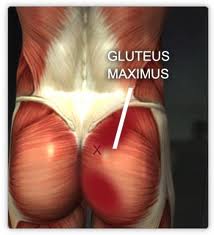
So, after reading (and scoffing at, initially) about the way we "should" be training the glutes, I gave it a shot. After all, if Bret was right, this would mean enormous advancements in improving people's athletic performance, low back health, physique enhancement, and quite a few other bonuses.
After spending about a year training my glutes with more focus than I ever had in the past, I was shocked with the results. Below are two staple exercises (after progressing appropriately) one can perform for stronger glutes: the Barbell Glute Bridge and the Barbell Hip Thrust.
Here's a 555lb Glute Bridge:
You can then increase the range of motion the glutes have to work through (thus having to lower the weight). Here's a 435lb Hip Thrust:
Now, it is imperative that one knows how to properly use his or her glutes to do these exercises. Otherwise, the low back will take over the force production, which is a recipe for injury. I often joke on bodybuilders for their touting of the "mind-muscle" connection in lifting, but I actually have to say that this is of extreme importance in glute training. Weighted glute movements are phenomenal tools, but you need to know how to actually use your glutes (trust me, you're probably worse than you think) before attempting these.
It's all about cracking walnuts The cue I give myself (and anyone I coach) during any bridge variation is to "Crack a Walnut" between the butt cheeks. I wish I could remember where I got this coaching cue from, because it is brilliant. For some reason, people don't know how to bridge correctly when I say "use your glutes," but as soon as I say "crack a walnut between your butt cheeks" they know exactly what to do! As funny as it is, it's actually key to do this to ensure you're not just hyperextending your low back to achieve the range of motion desired.
Progressions Below is a BRIEF listing of some of the bodyweight progressions you can use (for more exercises, as well as suggested sets and reps, go back and read the article linked above):
How do YOU benefit (regardless of your occupation)? So why should anyone really care about this stuff? Whether or not you're an athlete, effective glute training provides incredible benefits. Rather than reinvent the wheel, I'll quote "the Glute Guy" himself:
"Athletic performance • Strong glutes will help you jump higher and farther • Strong glutes will help you run faster and with more efficiency • Strong glutes will help you cut faster from side to side • Strong glutes will help you rotate faster, which means throwing faster and farther, swinging faster, and striking faster • Strong glutes will help you lift heavier loads in the gym
Physique enhancement • Possessing a nice butt separates you from the pack. It’s actually quite rare to find someone with an amazing butt, and both sexes will agree that when they’re in the presence of such a booty, it’s hard to look away! Our primal urges kick in and our hormones go into overdrive. • If you want to look “athletic,” then you need glutes. The Men’s Health and Women’s Health look is all the rage these days for the general public, and you can’t achieve this look by just jogging and doing push ups and sit ups. • Figure competitors typically lose their glutes when they diet down. They need extra glute mass to counteract this phenomenon.
General health and injury prevention • Strong glutes encourage good lifting mechanics and less low-back rounding, which spares the spine and decreases low back pain and injury • Strong glutes prevent knee caving (Valgus collapse) which decreases the likelihood of knee (patellofemoral) pain and knee injury such as ACL tears. Strong glutes also spare the knee joint by encouraging proper lifting form and having the hips share the load when lifting rather than having the knee joint take on the brunt of the load • Strong glutes are one of the keys to overall structural health, as they set the stage for proper mechanics. Failing to use the glutes results in postural distortions (Lower-cross syndrome) which goes hand in hand with upper cross syndrome and can lead to groin strains, shoulder issues, spinal issues, Sciatica, and hip pain (anterior femoral glide syndrome) • Sound lifting mechanics involves using the glutes, which is a large, active muscle group, and good form is actually more costly from a metabolic perspective in comparison to lifting in ways that don’t involve the glutes, so strong glutes burn more calories during everyday movement which will help get you leaner"
I would also like to add myself that glute strength aids in injury risk reduction of the hamstrings. How many of you know someone that has been through a hamstring pull/strain/tear? My guess is the great majority. One of the leading contributing factors to hamstring injuries is poor glute function!
Both the hamstrings and glutes function extend the hip in sprinting. However, when the glutes aren't doing their full job, the hamstrings will try to "take over" the movement and bear the brunt of the force production. The physiological term for this is "synergistic dominance." This usually results in some sort of hamstring injury and one point or another.
I'd say this is plenty reason to begin glute training! If you walk into SAPT, you're likely to see many athletes - as well as adults - performing some variation of glute bridging. Many of our high school guys are Barbell Bridging 300lbs+, and we've had quite a few females hit the 135lb mark.
Now (and I'll end with this), glute variations are no substitute for proper squatting, deadlift variations, and single-leg work when it comes to effective strength training. However, when combined with the staple lifts, this creates an outstanding synergistic effect in enhancing athletic performance.
Now go start training those glutes.