Squat vs. Box Squat (+ Personal Update)
I just stumbled upon a study published in the Journal of Strength & Conditioning Research in December 2010 titled: “Comparison of kinetic variables and muscle activity during a squat vs. a box squat.” Basically, what the study found is that box squatting was measured to produce both more force and more power than a traditional squat at certain working percentages!
I’m sure many people assume the box’s only value is to ensure depth, but those of us who are familiar with old articles from Westside Barbell or EliteFTS know better:
- A pause on the box – with or without relaxation – takes away the stretch-shortening cycle and forces the athlete to generate all that speed and power from the bottom position. No relying on stored energy, this pays huge dividends when you finally get the opportunity to use a “bounce” out of the hole.
- The same pause that removes the stretch-shortening cycle is also the responsible factor for why box squatting or dynamic effort box squatting can be considered valuable supplemental deadlift work, too. Why? In the deadlift you start from the bottom with virtually no stored energy.
- A bigger squat and a bigger deadlift?!? Sign me up!
Below I’ve put in a repost of mine from last May. Maybe the big gains were due to the BOX? Eh, it was still the dynamic effort work, I’m certain. But, I've now found real science backing up that decision to use a box:
Dynamic Effort Training to Fuel Huge Strength Gains (from May 2011)
I had something wonderful happen last week: the George Mason Throwers – who just came off the season – retested in the squat and everyone PR’d. I’m not talking 5lb PR’s, we had HUGE PR’s of 55lb and even 60lb (that’s a 365lb squat moving up to 425lb and a 455lb squat moving up to 510lb)! The lowest PR was 20lb. This progress occurred over about 16-weeks. By the way, I called the depth on each attempt myself, anyone who knows me personally knows I’m a stickler for proper squat depth.
I will be (and that day I was) the first to admit how shocked I was at our new numbers. You see, we were retesting so everyone could be sure they are working off the correct percentages for their summer training program. Coming off the season, I figured everyone would be down around their old max (if we’re lucky) or even below… that’s how it works, right? Maybe not…In hindsight, my approach to this team (much like the sprinters and jumpers I wrote about last week) has been extremely conservative. So what was the catalyst for all these great PR’s? Dynamic Effort Squats (or Speed Squats as they’re sometimes called) are the key to their success.
What are they? Dynamic Effort squatting is a squat that is performed using relatively low percentages and performed as fast as possible through the concentric portion.
Why did we use them?The Throws’ coach communicated to me at some point in December or January that the group, generally speaking, needed to learn to accelerate through to the “block” portion of the throw. I suggested Speed Squats.
How do you use them? Don’t mess with success: There is a pretty tried and true method to speed squat success and you can work off of these parameters for YEARS. If you are new to speed squatting try this wave over a three-week period: Week 1 10x2@50% - Week 2 10x2@55% - Week 3 8x2@60% - stay strict with a maximum of 60 seconds rest between sets.
Can Olympic lifts take the place of Dynamic Effort Squats? Theoretically, yes. In practice, absolutely not! The problem with the Olympic lifts and their variations is the complexity of the movement – it is, after all, its own sport. You are better off taking a simple movement that an athlete is familiar with and squeezing out every drop of progress (which will last through 4-5 years of a college career, I promise).
It blows my mind how relatively unknown Dynamic Effort lifting remains to many coaches. But, then again, the only reason I know the ins and outs of the method is via my colleagues over the years. Okay, I NEVER do this, so since you’re probably already sitting down – stay there! I don’t want anyone injured… Below are a full 4 waves of lower body lifting I wrote for the throwers this past semester. You’ll see that we did a lot of speed squatting and very little heavy accessory work. Really take a close look at the last few weeks. Oh, and a note about Wave 3, the team’s CNS was trashed so I took the DE squats out to let the team recoup. Finally, in addition to this mandatory team session lower body training day, we had an additional Saturday lift that was to be completed on their own. It consisted of very basic movements to “clean up” what we couldn’t get to during the two days they see me.
Wave 1: Weeks 1-3
A1 High Pull
6x3@65%
5x2@75%
4x1@85%+
A2 Rocking Ankle Mob
2x10
2x10
2x10
Banded DE Box Squat
10x2@40-50%
9x2@45-55%
8x2@50-60%
B1 Band Pistol Sq
2x5
3x5
3x6
B2 Pallof Press
2x6
2x7
2x8
C1 DB Swing
2x12
3x10
3x12
C2 Plate Pinch
2x:15
2x:20
3x:15
Wave 2: Weeks 4-6
DE Box Squat
10x2@50%
9x2@55%
8x2@60%
A1 Oblique Deadlift
6x3
6x2
4x1
A2 Body Saw
3x10
3x10
3x10
B1 Bulgarian Split Sq
2x5
3x5
3x6
B2 St. Arm Walkout
2x6
2x7
2x8
C1 OH Plate Squat
3x6
3x8
4x6
C2 Plate Pinch Driver
2x10
3x8
3x10
Week 7: Deload Week – light DB and bodyweight work… step away from the barbell!Wave 3: Weeks 8-10 – Taper Begins
“Low” Bar Squat (1/4 Squat depth)
4x3@75%
3x2@80%
3x1@85%+
A1 Oblique Deadlift
4x3
3x2
skip
A2 Partner Plank
4x:15
3x:20
2x:10
B1 SL DB RDL
3x6
2x8
2x5
B2 MB Side Throw
3x6
3x7
2x5
C1 OH Plate Squat
2x10
3x8
3x6
C2 Hex Hold
2xFAIL!
2xFAIL!
2xFAIL!
Wave 4: Weeks 11-13 – Taper Continues to Conference
DE Box Squat
5x2@50%
4x2@55%
n/a
“Low” Bar Squat
3x1
3x1
n/a
A1 SL ¼ Squat
2x5
2x5
2x5
A2 MB OH Throw
2x5
2x5
2x5
DB OH Squat
2x6
2x5
3x6
Lastly, here's a personal update from the weekend: Arabella "successfully completed" her first 1K race - I believe it was with a blazing fast time of 17:25. She made it on her own for a little less than half the race and I carried her the rest of the way.
In all honestly, the "Fun" Run was anything but fun. 1. It was super cold outside which wouldn't have been so much of a problem if they had started the race on time, not made everyone stand there for an extra 25 minutes. 2. Number 1 led to a fairly uncomfortable and cranky Arabella (finely tuned athletes can not be kept waiting!). 3. There was ice all over the place! Arabella slipped several times as she pushed for a PR.

The Goblin Gallop was well run, as always, and they certainly didn't have control over the weather. Regardless, I think this will be a wonderful memory for my family in the future!

On the Other Side of the (Training) Coin
My wife and I just returned from an awesome honeymoon in Boston, where we enjoyed some much-needed quality time together, experienced the city of Boston for the first time, and also got in some (five, to be exact) sweet training sessions up at Cressey Performance.
 Upon returning from the Northeast, there are a few summarizing points that immediately come to mind:
- The food in Boston is outstanding. We tried a number of restaurants and ordered an eclectic assortment of food, and are yet to be disappointed with the food quality/taste. *Fist bump to Boston for making it hard-pressed to find bad food.*
- While the food in Boston may be outstanding, the drivers are not. I couldn't believe I was experiencing drivers more moronic than those in DC. I understand it's expected to find ridiculous drivers when you enter any crowded area, but, I mean, it was literally as if the lane markers, stop signs, and traffic lights were casual suggestions as opposed to, oh I don't know, RULES maybe? To their credit, there quite a few ambiguous lanes and intersections, but needless to say we put on our bulletproof vests every time we set out for a drive, and I'm surprised we ended each day unscathed.

- The city of Boston is my favorite city thus far. I've been to most of the major U.S. cities (Atlanta, DC, Philly, New York, Chicago, L.A., San Diego) and I have to say that Boston takes the cake. Walkable, plenty of beautiful scenery, people biking/running everywhere, lots of history, delicious food (see point #1)
- Training at Cressey Performance was awesome. The staff was friendly/knowledgeable, the training atmosphere was invigorating, they have a dog mascot, Tank, who frequents the premises (see picture), and it was an incredible learning experience.

- Tony Gentilcore consumes dead animal flesh faster than anyone I have ever met (we went to dinner with him and his girlfriend, and I think he was finished his turkey tips and double serving of broccoli long before I got my first bite of new york strip down).
Anywho, as previously mentioned, we trained at CP five out of our six days there, and it was well worth every minute/penny. Not to mention, we enjoyed staying active and getting after it far more than had we sprawled out on a sandy beach for hours on end somewhere in the tropics. Don't get me wrong, we love sunshine and beautiful beaches, but this was our version of spicing it up a bit and doing what we love.
We got to play with some new toys, too. I used the giant cambered bar for the first time, which rendered me able to posteriorly load myself (with a barbell) for the first time without shoulder pain. It felt pretty darn good:
Kelsey played with rope pullups for the first time:
We worked on our "yokes" with the farmer carry implements:

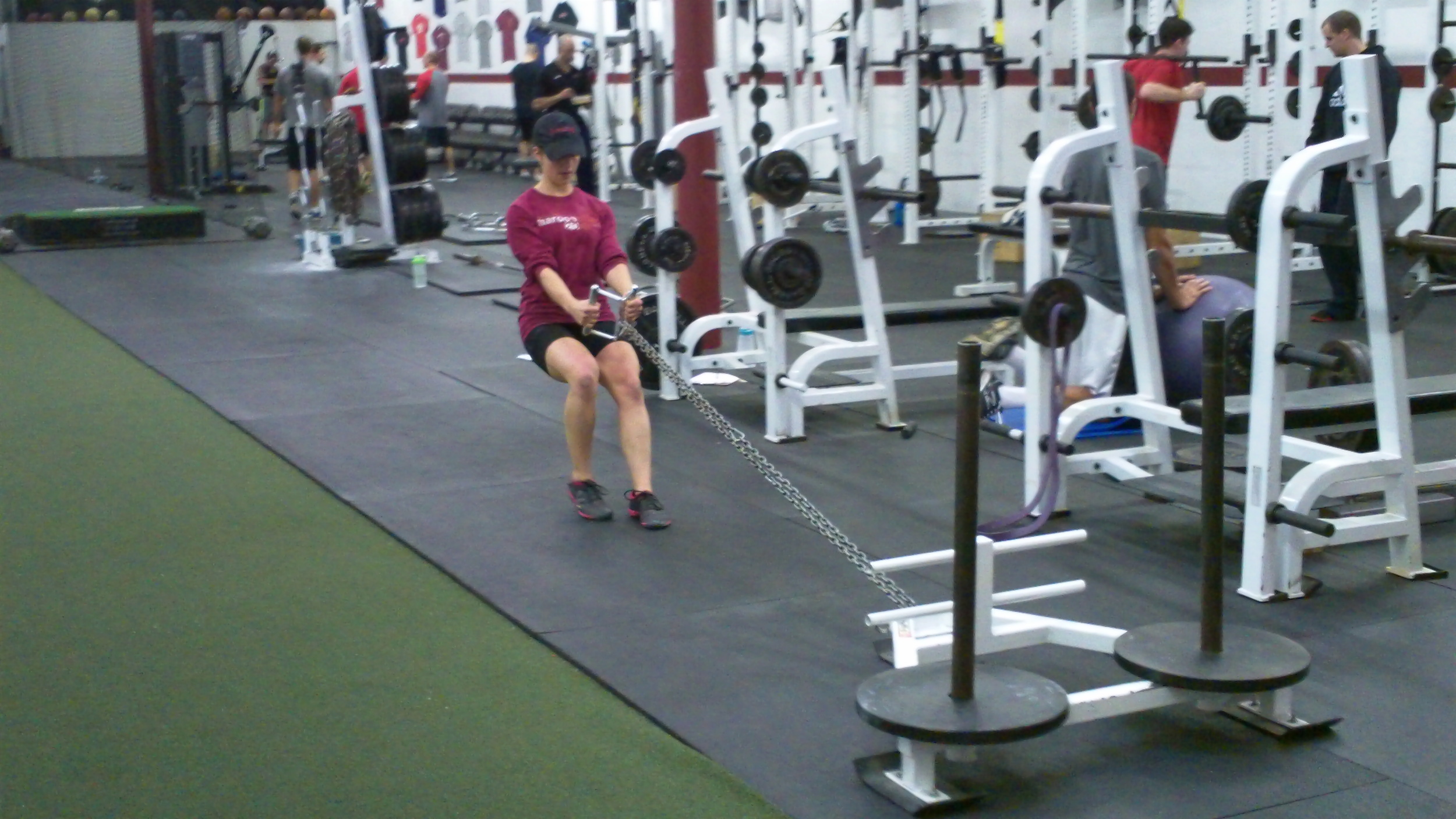
And we tried a variety of lifts using chains for added resistance. Deadlifts vs. chains, side planks vs. chains, hip thrusters vs. chains, and pushups vs......yep, chains.
Not to be outdone, my wife busted out a pretty impressive set:
(one of the CP interns made a pretty amusing comment to her - upon being shocked when she asked him to place 45lbs of chain on her - but I'll refrain from mentioning it here out of fear of offending a particular training camp).
I used to think people primarily used them (chains) for the general bada**ery obtained by doing any lift with them, but, after using them for the first time I can say that on top of the fact that while yes, you do automatically achieve mild superhero status when you add chains to a movement, they also offer a very practical loading tool. I'm foreseeing a trip to a marina sometime soon to pick up a few, and am definitely open for suggestions if anyone in the area knows of a good one.
Finally, getting to the central point of this post, I'd like to touch briefly on one of the bullet points I made at the beginning (specifically, that training at CP was an incredible learning experience). If I dug up only one golden nugget out of our experience up North, it was this:
Everyone, EVEN strength coaches, should be periodically coached and trained by someone else.
This was so invaluable for Kelsey and I that I can't even put into words all the benefits we received from this experience. Considering that Kelsey and I both spend 5-6 days a week coaching and helping OTHER people under our watch, it was a huuuge difference when we flipped to the other side of the coin last week and had the CP staff coach us.
 From the assessment Tony gave us, to the program he wrote for us (working around the myriad injuries we both have), to the coaching cues and tips we received, to talking shop with the staff after our sessions, it was enlightening to learn from someone else (in person) for a change. It reminded me of what it's like to be corrected, to ask questions, and to have a coach oversee your every move. I've already seen how this experience will help me become a better coach myself (hint: A LOT). Furthermore, it was quite refreshing to have my form corrected or given tips on various set-ups (ex. I had never really been cognizant of rib flare during exercises and/or everyday life and how this negatively alters kinematics further up/down from the diaphragm).
Also, the program I was given FORCED me to work on the things I suck at:
- Hip extension and rotation (primarily on the left side)
- Hamstring strength (or lack thereof)
- Breathing patterns
- Pec length (or lack thereof)
- Deadlifts
- General mobility (really Tony? Three E-series movements, repeated TWICE, at the end of EVERY session??)
This is great because these are all things I generally tend to skip/forget about in my everyday training as of late because of:
A) Rushing through training sessions either in between coaching sessions at SAPT and/or at the end of the night. B) Writing my own programs (and, as I've mentioned before, writing your own programs leaves you wide open to favoring your strengths and neglecting your weaknesses). C) In all honesty, failing to train myself (comprehensively) in the same way I train the clientele at SAPT.
Alright, it's time to wrap up this marathon of a post, so if you retain anything from this read, let it be that it will only be to your benefit to be coached by someone, and yes, this applies to strength coaches, too. If you're a competitive athlete or general fitness enthusiast, it is going to help you work on your weaknesses, reach your goals more efficiently, and give you a plan that will guarantee success. If you're a strength coach or personal trainer, it's going to give you all the benefits of the groups above but with the added benefit of allowing you to better serve your athletes/clients because you've walked in their shoes.
It's a win-win.
Friday Distractions
I don't know if we have any hard-core running sock wearers reading our site, but if we do, then THIS is the post for you: Running Sock Reviews from Runblogger!! From Sweat Science: Higher carb intake = faster Ironman finish
The fiance of a coach I worked with at VCU has a food blog with, what look to be, some pretty good recipes. Check out White Truffle Turnip "Risotto." I've never tried any of the recipes, but again, they look pretty good and tend to be based around Paleo style rules.
Lastly, if you're pretty much spent from the week and trying to get in the Halloween spirit, take a look at these photos of pets dressed up in Halloween costumes. It might be just what you need. HAAAAAA!
As for my family, we'll be participating in the Goblin Gallop 1k Fun Run on Sunday at Fairfax Corner. And, yes, Arabella will be getting her first race medal!


Develop a big league rotator cuff…
Check-out the videos below of a couple of our minor league baseball guys finishing up their training session with some grip and rotator cuff work.
Any deadlift/farmers walk variation will be improve rotator cuff strength through irradiation. Cook and Jones popularized this term, and many others have trumpeted it, so I’m not passing it off as my own. As the guys are “squeezing the snot” out of the trap bar all the nerves get jacked-up along that chain forcing the cuff muscle to pack and support the shoulder into a properly retracted position. The offset component makes it a “two –for” as we throw a little core stability at them simultaneously.
The medball on the wall drill, where they’re tracing the alphabet, is a predictable rhythmic stabilization drill where again, they’re packing the shoulder blades, and using the cuff muscles to stabilize the humeral head. You can increase the difficult of these drills by incorporating gentle perturbations, making them less predictable.
The sledge leveraging drills for are for forearm strength, and conditioning of the wrist and elbows.
A lot more than just sleeper stretches and full cans,
Chris
Q&A: Strength training vs. conditioning
During the season, I have 2 days scheduled in the weight room. For the time in the wrestling room, should I not have them do any sandbag work? Should it all be "conditioning"? What's the difference between strength training and conditioning??
I'll start by answering the last question and then work my way backwards - What's the difference between strength training and conditioning?
The simple answer is that pretty much everything can be considered conditioning (even strength training). It all depends on how you are combining the movements and planning the work to rest ratios.
Specifically for wrestling (and all of the combat sports) I would absolutely suggest utilizing the sandbags along with body weight resistance. After all, the conditioning required for wrestling deals completely with one wrestler being able to manipulate another wrestler's body weight during a specific time frame. So, focusing 1 or 2 days a week (of the three set aside for conditioning) on weighted conditioning series/circuits would be completely appropriate.
Here is a sample 3-min circuit:
1. Sandbag Zercher Squat x :25 (:05 given as rest/exercise transition time)
2. Up/Down to Broad Jump x :25 (:05 rest)
3. Sandbag Overhead Carry x :55 (:05 rest)
4. Jump Pullups x :25 (:05 rest)
5. Tiger Crawl x :30
Repeat 2-5 times.
Another tip I can offer when planning your team's conditioning: look specifically to the nature of the sport FIRST and then design specific training around the work to rest ratios that naturally occur in the sport. As an example, when I've trained fighters in the past, I have used isometric holds (like the bottom of a pushup) as "rest." But, it's important to note that you have to lead your athletes to this level first! Rest can occur as literally rest OR it can occur with other movements that are easier than the main movements and thus allow the athlete to recover before the next intense bout.
Hope this helps a little bit!
Guest Post: Anterior Humeral Glide
Ryan Wood has been given the green light to go hog-wild on a post for this week. Below is what he came up with... be warned, it's good - real good. Ryan may just find himself a regular weekly contributor soon: I’ve noticed a growing trend amongst gym goers that is possibly more annoying to look at than guys wearing skinny jeans. That trend is what’s called Anterior Humeral Glide (AHG). AHG, for simplicity’s sake, is the excessive forward glide of the humeral head during a wide variety of exercises but especially during vertical and horizontal pulls. You can see the problem clearly on exercises like a double or single arm horizontal row. Below is a video of a double arm band row performed incorrectly with AHG present.
Incorrect Row with AHG. Notice the head of the humerus moving anteriorly. This is due to an inability to properly retract the scapulae.
There are a number of problems as to why AHG during an exercise is not a good thing, but the two biggest ones are: 1. You’re flat out going to tear up your shoulder over time; welcome to impingement city. 2. You are in no way, shape, or form getting any benefit out of the exercise. The whole point in doing a row variation is to strengthen the upper back, most notably the scapular retractors (rhomboids and mid/lower trapezius) which you totally miss when you fail to properly perform the exercise.
So how do we address the problem in order to help out the athlete/client? First, check out the video below to see what a correct row looks like without AHG present. Correct Row with Proper Form. Notice in the performance of the row that the head of my humerus does not glide forward. The retraction of the scapulae causes the humerus to align correctly.
Believe it or not some individuals just might not be ready for an actual row; they need a progression. If you find yourself faced with an athlete in this situation, it would be wise to fill their program with exercises that focus solely on the scapular retractors. This will force them to be aware of how to use them effectively. You can saturate their program with this work early on in the session or hammer the movements in their warm-ups… either way, just keep in mind that for someone who has difficulty with scapular retraction, this is hard work! So, let them be fresh and able to concentrate while they work on the form (just like you would make sure an advanced athlete performs the compound lifts at the beginning of a session). Three exercises that can be used to teach scapular retraction:Banded Scapular Retraction
Prone I’s
Band Pullaparts
Coaching cues are a must when a row (or any exercise, really) is involved. If the athlete is not coached in the right way they can not be expected to perform the movement correctly. Here a few coaching cues to ensure retraction.
• Place your finger between the scapulae and tell them to pinch your finger
• Have them imagine pinching a pencil in between the shoulder blade as they retract
• A favorite of Coach Romo’s is to ask them how they would walk on the beach, and then proceed to tell them to stick their chest out!
• The best one of all in my opinion is for you to physical direct their humerus back as they are doing a retraction exercise or a row. Over time they will become aware of what it feels like to retract their scapulae
An exercise is only useful if performed correctly. Retract away my friends!