SAPT's Baseball Summer Training Program
It's that time of year! Time to get stronger, faster, more powerful, and pack some muscle mass onto your frame. Check out our special offer for baseball players this summer:

For the past 6-years, the coaches at SAPT have been helping pitchers and position players alike achieve their potential on the field. Set up a comprehensive evaluation today and start down your path to superhero status!
GMU Power Meet 2013
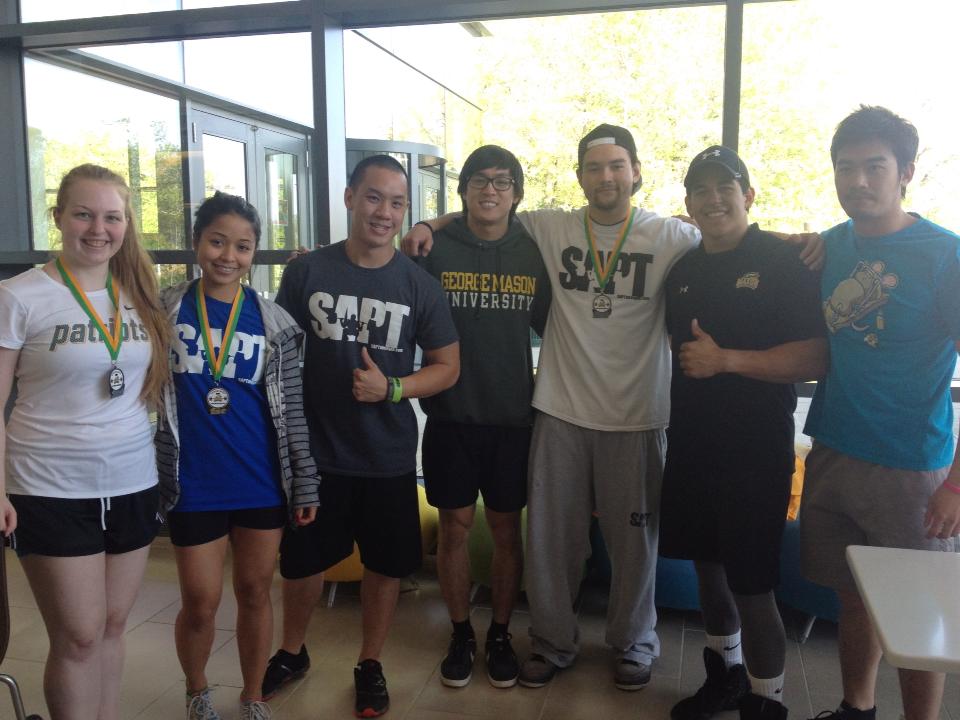 The second annual George Mason University Powerlifting Meet was held this past weekend, and a few of us stepped up to represent Team SAPT! Current intern Brian, my girlfriend Jennifer, and yours truly put our game faces on to throw some weight around on the platform.
The meet was run by none other than the man himself, Steven, whom some of you remember during his internship with us in the summer. The meet was well organized and flowed very smoothly. Even more impressive was that Steven competed in the meet as he was directing it! Multitasking at its finest!
The event had a great turnout of competitors and supporters, along with some great performances. Great job to all those who competed and thanks to all those who came out to support!
Enjoy the video below that Brian put together!
http://www.youtube.com/watch?v=lWAtISvl8Io&feature=youtu.be
Mental Monday Video Interview: Heather Kampf
Huge thanks to Heather Kampf - professional runner for Asics and Team USA Minnesota - for doing this interview!
Oh Those Hammies! Hamstring Info Part 1
Do you have tight hamstrings? Do you stretch them only to find that you're not any closer to the suppleness that you desire in those posterior hip extenders? Do you feel they're tighter than Gringotts Bank Security?
Thieves Beware...
Have you tweaked/pulled your hamstring (due to your tightness maybe?)? Today, we'll go over some of the reasons why the hamstrings might be tight and in part 2 we'll go over some of the prevention/rehabilitation techniques to deal with hamstring tweaks. You may be surprised to find that your tight hamstrings are not actually tight... That sounds like something Professor Dumbledore might say.
Ok, so here's some of the causes of "tight" hamstrings. (You'll see why I put "tight" in quotation marks at the end.)
1. Protective tension.
This is when the brain is telling the hamstrings to remain "on," for one reason or another, and it creates a sensation of tightness when the hamstrings are stretched. Why does this happen? I'm actually a good example of this. I have congenital laxity (meaning my joints are loose and I'm fairly flexible) but for a period of about 3 years, my hamstrings were constantly tight and I could feel them being tugged on every time I would put them in a stretched position, and because of my laxity (and a lifetime of NEVER feeling tight) this was as odd as Hagrid's love for horribly frightening beasts.
Yep. That weird.
Here's what was happening: my pelvis tilted, wildly I might add, anteriorly (forward).
The hamstrings attach to the (posterior) bottom of the pelvis (your "sit" bones) and my brain sensed the pelvic tilt I was constantly in and was desperately trying to prevent me tilting forward anymore by causing my hamstrings to fire constantly to pull me back into a neutral position. Thus, this unceasing firing of my hamstring was causing a sense of "tightness" in my hamstrings despite the fact that the actual muscles were not tight. Once my pelvic tilt (through lots of KB swings and anterior core work) was in a more neutral position... voilaThe tightness was gone. So, if your hamstrings feel tight, check our your pelvic alignment. Stretching the hamstrings will NOT improve your flexibility in this case.
2. Neural tension.
I know this sounds similar to the above reason, but this tension generally results from an injury. The most likely answer is an injury to a lower back disc. (since the nerve for the hamstrings runs through that region.) If there's damage to a disc in the L1-S1 region, there's probably compression on the nerve for the hamstrings which could be causing mishaps in the neural messages causing hamstring tightness. Usually this type of tension is accompanied by other symptoms such as tingling, shooting pain, electric pain or numbness. Two common tests to check for spinal issues are the slump test and the heel drop test (which consists of standing on your toes then dropping to you heels. If pain occurs, congratulations! You might have a compression issue.)
3 and 4. Nasty fibrotic tissue or tendonosis in the hamstring.
Sometimes muscle fibers get junky and gunky, either from poor movements, overuse, or prior injury, which changes the length and function of the muscle. Instead of the muscle fibers running parallel and working harmoniously, they're twisted up like spaghetti noodles (and work as well together and a plate of spaghetti). Soft tissue work such as SMR or possibly work by a professional is in order to help restore the tissue quality.
Not the way muscle fibers should be...
5. The hamstring muscles are truly short.
Yep, you're one of those people who either because of your genes (not your jeans. Ha!) or a surgery where the hamstring was immobilized in a shortened position (though this is not common), your hamstrings are actually shorter than they should be. This can happen in folks who sit down a lot during the day because the pelvis is tilted posteriorly (tucking your butt under) which does shorten the hamstrings a bit. However, this probably isn't the main source of tightness since they are only short at the very end range of motion.
So what have we learned? If your hamstring is tight, it's not necessarily it's fault nor will endless hamstring stretches change anything (even if you're drew the genetic short stick. Stretching won't do that much. Sorry.). Soft tissue work in the hamstrings, adductors, and glutes as well as some dedicated anterior core work and glute training (*cough* swings *cough*) can help to solve some tight hamstring issues.
Hamstring issues, begone!
Check back in tomorrow for some hamstring injury causes and care.
My Experience with ART: Part I
For years I’ve been interested in restorative and rehabilitative techniques. Whether it be something in the “do it yourself” category such as foam rolling, or something a bit more invasive like dry needling (a technique used by doctors of physical therapy to release tight muscles in spasm), I'm always interested in finding out what seems to “work” and what seems to be an expensive waste of time.
One of the rehab techniques that really sparked my curiousity was ART, or Active Release Technique. Was it a fancy style of massage? Was it chiropractic manipulation? I came to find that it was a style of treatment that involved locating scar tissue in the body that is suspected of causing soft tissue restriction or dysfunction, and using a combination of manual pressure and the patient’s own movement to break up the gunk in the body and restore the tissue to proper function.
As I read more about it and talked to several patients that have had ART before, the general consensus was overwhelmingly positive. I couldn’t resist anymore and got myself an appointment with Grove Spine & Sports Care.
The Assessment/Evaluation
I came in with no urgent concerns or problems, but I knew that I had some movement dysfunction of my own. My hips are fairly tight and I will get some lower back soreness from a long day of sitting, and my left hip will bother me if I over-do it with squatting movements. I was very curious to see what kind of condition the soft tissue in my lower back and hips were in.
Just as I suspected, there was something up with my left hip. My hip flexors are both super tight, but even more so on the left side. I’ve always felt that this is pulling my spine into a less-than-optimal hyperlordodic position.
My hip external rotators on my right side were also locked up, causing me to turn my right foot out more when I stand or sit relaxed.
But the fun didn’t end there. There was junky tissue in my adductors, spinal erectors, QL, and some scarred up ligamentous tissue in my lower back.
So I proceeded to have much of this knotted up nonsense “released” by the good Doctor. The “releasing” consisted of having deep pressure applied to the restricted area, and then moving my own body in a way that would stretch the tissue against the pressure. For example, for my hip flexors, I started in a side-lying position and deep manual pressure was applied to my psoas right next to my belly button. While the pressure was maintained I had to extend my hips by throwing my top leg back and reaching up toward my head with my top hand.
I was warned that it may cause some deep burning and even a painful sensation, but I thought it just felt awesome. I was still smiling throughout the session, so I guess that puts me at a 0-1 according to this fullproof scale.
After getting my left hip flexor, right external rotator, and left adductor magnus released I got up off the table to walk around and feel out my freshly ironed out hips. I must say I was very impressed. I did a few bodyweight squats and could definitely feel the increased ease at which I dropped down to depth.
The initial evaluation and first ART session was enough to convince me that there is something magical happening here. Of course it would be naïve to assume that my experience will be the same as others, but for those of you who have some nagging soft tissue aches and pains I definitely recommend you try it out! Stay tuned for further experiences with my future ART sessions.
Mountain Climbing
A few weeks ago I was fortunate to hear Allison Levine speak. Levine has climbed the highest peak on every continent, served as team captain of the first American Women’s Everest Expedition, and skied across the Arctic Circle to the geographic North Pole. As Levine spoke I found that her approach and mentality was very similar to the messages I talk about with clients. With that in mind, below are some of the notes that I took from her speech.
Levine spoke about how it’s easier for someone to say no, then to answer questions. She spoke about the importance of asking questions to gain information and to push people for specific information. This is an important message for athletes seeking information regarding role clarity, playing time, and team motivation.
Levine talked about Junko Taibei, the first Woman to climb Mt. Everest, and how she said, “Technique and ability alone do not get you to the top—it is willpower that is the most important. The willpower you cannot buy with money or be given by others—it rises from your heart.”
In addition to willpower Levine spoke about the importance of fear by saying, “fear is ok, but complacency will kill you.” Levine talked about fear in regard to the hazardous mountain weather by saying, “storms are temporary and they don’t last forever.”
As Levine continued to talk about her experience it was clear that she valued preparation, moment-to-moment thinking, and the importance of relishing the journey over the end result. Levine’s ability to conquer some of the largest mountains in the world is a reminder that in order to conquer the most difficult challenges, we need to make sure our mind is in as good of shape as our body.