Spurs Seven Virtues
Today we have a fantastic guest post brought to you by mental coach, Brian Levenson. Brian is a phenomenal coach who has helped/is currently helping countless different people from all walks of life to improve their mental game. He primarily works with athletes ranging from the youth to the professional level, but he also mentors business owners and even Jedi Masters, too. I think you'll really enjoy his post for today.
Spurs Seven Virtues
It’s been a week since the San Antonio Spurs were crowned champions of the NBA. Since then, they have been celebrated as one of the best, most selfless teams in history. Personally, I have never cheered for a team whom I had no allegiance/ties to, like I did for the 2013-14 San Antonio Spurs. It wasn’t that I fell in love with the way one guy played, or marveled at the sheer talent of the players on the floor, instead I found myself grossly enamored with seven virtues that the team possessed. As I dissect each virtue, think about your organization and how you may benefit from the Spurs way.
Virtue #1: Can>Can’t
Of all the people in the Spurs organization, RC Buford may be the most underrated. Buford is the architect behind a roster chalk full of what ESPN analyst Jeff Van Gundy called “heart guys”. They are guys who are willing to dive on the floor for loose balls, take a charge, and be gritty enough to keep playing hard even when they are struggling. When selecting those “heart” players the Spurs choose to look at what guys can do rather than what they can’t do. As Buford reflects in this article about their draft process: “We get everybody in a room, and ask each other, ‘What can we do to help this player?’” This not only crystallizes their decision making process, as they better understand a player’s potential, but it also helps them create an action plan to give that player the best opportunity for success.
Take a player like Kawhi Leonard, the recent MVP of the NBA finals, who was passed up by all the teams in the lottery, selected by Indiana at 15, and then had his rights traded to the Spurs. The biggest knock on Leonard was that he couldn’t shoot.
From the well-respected NBA draft website, Draftexpress:
“Leonard is not only an average ball-handler, but he also struggles to make shots consistently from beyond the arc. His 0.743 points per shots on jumpers ranks 16th of 17 in the class, where he shot an abysmal 31% from the field. His struggles extend both to his catch and shoot jumpers (32%) and pull-ups (28%).”
But teams were forgetting one of the most important characteristics to acquire a new skill, Leonard was coachable; and the Spurs had just the coach to help him acquire the skill of shooting. Chip Engelland is considered one of the best shooting coaches in the NBA, and he happens to be an assistant coach with the Spurs. The Spurs paired Leonard with Engelland and the rest is history.
Spurs take can’t and turn it into can.
Virtue #2: Honesty
Each player on the Spurs knows their strengths and weaknesses. They are honest with who they are and are open to feedback from their lead general, Coach Pop. Pop’s brutal honesty led to him writing, “DNP-Old” last year to describe why Tim Duncan wasn’t playing, admitting that during timeouts sometimes “I’ll say I’ve got nothing” as his players look to him for answers, and is part of the reason that he has the most brief in-game interviews with side-line reporters.
The honesty that Pop displays leads to accountability, which enables each Spur to get the most out of their potential.
Virtue #3: Empowerment
The Spurs empower each of their players to step up and produce. This was most evident in last year’s NBA Finals when Tony Parker walked up to Pop during a timeout to interject his opinion. Pop gave Parker the keys to the timeout huddle and Parker started explaining to his teammates what he saw. That empowerment to step up and make a difference is a hallmark of every player on the Spurs.
Pop explained the interaction in a press conference, "That’s not a rarity. While the coaches are out talking on the court, we do that so that the players can communicate and talk to each other because most of the time they know more what's going on than we do. There will be times when Timmy will sit in that chair or Manu will sit there or Tony will sit there and they'll talk to the team if they have something they want to get across. That's just how we do things.”
Spurs don’t put people in their place; instead they empower each other.
Virtue #4: Share
San Antonio had 1771 passes in the NBA finals compared to Miami’s 1299. That’s 472 more passes, or about 95 more passes per game. Pretty remarkable. Pop constantly tells his guys that the ball can’t “stick”; meaning ball movement is paramount.
The players bought in to the sharing concept as well. As Manu Ginobili pointed out in this article, “I think it can potentially be a game-changer, for other teams that don’t have as much talent to give (an individual) the ball and let them create like Kobe or Durant or LeBron. It kind of showed the way in the sense … if you don’t have as much talent, you still can do it. You can move the ball and put a lot of pressure on the defense."
Then, there are the salaries that each player makes. The Spurs "big 3" all took less money to stay in San Antonio. Parker made 12.5 million, Duncan made 10.4 million, and Ginobili made 7 million. Those salaries combined are less than what Kobe Bryant’s salary was this year (30.5 million).
Sharing is a non-negotiable for Spurs.
Virtue #5: Process Focus
“When nothing seems to help, I go look at a stonecutter hammering away at his rock, perhaps a hundred times without as much as a crack showing in it. Yet at the hundred and first blow it will split in two, and I know it was not that blow that did it, but all that had gone before.” --Jacob Riis
That quote has been at the heart of the Spurs culture for years. “Pound the Rock” has become the rallying cry for one of the best organizations in sports. It’s become so popular that there is even a popular blog named after it (www.poundingtherock.com). It didn’t matter if they had lost game 2, or were down 22-6 in game 5, the Spurs were always focused on executing and playing the right way for 48 minutes.
Regardless of the score, Spurs continue to chisel away at their opponents until eventually they break.
Virtue #6: Something to Prove
The Spurs are filled with guys who have had something to prove throughout their career. They are an eclectic, diverse group, highlighted by 8 international players, which led the league in that category. Each player on the Spurs has had a different journey to the NBA, but only one of them (Duncan) was selected in the NBA Draft lottery. The rest of the team is filled with late 1st and 2nd round picks, guys who were passed over because of weaknesses. They are a resilient, gritty group of guys who constantly have to prove they belong.
Nothing has been given to the Spurs and that’s why so much has been earned.
Virtue #7: Best Friends
Teams often talk about how there needs to be a mutual respect amongst each other, but that they don’t have to be “best friends” with their teammates. Yet, as Patty Mills grabbed the microphone during the Spurs celebration ceremony, he introduced his teammates as his “best friends”. He went on to talk about each and every player and how they brought something unique to the team. He was genuine, funny, and comfortable talking about the guys he sweated with all year. He mentioned their quirks, how they were better people than players, and how much he loved each of them.
It’s not good enough to just be a teammate, Spurs must love each other like best friends.
The word “virtue” has many different definitions, but the one that sticks out is “a good or useful quality or thing.” When it comes to the 2014 NBA Champions there are plenty of good qualities to go around, and those champion qualities should be celebrated, admired, and duplicated by us all.
Off-Season Training: Overhead Athletes

Last week, we laid out some general guidelines for athletes heading into their off-seasons. You should read it, if you haven't already. Today, we'll delve into some specifics for overhead athletes (i.e. baseball, softball, javelin, shot put, swimmers (though it seems as if they never have an off-season), etc.). Shoulders are rather complicated and annoyingly fickle joints that can develop irritation easily which is why proper attention MUST be paid to shoulder mechanics and care during the off-season. There is nothing "natural" about throwing a heavy object (or a light one really, really fast) and shoulders can get all kinds of whacky over a long, repetitive season. I'm going to keep it sweet and simple.
1. Restore lost mobility and improve stability
- Hips: they get locked up, especially on athletes that travel a lot during the season (helloooo long bus rides). Restoring mobility will go a long way in preventing hip impingements, angry knees, and allow for freer movements in general. Locked up hips will prevent safe, powerful throws and batting, thus, now is the time, Padawans, to regain what was lost!
- Lats: Usually tighten up on the throwing side and create a lovely posture that flares the rib cage and makes breathing not-so-efficient. Loosen up these bad boys!
- Breathing patterns: Those need to be re-trained (or trained for the first time), too. Breathing affects EVERYTHING. Learning proper breathing mechanics will do a lot to restore mobility (T-spine, shoulder, and hips), increase stability (lower back and abdominal cavity), and create a more efficient athlete (more oxygen with less energy expended to get it). I've written about it before HERE.
- Pecs and biceps: These guys are gunky and fibrotic and nasty. Self-myofacial release is good, finding a good manual therapist would be even better, to help knead that junk out! One caveat: make sure that as you release these two bad boys, you also add stability back into the shoulder. This means activating lower and mid-traps and the rotator cuff muscles to retrain them to work well again. Why? Most likely, the pecs and biceps are doing a LOT of stabilization of the shoulder (which they shouldn't be doing so much) so if you take that away through releasing them, one of two things will happen: 1) injury will occur since there's nothing holding stuff in place, 2) no injury, but the pec and/or bicep will tighten right back up again as your body's way of producing stability. So, mobilize then stabilize!
2. Improve scapula movement and stability
Along the lines of restoring mobility everywhere, the scapula need particular attention in overhead athletes as they are responsible for pain-free, overhead movements. Below is a handy-dandy chart for understanding scapula movements:
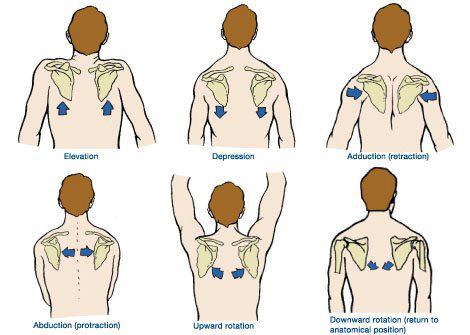
Now, over the course of the season, an overhead athlete will often get stuck in downward rotation therefore at in the early off-season (and throughout really) we want to focus on upward rotation of the scapula. Exercises like forearm wallslides are fantastic for this.
Eric Cressey notes that the scapula stabilizers often fatigue more quickly than the rotator cuff muscles. This means the scapula doesn't glide how it should on the rib cage, which leads to a mechanical disadvantage for the rotator cuff muscles, which leads to impingements/pain/unstable shoulders.

As we increase the upward rotation exercises, we want to limit exercises that will pull the athlete back into downward rotation, i.e. holding heavy dumbbells at their sides, farmer walks with the weight at sides, even deadlifts.(whoa now, I'm not saying don't deadlift, but limit the volume on the heavy pulls for a few weeks, and like I said in the last post, training speed work will limit the amount of load yanking down on those blades.) Instead, athletes can lunge or farmer carry in the goblet position (aka, one bell at their chest).
There is more to be said, but let us move on, shall we?
3. Limit med ball work
At SAPT, we back off on aggressive med ball throwing variations for the first couple weeks post season as the athletes have been aggressively rotating all season. Instead, we'll sub in some drills that challenge the vestibular such as single-leg overhead medicine ball taps to the wall. (I don't have a video, sorry.)
Or, stability drills such as this:
If we do give them some low-intensity throws, we'll have them perform one less set on their throwing side than on the non-throwing side.
4. Limit reactive work
We don't usually program a lot of sprint work or jumps the first few weeks. If we do program jumps, we'll mitigate the deceleration component by adding band resistance:
5. Keep intensity on the lower end
As mentioned in the last post, instead of piling on weight, we enjoy utilizing isometric holds, slow negatives, and varying tempos to reap the most benefit from the least amount of weight. We also maintain lower volumes over all with total program.
There you have it! Tips to maximize the off-season and lay a strong, stable foundation for the following season!
Summer = Off Season = TRAINING!!!
Summer is nearly upon us, spring sports are over (or nearly so), school is winding down, and the sun is waking us all up quite a bit earlier. **DEEEEEP BREATH*** I love summer.
Not only is it fantastically warm and I finally sweat profusely during my workouts (contrast that to the winter to where I'm lucky to break a sweat, in my sweat pants...I get cold pretty easily) but it's the off-season for high school sports. I know some of you play your sport year-round in clubs and stuff (see my thoughts on that HERE), but seriously, the summer is a perfect time to start training and getting stronger for next year's season.
So, it's time to hit the weight room, right? Start smashing PRs and moving heavy iron bars around, right? Not so fast, cowboy.
A huge flub athletes commit in the beginning of the off-season is training too hard, too fast. Think about it, you just spent 3, 4, even 5 months in-season with practice after practice, games, and no-so-much lifting. Your body is probably weaker (even if you trained during the in-season, it still isn't PR shattering material) and you've been performing the same, repetitive motions to the point where you've probably developed at least one sort of wacky asymmetry. For overhead athletes, they've been throwing or hitting on the same side, soccer players kick with the same leg, track athletes have been running in the same curve (to the left), and lacrosse players have been whipping their upper bodies around the same direction. Show me an athlete coming out of the season that isn't crooked somewhere (that's the technical term) and I'll show you a One Direction fan that isn't a female teenager. Oh wait, they don't exist. (if you don't know who they are, keep it that way, it isn't worth your time.)
To keep it pretty general, as the two subsequent posts will deal more with specific sport recommendations, here are some thoughts on the first 3-4 weeks of off-season training:
1. Keep the volume down- You've pounded your body all season, high volume work will only stress it out more. Stick to 15-20 reps total of your main lifts (squat, deadlift, bench, etc.) and 24-30 reps of accessory work, total. There should only be 2-4 accessory lifts and 1 main lift per workout.
2. Keep the intensity reasonable-- I'm not advocating lifting 5 lb dumbbells for everything, but again, you've pounded your body for several months, starting at 60-75% of your maxes is not a dumb thing to do. Get some quality, speedy reps in of the main lifts. For you accessory work, move weight that will get your blood flowing, but leaves some gas in the tank (a lot of gas in the tank). If you really want to burn, adding negative reps or isometric holds can increase the intensity without overloading your joints. For example, we like Bulgarian split squats with a :06 negative, or pushups with a :05 isometric hold at the bottom.
3. Take a week away for the barbell-- It's just a week, calm down, but replacing barbell squats with some goblet squats or deadlifts with some swings are excellent ways to give your body a break and still train those movements.
4. Work on tissue quality- Foam roll, use a lacrosse ball, or better yet, go see a manual therapist to dig out the nasty, knotted tissue that resides in your body. Mobility drills for the tight bits and stability drills for the loose bits should be prevalent in your workout. For example: soccer player's hips will be pretty tight and gunky, so that requires some attention to tissue quality of the glutes, quads, and TFL and mobility work. Contrast that to a baseball player's anterior shoulder (front side) of his throwing arm, that this is probably much looser than it should be, so he'll need some stability work to pull his humerus into a more neutral position.
5. Sleep a lot and eat quality food-- I bet both of these have been in short supply over the course of the season, huh? Yes, these two are SUPER important for recovery purposes as well as muscle growth. Shoot for 7-9 hours of sleep per night and load up on the vegetables!
The sole goal of the first couple weeks after the season is to restore the poor, asymmetrical, beaten-up body and allow for some recovery time. Keep the volume and intensity low to moderate, work on tissue quality and mobility as needed, and sleep! Then, and only then, mind you, can you attack the rest of your off-season like the Hulk.
Early Sport Specialization: Why This Needs to Stop (with a capital "S")
Here in northern Virginia, and in other hub-bub places too, it's not uncommon for an athlete to play a sport during the high school season, and then transition straight into the club season (which lasts f-o-r-e-v-e-r), leaving the athlete with maybe 2-3 weeks rest before try-outs for the next year's high school season start. Does this sound familiar? Does this sound healthy? Today we're going to address a growing (alarmingly so) problem with youth athletics: early sport specialization. As a strength coach, I see some messed up kids when it comes to movements, joint integrity, and muscle tissue quality (all = poop) who play year-round sports at young ages (that is, under 16-17 years old). I see year-round volleyball players who can't do a simple medicine ball side throw. Why? Because they spend ALL YEAR moving in the saggital (forward/backward) plane with a little bit of the frontal plane (side to side shuffling, but even that is dominated by their inability to actually move sideways; they tend to fall forward and/or move as if they're running forward, just facing a little bit to the side.) They have limited movement landscape (remember this?) and therefore are limited athletes.
I see young baseball players with chronic elbow or shoulder pain. Why? Because they throw a ball the same way ALL YEAR ROUND. And they're not strong enough to produce the force needed to throw it properly, (because, heaven forbid, they take some time off to actually weight train and get stronger) so they rely on their passive restraints (ligaments, tendons, and joint capsules) to throw.
This topic gets me fired up because I see SO MANY injuries and painful joints in kids who shouldn't have injuries or painful joints. I see kids who can't move like a normal human being because they're locked up and, worse, don't even have the mind-body connection to create movements other than those directly related to their chosen sport.
There's this pervasive myth that if a kid doesn't play year round or get 10,000 hours of practice, then he/she will never be a good athlete. Parents get caught up in chasing scholarships and by golly, if Jonny doesn't play travel ball he'll fall behind, then he won't make varsity, then he won't get into a good college... and on and on. My friends, we need to take a step back and think about what's best for the athlete. Do the aforementioned afflictions sound good to you?
But enough of my opinion, let's look at some hard science to support the Stop-Early-Specialization-Theory.
Playing multiple sports and playing just for the sake of running around like a kid builds a rich, diverse motor landscape, especially during the years before late adolescence. Diversifying the motor landscape, or movement map, or the bag-o-skillz, or whatever you want to call it, is essential to human development and especially valuable to athletes. I'm going to sound like a broken record, but kids need a broad and varied map to:
1. Understand how to move their bodies through space
2. Create and learn new movements
3. Learn how to adapt to their environment
4. Develop better decision making and pattern recognition based on their circumstances (i.e. being able to find the "open" players in a basketball game helps in finding one on the soccer field. )
Matter fact, this really smart fellow, Dr. John DeFirio MD, who is the President of the American Medical Society for Sports Medicine, Chief of the Division of Sports Medicine and Non-Operative Orthopaedics at the David Geffen School of Medicine at UCLA and Team Physician for the UCLA Department of Intercollegiate Athletics (that's quite the title, eh?) says this:
"With the exception of select sports such as gymnastics in which the elite competitors are very young, the best data we have would suggest that the odds of achieving elite levels with this method [early sport specialization] are exceedingly poor. In fact, some studies indicate that early specialization is less likely to result in success than participating in several sports as a youth, and then specializing at older ages"
And, Dr. DiFiori encourages youth attempt to a variety of sports and activities. He says this allows children to discover sports that they enjoy participating in, and offers them the opportunity to develop a broader array of motor skills. In addition, this may have the added benefit of limiting overuse injury and burnout.
You can read his full article here. The article also notes two studies in which NCAA Division 1 athletes and Olympic athletes were surveyed regarding what they did as children. Guess what? 88% of the NCAA athletes played 2-3 sports as kids, and 70% of them didn't specialize until after age 12. The Olympians also all averaged 2 sports as kids Are you picking up what he's putting down? Specialization doesn't make great athletes, diversification does!
Side bar: Check out Abby McCollum, who played 4 sports for a Division 1 school. The article says that she was recruited last minute... probably because she was such a great all-around athlete that she could play any sport.
Next up: injuries rates.
Dr. Neeru Jayanthi, a sports medicine physician, in conjunction with Loyola University published a few studies using a sample set of 1,026 athletes between ages 8-18 who came into the Lurie Children’s Hospital of Chicago for either sports physicals or treatment for sports-related injuries. The study ran from 2010 to 2013. Dr. Jayanthi and her collegues recorded 859 injuries, of which 564 of them were overuse injuries (that's well over HALF). Of those 564 injuries, 139 of them were serious injuries concerning stress fractures in the back or limbs, elbow ligaments or injuries to the cartilage. All of these injuries are debilitating and can side line and athlete for 6 months or more. The broad study is reviewed here and a more specific cohort (back injuries, which carry into later in life) is here. I highly recommend reading both as the data are eye opening.
To sum up Dr. Jayahthi and co.'s recommendations on preventing overuse injuries (I took it directly from one of the articles in case you don't have time to read them both):
• If there's pain in a high-risk area such as the lower back, elbow or shoulder, the athlete should take one day off. If pain persists, take one week off. (though I think it should be more)
• If symptoms last longer than two weeks, the athlete should be evaluated by a sports medicine physician. (and go get some strength training! There's a reason that pain is occurring; something is overworking for something else that's NOT working.)
• In racket sports, athletes should evaluate their form and strokes to limit extending their backs regularly by more than a small amount (20 degrees). (this should also apply to any overhead sport like volleyball, baseball, softball, etc.)
• Enroll in a structured injury-prevention program taught by qualified professionals. (hey, like SAPT? Lack of strength is a common denominator among injured athletes.)
• Do not spend more hours per week than your age playing sports. (Younger children are developmentally immature and may be less able to tolerate physical stress.) (10 year-olds don't need 12 hours or soccer! Also check out Dr. Jayahthi's injury prediction formula.)
• Do not spend more than twice as much time playing organized sports as you spend in gym and unorganized play. (Kids, go play tag, get on the playground, play capture the flag, anything; JUST PLAY!)
• Do not specialize in one sport before late adolescence.
• Do not play sports competitively year round. Take a break from competition for one-to-three months each year (not necessarily consecutively).
• Take at least one day off per week from training in sports.
The highlights and comments are mine. Do you see the RISK involved in specializing in a sport early in life? Not only does the risk of injury skyrocket, and the ability to move fluidly and easily plummet, but there's a lot of external pressure on the athlete to perform. Stressed athletes don't perform well. I don't know how many times I've asked my year-round players what they're doing on the weekends, it's always "tournament" or "practice." They have NO LIFE outside of sports. To me, that seems unhealthy and frankly, a recipe for burn-out.
Parents, athletes, and coaches, in light of all this research, I urge you to strongly reconsider year-round playing time for kids under 16 or 17. I urge you to allow athletes time off, to play other sports besides they're favorite, and to just be a kid. I urge you to keep the long-term development of our athletes in mind; do you want to risk a permanent injury, hatred of sport (because of burn out), or development of weird compensations and movement patterns?
Let's build strong, robust athletes that can do well in the short- and long-term instead of pigeon-holing them into a particular sport and limiting their athletic potential.
An Intro to Vision Training
Today’s Post is part 1 of a 3 part series as we tackle vision training. In this first installment, I’m going to try to explain the importance and reasoning for vision training as well as some affects that it can have on just about any task. Make sure you check back later to see the second installment that will deal with more specific scenarios for sports and the third one that will give you some drill and programming scenarios that you can use yourself. Enjoy!
For every action, there is an equal or opposite reaction. In the world of sports, this stays true between competitors. The accuracy and level of this reaction is determined by the perception, strategy and physical ability of the athlete. There are thousands upon thousands of articles written about the later two, but very few on the topic of perception and its role in the way we move and perform.
First, let’s define perception and it’s affect on the way we move. Your perceptions consist of the sensory input that your brain collects from your internal and external senses. Essentially, every movement that you have ever performed has been based off of these perceptions. Your brain collects all the different factors of your environmentthrough your sight, hearing, taste, feel, proprioception, smell, vestibular feedback(think balance) and relates them to past experiences. Based on the combination of past experience, current conditions and the task at hand, a movement is chosen and performed. An example of this would be running on wet grass. You seldom consciously think, “I better brace my movements so I don’t frickin’ eat it when I change direction.” You naturally change the length of your stride and adjust the angles appropriately. This is because your brain processed the sensory information: the feel of dampness, the sight of the glistening grass, the proprioceptive feedback of where your legs moving, the vestibular feedback of your body leaning, and the sound of feet skidding on the grass, then reflected on a past experience (probably of biting it on wet grass). It then pieced together a motor program in the cerebellum to be carried out by the body and caused you to run more carefully on the grass.
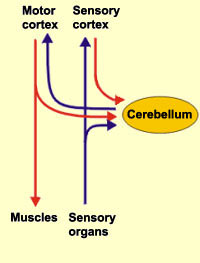
The outcome of this motor program will be more or less, “recorded” for future reference when you need to complete a similar task. Whether the task is successfully completed or not and how it made you feel, determines if the program will be closely replicated next time.
All of this is relevant to keep in mind when it comes to any type of training, but it encapsulates the whole premise of perceptual training. Perceptual training consists of helping the athlete to identify key elements in their environment to cue them on how to react with the appropriate movement.
Now you can get pretty deep in sport-specific factors that may be important in perception, but for the purpose of this installment, we are only going to look into the visual elements of general sport. For starters, a few key visual factors that will influence all sports are eye dominance, spotting and the vestibular system.
Eye Dominance
Eye dominance plays a key role in how your brain handles site. Just as you have a hand that you prefer to use, you also have an eye that prefer to see from and they may not be the same side. Because both eyes send slightly different portraits of the world, the brain chooses one that is trusts more. In this eye, images may appear clearer, more stable, larger and it has even been suggested to have perceptual processing priority. Some have even hypothesized that it can actually inhibit the sensory information from the non-dominant eye.
There are several types of dominance and honestly, it can all get pretty thick, but the key point to hold onto is that the information gathered through the dominant eye is going to be more credible, processed more quickly and may potentially affect the action taken as compared to if processed primarily through the non-dominant eye. Now there are studies that look into if cross-dominant individuals(right-handed and left-eyed) have an advantages in side-stanced skills like batting due to the closer position of the dominant eye, but they have found no relationship. This is because the stimulus is still well within the focal system of vision, just as it would be with a non-cross-dominant individual.

Now here’s where the shizz-nit gets cool for coaches. Though the athlete may not have an advantage to the dominant side of focal vision, they should theoretically have an advantage in that side’s peripheral vision. This is because the peripheral vision is dependent on the ipsilateral eye, as noted on the above diagram. If we know that one side’s ambient/peripheral vision will have a decreased response time, we can play it to our advantage This could be a game changer in where we position certain athletes.
Another important note to make is that the ambient system is largely controlled by subconscious function. So to take it a step further, you could start performing reaction-type drills within the athlete’s dominant peripheral vision so that the desired response is autonomous(done without thinking). This would help to ensure not only the decreased response time, but more desired responses. This may include drills such as setting a volleyball to a player from their dominant side just within their peripheral vision.
Spotting
No I do not mean the action of helping your bro with his bench press. The spotting I mean is the action of fixating on a particular point during a rotational movement to help reduce dizziness and keep the athlete oriented. You see this when a dancer spins, they will look to one point and keep their eyes set on that point until they are forced to reset. This serves as more of an internal cuing for the vestibular system, but it can be very important in skill acquisition and perception.

As many coaches can note, vision drives movement and wherever the eyes go, the body will follow. This is why appropriate spotting is key in a variety of movements. If the athlete fixates in the wrong position or the wrong time, they could easily throw off their movement, timing and overall performance. An athlete that seems to be over-spotting could be compensating for a vestibular issue. If that’s the case, no amount of technique work will bring that skill to fruition until their vestibular input is restored.
Just the same, there are several cases where the spotting point should be coached to help drive a skill. Think about the individuals who adjust their vision as soon as they hit a golf ball and how it affects their follow through. Or how some baseball players may prematurely look into the field when they hit and negatively affect their swing. You want them to stay fixated on a spot so that the movement can be completed smoothly without alteration of perception.
Vestibular Input
As I mentioned when reviewing spotting, the vestibular system is going to play a vital role in an athlete’s perception. The vestibular system is an internal sensory system that controls the sense of movement and balance, soooo it’s kind of a big deal. It’s largely overlooked in many training programs, especially considering it is the system that will influence EVERYTHING we do. In fact, it is so important the first sensory system to fully develop(at 5 months post conception).
The reason I am including this system in an article on visual training is that the vestibular system will rely heavily on sight for reassurance. It’s always trying to find equilibrium to keep you from falling on your face. Whereas most of the informationused for equilibrium comes from balance organs in the inner ear, it’s estimated that 20% comes from your vision. Consider the fact that most people do not regularly challenge the sensory organs in their ears(rolling around, tumbling, etc.) and yet they are almost ALWAYS using their eyes for feedback, you can see how a compensatory relationship can form.
If an athlete does have a dysfunctional vestibular system, you may see several signs: a loss of mobility when the head is no longer neutral, constant spotting, poor overall balance, etc. The easiest way to rule this out as an issue is to have them stand on one leg with their eyes closed. If they truly suck at this, THEN IT NEEDS TO BE ADDRESSED. Motor control cannot be progressed without the athlete first being able to figure out where they are at in space.
** Fun fact: Regularly working the vestibular system through activities that will work the inner ear organs will help to keep an active brain and grow new nerve cells.
Putting it together
With these factors in mind, I coach can easily address vision training on the field or in the weight room. Knowing an athlete’s eye dominance, when they should be spotting and when their vestibular system is the limiting factor are all HUGE factors of performance. Being able to incorporate the appropriate drills and strategies to match these needs can easily take your athletes to the next level. My next installment will include more sport-specific and task-oriented elements that will help you to take your drills a step further and have your athletes a step ahead of the game.
Movement + Young Kids = Successful Athletes
Today"s guest post is SAPT"s Mike Snowden, Intern Extraordinaire!
Today’s post carries on this month’s idea of training for youngsters. In previous posts we’ve seen how strength training can benefit this population and now we will discuss how movement plays a critical role in a child’s development. Brain development research has shown that humans possess a “window of opportunity” where sensory and movement experiences are necessary. These experiences play a unique part in the social, emotional, spatial awareness, sensory-motor, language, and cognitive skill progress of a child. For the development of skills, this “window of opportunity” is open from before birth to around age 7 and it begins to narrow with age. Experiences during this period are vital in laying the foundation of a person’s motor control skills.
So how can you help a youngster, you might ask?
- Give children lots of sensory-motor experiences, especially of the visual-motor variety.
- Example: Having kids strike, kick, throw, bounce, and catch balls or soft objects of different sizes and shapes with both sides of their body.
- Have your child perform an assortment of gross motor activities involving locomotion, postural regulation, and coordination.
- Example: Crawling, rolling, tumbling, jumping, running, balancing games
- Combine these movement activities with music
- Musical chairs AKA The Best Game Ever!!
- Encourage children to draw and scribble with markers or pencils (on paper not walls) to develop fine motor skills.
- Allow kids to play
- Experiences with outdoor playground equipment stimulate movement exploration (problem solving) and creative play (critical thinking)
The Science
The importance of movement and sensory experiences was found during studies (find a related article here) that compared brain structures of animals raised in environmentally normal, deprived, and enriched settings. The animals that experienced the enriched settings were given the opportunity to interact with toys, treadmills, and obstacle courses (animal playgrounds). This research led to the conclusion that stimulation is a significant factor in overall brain development. Animals placed in enriched environments had brains that were larger and contained more synaptic connections.
What does this have to do with kids?
"Though animal stand-ins don’t exactly represent the biology of the human brain, their brains have many of the same basic structures and functions," - Dr. Sharon Juliano Uniformed Services University of the Health Sciences
Thus, we can cobble together reasonable theories that can be applied to humans. More information on it can be found here.
(Note: the following is not scientifically verified, but based on our experience over the years with our athletes.) As coaches, we can see the difference in kids who were not active as young children compared to those who were. Kids who were physically active generally have more body awareness, greater overall motor control and strength, and learn new movements relatively easily. At SAPT, let"s say we have an athlete who struggles with the aforementioned skills. We program rolls, crawls, jumps, tumbling drills, and toss-and-catch drills. Guess what? That usually produces vast improvements in their global movement patterns (like the squat or lunge pattern, for example). Not only that, but as their confidence increases as they improve, which only leads to even more improvements as they tackle new exercises and movements. Win!
What that all boils down to is: MOVEMENT! Young kids, (infants, toddlers, etc) need to move. Movement is how they explore and learn about their bodies and how to respond to their environment. Those first 7 years are critical when it comes to developing their motor map. Play on!