
Keep It Regular During the Holidays: Eat Your Fiber!
Oh, the Holidays...between Thanksgiving and January 2nd, there is a LOT of food rolling out of the kitchen. Considering all that delicious meats (turkey, ham or, in my family’s case, crab), sweets (pies, cookies etc.) and higher fat foods (which are fine in moderation) fiber tends to get pushed aside and then we end up with not-so-regular bathroom habits. And we all know what that feels like…
What better way to prevent all that than to make sure your fiber intake is still high? (I know, that’s a grabber of an opening sentence). This is from the nutritional fitness person who believes that poop is important and I want to ensure the SAPTstrength readers are prepared to be comfortable this holiday season.

Fiber comes in two flavors, insoluble and soluble.
Insoluble: fiber that does NOT dissolve in water. This is found in things like corn, carrots and some nuts and seeds (any fruit/veggie with tough cell walls that don’t break down easily), and it bulks up the stool. Gives it some heft, one might say, so that gravity can do it’s job of pulling it down and out.
Soluble: fiber the DOES dissolve in water and forms a gel-like substance to help ease the passing… glide, slide or shoot through, however you want to think of if. Soluble fiber is found in oats, beans, apples, peas, lentils and psyllium husk (Metamucil anyone?).
Why eat fiber?
1. Regular bowel movements -> Need I elaborate?
2. Maintain healthy intestines -> Those regular bowel movements ensure that stuff doesn’t just sit in your intestines (ewww…) and can help prevent ulcers and other unpleasant things like that. There also seems to be a connection between the fermentation of fiber and gut health; more research is being done in that area.
3. Lowers blood cholesterol -> Soluble fiber may help lower LDL (the “bad” cholesterol). I’ll let an article from How Stuff Works.com explain:
When fiber interferes with absorption of bile in the intestines, the bile is excreted in the feces. To make up for this loss of bile, the liver makes more bile salts. The body uses cholesterol to make bile salts. So in order to obtain the cholesterol necessary to make more bile salts, the liver increases its production of LDL receptors.
These receptors are responsible for pulling cholesterol out of LDL molecules in the bloodstream. Therefore, the more bile salts are made from the liver, the more LDL cholesterol is pulled from the blood. There is more to be learned about the relationship between soluble fiber and cholesterol, however. It is also possible that one of the short-chain fatty acids produced by the fermentation of soluble fiber in the large intestines may inhibit the amount of cholesterol produced by the liver.
Cool huh?
4. Helps maintain a steady blood sugar levels -> Fiber slows the absorption of glucose into the blood stream thus preventing wild spikes and dips. And we all know that the holidays are laden with super-sugary foods can lead to these spikes; these aren’t great on the body.
5. High fiber diets aid in both weight loss and weight maintenance -> How? a) See #4; wild blood sugar highs and lows lead to insulin spikes which wreck havoc on the fat-loss biological pathways (insulin isn’t evil, but constant spikes can hinder fat loss). b) fiber keeps you full longer and generally high fiber foods are lower in calories. c) High fiber foods also tend to be high in antioxidants and anti-inflammatory compounds which, while I can’t point you to any studies, anything that reduces inflammation and stress in the body is going to help promote healthy weights.
So, if fiber is SO AWESOME… how much do you need?
The American Academy of Sciences’ Institute of Medecine recommends for men under 50, 30g and women under 50, 25g. Men and women over 50 should shoot for 30g and 21 g, respectively. Active folks need up towards 40-ish grams. (not sure why that is.) Anyway, the average American eats about 4-11 grams…fail.
How much to you eat, realistically? Think about that…
Anyway, how does one get more fiber? Pretty easily actually. Just eat more vegetables and fruits. It’s not terribly complex. I also take Metamucil (as does my husband… but don’t let his experience deter you!). I know, I know, you should always go for the whole food sources first, and I can tell you: I do. I eat a LOT of vegetables and fruits (kale, 2-3 apples per day, and a lunch and dinner that’s 60-75% vegetables). Unfortunately, I have a very sensitive system. If I’m even just a little stressed (as in, I only got 7 hours of sleep instead of 8), I won’t poop. (More info that you wanted, but I know I’m not the only one who struggles with that.) Which in turn, stresses me out a bit more because I’m uncomfortable and the cycle just continues. Metamucil has made my life much better as it just helps give my system the extra budge it needs.
So, while I say first reevaluate your vegetable and fruit intake and only if you’re eating a lot at every meal and still struggling… add in some pysllium husk (which you can also take by itself).
Anyway, for a healthier and happier holiday season, don’t leave fiber out in the cold!
Set/Rep Schemes: Is 3x10 King?
“What’s the right formula for number of sets and number of reps for an exercise? I’m so used to hearing '3 sets of 10,’ is that right or wrong?” On the heels of Jarrett's post on Friday, I thought we'd talk about the common 3x10 set/rep scheme and why it's ok to NOT follow it.
Excellent question, especially since the coaches at SAPT rarely program 3 sets of 10, at least not on a regular basis. Has this been a burning question on your mind? Of course it has, so let us dive in.
First, a brief history lesson. The famous “3 sets of 10" actually came out of the brains of two fellows named Dr. Thomas Delorme and Dr. Arthur Watkins. Both were Army physicians during of WWII, and towards the end, there was an enormous backlog of soliders with orthopedic injuries. The recovery time was slow due to lengthy rehabilitation procedures. They were the first ones to develop a structured weight training protocol based on progressive overload, which, they theorized, would speed up recovery time. They wrote a paper (1948), and later a book, Progressive Resistance Exercise: Technic and Medical Application (1951), detailing their research findings. One quote I thought was rather lovely:
“The number of contractions per bout is arbitrarily set at ten. If fewer repetitive lifts were required, the resistance could be increased. Whether ten is the optimum number for rapid increase in strength has never been established in terms of criteria other than the empirical practice of weight-lifters. It is probable that the number closely approaches the optimum.”
See? 3 sets of 10 reps is not set in stone; it’s just the numbers the good doctors worked with and recorded their results. You can read about it here, if you want.
Now, moving on to why we’ve expanded upon Drs. Delorme and Watkins’ work. Subsequent research has provided insights on muscle inner-workings and strength building. In the effort of remaining true to the KISS principle, I’ll list a small snippet of the knowledge out there since the Drs. created their famous set/rep scheme.
Keep in mind that this is merely a scratch upon the surface of what goes on physiologically during weight training. (to include: energy systems used, hormonal responses, and what types of conditions elicit the various physical responses of the body. It will blow your mind. Mine is continually blown up every time I read about muscles. )
Ahem,
- As load increases, reps decrease and vice versa.
- As total exercise volume increases, intensity will decrease and vice versa.
- Muscles will adapt to the demands placed upon them (SAID principle).
So how does that help us coaches (and self-trained folks) determine set/reps. Well, as always, it depends.
If your goal is strength- which, by the way, it should be- you’ll want to stick to lower rep ranges (1-5) with weights closer to your 1 rep max. I shall NOT be diving into percentages and what percentage matches with what rep scheme as I’ve found they’re wildly different person to person. Generally, the closer you approach your 1 rep max, the less repetitions you can perform, as noted by Dr. DeLorme observed in his quote. As a coach, the exercises that mesh nicely to the heavier weights/lower reps thing, typically, are the money-makers: squats, deadlifts, chin/pull ups, and presses.
If your goal is strength, which it should be, (no, this is not a typo. Strength is the KING of physical adaptations.) using the 6-8 rep range lends itself well to assistance lifts such as single-leg work, rows, pushups, anything-that’s-not-your-main-lift, again, you can lift a heavier load for 6 reps than you can for 10, so… strength means picking up heavy things. This rep range affords a longer time under tension (meaning the muscles are working longer than say a 2 rep deadlift set), therefore building up their strength-endurance a bit instead of, say, a max-effort strength.
Now, this is not to say that you can’t get stronger using the 3×10 protocol (assuming you’re increasing the load), but it tends to only work for a little while, and it works best with beginners. In order for muscles to adapt to lifting heavy things, you have to impose that demand upon them by lifting heavy things. It would be more effecient to lift a lot of weight a few times than a little weigh a lot of times (this goes back to the energy system and hormonal response thing I mentioned earlier. This will be a future post… but for now, from a physiological standpoint, you’ll get stronger faster lifting a heavier weight a few times.)
Another reason, outside of the strength reasons, SAPT coaches use sets composed of less than 10 is technique. We’ve found that having someone, especially a beginner, perform sets of 10 squats just ends up in fail. Form goes out the window as muscles get tired and attention wanders. There’s a lot going on in the big lifts (chest up, butt back, toes up, on your heels, brace… etc) and it’s difficult for a new athlete to keep it all in his/her head for extended sets. Thus, sets of 5, for our beginners, works out nicely. Our more experienced athletes stick with this rep range as they progress, well, because they’re lifting heavier things.
We do program sets of 10, but usually it’s a corrective or mobility exercise, such as a facepull or wall slide, or sometimes we’ll throw in some reverse crunches so our athlete’s can “feel the burn.”
In the end, we stick to the lower rep ranges to either practice technique (beginners) or elicit strength adaptations (experienced). As the smart Drs. said, the reptition number was arbitrarily set at 10. Later, research found that strong people lift heavy things a few times. The set/rep combinations are endless; train for strength, keep it simple, and have a fun workout!
Rapid Wave Sets for Size and Strength
Tis’ bulking season for most trainees and that means a constant search for methods of stimulating new muscle growth for strength and size. Today’s post is just that, and at no better time than a week before the Christmas Feast gainz.
What you Need to Know:
-Wave Sets are easily manipulated for whatever goal you have.
-Rapid Wave Sets with controlled rest periods are a great way to put on some size while still working towards your strength goals by capitalizing on PAP.
-Rapid Wave Sets are a great way to break plateaus for experienced lifters who no longer respond to traditional rep schemes.
-For optimum mass gain, you need high volume at a relatively high intensity with limited rest, which is something you can achieve when manipulating the waves correctly.
How they work:
A Rapid Wave Set is typically used for your main strength movement. The, “wave” indicates that there will be a high and low number of reps done depending on the set and as you guessed, rapid wave sets indicate that those numbers have a fairly steep jump/drop.
By first doing lower reps at a higher intensity it ramps up your CNS to elicit more high-threshold motor units for subsequent sets due to a potentiation affect. By doing a heavy double and then following up with a set of 6, you are recruiting more fibers than if you had just started with the set of 6. This allows you to hit a higher weight for the higher-volumed set than you usually would get.
Through manipulating the rest periods between sets, you can help to elicit more of the training effect you want. For those of you looking to put on some meat, lowering the rest between the heavy double and the set of 6 to about 30-45 seconds may be optimal. I’d also suggest keeping the rest between the set of 6 and the doubles to 90-120 seconds. So in short, an example for an experienced trainee who is looking to put on some muscle may look like this:
2 @ 85%
:30 rest
6@ 75%
:90 rest
2 @ 87.5%
:30 rest
6 @ 77.5%
:90 rest
2 @ 87.5%
:30 rest
6 @ 77.5-80%
The heavy set is mainly there to help improve the volume set and thus does not need a lot of rest. Keeping the rest to 90 seconds between waves and 30 seconds between low and high volume bouts should help to provide a large amount of work in a short time period without sacrificing much else. Of course you can choose different rest for different rep scheme choices, but the ultimate goal is to capitalize on the PAP with minimal affects from fatigue. Typically this type of effect is used for improving rate of force development within athletes, but as I said before, this article is looking more into its use for putting on mass. By capitalizing on window 1 below, we prime the PAP, but rather than using the hightened state for overall force development, we use it more for its affects on power endurance. By doing so, we are able to recruit more motor units(primarily of our fast twitch fibers, which have more potential for growth) to be stressed in the subsequent higher rep scheme that they would not normally be present in. This gives a rare time-under-tension stimulus for these motor units that yields a huge potential for growth.
You’ll also notice how the percentages increase steadily, but the heavy sets start to level off. That’s because for the desired training stimulus, there is no reason to go heavier on the doubles. You actually run the risk of over-exerting yourself and pulling away from the sets of 6(which are going to be fairly hard). So even though the amount of weight being lifted SHOULD be higher, the RPE(rate of perceived exertion) should remain somewhere between a 7 and 8(moves with good speed but still feels heavy) while the higher sets are closer to 9. I use the percentages above just as an example, in reality since this method relies heavily upon an immediate response of the CNS, it's much more appropriate to go off of RPE and feel. Some days you will respond much more positively than others. After the first wave you will have an accurate idea of how much you can increase you volume sets.
Give these a try on your next program, I guarantee you won’t be disappointed. Just keep in mind what movements may or may not be appropriate for it. I mainly use it when programming for the big 3, but have even had success when using them for pullups. Also remember that this method can be very taxing to the system, so be mindful of when to deload. Enjoy!
Part 9: In-Season Template
The Triathlete Strength Training PrimerPart 9: In-Season Strength Training, Continued.
After another brief hiatus, we’re back with Part 9 of this series! In part 8, we discussed what the goals of a triathlete’s in-season strength training program should be. It’s important to understand that the time to focus on gaining strength, power, and endurance was in the off-season. Now that competition has begun, we need to structure our strength work in a way that allows us to maintain the gains made in the off-season, and negate any of the repetitive, tissue-stressing forces that result from sport training.
Before we dive in, let me state that what is provided below is strictly an EXAMPLE template. It’s a snapshot of one day of training, crafted from the templates that have been created during the last 8 articles in this series. Your training may look slightly different, and should be tailored to your own individual strengths, weaknesses, and whatever chronic issues that you personally deal with. However, when all is said and done, your training should follow the principles and concepts that have been laid out in this series. These include, but are not limited to, specificity, progressive overload, reversibility and the periodized goals of the current season.
With that being said, let’s take a look at an example template and break it down into something a little more digestible…
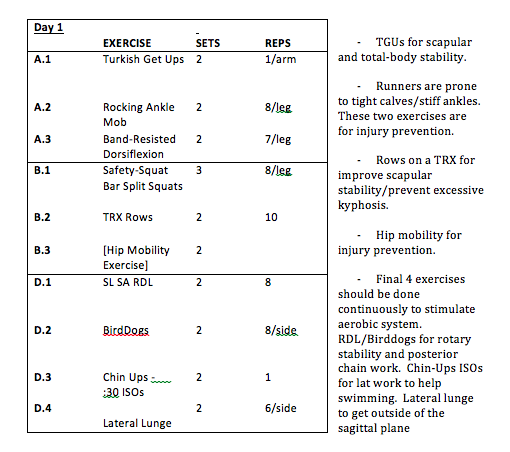
- Volume and Frequency
You’ll notice that the session’s total volume is much lower then any given pre-season or off-season session. Sport-training should be at it’s highest during the competitive season, and due to this, we need to compromise by decreasing our time in the weight room. Our focus has shifted to maintaining performance elements, and this requires less total volume then if we were looking to build strength or endurance. In this case, we have decreased the number of sets that we’re performing of each exercise in order to decrease our volume.
Since the in-season involves a much higher volume of running, cycling, and swimming, we’ll transition to programming only one or two strength sessions per week. This is really all we need in-season, and scheduling any more will simply be taking up time that could be spent refining your running technique, or recovering from your last long-distance ride. I would suggest getting in the gym twice a week on lower-volume weeks, and maybe only once a week during high-volume periods or in the week leading up to a race.
- Exercise Selection
Looking at exercise selection, you’ll notice that the movements have all been performed previously in this athlete’s training. The competitive season is not the time to introduce new movements. Programming a new movement will stress the body in a way that it has not previously been exposed to, and, oftentimes, you’ll experience unwanted soreness as a result. On top of that, adding a new movement and then performing it with a challenging load is a recipe for disaster, and your sport-training will most likely suffer. Your sport-training should be a priority during this time of the year, and trying new things in the weight room will only undermine from this approach.
On top of that, you’ll notice the exercises are very specific. The main movement is a safety squat bar split squat. This was chosen because this split stance more closely mimics gait than a traditional bilateral back or front squat, and it doesn’t contain the element of absorbing force the way a barbell lunge does. With all the running volume, I would personally steer away from using a lunge variation in-season, as we’re getting plenty of deceleration and impact-absorption during our sport training. We could cycle in lunge variations throughout the competitive season, but I would be mindful to use them during times when your running volume is lower.
https://www.youtube.com/watch?v=plb8z9oBoG4&list=UU5TxLuwpeMisc6vJuPAmZ2w&index=6
- Exercise Intensity
Now let’s talk exercise intensity. We shouldn’t be trying to move the heaviest weights we possibly can during these movements. The safety squat bar split squat is programmed at 8 reps/leg, but I would coach this athlete to use a weight that he can hit for about 12 reps. This way we’re not overloading the body too much, but the intensity isn’t so low that our muscles are not being stressed. You can certainly vary the number of reps you are programming. Early on in the competitive season may provide a good opportunity to bring back sets of three or four in order to train strength, but as the more important competitions approach, the athlete should be working in the rep range that is the most specific to their event which, in this case, is higher repetitions in order to train local muscular endurance.
- Cycling in isometric work/removing the eccentric portion of the lifts.
The eccentric portion of any given exercise is where most of the muscle tissue damage occurs. By removing this portion from our program (as in the chin-ups in the template above) we’re removing the portion of the lift that is going to cause soreness, but still working the desired musculature. Looking at this template, it might be a good idea to cycle between safety squat bar split squats, and safety squat bar ISO holds. A savy program designer could up the intensity on the ISO hold weeks (while still being mindful not to over-do it), and lower it during the split squat weeks. This way, we’re varying the intensity of our main movement and maintaining several performance attributes throughout the season.
- Piggy-back off of your Off-Season plan.
If you’ve been paying attention, you’ll notice that the early off-season and competitive season share a couple of similarities. Specifically, the goals of both include preventing or reversing injury caused by the sport. Last time, we talked about triathlon landing on the far left of the “Speed-Strength Continuum,” and the inherent lack of stability that this can cause at our joints. Due to this, we want to ensure that we are programming in a way that minimizes this effect. The Turkish Get-Ups, TRX rows, and lateral lunges are in this program for that very reason. The get-ups are a fantastic “catch-all” stability exercise. Using a suspension trainer for the rows will shift the focus more toward scapular stability, while also pulling the athlete out of the kyphotic posture that they are sure to develop on the bike. Finally, programming lateral lunges will help stretch out our adductors in a dynamic movement, demand stability at our hip joints, and get us out of the sagittal plane.
https://www.youtube.com/watch?v=CZ6BT0X4nJQ
Wrapping Up
Hopefully this article has caused you to think about your in-season training a little more methodically. The past two articles have laid out exactly what a triathlete should be focusing on in-season, and then provided examples with detailed explanations and more. As always, please reach out and leave a comment if you liked the content, or have any questions or concerns. I'd love to be a resource for all your endurance athletes out there, and help you make the most out of your gym time. Next week, in what should be the final post of this series, we'll discuss what to do immediately after the competitive season ends.
The Triathlete Strength Training Primer
Part 1: An Intro to Periodization - Seeing the Bigger Picture Part 2: The Repetition Maximum Continuum Part 3: The Preparatory Period a.ka. the Off-Season Part 4: Off-Season Periodization Part 5: Off-Season Periodization, cont. Part 6: The First Transition Period Part 7: The First Transition Period, cont. Part 8: The Competition Period - In-Season Strength Training Part 9: In-Season Template Part 10: Post- Season Training
A Gift Guide For The Athlete in Your Life
It’s the most wonderful time of the year again so let’s take a look at some of the gifts for the athlete in your life that they may be craving but forgot to mention on their holiday wish list. The athletes of today require diverse gear and fabrics that can take a beating and keep them jolly. To save you time I combed the internet and spent hours researching and collecting data on products to make you the best gift giver of the year. Discussed below are twelve products, in no particular order, guaranteed to put a smile on the face of the athlete in your life come December 25th.
Trigger Point Grid Foam Roller
Muscles need work but they also need help recovering and recuperating to be strong and healthy. Give the gift of mobility with the foam roller that is just the right size to haul around. It comes in multiple sizes as well as some pretty slick colors.
Epic Bison Bacon & Cranberry All Natural Meat Bar
These awesome bars are a combination of trail mix and jerky. . . . Yum
The North Face ETip Gloves
There aren’t many things more annoying than having to take off your glove on a frigid day just to answer a text message. Etip gloves eliminate that experience by having a technical fabric on the fingertip that is recognized by touchscreen phones and devices so you can keep your digits warm and cozy.
"Mind Gym" by Gary Mack and Dave Casstevens
This is a great read for athletes of all ages to learn about the effects the mind has in reaching excellence.
Nike Epic Lux Printed Women’s Running Tights
Tights are very universal. They can be worn alone in multiple settings. They can also be worn as a base layer under jeans or sweats when it really gets cold outside. This functionality combined with an awesome snake skin print makes these pants a win win deal for a sporty lady.
Taylormade Lethal Pack
Perfect for the golfer who consistently runs out of golf balls. Taylormade now has tour caliber balls available in 20, 50, and 144 packs.
The Myobottle
If your favorite water bottle and foam roller had a child it would look something like this. This awesome bottle holds 1.5 liters of your favorite sports drink and has a eye catching four ball shape that can be used to release tacked down muscles fibers.
Re-Stringit Drawstring Re-Threader
If you've ever had to figure out how to restring a hoodie or your favorite sweatpants you know how tough and infuriating it can be. In comes this handy gadget to save the day.
Trail Mix of The Month Club Membership
One thing someone with an adventurous lifestyle doesn't want to forget is a snack. With a membership here, the athlete in your life won’t get caught hungry again with a new mixture of high quality trail mix delivered every month.
Tory Birch Gold Fitbit Bracelet
If the standard rubber Fitbit bracelet isn’t stylish enough for your loved one then spice it up a bit with this gold or silver bracelet that’s ready to transition from sweaty to chic when they are.
Endless Pool Spa with Underwater Treadmill Option
For those who like to go all in, the newest Endless pool spa may be just the gift you've been looking for. This spa has a current that allows you to swim in place plus a built in treadmill so you can knock out a nice run. The spa also has ample seating space so friends can have a seat and watch you train.
Experia by Thorlo Socks
These aren’t the socks grandma used to give out. This super light socks breath very well to let moisture escape. They also have reinforced cushioning in the strike zones of your foot to ensure your 14,000th step of the day is just as comfortable as your 1st.
Hopefully this list has given you some great ideas as Christmas day gets closer. If not, there is still plenty of time and remember if all else fails go with a Starbucks gift card.
Lembas Bread For Muscle Building Outside Middle Earth
Admit it, when you either read or saw lembas bread in Lord of the Rings, you really wanted some.
There’s several recipes out there for it, but I made up a protein and fiber-rich version for the nerdy-lifter that I am. *Disclaimer* I’m still tweaking the amounts, so this may not be perfect but it’ll at least be a platform in which to launch your own version of lembas.
I used coconut flour as my base. Say wha? Yep, coconut flour is merely dried coconut meat ground up into a flour-like consistency. What’s so good about coconut flour? I’m so glad you asked!
Coconut Flour Fantastic-ness:
1. Very high in fiber, about 9 grams for 2 tablespoons, which is terrific for, well, the whole poop thing. Compare that to the fiber content of wheat flour, which is a dismal 1-2 grams… ick. Perfect for keeping you regular while traipsing through Middle Earth.
2. It’s gluten free which is helpful for those who have a gluten intolerance or allergy and still want to eat lembas. Or, even if you don’t, it’s nice to give your system a break from the gluten of bread and other gluten filled treats. (it’s everywhere…).
3. Contains the healthy fats of the glorious coconut. However, I’m not sure how much of it is actually retained in the flour version since it goes through a defatting process. Some of that fat is better than none though. This helps fuel long treks across Mordor. How else do you think Sam and Frodo made it? Not on fat-free Snackwell’s cookies!
4. Does not have the power to raise glucose levels like other flours (wheat, oat, etc) so those watching their blood sugar… rejoice! Steady blood sugar bodes well for sustained battles with orcs.
Now, onto the recipe. Sorry I don’t have pictures. I didn’t think to take any during the baking process.
- 1-1.5 cups coconut flour (depending on how big of a batch you want to make)
- 1-2 scoops protein powder-o-choice
- 1 somewhat-heaped tablespoon of coconut oil, melted
- Roughly 1 cup of almond milk (or regular milk). The amount will vary depending on the consistency of the batter you desire.
- 1 egg or 1 heaping tablespoon of nut butter. Coconut flour can be very dry, so the addition of either one will help cut that down a bit. Just know that the peanut butter will take away from the lembas-y taste. I doubt the real lembas had peanut butter in it.
- 1-2 tablespoons of agave or honey
- 1 teaspoon of vanilla
1. Preheat oven to 275 and grease a cookie sheet.
2. Combine the dry ingredients, flour and protein powder, and break up any lumps with a spoon.
3. Add the coconut oil, egg (or PB), vanilla, and agave/honey and combine well.
4. Slowly add the milk until the consistency no longer resembles wet sand. It should be more clay-like or maybe slightly watery clay.
5. Spread evenly in pan and bake from 15-25 minutes or until lightly brown on top.
6. Allow it to cool before either gobbling it up or wrapping it in nice big leaves.
There we have it. A LOTR-inspired protein bar for the athlete or hobbit on the go!