What You Need to Know About Training While Sick
It’s flu season! And with flu seasons comes the age old dilemma of figuring out if you’re too sick to train. Every trainer can attest to the dozens of emails and texts that we receive stating, “I’m kinda sick, should I still come in?” Just like every other answer we give you about training, it depends. Are you contagious? Fever? Just a cough?
The last thing you want is to make yourself worst or lessen your recovery, but the thought of missing out on all the gainz is just as maddening as the tickle in your throat! This dilemma is sure to be even more prevalentthis year considering the fact that the flu shot has missed its mark and is only 23% effective.
"Listen to your body"
Yes, I just dropped that cliché line. But honestly, it’s true. If you’re feeling unmotivated and weak from your illness, then pushing through it is not a great idea. It’s important not to mistake motivation for stupidity. Forcing one intense session while still recovering can prolong your recovery and keep you from getting back to positive training effect sooner.
The main symptoms that will excuse you from trying to get your gainz on are generally:
- If it’s anything below the neck(chest congestion/bronchitis, diarrhea/stomach issues)
- If you’re contagious…. Seriously, if you come in and get me sick, you’re getting backflips to failure in your next program
- Fever
- Wide-spread muscle aches (has potential to create compensations in your movements and cause an ineffective session)
Obviously if it’s just a runny nose or just some minor signs, get over yourself. You may need to scale the intensity, butexercise should actually help your condition. In fact there are several studies that have linked cardiorespiratory exercise to significantly reduce the likelihood of upper respiratory infections aka the common cold.
Strength training will also help to stimulate the immune system, however it’s recommended that intensities stay conservative. Higher intensity lifts can take more of a toll on the CNS and result in temporary immunodepression. This is no bueno if you’re currently fighting off an illness and could make it easy pickings for the bacteria. It’s for that reason that it’s usually a smarter idea to have a speed day or stick to about 80% effort.
With all of this being said, even if you’re too sick to train, you’re not too sick to move. Be sure to get your rest, but staying in bed all day may actually limit your recovery. The reason for this lies in your lymph.
We’re used to hearing about how important it is to get the proper nutrients and to stay hydrated while we’re sick, but not much is mentioned beyond that. When you have a fever or when you’re fighting off illness, your cellular metabolism increases. This is why the extra hydration and nutrients are key. With the increased metabolism, comes increased biproducts and waste. The lymphatic system serves to help clear this waste as well as extra fluids, nutrients and infectious material/bacteria to the closest lymph node where white blood cells do their thing to clean everything up.
The way lymph (and the bacteria, waste, fats and fluids that it carries) is transported through the bodies is through capillaries similar to veins. Unlike arteries who use the pressure created by the heart to shoot blood forward, lymph capillaries and veins rely on muscular stimulation for transportation. Their structure prevents any back-flow so that when tension is put on the segment, the fluid can only move forward. Without surrounding muscular stimulation, there is very little movement.

The lymph already doubles blood in volume within the human body, but during illness there may be even more. Ideally it serves to move that much more waste and infectious materials to the lymph nodes, but when the individual remains bed-ridden it’s all for naught. This just pulls more of the hydration from the blood and can result in lymphatic congestion when one is extra sloth-like. Without the muscular stimulus to push the lymph through its capillaries, the infectious materials, pus(gross, right?) and bacteria just pool instead. This is VERY counterproductive to getting back to health.
By giving your body certain conservative movements, you can actually help to expedite your recovery process through draining the congested lymph structures. All while helping to maintain joint mobility and peace of mind.
Movements to do while laid up
1. Bounce
Yup, bouncing up and down. It sounds silly, but it actually helps to move the lymh through the entire body. Because the body goes from a moment of weightlessness to almost double within seconds the body’s tissues go from no pressure to a lot of pressure back to back. This creates a pump-like stimulus on the tissues and helps with lymph and venous return to help clear out the congestion. It also doesn’t need to be as weird as it sounds, if you’re healthy enough you can jump rump or do jumping jacks. If you’re pretty ill you can just sit there and bounce on your bed. Or you can even do whatever this is:
2. Foam Roll
Foam rolling is rarely a bad thing. This too can help to serve as excess pressure on the tissue to improve lymph flow. It also is just good for general soft tissue health. You can increase its effectiveness on your illness if you focusing on rolling centripetally(towards your heart). This will just help to ensure more of the fluids are moved towards their respective lymph nodes and eventually back to the thoracic duct.
3. Movement Flows
Just doing light movement flows can make a world of difference in the way you feel. Again the activation will help move some fluids around, but it’ll also just help you to work on mobility, stimulate your parasympathetic nervous system and just give you some quality patterning work.
https://www.youtube.com/watch?v=-SdYZk-YYJY
4. Balloon/straw breathing
There are hundreds of breathing drill variations, but choosing one that focuses on thoracic expansion and active exhalation can be extremely beneficial when you’re recovering from a flu or cold. The thoracic duct(think end of the line for lymph) sits in the thoracic cavity, obviously. By focusing on a breathing drill with these characteristics, you can create the pumping mechanism once again, but right where the lymph delivers the excess nutrients it picked up right back to the blood. It also assists in getting a good stretch out of your intercostals, which are probably pretty tight from all the coughing you’ve been doing.
https://www.youtube.com/watch?v=PfgBGJY4VEw
So stop being a bum and get out of your bed so that you can get back under the bar or on the field that much faster. Utilizing these movements within reason as well as covering your rest, hydration and diet can dramatically shorten the amount of time you're out.
Movement Patterning: The Why and the How.
Movement Patterning: The Why and the How. I love lifting weights. I think it's safe to say that every single person who works for SAPT, also loves lifting weights. Sometimes the very thought that people exist who actually don't enjoy the process of picking heavy objects up and putting them down again, keeps me up at night. How could you not enjoy this...
https://www.youtube.com/watch?v=UrQ7Jq1s95o
That's 462 pounds!! Insane!
BUT, before I was able to enjoy dropping down into a nice deep squat with 225 pounds on my back, I had to learn how to actually perform a proper squat in the first place. You can't be strong without first being proficient. Words to live by.
As you may have gathered, today I want to talk about the importance of becoming proficient at a movement pattern PRIOR to becoming strong at a movement pattern. It may seem obvious, but it's something that a lot of beginner lifters get wrong, and it's something that we hold in high regard when progressing our own athletes. In my opinion, possessing the ability to teach a new movement to a beginning lifter, is just as valuable (if not more so) then the ability to progress a lifter's strength levels. This is what separates the good coaches from the great coaches, and our track record of teaching proper lifting mechanics speaks for itself.

The Why?
It may seem crazy, but I've heard stories of coaches attempting to lower an athlete's squat depth by loading up the bar with more weight then they can handle and telling them to squat and hold it at the bottom, essentially using a large load to "push" the athlete into a deeper squat. I hope it's obvious to you how poor of a strategy this can be. Unsafe, unreliable, and unacceptable, we prefer to use much safer and more effective methods at SAPT.
https://www.youtube.com/watch?v=lbozu0DPcYI
During the first 6-8 weeks of lifting, the "gains" that a beginning lifter experiences is mainly a result of increases in neuromuscular efficiency. Let's take the squat for example... When you first start squatting, your body needs to adjust to the demands of the movement. Rarely can a beginner drop down into a perfect bodyweight squat without falling backward, and even more rarely are they able to do it with a barbell on their back. It's a completely new movement, and a completely new demand that we're asking our body to undertake.
Muscles are stupid. They're "good soldiers" in that they simply accept commands and follow them through. Movement originates in our central nervous system. The motor cortex of our brain is termed the "motor control center," and it's job is to send commands down our spinal cord, through our efferent nerve fibers, and into our muscles. Our muscles then perform their role as "good soldiers" and provide a response in the form of movement. Only once these motor patterns are cemented down as reliable, effective motor programs, should we begin loading these movement and training strength. Remember, like Gray Cook says, movement quality over movement quantity.
The How?
Now how do we actually go about training movements and getting our athlete's proficient at them? Drills. Sport coaches have their players perform drills in practice in order to reinforce positioning, technique, and play proficiency. It simply makes sense that one would apply similar tactics to teaching someone a new skill such as deadlifting. Let's take a look at a couple of exercises that we use at SAPT in order to teach our athletes proper deadlift technique.
The Dowel Rod Hip Hinge
https://www.youtube.com/watch?v=2lHamIPidrc
This drill is our "go-to" exercise when it comes to teaching our beginner athletes proper deadlift technique. By performing this drill properly, the athlete learns how to organize their spine in a nice, neutral fashion, and hinge at the hips instead of at the knees. This drills a great "intro" to deadlifting, but is also useful as an activation drill for more experienced lifters and acts as a good "grease the groove" movement. We'll often include this drill in an athletes warm-up, their A series, or throughout the session. Below is an example of a deadlift day template where the hip hinge drill is used to groove the deadlift pattern.
BR KB Deadlift ISO
https://www.youtube.com/watch?v=ZPnyLULK9Cg
We use this next drill to teach our athletes how to set up properly and gain confidence in the bottom position. We've found it works very well to teach out clients how to properly engage their glutes, and we add a dynamic component to order to really get those suckers to fire during the lift.
https://www.youtube.com/watch?v=0uHFeR55Su0
This certainly isn't a comprehensive list of drills that we employ of SAPT, but they're effective and powerful tools for teaching proper mechanics. Jarrett Brummett, our on-staff Massage Therapist, brings up a few other drills and shows you the proper way to implement his creations in the post: 4 Drills to Clean Up a Hinge Pattern. I hope that this article helped you in some way, and please feel free to reach out if you have any questions at all. Enjoy your Thursday!
BONUS: Below is a snapshot of some of the other drills variations that ConcentricBrain has to offer!
Book Review: Power Positions by Andrea Hudy
This winter I’ve had a great opportunity to read some rather fantastic books on a variety of topics. One strength and conditioning related books I read was Power Positionsby Andrea Hudy, Assistant Athletic Director for Sports Performance at the University of Kansas. This book was a very easy read designed not only for the sports performance professional but also for parents and coaches looking to help athletes improve their athletic skill. Coach Hudy primarily works with the basketball programs at Kansas, but the book goes beyond that sport and separates athletes into three power positions that emphasize different types of training. These positions were:
Lateral or Reactive Athletes: Basketball Players, Setters and Middle Blockers, Defensive Backs
Rotational Athletes: Golfers, Tennis Players, Pitchers
Linear Moving, Speed Athlete, or Timing Athlete: Cyclists, Outfielders, Wide Receivers
The authors goes on to describe the physical requirements of each athlete based on sport and position and lays out typical methods used to train each type of athlete throughout a macrocycle. It’s complete with charts, data, and sample workouts to make the information easier to digest for the reader.
One portion of the book that I found to be very unique were the author’s descriptions of the fundamental movement qualities that she measures in athletes including:
Load: The ability to decelerate or control the body against gravity through anterior chain strength
Explode: The ability to create strength through muscle stiffness and brace against forces
Drive: The ability to overcome gravity to reach and maintain maximum speed through compliant muscular contraction in the posterior chain
To conclude, I think this book makes for a very useful resource with an abundance of information from an intelligent and experienced coach. Check it out if you are looking to increase your knowledge or are curious as to why, what, and when training is important.
Guest Post: Running Basics From The Mid-Distance, Mid-Aged Runner
Today"s post comes to from, in his words, "The Mid-Distance, Mid-Aged Runner." Thomas lives with his wife near Charlotte, NC. He began competively running in 8th grade and competed year-round all through high school. He"s been an active competitive long-distance runner since graduating high school in 1993. Currently, he runs 12-15 races per year (5-10K distance) and has a plethora of experience to share. Thanks Thomas!
Happy New Year Runners!
I hope everybody out there had a great Christmas and Happy New Year. I’m sure there are many people who made a New Year’s goal to get in better shape, and this potentially includes running. Unfortunately the weather this time of year and the eating habits of folks around the holidays can delay lacing up well-worn running shoes, much less band new ones.
The good news is, despite the weather and Christmas-cookie dinners, your running plans and hopes do not need to remain just that! In the majority of this first post in the series, I’d like to speak to the new runner; avid runners usually don’t need further convincing to run they just run! So to all my new runners (sometimes affectionately referred to as “Resolution Runners”) you had the tenacity to say you were going to try running, now let’s follow up on that declaration. I realize that this is easier said than done so here are my tips to get started.
First off you need to ensure you are ready to run. I’m not referring to the very popular three to four minute general stretching session that begins with both hands up in the air together in diving position, followed by a quick attempt to touch your toes (usually only reaching slightly below the knees), then progressing to the pull-foot to the buttocks standing quad stretch, and finally ending with the alternating arms crossed in the front of the body shoulder stretch. I can’t tell you how many times I see folks try to use this as a means to get warm and avoid injury.
If I may, allow me to be blunt: that modality of stretching is worthless, and can in fact lead to injury. Here is a great In Tennessee, traffic driving test game can be taken in person at a commercial driving school, or it can be completed online via a DOS-approved provider. stretching video for runners I recommend form YouTube: https://www.youtube.com/watch?v=nlitqDM40BE. A key point to remember is that you need to stretch after running as well. The post-run stretch is very important as this will increase blood flow. Many of the same stretches from the video can be used post-run as well.
Another piece of the puzzle is nutrition. This may sound familiar, but you perform to the level of fuel you put into your body. Good food choices include lean protein sources and plenty of fresh fruits and vegetables. Avoid regularly ingesting sugary, fatty foods, and other poor nutrient sources like alcohol. It can be beneficial to limit your caffeine intake to increase your sensitivity to it. This will increase it"s effectiveness during a race or long training run. Next, and I can’t stress the importance of this enough, drink plenty of water throughout the day. Your intake will vary slightly based off of mileage ran and temperature, but maintaining a consistent intake all year round I found helps my performance. For example I usually consume around a gallon of water (128 ounces) in a given 12 hour period. This may seem like a lot of water, and for the first few days you might feel like you are floating, but you will quickly become used to consuming more water the more you run. You will really notice how much better and energetic you will feel during your runs.
The next major focus to start running is to set attainable goals. Nothing can sideline running progress like setting too high a running goal early on, and then ending up with an injury, such as shin-splints, within a week of starting your new running habit. An option to consider is incorporating walking breaks during your run to help you recover and build up your endurance, especially if you"re brand new to running. If you are opt to use a walk-run training method I recommend using a time method such as run 2 min/walk 2 min. If you fitness level is decent but you do not run regularly at this point, perhaps begin your running training with a goal of competing in a 5K by say, March. There can be so many variables for goal setting, and no one solution will work for everybody- you might need to try a couple of running plans before finding the correct one for you. For direct help I suggest visiting your local “serious” running store. I’m not knocking big-box sporting goods chain stores, but usually the employees are not specifically trained in running.
Now that we have discussed the basic running components of proper stretching, the need for hydration and proper nutrition, and setting realistic goals, let’s examine a few running shoe choices. Before I get started on this topic two things to keep in mind, first I know many people already have their own opinion on what the best running shoe is out there, and second I am not paid to advertise any of the following shoe brands.
Now with that being said, there are many variables that go into selecting a good running shoe. What one brand/model of shoe offers one individual many not be the same for everybody. I can attest to this by the fact that there are two popular running brands out there I will not wear as I have tried several models of their shoes without finding a good fit. I will not use their names so I don’t sway opinions. Currently my favorite brands are: Hoka One One, Brooks, Saucony, and Mizuno. For the last quarter of 2013 and all of 2014 I have been running in Hoka shoes. These shoes are designed for long distance running and max cushioning, but they have models that fit all running types and conditions. Don’t let the look fool you, these are great running shoes, and they hold up to running abuse well. Hoka’s are the only running shoe I have been able to push over 500 miles in and still feel good cushioning and responsiveness. I would encourage any runner at any level from beginner to advanced to give then a try.
Whew, that was a lot. There"s just so much to say on these topics, and I really just scratched the surface. In next month’s conversation I will address setbacks from injuries (always a fun topic in running!), and specific models of Hoka shoes for different running surfaces, distances, and race/fitness goals.
Until our next conversation take care and enjoy the run!
The Mid-Distance, Mid-Aged Runner
Teaching and Improving the Vertical Jump- Technique
Here at SAPT volleyball players abound. Volleyball players (and their coaches) often come to us with one goal: to increase their vertical jump height. Personally, I think there are several other skills that are just at important, i.e. upper body strength/power, ability to shuffle sideways- you'd be surprised how many girls I see who CANNOT do this- core strength and force transfer, and improving overall athleticism. But I digress.
While there are whole books devoted to increasing vertical jump, I'm only going to focus the basic technique that will, honestly, improve the jump considerably. I think it should be obvious that to increase height, one must also increase their strength (ahem, lift heavy things) but that's not today's focus. Next week, we'll look at specific strength training exercises.
Our typical age range for VB players is 13-18 and this is the typical jump technique we see:
Yes, this is RGIII, and yes I'm comparing his jump form to a 15-year old volleyball player's form.
Similar to the above picture, when we evaluate a volleyball player 99% of the time we see valgus collapse (knees coming together- helloooo ACL tear!), knee-flexion dominance, loosey-goosey core, and usually, minimal arm swing involvement.
All these work against the poor girl and her goal of leaping high aloft to spike the ball into her opponent's face. I'm going to briefly break down the mechanical flaws previously mentioned and then present a few drills we use to re-pattern the jump to create leaping, jumping, ball-spiking machines.
1. Valgus collapse- When one's knee caps touch, it results in a decrease in power since the quads, hamstrings, and glutes are at a mechanical disadvantage. Try it, you won't get up very high. What's worse, is it dramatically increases the risk of an ACL, or two, tear. As you read this, stand up, bend your knees, then put them into valgus collapse. Do you feel a little bit of torque on your knees? Now imagine launching into the air and landing again (which landing is roughly 2-4x bodyweight force) in that position. Yikes. Is it any wonder that many volleyball players have knee pain? The knees should be neutral, aligned directly over the 2nd or 3rd toe.
2. Knee/Quad Dominance- Most girls are quad dominant. It's not their fault, that's just how they grew up. At SAPT we aim to change that. As any long-time reader of our blog knows, it's all about dem glutes!
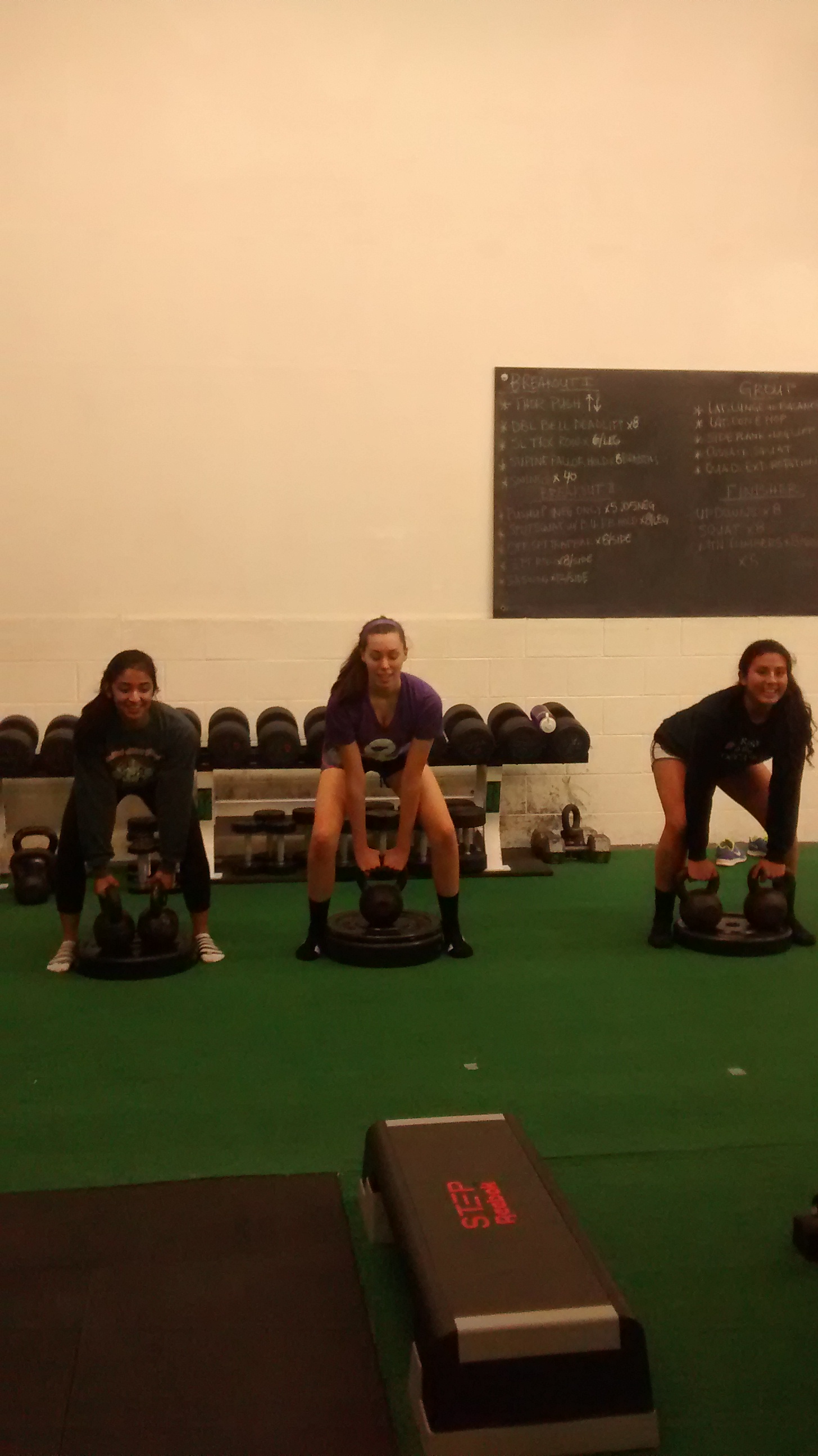
The posterior chain, that is, the glutes and hamstrings, are where it's at when it comes to lower body power production. The glutes and hamstrings are way, way, WAY better at extending the hip than the quads (mostly because, the quads can't do it at all). Quads are important in the vertical jump- as is knee extension- however, the power comes from the back. Athletes who don't tap into their posterior chain will remain on the lower end of the VerTec.
3. Loosey-Goosey Core- That is a technical coaching term by the way. A lot of our VB players don't know how to stay tight during the take-off. All the power they applied to the floor disseminates and leaks out at all the loose points so they wind up going nowhere. Imagine a cooked spaghetti noodle trying to jump and that's what it looks like.
4. Little to no arm swing- How people learn to jump without using their arms is a mystery to me. The arms help increase velocity at take off by storing potential energy in the arms and then releasing it upon take off. They also help "pull" the body upwards. Don't believe me? Some one did a research study and you can read the abstract here.
So, how do we fix all this?
First we teach hip hinging without knee valgus collapse. The easiest way we've found is employing a dowel rod.
Coaching points: 1. The athlete should maintain contact with the dowel rod at three points: head, mid-back, and tail bone. 2. Knees should be behind the toes. I will put my hand in front of their knees to ensure they sit back in the hips and not bend forward from the knee. We also coach neutral knee alignment here.
Next, we put the hip hinge in context of a take-off/landing, but no jump. By eliminating the jump, the athlete can focus on his/her form.
Coaching points: 1. Arm swing, arm swing, ARM SWING! I tell the athlete to pretend she's pushing through water. The arm swing should be forceful. 2. The hip hinge should be there, the knees should be neutral and behind the toes, just like the dowel rod hip hinge drill. I use the analogy of booty-bumping their friend. Girls get this, guys don't. I guess fellas don't booty bump. 3. This is a perfect time to teach tightness. The athlete's core should be taut and the spine should remain neutral. This is where the limp noodles happen, so be vigilant!
After the athlete masters the arm swing + hips, we move to a paused vertical jump. Again, the pause is there for the athlete to focus on the form before taking off. If they're not in the right position, they can fix it- or rather, you the coach can fix it.
Coaching points: 1. Stress to the athlete that it's NOT about the height of the jump, but the technique. I've seen girls with great technique fall to pieces as soon as the jump is part of the equation. 2. The landing should look like the take-off 3. Hammer all the above mentioned technique points.
Practice makes permanent, not perfect.
These three drills are SAPT's basic jump technique teachers. We've seen great results and many girls add inches to their vertical just by becoming more efficient at the jump itself. I'd also like to point out that none of these use fancy equipment. So often it's the simplest way that is the most effective!
Next week we'll take a look at both strength exercises to increase vertical and some more specific drills for power production.
An Often Over-looked Form of Soft Tissue Treatment
As many of you may know, within the next coming week, SAPT will be offering Soft Tissue Therapy! This is something that I've long been waiting to offer as a service as we can now put my NKT, massage and other modalities to use! Today's post is to help us kick this off as I talk about Spindle Cell Compression and how it can be used to help treat dysfunctional sensory information from trauma to help correct movement dysfunctions.
https://www.youtube.com/watch?v=I5745g6ybhI
If you're interested in signing up for a session with me, shoot me an email at jarrett@saptstrength.com and we will have more information posted on our site soon!