SAPT Exercise of the Week: Stir the Pot Alphabet
 When it comes to training someone's "core," I'd often rather have them jump in front of a moving a school bus than perform endless sit-up and crunch variations. However, I've explained the "why" on this site multiple times (and most people are caught up to this information by now anyway), so I won't belabor the point here and now.
Moving on, planks (and their variations) tend to be one of the best bang-for-your-buck exercises when it comes to training the "core," or - the muscles that control the pelvis and thoracic region with respect to the lumbar spine - to put it in "non-bro" terms.
When it comes to training someone's "core," I'd often rather have them jump in front of a moving a school bus than perform endless sit-up and crunch variations. However, I've explained the "why" on this site multiple times (and most people are caught up to this information by now anyway), so I won't belabor the point here and now.
Moving on, planks (and their variations) tend to be one of the best bang-for-your-buck exercises when it comes to training the "core," or - the muscles that control the pelvis and thoracic region with respect to the lumbar spine - to put it in "non-bro" terms.
This is why, once someone has mastered the basic plank, I'll progress them to something more difficult (and fun!) than just holding a static bridge for 60 seconds. This is where something like a move-the-mountain plank or a plank bodysaw will come in handy to make someone's abdominals hate life. Today I'd like to share another plank variation I love to use, that is challenging and also helps keep those with ADD a specified task to focus on.
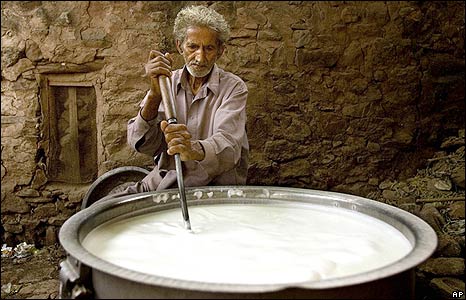
Here we have SAPT's exercise of the week, along with allowing you to finally understand why I placed a picture of a random man stirring a large pot at the beginning of this post (don't pretend like you didn't doubt me).
Stir the Pot: Alphabet
What is it: This is a progression from the classic "Stir the Pot" exercise that Dr. Stuart McGill invented. It trains your core to resist extension and rotational forces, on top of improving core endurance, a key component in keeping back pain at bay.
The idea for the featured variation actually came to me after Coach Chris invented the Pallof Press: Alphabet back in 2010.
How to do it: Get in a nice plank position (abs tight, glutes SQUEEZED, yadda yadda yadda). Then, trace the alphabet in big, CAPITAL letters. Take your time here. and ensure that there is minimal movement taking place at your low back and hips.
I typically like to progress this by having someone start by tracing just a portion of the alphabet (ex. A-L) and eventually have them work through the entire alphabet. Perform 2-3 sets, working as far through the alphabet as you dare.
To make it even more difficult, you could have someone appear out of nowhere and samurai-kick the ball. I heard my friend Tony Gentilcore mention this for the original stir the pot, and I feel it is a fair progression.
 Why I like it: As mentioned above, it's a good fit for us ADD folk in the crowd. Not to mention it will kick your butt. While an advanced athlete can make a plank very difficult if they put their mind to it and actually focus throughout the entire thing, I honestly can't always count on people to do this. Variations such as Stir the Pot practically force you into staying tight, as otherwise you'll fall over and/or snap your spine in two.
I also like this because those of you who train in commercial gyms can do it without any special equipment. Commercial gyms tend to have so many of those stability balls that I often feel like I'm a very small person in the middle of Goliath's equivalent of a Chuck E. Cheese's. This will give you something useful to do with those balls other than throwing them out the window.
Growth Hormone Response to Resistance Training
Lots of research has been conducted on how to elicit the greatest growth hormone (GH) response in the body. There are actually several GH isoforms, but by far, the most commonly studied is the 22-kD molecule that consists of 191 amino acids. If you’re attempting to get some more size on your frame, then you should be concerned about your body’s GH response to your lifts.
Rules of Thumb:
- GH is maximized via concentric muscle action, specifically.
- Men and women have similar GH responses to resistance exercise. However, women naturally have more GH at rest than men do.
- The idea the GH response is limited in “older” individuals is a fallacy. GH response is primarily linked to EFFORT, not age.
- Planning is crucial. If you are “winging-it” in the gym, you’re probably wasting your time - in terms of muscle growth. Everything is important: sets, reps, intensity, total volume, rest time, exercise selection. So, very difficult (some may say “insane”) set/rep schemes are in order. Ex. 10x10 @ 70% with 2-min rest or 6x15 @ 60% with 3-min rest.
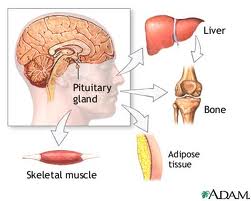 Cocktail trivia you can breakout for your meat-head minded friends: growth hormone is secreted from the anterior pituitary, which receives its “orders” from a neural response initiated by higher brain centers – like the motor cortex – as they react to certain muscle actions.
One last tip: A Cup-O-Strength may be required to make it through 6x15 squats… hey, can’t hurt, right?
One Way to Combine Strength and Size Training
Very rarely do I program more than five reps of of a main lift for an athlete. Why? For beginners: it helps keep technique in check and helps them to stay focused (I often see the young athlete's eyes glaze over and head turn left+right to look at other distractions once he or she passes the 5-rep mark!).
For the intermediate and advanced lifters: low reps keep recovery prompt and hold muscle soreness at bay. Having an athlete perform sets of ten to twenty on the squat would leave him/her absolutely torched come game day or time for sport-specific technique work.
Not to mention, sets of four to five reps seem to be the crossroad for muscle building and neural training. You can still pack on some size, while at the same time teaching the neuromuscular system to contract faster and with greater force.
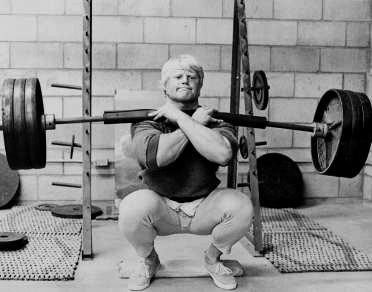
Anyway, higher reps can still have their place in training, especially for the "Joe's and Jane's" out there simply looking to pack on some lean body mass. I have also found that some athletes respond better to higher reps, but I still want to keep the total volume in check. So, how does one go about this? How do you simultaneously train strength and size, without adding too much volume that it becomes detrimental to the nervous system?
First and foremost, be honest with yourself. If you're still a beginner (can you realistically squat 1.5x your bodyweight with perfect form yet?), and even if you've just entered into the "intermediate" portion of the continuum, don't even concern yourself with this strategy. In all likelihood your technique is going to breakdown and you'll expose yourself to injury.
Moving on, here's what to do if you're at the appropriate stage in your training:
Do a few heavy sets, and follow it up with one "back off" set of higher reps.
This way, you stimulate the high-threshold motor units via lower reps, and provide a solid strength stimulus. Then, the bodybuilder side of you can satisfy his/her craving via the "get your pump on" set at the end!
Here are a few examples:
3x5, 1x10 3x4, 1x12 2x5, 1xAMAP ("as many as possible") 3x3, 1xL2ITT ("leave two in the tank")
There are a bunch of ways to do this really. Putting the last example into a real-life example, here's something I might do....
Using chinups as the lift of choice, I may work up to a heavy set of three, but still ensuring the reps are crisp and I'm not grinding them out. So, I might work up to 110x3:
Rest a couple minutes, and then do a bodyweight set of 17-18 chins, leaving a couple in the tank (it should be obvious but just in case: that higher rep set should utilize much less weight than the heavy sets).
I find these set-rep schemes lend themselves particular well to chins, squats, pushups, and rows.
A couple caveats:
- Don't do this year round, but cycle in a few, 3-4 week blocks of this throughout your yearly training
- Be especially careful with the squats, stopping the set if you're near failure and/or are turning your squats into an ugly "goodmorning/squat" combo. The more squat videos I see on the internet, the more hesitant I become in providing public advice like this because most people's technique is atrocious at best.
- I'd avoid this high rep back-off set strategy with deadlifts as the risk:reward ratio simply isn't worth it.
That's it. You can use your imagination really....just do a few heavy sets, staying away from failure, and then back off the weight and get your pump on with one, higher rep set to finish it off.
Miscellaneous Musings 1/27/12
1. One of the best parts of working at SAPT is the privilege of training a BROAD spectrum of people each and every day. On any given day I may get to work with pro baseball and soccer players, high school athletes (our predominant group of clientele), Jewish school teachers, hobbits from the Shire, 12-year-olds learning to play soccer for the first time, you name it. I point this out because oftentimes parents are surprised when they walk in for the first time and see adults training right alongside high schoolers. "Oh, you work with adults, too??"
Yes, we do. Age is just a number, really! For example, here is Big Joe (*in his 40's, mind you), smashing 405lbs for a trap bar deadlift PR. We recently helped Joe prepare for the East Coast "Tough Mudder", a brutal 11-mile race brimming with unforgiving obstacles. He placed a whopping top 5% out of a few thousand people.
Needless to say, we're looking forward to seeing how he does in 2012!
On a related note, we also work with multiple people that have injuries and/or are coming out of surgery.
Case in point: below is Conrad, just coming out of knee replacement surgery. He was practically banging on our doors as soon as he could post-operation, and we're thrilled to be helping him back on his feet in the iron realm. Already he's back on the trap bar, ingraining proper technique and slowly but surely regaining strength back in his leg.

He's been getting AFTER IT, and just upped his number of training sessions to 3x/week with us. His doctor/physical therapists told him he had one of the fastest recoveries they'd ever seen for his age, which goes to show how far some dedication will go. Again: age is just a number!
This being said, don't let the fact that you're injured, or past your "golden years," keep you from getting after it!
2. Sam Giguiere (NFL wide receiver) training. This video has been out for a little while now, but for those who haven't seen it, it's awesome. I love the way elite athletes combine maximal power with simultaneous relaxation of movement.
 3. This weekend I head out to celebrate my sister's wedding. Hence this quick n' random post so that I can take care of everything before the coaching hours begin. I'll then immediately head out from SAPT to the rehearsal, rehearsal dinner, and follow up Saturday's ceremony by partying it up like it's 2012. Oh....wait.....it is 2012. Ohh how I crack myself up sometimes.
(Cue personal shout-out to sister:) Jenn, I'm crazy excited for you!!! You can bet I'll be busting out some bubble gum dances and robots for you on the dance floor.
And your husband-to-be is totally going to have to arm wrestle me to prove his honor before he says "I do." Hah! I kid, I kid.
A HUGE congratulations to you both!
4. This is awesome. See the video below for Ray Lewis's speech to the Ravens after they lost to the Patriots in the AFC Championship Game.
I personally feel many take sports wayy more seriously than they should, and Ray leads by example here, despite the fact that he was on the losing side (especially immediately post-game, when emotions would be the highest). I'm not a Ravens fan, but this is great.
That's all for now. Have a great weekend everyone.
*Joe, please don't hurt me for giving your age. I was using it as a compliment. Really!
It All Starts With the Grip
I decided to give my on camera prowess a go today and talk about an awesome squat grip. It’s a thumbless, pinkyless grip that I’ve seen great results with. I learned this from a strength coach that I used to work under who currently trains at Tampa Barbell. I suggest giving this a shot if your shoulder and t-spine mobility is as bad as a T-Rex. Lay off me about my on camera ridiculousness; I felt like Ricky Bobby, wasn’t quite sure what to do with my hands. 
[vsw id="EsoWv6qwZ7c&feature=autoplay&list=UUKSYQ75Buogznl62rdbks2Q&lf=plcp&playnext=1" source="youtube" width="425" height="344" autoplay="no"]
On another note, I am preparing for my first geared (single-ply) meet in April. In all my other competitions I have competed raw and really had no idea how different lifting in gear would be. I got my bench shirt in the mail the other day and decided to try it out. Needless to say, it was rough. And after trying it out I don’t want to ever hear people say using gear is easier, it’s not. Out of all the things I’ve done in the weight room it was by far the hardest and most taxing. My bench shirt repeated yelled at me, “I PWN NOOBS”. Check out the video of my epic fail; couldn’t even get it to my chest.
[vsw id="0TQ5LNXlvMM&list=UUKSYQ75Buogznl62rdbks2Q&index=1&feature=plcp" source="youtube" width="425" height="344" autoplay="no"]
SAPT Exercise of the Week: Goblet Squat to Stepback Lunge
Here's a cool hybrid exercise that will work your lower body and smoke your core as well.
Goblet Squat to Stepback Lunge
How to do it: Pretty self-explanatory. Grab one or two kettlebells and hold them in the goblet or "racked" position as shown in the video. If you don't have kettlebells, hold one dumbbell at your chest as shown in the picture below.
One squat followed by a stepback lunge with each leg equals one rep. Perform 5-12 reps, depending on your goals.
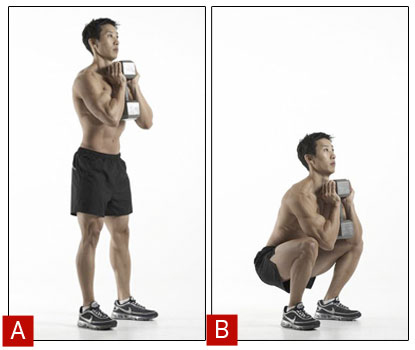 Why I like it: I find this exercise to be useful for a few scenarios:
1) Travel. It's no surprise to most of you reading that hotels aren't the best-equipped when it comes to their "fitness rooms." The first thing you'll notice is the lack of a squat rack (which would cost less than the myriad machines they have, along with providing countless more uses, but I digress). You'll then quickly notice a bunch of treadmills, machines, and, if you're lucky, a dumbbell rack.
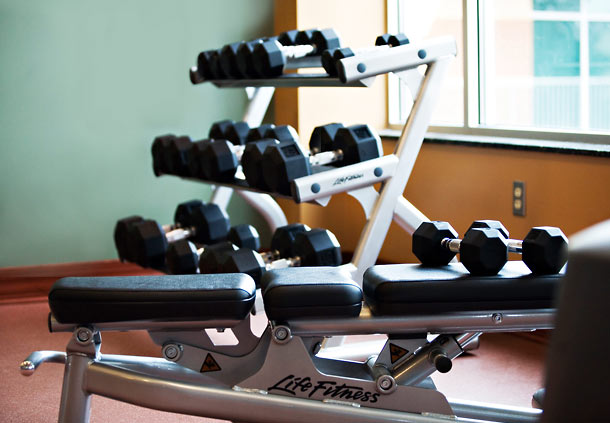 However, more often than not, the dumbbells stop at 50lbs. This is all well and good....I get why they do that. Nonetheless, sometimes those who are a bit stronger run out of ideas with what to do with sub-55lb dumbbells besides doing thirty reps of everything. Since the goblet squat to stepback lunge demands more from you than performing a squat (or stepback lunge) on its own, you can get more out of the lighter dumbbells. Also, with the weight being held at your chest, your entire midsection is going to have work like crazy to keep yourself upright.
Another note here would be if you're in a normal gym with only a few minutes to train and the squat rack is being hogged by a dude doing shrugs for an hour.
2. To use on an "off" day. The more I train, the more I tangibly recognize the truth of Dan Gable's sage advice: "If something is important, do it every day."
Wanna know something that's important? Squatting! Toss in a few of these babies on your off days to get some bloodflow going, "unglue" yourself after a long day at the office, and ingrain some proper motor patterns.
Not to mention, the stepback lunge is the most "knee friendly" of all the lunge variations, on top of the fact that it doesn't typically invoke too much post-workout soreness due to lessened deceleration demands (as you'd experience during a forward lunge or walking lunge).
If you are using these on an off day, go light with the weight selection. No need to be a superhero, big guy.
3. Accessory Work. We've also programmed these for people as part of their main training day, for a few reasons. Maybe we're trying to give their CNS a break from the barbell (ex. if they're overwhelmed with in-season demands or are doing a lot of extra work outside SAPT with the military, their sports teams, etc.). Or, sometimes, we're just trying to deload their spine a bit and take some time away from barbell squatting/lunging. Or, maybe we just want to make them hate life.
4. Conditioning Work. As noted above, these things have the potential to make you hate life. Toss them in from time to time to develop that good ol' work capacity.
**Addendum: This also makes a great variation for sandbag work. See the video below in which me and a few buddies of mine did these for part of an outdoor workout.