Some Get Jacked Recipes
I get questions all the time about what I eat and how I train (mostly from friends and the high schoolers we work with) which I’ve answered before on my blog posts. However, I don’t do it very often so I figured I’d make it more of a reoccurring thing so here are two recipes I’ve been hooked on lately. Recipes
My nutrition is something that I’m really on top of or something that falls to my last priority; I’m never in the middle. I get really busy during the week which is what I hear from the high schoolers as well. With that in mind I need to take time on Sunday to cook my food for the week. I am always looking for something new that is going to taste good, be healthy for me and will last all week. Just ask Stevo and Kelsey, anytime they cook something new or are on a new kick I usually jack their style and will bring it in the next day to work. Lately,they have been utilizing a slower cooker/crock pot to do a lot of their cooking (who am I kidding; KELSEY has been utilizing a crock pot lately for their cooking… just joking Stevo, but seriously…). So I jumped on the bandwagon and let me tell you, it’s awesome the stuff you can do with it. I’ve been experimenting with different recipes and here is my favorite one so far.
Spicy BBQ Chicken
- 3-4 pounds of boneless chicken breast into the slow cooker
- Mix up the following ingredients in a separate bowl
- 1 (12-14 ounce) bottle of spicy or regular BBQ sauce (try and find BBQ sauce with natural ingredients)
- ½ cup Italian salad dressing (again try to find one with natural ingredients, if you don’t pay attention you’re going to buy one with a lot of artificial sweeteners and flavors)
- ¼ cup of natural brown sugar
- 3 tablespoons of Worcestershire sauce
- Once this is all mixed pour it over the chicken in the slow cooker
- Depending on how big the chicken breasts are you’re going to want to cook it for 6-8 hours on low
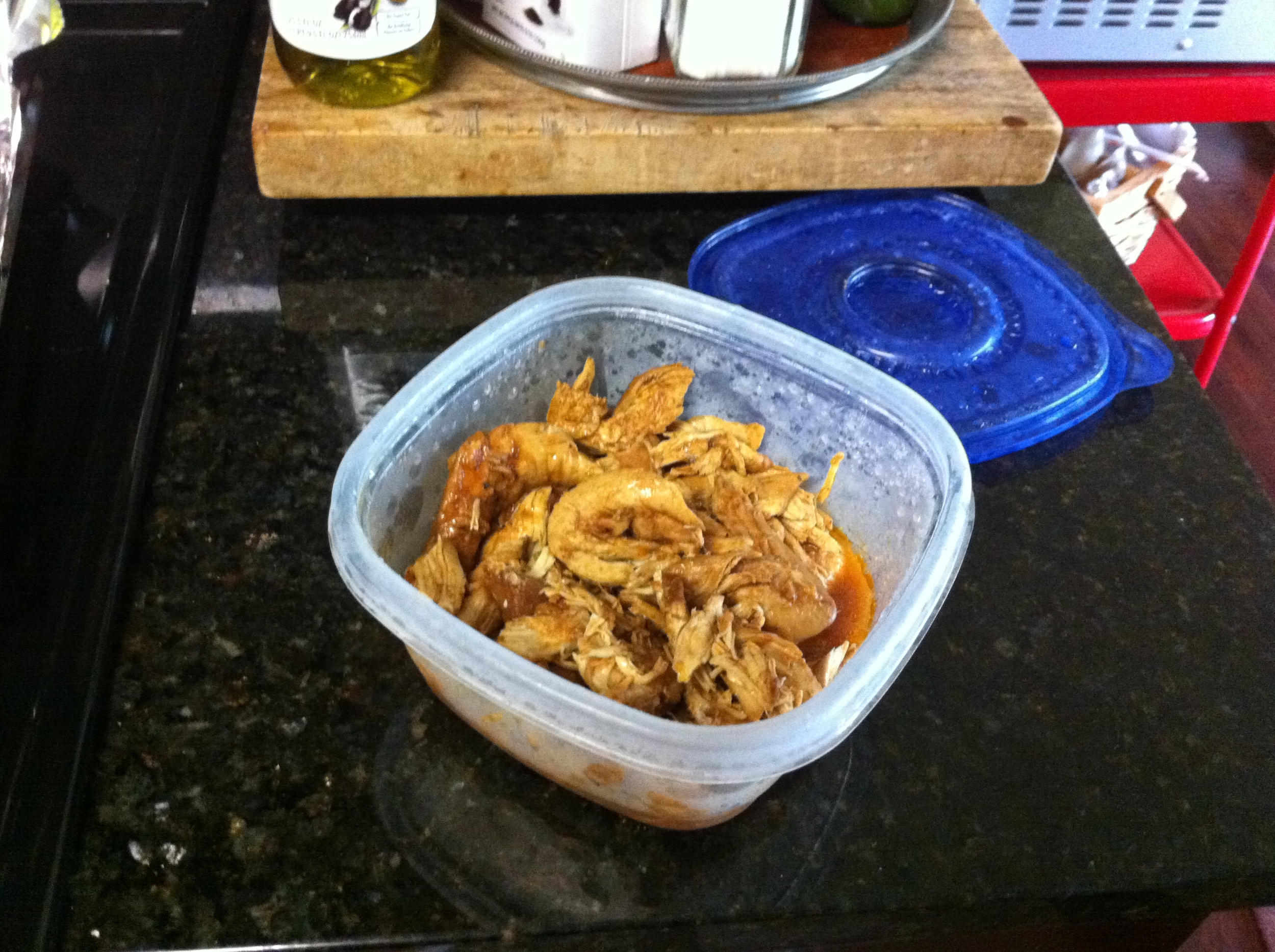
The great thing about this is that yeah it takes a long time but the prep takes about 10 min. Once you throw it in the slow cooker you don’t have to go back to it until it’s done. By the time it’s done the chicken should be really soft and look shredded like the picture below. I usually eat this with 4% milk fat cottage cheese and some stir fried vegetables.
Homemade Protein Bars
I have been struggling as of late to get in enough calories so I have been looking for ways to help remedy the situation. I used to eat store bought protein bars back in the day between meals. However, they are usually really processed and have a great deal of artificial ingredients. I decided to go find a recipe online that suited my goals. I found a great one and just made my own modifications to it. So here is the recipe for a better alternative to a store bought protein bar.
- Mix up the following ingredients in a bowl…
- 8 whole eggs
- 6 heaping scoops of whey protein (I used Optimum Nutrition’s Vanilla Ice Cream whey)
- 4 cups of oatmeal
- 300ml of almond milk
- 4 tbsp. of brown sugar
- 3 tbsp. of NATURAL peanut butter (if you look at the ingredients it should just say peanuts, that’s it)
- And my favorite part…. A LOT OF CHOCOLATE CHIPS!!!
Once you have everything mixed up then lightly grease a one inch deep cookie sheet with olive oil or coconut oil and pour on the mixture. The mixture should look pretty gooey like the picture below; it won’t look as dry as cookie dough does.
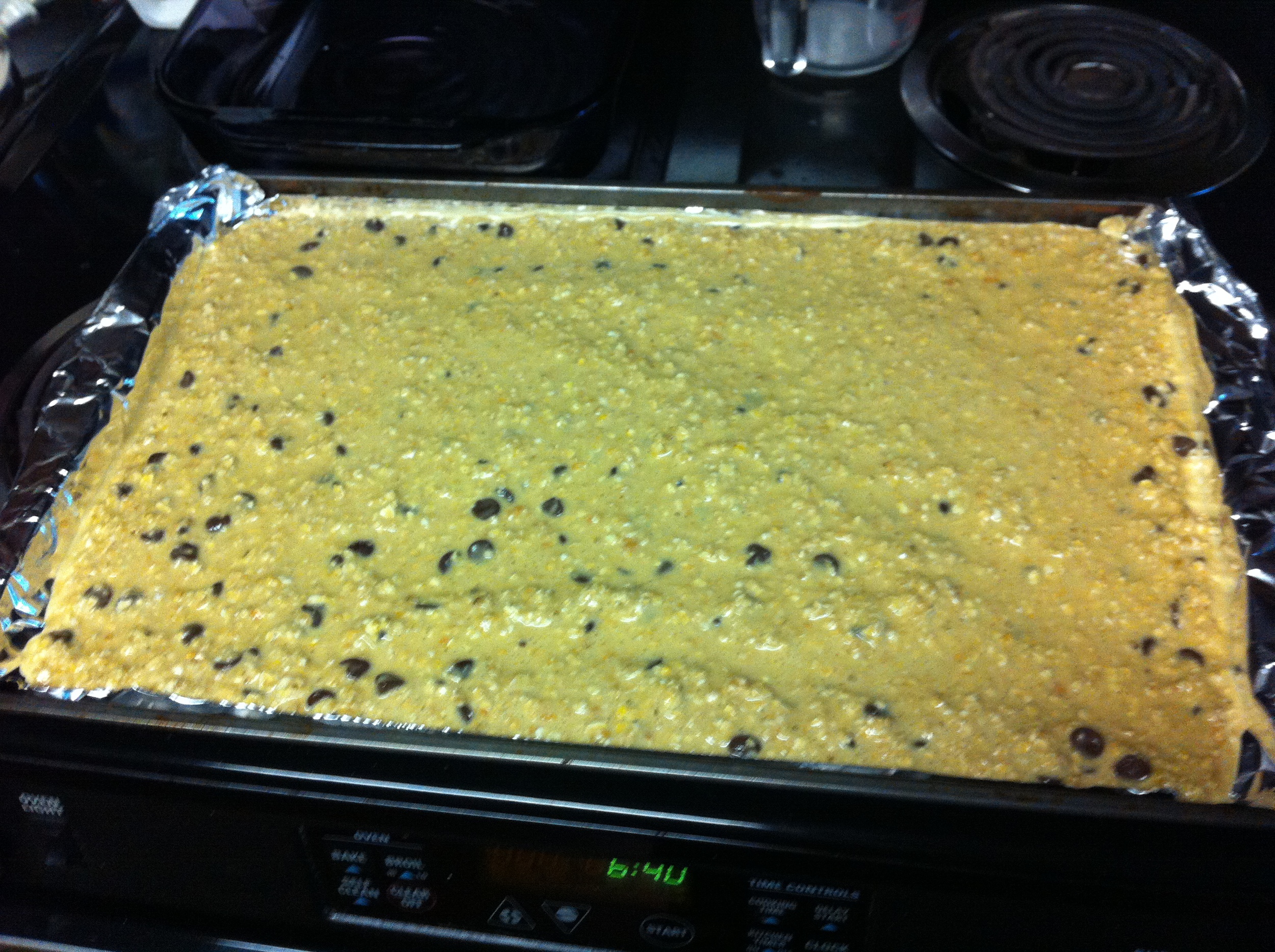
Cook in the oven at 350 degrees for 20-25 minutes. It might not look cooked because it does not brown like cookies do so just do the fork/toothpick trick to check if it’s done (picture also below).

In hindsight I should have made two batches because I have been devouring them this week. This is a great way to get in some extra nutrient dense calories that you can keep in the fridge all week. So for all the high school kids who tell me they don’t have time to eat, you have no excuse anymore.
Q & A: How to Write Resistance Training Programs, Part 6: A Blueprint
Q: Hi Steve,I’m very new to the powerlifting/strong(wo)man training world … and I love reading your blog! It’s always chock full with information. One thing I was wondering, and maybe it’d be a topic to write about … how do you come up with workouts?? Do you make stuff up?? Have a “grab-bag” of moves and pull out of that?? Borrow and modify from other trainers?? I always wonder where trainers come up with new ideas.
Thank you for all the great info!!
A. For those of you who have missed it, you can find Part 1 (Train Yourself), Part 2 (Coaching), Part 3 (Practice Writing Programs), Part 4 (Try Yourself, and Borrow/Steal), and Part 5 (Perfectionism) in the respective links. FINALLY, we're going to wrap up today with a few "blueprint" suggestions.
This is going to be far from a comprehensive list, but hopefully it will get you started on the right track and shed some light into a few things that go through my brain as I right programs. Honestly, I'm just going to spill out a few bullet points as they come to me, so forgive me for the potential non sequitur and/or lack of structure that may appear below.
6. Bluprint
- Yes, I do have a "grab-bag of moves" that I pull from. I make sure that every program contains at least one exercise from the following categories: Squat, Hinge, Pull, Push, and, stealing a chapter from Dan John's book, a Loaded Carry. I have a list of exercises from each category, and pick and choose from them based on the athlete and his or her needs.
- For stronger athletes, 10 total REPS is a good number to hit for the main lift in one session. Ex. 3x3, 2x5, 5x2 will be plenty to make them stronger, while at the same time not frying them.
- For the in-season athlete, stop the workout if they begin to feel exhausted and/or more tired than when they walked through the door. In-season training should "fire them up" and allow them to perform better (duh?), so there's no need to beat them into the ground. A general rule of them would be to reduce the volume by 50-65%, and primarily focus on the main, compound movement of the day.In fact, it's funny as we've had numerous baseball players tell us they had some of their best games (in-season) the day after training at SAPT because their CNS was so charged up.
- Everyone needs mobility drills, but not everyone needs them in the same places (ex. while Person A may need some closed-chain ankle dorsiflexion work, Person B may not need it at all).
- 3-4 main movements per day is really all most people need to reach their goals. Anything more than than that and you get become mediocre at a lot of things instead of great at a couple things (and I'm not just talking about the actual lifts in the gym). Give it your all on just a couple lifts each week, instead of half-hearted effort on a bazillion exercises.
- This list could literally go on for pages, but I'll stop now as I'm out of time. In actuality, if you follow Parts I, II, and III from this series for an extended period of time you *should* discover a lot of this yourself.
Note: In case you missed Sarah's notice from yesterday, SAPT is currently giving 25% off for our training sessions. Click HERE for more information, and spread the word!
SAPT 5-Year Anniversary Sale!
(Note: This is a message from Sarah Walls, the SAPT President.) In honor of a summer-long celebration for SAPT’s 5th Anniversary, we’re offering a 25% discount on ALL paid-in-full session packages* until Thursday, May 24th!
For our most popular Nuts-&-Bolts package, the savings will top $175 and for our twice-weekly adult training package, the savings will easily exceed $225!
As I just now begin to reflect on the last 5-years of my life, numerous memories come to the forefront of my thought and – I can admit – they are overwhelmingly positive. My life has been enriched in ways I could have never imagined when I conceived the foundational ideas for SAPT in 2007.
We’ve survived and continue to press forward in, what can be described as, a TRUE small business start-up situation. What does this mean? It means I’ve never had any big (or small) financial backers or fancy back-office support staff. My husband and I managed to scrape together enough money for the bare minimums and grew from there with the support of a fiercely loyal clientele and amazing set of coaches.
Please take advantage of this 25% session discount offer – I’ve NEVER offered an across-the-board discount like this and will probably not offer another one until we’re prepared to celebrate 10-Years of SAPT Goodness!
Here are 5 SAPT “Growing Pains” Facts that – up until today - only a few of us knew about:
- For the first – oh, I don’t know – 6-months or so, we conducted business from an ancient folding table placed in the corner of our current Pickett Road facility. Chris sat on top of several stacked sandbags and I sat in a folding camping-style chair (gotta keep up appearances - I was the boss, after all).
- Before moving into our permanent training facility, we would host Saturday morning sessions in the Field House at George Mason University. One morning I had the group stretching in a racquetball court at the end of the session… it was completely silent… then we all heard something small fall to the ground from, well, to this day I don’t know where. “It” fell near one of the girls. “It” was a very old broken tooth! Let me tell you, an old tooth is NOT what you want to have a 14-year old girl find while she’s laying on the ground stretching.
- Our beautiful Sorinex Base Camp racks were ordered and scheduled to be delivered in conjunction with the opening of the training facility. We received delivery of the bars, plates, and kettlebells within a week. But the racks were delivered 4-months late! 4-months! Writing this, I still believe this was an unacceptable situation on Sorinex’s part, but I must also acknowledge that what I (at the time) considered missing VITAL training equipment helped us forge our exceptionally Spartan training style. We were forced to refine the basics for our clients and ourselves. I suppose it was a blessing in disguise. Our clients can thank Sorinex for the development of the multitude of variations for EVERY sandbag, tire, sledgehammer, kettlebell, band, body weight, and slosh pipe exercise introduced in 2008.
- In April 2008, northern Virginia was experiencing severe rain storms almost every evening. I remember well because our “well-maintained” facility we’d recently moved into was springing leaks from the roof in honor of each storm. One evening – it was raining quite steadily outside - I was wrapping up a trial session by taking the athlete through a ground-based stretch when the roof drainage pipe above us burst. All… over… her. You see, there are two roof drain pipes in our unit and up to this moment, only the other one was leaking. It was mortifying. But as this athlete is an exceptional young-woman, she still signed up and trained for years before heading off to college to play soccer.
- Personally, this last one I think is pretty funny: for at least 6-months SAPT did not have internet. Instead there is a very weak free signal that we would tap into daily (you just had to sign-up every 24-hours). But the signal was so weak, you literally had to walk outside and hold your laptop up towards the sky while praying for the free daily internet god to transfer the data to its final destination.
All those challenges are definitely funny to look back on… but, WOW, in the moment… no thanks!
Please take advantage of this once-every-five-years deal! 25% is nothing to shake a stick at! It is open to current clients, new clients, anyone! Just submit your info here OR email Kelsey directly at: kelsey@studentathletept.com.
If you’d like to give us a helping hand in spreading the word , please post on your Twitter feed, Facebook page, Pinterest, or whatever outlet you use!
P.S. – If you’d like to see my Doppelganger, cruise on over to StrongGirlsWin.com for the Domestic Goddess I turn into during “Super Moons”!
*A minimum package purchase of 12-weeks at 2-sessions per week applies to receive this special discount.
The Pitfall of Perfectionism (Q & A: Writing Training Programs, Part 5)
Okay, I'm almost done with this seemingly never-ending series, I promise. I only have today's post - to cover an often overlooked component of program design - and I'll finish off the series on Wednesday with a few "blueprint" suggestions. Moving on, let me briefly touch on an achilles heel of mine....
5. Perfectionism
I'm currently reading a phenomenal book on writing, titled Bird by Bird (thank you Tony Gentilcore for the recommendation), and the author, Anne Lamott, touches on this very topic:
"Perfectionism is the voice of the oppressor, the enemy of the people. It will keep you cramped and insane your whole life, and it is the main obstacle between you and a first draft. I think perfectionism is based on the obsessive belief that if you run carefully enough, hitting each stepping stone just right, you won't have to die. The truth is that you will die anyway and that a lot of people who aren't even looking at their feet are going to do a whole lot better than you, and have a lot more fun while doing it."
Now, before I go any further, take a moment to read that again and really let it sink in. While I'm currently addressing the writing of training plans, the advice above can easily be applied to any facet of life for those of you who are perfectionists (you know who you are).
Be it your work habits, your possessions, your relationships, the obsessive believe that you need to be perfect can, and will, utterly destroy you.
Perfectionism, in my opinion, is analogous to fire. It can be very useful provided it's retrained to its intents and purposes, but all-consuming and incredibly destructive if it's not contained. A small fire can be used to forge and refine a steel blade, or provide warmth, but it can also bring your entire house to the ground should it spiral out of control.
Yes, I actually did just come up with that analogy myself, and yes, you may steal it.
My office space isn't necessarily the neatest, I don't wash my car every other day (unlike my brother), and I don't line up everything in my home at 90 degrees to each other. Heck, maybe all those things are more closely related to OCD than perfectionism....I don't really know....but the point is that there are areas of my life in which I'm a perfectionist. In high school, one of these areas was my schoolwork (choosing homework and studying over hanging out with friends, anyone?), which, over time, translated over to this obsessive need to perfect anything I take honest time out of my day to complete that involves a pencil, paper, computer, and that little thing they like to call the "cerebral cortex."
My high school life basically consisted of homework, studying, reading book after book, and lacrosse practice (I've heard getting outside and remaining active is important for cognitive function).
Helloooo to good grades and cruising into the college of my choosing, but goodbye to time with friends, overall sense of enjoyment, and my hopes of becoming globally ranked in Legend of Zelda: Link to the Past speedruns.
Needless to say, there was a price to pay for my perfectionism, and I missed out on some pretty important stuff (I'm referring to Zelda rankings, of course, not time with friends).
Where was I again? Oh yeah, perfectionism and writing programs.....
Look, when it comes to designing workouts and resistance training programs, IT DOESN'T HAVE TO BE PERFECT. I'm speaking from personal experience here, as I used to spend an unholy amount of time writing programs. In fact, I'm not even going to tell you how long I spent on on a 2x/week training plan, let alone a 5x/week training plan, as it'd be embarrassing to recount.
I would practically torment myself with finding the perfect set-rep scheme for each and every exercise, the most flawless waving of volume and intensity, and the best sequencing of exercises. Guess what? In the grand scheme of things, it doesn't really matter.
I realized that I was, in fact, doing my athletes a disservice, because it was taking time away from continued education, and I remain a bit emotionally distant during their training sessions because I would still be thinking about the program design. And you know what I discovered in the process, that was a bit of an "ah-ha" moment for me?
Good coaching will trump "perfect" program design, any day of the week.
A good coach will help someone get more out of a freaking bodyweight split squat than many poor trainers can provide someone during a bilateral squat with a barbell. Along a similar vein, an excellent coach can help someone receive a better training effect from PUPPing correctly than a bad coach/trainer walking someone through pushups (at least what they're calling a pushup).
And, you know what? I can't tell you how many times I've written a program for someone, only for them to walk in the following day telling me they tweaked their back, shoulder, or knee, and I've then had to modify virtually the entire thing anyway, right there on the spot. Or, they have an unexpected business trip, which is going to throw the workout split off schedule. Or, their girlfriend just broke up with them and they had their computer stolen. All of these things are going to require program-modification on the fly.
The point in all of this isn't to tell you to stop working hard in your job, or to fail to give your clients and athletes everything you've got. But there is a very thick line between giving other people your best, and allowing your perfectionism to spin out of control like a wild fire, negatively affecting your own mind, along with those around you.

You Might Have a Bad Strength Coach or Trainer If....
I’ve had many conversations with family, friends, and random people about general fitness and what they should be doing. For the most part people tend to be know-it-alls and really aren’t seeking my professional opinion. All they really want is affirmation that what they are currently doing is correct. When I go on to tell them that standing on a BOSU ball doing dumbbell curls actually does nothing for their physical fitness level they get very defensive with me. Maybe they’re actually angry about the fact they spent a bunch of money on a useless piece of equipment, who knows? The other people who are actually interested in my advice tend to tell me they want to get a personal trainer or a strength coach to oversee their training. This realization they come to is a mixed bag for me. On one hand I’m excited for them that they are willing to invest their time and hard earned money in their personal health. On the other hand I’m weary of their decision. The reason being is that there are so many terrible trainers out there that these honest hardworking people are going to end up flushing their money away. I refuse to sugarcoat things for anyone which is why I tell them exactly this if they tell me they want a trainer/coach. They respond with “well, how do I figure out if the trainer/coach is good or not?” Great question! My answer USED TO BE to make sure they have a bachelor’s degree in something exercise related and to make sure they have their CSCS or CPT through the NSCA. As I’ve gone on in my career I have come to understand how WRONG I was. Since I’ve been a strength coach I’ve found that neither of these things mean you are a good trainer (it doesn’t mean you’re a bad one either, I myself have both). This lesson has been learned through life’s greatest teaching tool, experience. Some of the best fitness professionals I know have neither of these. So, what do I tell people now? Honestly, I try and keep it short but the following are some things you should find out before enlisting the aid of a trainer or coach. Without further ado; You Might Have a Bad Strength Coach or Trainer If….
- You don’t see any pull up, row, squat, deadlift, or pushup variations (because these aren’t functional movements right?)
- They use the word “functional” or “core” more than 5 times within the first 5 minutes of meeting them (“What we’re going to do for your first session is get you up on this wobbly lookin’ platform and have you squat for 2 sets of 15 reps to really help your “functional” balance and to really get you to engage your “core”. Don’t worry about that pain in your knee, that’s perfectly normal.”)
- There is any type of bicep curl at the beginning of your program (just trying to sculpt the guns BRO!)
- They have you do a cable row while squatting on a BOSU ball (two birds with one stone right?)
- They have you perform a snatch without teaching you how to goblet squat correctly (DUDE! It’s all about being explosive. Forget about the back pain, correct form is for SISSYS’!!!)
- They have never heard of a goblet squat (I feel like it has something to do with Harry Potter, am I close?)
- They have no idea who the following people are (comic book villains?)
-Mel Siff -Tudor Bompa -Leo Matveyev -Yuri Verkhoshansky
- They ever put you on a BOSU ball or wobble board and try to get you to pistol squat holding a med ball over your head (Hey guy! I thought I told you, we are trying to functionally engage your core)
- They look like this guy…
- Honestly, it’ll just save us some time if I just say… They have you do anything on an unstable surface (I know I know, we get it… It’s all about being functional and engaging your core)
- Their idea of a good deadlift looks like this… (We want to take your hamstrings and glutes completely out of it. It’s all about using your lower back and lifting the bar with a jerking twisting motion.)
[vsw id="YyhHDQ7X0dA" source="youtube" width="425" height="344" autoplay="no"]
- Your workout consists mostly of ladder drills and cone drills (It doesn’t matter that you can’t squat 15lbs correctly; it’s all about working on your AGILITY!)
- You get thrown on a bench press yet still can’t do a bodyweight pushup correctly (If you can’t bench press 315lbs you will never be a good athlete…. HAHAHA! Sorry, I couldn’t keep a straight face with that one)
- They coach you on how to turn your pinky up at the top of a bicep curl (FOR THE LAST TIME! We are trying to sculpt the guns!!!)
- They tell you that the only way to get fit is to get on the treadmill everyday (Strength? What do you need strength for? Lifting weights is just going to get you bulky and then that muscle will turn to fat when you’re older. I see you have an awesome valgus collapse going on in your knees and your feet have no arch whatsoever… Sweet! Let’s go run for 30 minutes on the treadmill!)
I’m running short on time, that’s all I can think of for right now. RELAX internet warriors; I’m only 99% serious, HA!
If anyone has any other ones they want to share then feel free to post it to the comments section.
Q & A: Writing Training Programs, Part 4: Try Things Yourself, and Borrow and Steal
Q. One thing I was wondering, and maybe it’d be a topic to write about … how do you come up with workouts?? Do you make stuff up?? Have a “grab-bag” of moves and pull out of that?? Borrow and modify from other trainers?? I always wonder where trainers come up with new ideas.
4. Before Giving Something to an Athlete or Client, Try it Yourself
One of the things I pride myself in as a strength coach is never giving someone an exercise or program that I haven't tried myself. Well, most of the time.

One such instance in which I failed to do this happened a little over a year ago. I was doing the programming for Ron, who was in the middle of a "get shredded" phase. I had progressed him through the basic planking exercises, and wanted to spice things up a little. Sitting at my keyboard, Ron's excel file open and perhaps a bit too much caffeine running through my blood, I had a vision of a more challenging plank variation I wanted to give him. It was a single-arm PUPP with the feet suspended in the TRX (see picture on the right).
No, I hadn't actually tried this myself at the time, but I figured, "How hard could it be? Ron's a beast and he'll love this one."
Well, the following week, I'm on the coaching floor and I hear some laughing followed by grunts of frustration coming from the corner of the gym that Ron was using. I turn around to only to see him face down on the floor, feet suspended in the TRX, laughing a bit to himself. He then looks up at me and shouts across the gym for everyone to hear:
"Steve, have you actually TRIED this exercise, you inconsiderate, good-for-nothing, bag of fart???"
That was not verbatim.
So I stood there, stammered for a bit as everyone else around waited for my response, and then replied, "Ummm, yes of course I have....well, kinda....okay maybe I haven't actually tried it."
Come to find out, it was a pretty darn hard challenge even for me to do! I'll admit it took me a few tries to get it, as you literally have to fight for your life to prevent yourself from being barrel-rolled 180 degrees in the air and thrown onto your back.
Now, fortunately Ron is very good-humored and knows how to laugh at his own expense (he also never forgets to remind me of that fail of mine with his programming). We figured out a modification so that he could do something similar, and we moved on. He also never hurt himself in the process.
But what if you're working with someone who's not-so-good-humored? What if the athlete ends up getting hurt because you didn't try something beforehand? I really don't feel I need to explain the "why" behind trying an exercise or program out yourself before giving it to someone else, as I feel it's pretty self-explanatory.
The key is to set people up for success. Make it challenging, but at the same time ensure that you match the appropriate progression/regression to the individual so that they can see and experience themselves succeeding as opposed to failing.
And the best way to do this is to yes, practice writing programs and coach people on a regular basis, but also try everything yourself before giving it to someone. You'll discover a number of things this way:
- Some programs look MUCH easier on paper than they actually are in application
- What supersets really suck, and others that don't
- Exercise sequencing that is brilliant, and sequencing that is not-so-brilliant
- What exercises make you unnecessarily sore (that will negatively impact a subsequent training day and/or sport practice and competition)
- The ideal set and rep range depending on the movement/where it is in the program
Etc., etc., etc.
5. Yes, Borrow and Steal
You asked if I ever borrow and modify from other trainers/coaches. In a word: Absolutely, and shamelessly.
But rather than reinvent the wheel, I'll direct you to this post by Mike Boyle (seriously, read it, it's short) as he discusses the very topic:
Should You Stick to the Recipe?
HOWEVER, remember that other strength coaches and trainers are only human. They still make mistakes, and not everything they say should be taken as pure, liquid gold.**
Following the programs of other trainers can be fantastic start (assuming you don't pick a doofus to emulate), but eventually, once you become a "chef," as Boyle said, you need to be confident in you're own program writing skills. In fact, I find myself disagreeing, on multiple occasions, with the opinions of many of the world's current "renown and expert" coaches. Does this mean these men/women are inferior and less knowledgeable than me? Of course not. But you have to be careful to avoid falling into the trap of blindly following every word they say without doing some critical thinking of your own.
Another note is, once you have taken a look at a number of trainers and coaches, only pick a few to follow. Often we quickly experience paralysis by analysis by continually looking at too much "stuff." You'll begin to spin round and round with no direction if you try to follow everyone out there.
A book that holds a special place in my heart is The New Rules of Lifting by Alwyn Cosgrove and Lou Schuler. It was the first book I read that took me away from the stupid, brought me over to the Dark Side, and opened my eyes to the beauty of good training habits. If you're brand new to the field, I highly recommend this. Is a bit of it outdated? Yeah. But if you're still programming 3 sets of 10 for everything, reading Flex magazine and Bodybuilding.com for your primarily sources of information, it's a great place to start.
If you've been in the field for a while now and/or have a solid base under you, I honestly can't recommend Easy Strength, by Dan John and Pavel, highly enough. The book is easily worth its weight in gold, and I honestly think that the price is a steal for what it provides. If you train anyone, be them elite athletes or pure newbies in the weight room, do yourself a favor and read it.
And that's it for now. I'll be back on Friday discussing the pitfall of Perfectionism. And yes, I realize we're bordering on a marathon here with this series so I promise you I'll save you from your misery soon enough.
**Unless they're the SAPT staff.