
Attitude vs. Environment
Great teams create an environment and culture that allow players to unlock their potential. Outside of sport, where we grow up, who we socialize with, and what our family structure is often shapes our personality. There’s no doubt that a strong and positive environment can be a major factor in determining success, however environment isn’t everything.
As a coach, or organization, it is your job to try to create the best possible environment for your players. The signs in the locker room, the practice facilities, and the marketing of the team, can all have a great impact on the performance of an athlete. Don’t take for granted the ability to shape environment and give athletes the best opportunity for success.
As a player you often have little control over your environment. You don’t pick your team, your teammates, the coaches, where you play, etc. In fact, we may be forced into certain environments that we have little control over. It’s often in those situations where excuses manifest and frustration takes over. Examples like, “my team doesn’t care about winning”, or this team “isn’t any good”, or “nobody takes this seriously”, are real examples of environment dictating attitude.
As a player figure out how you can have the best possible attitude even in the worst possible environment. Let your attitude be a driving force in changing the environment for the better. Often when our environment is poor, we fall into the trap of allowing ourselves to blend into that poor environment.
If your environment is a 2 out of 10 and your attitude is a 4 out of 10 then you may be contributing to the poor environment. However, if you take that 2 environment and improve your attitude to a 7 then maybe you can improve your environment. It’s a simple change that can often be the difference between winning and losing. Make the change and improve your attitude and environment today.
As the great Gandhi said, “be the change you want to see in the world.”
One More Baseball Testimonial
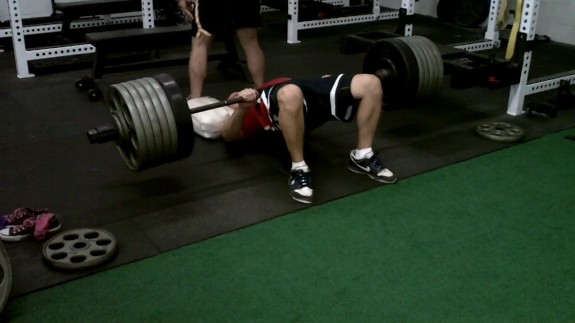 A couple weeks ago I posted a few testimonials of some of our student-athlete baseball players headed off to DI schools to play this upcoming Fall (You can view it HERE in case you missed it). Making a long story short, I didn't end up including one of them due to not having access to it at the time, but I'd like to post it now as it's more than well-deserved.
David Palmer was kind enough to do this for us. As you can see from the picture at the top of this page, he loves barbell glute bridging. The picture of him showcases him hitting a 600lb BB Glute Bridge (a personal record for him) for reps at the end of Summer training. No, we don't typically "test" people's glute bridges, but given David's enamorment with the lift, we thought it only fair to grant his request to test it.
Anyway, David is a competitive swimmer on top of excellent at baseball, and he drove the 30+ minutes each direction to train at SAPT year-round, no matter how many other commitments he had going on. He's headed off to Radford this Fall, and we wish him the best! Take it away David:
How Will You Succeed?
I stumbled across this on Facebook the other day. Normally I just scroll through things like this; it doesn't usually make a huge impact on my day. For some reason though this one stuck when I saw it. I'm not entirely sure why but it just struck a chord with me, and I really liked it. I believe it was the first line that might have done it for me, "I succeed because I am willing to do the things that you are not." I have a lot of changes going on in my life and this line made me think about all the athletes and clients I've worked with over the past couple of years at SAPT. The large majority of which have succeeded or will succeed in the near future. Is this because of me or the other coaches at SAPT? I say no. The coaching staff at SAPT is merely a vehicle our athletes and clients have used to travel on the road to success. It's something they posses within themselves that has gotten them to where they are. As I said SAPT was just the vehicle, it was up to them to turn on the car and drive down the path. The people I look back on and also the ones I currently watch train now have something their peers do not. They succeed because they are willing to do the things their peers are not. They are willing to wake up in the early morning during their summer break to come train hard. They are willing to come in after a long, hard day at work and get after it. They are willing to train through and around injuries. They are willing to hold onto hope that they will get past those injuries, even when it seems like all hope is lost they still do not ever give up. And they are willing and able to understand that success does not happen over night but only through hard, grueling work.
When I think about the kids, teenagers and adults I've worked with I am in awe of their drive, their tenacity and most importantly their heart. I am forever grateful to them for the inspiration and motivation they have given me and the other SAPT coaches. They will never stop getting better, they will never give up... Ever. That is why they succeed.
How will you succeed?
Q & A: Can I Add an Extra Session to my College Strength and Conditioning Program?
I recently received the email below from one of our student-athletes who's currently playing D1 baseball for a university, and I thought I'd share the question+response for those of you who may be interested. Hey Steve,
I just had a quick question for you. Right now, the lifts we are doing as a team are pretty intense, but only last about 30-45 mins. I feel tired at the end of them, but don't feel like I am getting the necessary amount of work in. Obviously I have to do the team lifts but is there anything else I can be doing on my own to try and increase my strength? Right now, we do Squats-mon, Bench-wed, and close grip press-friday, however, all three days we do complete body work in some way. I know, two bench lifts in a row...bad. One day is bad enough. Could I be doing dead lifts on Sat or something?
Any input you could give me would be great. Thanks.
Always a good time when you're bench pressing twice a week, on back-to-back lifting days, right? Especially in the context of a baseball strength and conditioning program, given that bench press numbers have consistently shown such a strong correlation with rotational power, throwing speed, and batting average......Or not.
First of all, I'm honest when I say I'm extremely proud of you for recognizing some of the "holes" in the program you're doing, and your drive to make yourself better by working hard even outside of the mandatory lifting hours you're required to complete with your team. And while bench pressing can certainly have its place in a good resistance training regimen, you hit the nail on the head by recognizing that it may not be the best option for you personally, given your sport and time constraints.
That being said, there are two points worth noting before we continue:
1) In a strength and conditioning program, you can't always just "keep adding." Your body, unfortunately, only has a limited capacity to recover, and there comes a point where adding extra exercises, training days, etc. can hurt you more than help you.
Stealing an analogy from Tim Ferris: “To boil water, the minimum effective dose is 212ºF (100ºC) at standard air pressure. Boiled is boiled. Higher temperatures just consume more resources that could be used for something else more productive.”
Carrying this analogy over to your strength training regimen, you have to be sure that your body's "pot of water" is not already set to "boiling." If it IS, then adding extra stressors (exercises, training days, etc.) are only going to actuate more fatigue, lengthen your recovery time, and could actually REDUCE your power output and strength.
So: Give yourself an honest, unbiased, introspective assessment into how you're doing. Are you at "boiling" already? If not, then proceed with #2.
2) Since #1 is true, then you must begin your quest of adding an extra session by using the lowest intensity and the least amount of volume in order to incite adaptation.
See how your body responds and feels during the following week - both in the weight room and out on the baseball field - and then you can continue to tweak and refine from there, but still only adding the "minimum effective dose," and nothing more, to see continued improvement.
William of Occam said it best:
"It is vain to do with more what can be done with less."
Solution
You're on the right track suggesting a "deadlift day" for Saturday. Provided you're smart about it, I think it could really help fill in the missing gaps you're currently facing, along with providing you the perfect stimulus for continued strength and power gains.
Based on what you told me, I'm guessing that your coach isn't having you all do any dynamic effort work. Since most of your barbell work is probably being done at heavy loads+slow speeds (or "absolute strength" work) you could definitely use some work on the "speed-strength" end of the continuum.
Enter: Speed Deadlifts.
I love speed deadlifts for four reasons:
- Provided you do them correctly, they have enormous potential to actually refresh you upon completion, leaving you feeling charged up and ready to kick down the doors of the playing field (if your playing field has doors....)
- They provide an EXCELLENT way to tap into the higher threshold motor units, namely, those that have the greatest potential for force production. They also assist in neurotransmitter uptake and release, along with positively impacting the excitation-contraction coupling mechanism in muscle cells, for you exercise physiology nerds in the crowd.
- Since you'd typically perform multiple sets at a load load and low rep scheme, it's certainly a good time to hone in on technique, practicing the set-up and execution multiple times in one session.
- If you move the weight AS FAST AS HUMANLY POSSIBLE, and if you're good at doing this, then you experience the inevitable pleasure of causing everyone unfortunate enough to be around you at the time to destroy the backs of their pants.
For your first session, I'd recommend starting off with 6 sets of 2 reps, at 50% of your 1-rep max, with :45-:60 rest between sets.
And move the bar as fast as you can.
Did I mention you need to move the bar as fast as possible?*
Toss in some very low volume horizontal rowing (bent over DB rows, chest-supported rows, single-arm cable rows, etc.) and some scapular stability work (low box walkovers, forearm wallslides, easy pushups, etc.) after your deadlifts and call it a day.
Hopefully your coach doesn't mind you doing this, either. If he does, you may very well have to enter the weight room surreptitiously and pray he doesn't catch you.
The most important thing will be to start with the LEAST required to get stronger, LISTEN to what your body is telling you, and then make further adjustments (if even necessary) from there.
*You need to move the bar as fast as possible.
Running & Wrestling: Like Oil and Water?
I have this very special file on my computer that is titled "Master Programs" and inside are all the important tidbits of information that have helped define SAPT's training approach and the template variations we have created. Looking through it is like taking a trip through time, as I remember where I was and who I was working with when each variation was put through its paces. There are a number of sub-folders with names like: 400m Training, Agility, Assessment, Healthy Knees, Intensity Tools, Nutrition, PL/WL (that's powerlifting and weightlifting), and Sport Specific. Within the Sport Specific folder I found an old document I put together in 2007 where I polled a number of other active D1 strength coaches regarding their approach to conditioning (specifically running) and wrestling.
To give this a bit of context, SAPT was in its infancy... I think the company was like 2 months old, and I had somehow convinced a high school wrestling coach to let me take his team through a 6-week pre-season training (thanks, Jack).
At one point we touched on the idea of running and wrestling. My stance was (and still is) that long distance running would actually do more harm than good for a wrestler. WELL, let me tell you this was not well received by the guys. So, in case I was crazy, I polled these other coaches. Here were their responses:
What’s the deal with running?
Responses from a variety of collegiate coaches…
“The majority of the AU wrestling conditioning is done on mat. The running is predominantly sprint work on the track at distances of approximately 30m, 60m and 100m. The long distance runs are primarily for recovery or for dropping weight. You need to explain that to those parents as best you can. Maybe you can use this to help you: "Due to the previously discussed increased risk of injury during periods of fatigue (30), designing the injury prevention program to incorporate metabolic system training proves essential. Specific to wrestling are activities that require high levels of anaerobic power and muscular endurance (8, 22, 54). Over the course of a 2-minute period, an explosive attack occurs approximately every 6 to 10 seconds (35). Simulating the metabolic needs of practice and competition is best accomplished through interval training (33). Intervals involving periods of intense resistance exercise, running, or biking interspersed with periods of relative rest should be considered the ideal training method to achieve physiological responses similar to wrestling. If possible, injured athletes should continue conditioning programs that also mimic the physiological needs of practice and competition (Table 3) to prepare for return to competition after adequate healing occurs."
From:
Terry L. Grindstaff PT, ATC, CSCS, *D and David H. Potach PT, MS, CSCS, *D;, NSCA-CPT, *D. 2006: Prevention of Common Wrestling Injuries. Strength and Conditioning Journal: Vol. 28, No. 4, pp. 20–28.
Or check this article out:
Zsolt Murlasits MS, CSCS. 2004: Special Considerations for Designing Wrestling-Specific Resistance-Training Programs. Strength and Conditioning Journal: Vol. 26, No. 3, pp. 46–50.”
Email response from Jason Riddell, Head Strength and Conditioning Coach at American University
“LSD for wrestlers depends on why they're doing it. For performance gains it's worthless, it's like having your sprinters do it for greater speed improvement. But, for improved aerobic capacity to aid in match recovery it has a small place, and I think there are much better ways to improve this capacity rather than going on long slow runs or staying on a bike for a long time, so I would say on occasion it may be okay but not as a regular activity. Last, and probably the one most wrestlers use as their excuse for wanting to do LSD is for weight loss, cutting weight.
There are a lot of variables to this debate, LSD or no LSD?
LSD has been proven to cause:
Decrease in strength and power
Decrease in anaerobic power
Decrease in muscle mass
Last time I checked wrestling relies pretty heavily on all three of those, and a decrease in them will ultimately cause a decrease in match performance.
I prefer the Tabata method of HIIT (high intensity interval training) and this is what we had our wrestlers doing. But, there were always those guys that went on the LSD runs to cut weight.
I hope this answers your question.
Give my best to Handy.
I look forward to meeting you some day. Feel free to come down and visit when you have time.
GW”
Email response from Greg Warner, Head Strength and Conditioning Coach at JMU
“First of all, thanks for being an avid reader of Elite. Funny you asked this question, b/c we just had this conversation with our wrestling coaches. They were all about these long distance runs and once we finally explained it to them in a way they could understand, it clicked!
Here’s how we explained it. You know how wrestlers get “heavy leg” syndrome? Well, that’s due to lactic acid build-up. The more that they are trained at lactate threshold, the better their bodies will get at getting rid of and recycling the lactic acid. Running long distance is aerobic. It won’t help them at all when they are in the third period and their muscles are “heavy” or filled with lactic acid. Some longer recovery runs are beneficial on days in between hard workouts or hard practices. We typically do a “2 minute/ 3 minute routine”. Two minutes of running (either done on a football field where they have to make a certain number of yards or on a treadmill at a certain speed…. Heavy weights and light weights are different, of course), then 3 minutes of recovery (walking). This is the longest running we will do with almost any of our athletes. They do need to have some aerobic training, but not 5 miles straight, know what I mean? Most of our training is done in shorter intervals (30-60 seconds).
I hope that helps to explain it. Once we explained it in terms that the coaches could understand (they understood “heavy leg syndrome” not lactic acid build-up), then it made sense to them and they were more open to changes.
Let me know if you have any more questions.”
Email response from Julia Ledewski, Assistant Director of Sports Performance at New York University at Buffalo
“Ok, here is my advice......GOOD LUCK!!! Seriously, this is a tough battle to fight, and one that I think very few can win. Why, because they have been doing it for so long that they are convinced it works.....yet too close-minded to acknowledge that there might be a better way. Also, as I have learned since coming to UTEP, people in athletics really don't like change.....even though if you don't change you will never get better. If you have Jason Feruggia's book, "Tap Out!!!", he gives an excellent description that may help you fairly early on in the book.
#1. I remember when I was wrestling in high school that we did distance runs for the first couple weeks of training, but after that never ran anything that lasted more than 2 minutes. And, these were sprints. How long is a period in wrestling?.....2 minutes. We also had one of the best wrestling teams in Missouri. In fact, after I left they won the state championship 3 years in row. They also place in the top 6 nearly every year. Several of the guys I wrestled with went on to wrestle at the D1 level. In fact, one guy competed at the international level and was expected to go to the Olympics, but had a few distractions. In high school, you don't get to recruit your athletes, instead you have to train the ones you have. For me, that's enough evidence to say that wrestlers don't need to run long distances to be good.
But, to play devil's advocate, what did nearly all of us do on our own after practice? We went for a long distance run. But, that was more to keep our weight down than to stay in shape.
#2. If you walked into a wrestling meet, and had to bet on one of two wrestlers, which one would you bet on? One wrestler looks like a marathon runner....thin, frail, no muscular development, and slow. The other looks like a sprinter.....lean, hard, muscular, fast, explosive. Knowing nothing else, except what you see, which one would you bet on?.........Here's a hint, most high caliber wrestlers have more similar characteristics of sprinters than marathon runners.
#3. Running long distances requires you to be slow. Why would a wrestler want to be slow? Sprinting requires you to be fast. Don't wrestlers need to be fast and explosive?
#4. They might like this arguement. Have the athlete run six 400 m sprints at a challenging pace (1 min 35 sec or less) with only 5 minutes rest, then on a separate day have them do a 1.5 mile run at their normal distance pace. Then, ask them which is harder and requires more mental toughness? If they are being honest with you, and running hard on the 400s, the answer should be obvious. By the way, which one is more similar in energy demands to a wrestling meet? In high school a period lasts 2 minutes, and there are 3 periods per match. Furthermore, I would be willing to bet that you could increase the distance run to 3 miles and it would still not be as hard as the 400s. *(The time I listed is what one of my soccer girls ran her 480 yd sprints in, so it may need adjusted for a male athlete who is only running 400 meters).
#5. You can try explaining the energy systems to them, but I don't think you will get very far doing this. They will not understand, nor do they want to understand science. Even if they say or they think they believe in science, their "honest" opinion is that there is no science in athletics. The only thing they will see is results. And, some are sold on hard work, but carry it WAY TOO FAR in that they will actually tear their athletes to pieces before backing off. These are the people that blame losing on not working hard enough, so that after a loss they kill their athletes in workouts so they are too tired to perform in the next match, and lose again.......from here it is a downward spiral. Again, it all comes down to results that they see (W-L). If you do your running, and they win, you are a genius and they will be sold on your ideas. If they lose, it will be your fault and they will never buy into your ideas, regardless of whether you are right or wrong.
I saw the Thinker's response. That arguement will go nowhere with the people you are dealing with.
All the weights on our racks are in kilos, so I don't bother to do the math on anything I don't think is close to a PR. Also, if I do want to do the math, seeing it in kilos first distracts me from the depressing number of pounds I am lifting, in that doing the math is so fun that it takes the focus off what I actually did. By the way, how can you say "stay" strong when you know how much I am lifting? Shouldn't you be saying "get" strong, instead?
yes, it is depressing,
David”
Email response from David Adamson, Assistant Strength and Conditioning Coach at University Texas at El Paso
“Thinker: How much value (or lack of) do long slow distance runs bring to the table of conditioning for wrestlers? I'm trying to dispell myths among parents and athletes... running seems to be a VERY hot button for them! Thanks so much for your help!
Hello Sarah, Let's consider this from a physiological perspective:?? Long slow runs are certainly a viable means of developing oxidative capacity; and running in general provides a great deal of latitude in terms of how it may be manipulated (intensity, duration) in order to develop a multitude of capacities (developing cardiac power, pushing the anaerobic threshold, developing speed strength, sprint speed, speed endurance, etc).??The question, however, is: is long slow running the optimal means of developing oxidative power for the wrestler???Sarah, the answer is no.?? The oxidative power may much more effectively be developed via the performance of exercises that also develop the local strength endurance of the muscles of the legs, trunk, arms, and shoulder girdle.??These exercises may be performed with the most rudimentary of apparatus (bodyweight calisthenic/gymnastic, barbells, dumbbells, med balls, kettlebells, etc)??The key, however, is that the exercises are performed via the appropriate method (such as circuit or serial), the appropriate resistance, for the appropriate durations, and at the appropriate speed of movement to yield the targeted adaptations (in this case oxidative power). A heart rate monitor is an exceptional tool for regulating such a form of exercise.??In regards to developing oxidative power, most of the literature suggests that heart rate zones 60-70% of the maximum are ideal for recovery purposes and at the higher end (70-80%) you will begin to develop the power of the oxidative system. At you progress into the 70th percentile you are still beneath the anaerobic threshold and continuing to develop the power of the oxidative system. ??So, essentially, any form of exercise beneath the anaerobic threshold (which must ultimately be quantified in the laboratory or with technology like the Omega Wave) is stimulating the oxidative process (the lower the intensity the more the restorative the stimulus- the higher the intensity the more developmental the stimulus to the power of the oxidative system)??Specificity to sport is then imparted via the exercises performed and the work/rest intervals.”
Response from Pitt Performance Department
I have to say, it was pretty cool getting such thoughtful responses from so many of my mentors at the time. The take-away here is whether you are a wrestler or not, you should always examine the reason(s) why you are doing the conditioning you are doing. Is it actually helping you gain a performance improvement? Or is it actually hindering your peak? SAPT's tremendous coaches can, of course, help you reach that peak.
Good Goals
Every athlete has goals they want to achieve. The problem isn’t always the desire to have goals, but in the way the goals are set. I often use Allen Iverson as an example of someone who always talked about his goal of “winning a championship”. Yet, Iverson’s infamous comments about “practice” have long lived in Youtube lore, with close to 6 million hits. There’s no doubt that Iverson was one of the greatest scorers of all-time, and his will to compete when the lights were on was unbelievable, but perhaps his goal of winning a championship never occurred because of his lack of organized goal setting.
Many athletes are misguided in where they direct their attention. Often they focus on outcome goals—win a championship, be an all-star, average 20 points per game, etc. While setting outcome goals can be effective, and I believe they are somewhat necessary, setting practice goals that give you a road map are even more important.
As an athlete you determine how you practice. Sure a coach may have you for an hour or two a day, but after that you can decide how you want to use your time. Create practice goals that you want to accomplish on a daily, weekly, and monthly level. Goals like making 50 free throws a day, 300 a week, and 1200 a month. Create a process for success.
While playing time is largely out of your control, the amount you work on your craft in practice is almost completely in your control. Practice goals lead to improvement in skill, which leads to the best opportunity to getting the desired outcome. The process of improvement should be at the forefront of your mind rather than simply the dream.
What goals do you want to establish today? How can you improve today so that you’ll be better tomorrow? What’s going to give you the best opportunity to succeed a year from now? Know your outcome goals, but direct your attention to your process.