Circuit Training for Fitness
Picture this:
You got out of work later than ususal... perfect timing to hit rush hour at its height and extend your normal 20-minute commute to the gym into an all-out 45-minute crawl full of frustration.
By the time you get to the gym, you only have about 25 minutes before you need to leave.
What do you do? Do you literally throw in your towel and just go home? How can you possibly salvage a decent training session out of the train wreck that was the afternoon?
Circuit Training is waiting to save the day! Well, so are Time Turners, but pretty much no one has one of those things...
What is Circuit Training?
The possibilities are limited only by your imagination (and your physical capacity. I know from personal experience that performing box jumps after a barbell sumo deadlift is a baaaaad idea).
Typically, circuits are comprised of 5-8 exercises and you want to work with weights about 75-80% of your max. Translation: pick weights that you could probably perform for 8-10 challenging repetitions. String them all together, and work through the circuit with minimal rest between exercises.
In terms of time, you can set up your circuit a couple of different ways:
1. Set a particular rep goal per exercise and then set your time for 15-25 minutes and see how many rounds of the circuit you can perform.
2. Pick a number of rounds to complete and try to finish as quickly as possible. Usually, if you have about 5-8 exercises, 5 rounds will be around 20-ish minutes.
Benefits of Circuits:
1. They're a great way to improve overall conditioning without watching your hard earned muscle mass wither away. Two recent research reviews (abstracts here and here) have found that steady state cardiovascular training can a) decrease power output (yikes! Not good for athletes that need to produce power aka: everyone) and b) compromise muscle mass (and thus strength) gains. This effect is seen most prominently when aerobic training is 3x/week for greater than 20 minutes. The metabolic pathways that aerobic and anaerobic (think strength training and sprint/interval training) are conflicting. It's very hard to maintain a large amount of muscle mass and be a long-distance runner!
Circuit training is similar, metabolically, to sprint/interval/hill training in that it preserves lean muscle mass.
Steady state cardiovascular training, on the other hand, can lead to elevated levels of cortisol (stress hormone) which can decrease the effectiveness of muscle-building hormones such as testosterone and insulin-like growth. It also encourages muscle protein break down.
While strength training too breaks down muscle tissue, the anabolic (building) environment produced by strength training encourages repair more than the catabolic (break down) environment of aerobic training. Strength coach Charles Poliquin says:
Whereas endurance exercises compromise anaerobic performance and body composition, anaerobic training modes such as sprint intervals and weight lifting will benefit endurance athletes if programed properly. To improve endurance performance, do a strength-type resistance training program with loads of 80 percent of the 1RM or heavier. This will train the type IIA muscle fibers so they increase the rate of force development and get faster.
Type IIA muscle fibers = strong, powerful muscles. We want those!
So if you're still with me, we'll move on to the second point.
2. It's time-efficient. After a quick dynamic warm-up and maybe a warm-up set or two of the planned exercises, the total time of a circuit should be no more than 25-minutes start to finish. 15-minutes would even be sufficient depending on the intensity of the exercise selection and weights used. Nice huh? It's just long enough to make you feel like you've worked out but not too long that you're home late for dinner.
3. (but really 2.5) Not only are they time-efficient but they're efficient in the sense that a circuit can hit a lot of muscle groups, through full ranges of motion, in one fell swoop. While a jog will really only get your legs (and, I would argue, not very well since the range of motion is small, the force production is low, and the intensity isn't that high either) and maybe some low level core activation, a circuit can be full body. Take a look at this sample:
Goblet or barbell squat x 6-8
Pushup x 8-10
Step back lunge x 6-8/side
3 Point Row x 8/side
Kettle bell swing x 10
Can you see the total body genius in that? We have lower body (both bilateral and unilateral movements), upper body (push and pull) and a delightful amount of full range of motion exercises. All of which, if one wanted, could be done with just one kettlebell.
Run through that baby 5 or 6 times and try to tell me that's not cardio. Oh wait, you can't. I can't hear you over your screaming lungs and gasping breaths.
4. Because circuits demand so much from your muscles and cardiovascular system, they're pretty calorically expensive, which means your body will be burning calories longer post-workout than they would after a lower intensity training session (aka: low-intensity, steady state cardio). On those above-linked research reviews, it was found that athletes reduced body fat when they performed high intensity exercise (sprints or circuits).
So, if you're looking for an efficient way to reduce body fat, preserve lean tissue, AND improve your cardiovascular fitness, circuit training is definitely a tool you want in your toolbox!
I feel obligated to note that strength training, solid strength training sessions, need to make up the bulk of your training week. Picking up heavy things repeatedly is the best way to build muscle and get stronger. Circuit training, while it won't make you weaker and can aid with strength gains, is inferior overall to 80-90% max lifting in terms of producing maximal strength gains. While I don't recommend basing your entire training plan around circuits, they are beneficial and even fun (yes, fun.) to throw in every once and a while.
Strength as a Foundation
On March 15, 2013 I became a regular person - well my perception of regular anyway - and I love it!
Why did I have to relinquish my super-hero status? I’ll leave it at this: I saw my dreams not just faltering, but failing. So, to get back on track, I stopped working two full-time jobs... which I had been doing for years for "fun" versus necessity. I took a break from my love-affair with iron. I also sit more than I have in about 15 years... that's a mega regular person activity!
Well, if we fast forward to today, my big dreams in life are properly realigned and effectively back within reach. But, I want to talk about what has happened to my physical foundation over that time.
SAPT’s methodology is based on the approach of Strength as a Foundation. We use various examples to explain why this is the best approach for building speed and explosiveness, but my favorite is “imagine shooting a cannon out of a canoe” sounds silly, right? Well that’s because it is. Never having operated an actual cannon myself, I can still easily imagine how ineffective and potentially dangerous it would be to try to shoot the thing out of a canoe.
The same concept holds true for performance training. If Strength as a Foundation is ignored, you’ve effectively set yourself or your child up for ineffective and potentially dangerous training.
Okay, so getting back to my little story: since becoming proudly “regular,” I’ve been working out at home and put a huge emphasis on improving my overall fitness. “Fitness” in this case meant I wanted to put a big focus on improving my cardiovascular system's functioning and efficiency. My exercise of choice? Running. And because of time limits I have only been lifting an average of 20-minutes, twice a week... but my running workouts stick around 60-90 minutes, 4-5 days a week.
Do you see where this is heading...?
I've let my foundation crack. My strength foundation. It sort of sucks. But, I planned for this to happen... I guess I just didn't know what it would feel like once I arrived. I've been lifting consistently since I was 19 years old. The longest break I’ve ever taken (up until this year) would have been a MAXIMUM of one week off from lifting. Crazy, but this 20-min/2x per week lifting has been going on for almost 4-months. With several weeks in there taken completely off from lifting.
I’ve been trying to shoot a cannon out of an ever destabilizing canoe. Attempting to keep up such a high volume, frequency, and intensity of running without maintaining my strength foundation is trouble. I’m feeling it now.
My goals have been accomplished in terms of “fitness” but I’ve been surprised what a slippery slope running that much and lifting that little has been. It’s like the losses are compounded. My knees often ache and the muscle mass in my legs (read: glutes and hamstrings) has dropped significantly.
What’s the plan and what’s the lesson?
I need to build muscle and lift weights more frequently. That’s the plan. And the lesson? As advertised, running really is detrimental to strength levels. I’m undecided about how I feel about this. Where I am in my life, running really lines up well with my mentality and goals. I can’t even begin to tell you how many excellent ideas I’ve had while running... SAPT was actually conceived during a run 6-years ago(!). But, I need to prioritize more prehab exercises to keep myself on the trails. In terms of the biggie compound lifts, eh, I’ll probably continue to take a break. 13 years straight of weight training means I’m certain the lure of the iron will pull me back when the time is right. In the meantime, I’ll continue setting a laser focus on building an amazing business and embracing my “regular” side.
Last week I attended a workshop on marketing for the small business owner. It was amazing and led by John Jantsch who is *tha guy* when it comes to this topic. As much as I believe the experience has already had a permanent and positive change on SAPT, I will try to exercise some self-control and stay on-topic. I do mention the experience for good reason: the first - and most tangible - impact from this workshop for our readers is in how we deliver content on the blog. Here are the changes you can look forward to:
- Each month will have a theme that each primary (MWF) post will address. This month's theme: Give Me Strength!
- We will be attempting to up our quality from an internal standpoint by actually editing posts ahead of time.
- All this requires *gasp* planning, so posts should be more reliable with few, if any, missed posts.
Please engage if you like or hate or even have no feeling about what you read here!

SAPT Virtual Sprint Seminar, Episode 1: The Falling Start
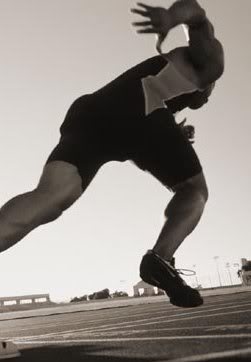 This begins a series of virtual sprint "seminars" that I'm sure many of you will enjoy. I - along with two of our Summer interns, Josh and Goose - have been working with a number of our college baseball guys to improve their sprinting speed. Given we meet with them 2x/week outside of their usual lifting program, and that they're making some sort of improvement each and every session, it makes for excellent blogging fodder that hopefully you human movement geeks out there will enjoy.
Questions that will be answered in this episode:
- What is the Falling Start? And why does it help with improving sprint speed and mechanics?
- Why having or developing "quick feet" may NOT actually be the answer you're looking for when it comes to improving sprint speed.
- Common errors that nearly everyone makes during the falling start, and how to correct them.
- How to reduce your risk of injury when beginning a sprint training program.
- What Street Fighter can teach you about ensuring a strong acceleration off the line.
Comments? Feedback? Was this helpful? Mind blown? Share any thoughts below!
RUNFAST! Take a Peek At What It's All About
The first RunFast workout occured yesterday. Check out this great video that Goose created on-the-spot as we went through our first work out.
Prepare for the fall seasons this summer and come out and join us for conditioning, technique work, and loads of fun!
My L5-S1 Disc Explosion Part I
So I destroyed one of my intervertebral discs in my lumbar spine a few years ago, and it was followed by a year of pain, endless treatments, frustration, de-training, and overall unhappiness. I’ve been wondering for a while if I should write a blog describing the injury and the path it led me down. I’m sure some people may find the story interesting, or others with a similar injury might find solace in seeing that they aren’t alone. I know that while I was injured I was desperately reading through articles, blogs, forums, and spinal research books to not only search for information that might help my condition but to also read others’ stories and see what they’ve gone through. But for a while I didn’t want to write it because I’ve come to HATE the fact that this injury took away so much from me. I HATED the fact that I still owe money to some medical practices for the treatments I went through. And I HATED the fact that for the better part of a year the injury became the focal point of my life. I just wanted to leave it in the past and move on.
But...I figure it’s time to stop being a drama queen and give you guys a “play-by-play” of what happened.
A Long, Long Time Ago...
I’ve always been an active kid, partaking in activities like skateboarding, snowboarding, fishing (is that active?), pick-up basketball and football, dirt-jumping on bikes, and all kinds of stuff that are fun and dangerous. In high school I played lacrosse as my primary sport, but also dabbled in various track and field events. After high school I played club lacrosse at VCU before transferring to GMU but also got hooked into grappling sports. I started competing in Brazilian Jiu Jitsu and submission grappling fairly regularly. I loved it! It definitely made me regret not wrestling in high school. This was also around the same time that I started lifting a little more seriously.

Life was good! I was squatting, deadlifting, wrestling, grappling, and having a lot of fun. In terms of training I admit I did some stupid stuff. I never cared about “overtraining”, soft tissue quality, mobility, or pre-hab. I just wanted to get stronger and lift more weight. I always looked at “ab work" as a waste of time and effort.
I distinctly remember one day grappling with my training partners one and getting caught in a shoulder lock called a “kimura”, which basically forces your shoulder into deep internal rotation. It happened so quickly that I couldn’t tap in time and heard (and felt) a loud “POP” in my shoulder.
What did I do later that day? Heavy weighted dips! Genius I know… But my shoulder was fine! I was invincible!
In 2011 I was training extremely hard for an international grappling tournament in New York. The year before I had competed in the same tournament and lost in the first round pretty quickly. The loss really drove my motivation to come back and perform this time around. I was training 7 days a week, sometimes twice or even three times a day. I continued to lift heavy and hard as well. I was sore all the time. My entire body ached, but I noticed that my back was especially flared up. I simply shrugged it off. If you’re training hard you should be sore, right?
One particular day I was grappling with my coach for about an hour and a half, then went to class. As I sat through the class I couldn’t take my mind off of how uncomfortable the desk chair was. Finally, when class was dismissed and I stood up it felt like someone took a baseball bat to my lower back. My back locked up and I couldn’t pick up my backpack. It was time to see a doctor.
The General Practitioner
Keep in mind that back pain is one of the top reasons for a doctor's visit, second only behind the common cold. It's a very common occurrence and more often than not some pills and time off will do the trick.
At the doctor’s office, I gave the doc the rundown of my symptoms and she gave me some anti-inflammatories. I expressed my concern about a disc issue and she was convinced that it was just a muscle strain. I went home, took the pills for about two weeks and called back for another appointment. My back was still jacked up.
The second time she gave me some muscle relaxers along with the anti-inflammatories. She was still convinced that there is no need for an x-ray or MRI.
Again, I was back in her office within a few weeks. Despite putting my training on hold and diligently popping these prescription pills, nothing had changed. She finally put in an order for an x-ray. The x-ray came back with no significant results, and she said the structure of my spine is fine. That’s all good and dandy, but it’s important to note that an x-ray will not image the intervertebral discs between the bones, and you need an MRI to diagnose a disc herniation. She was still unwilling to give me a referral for an MRI.
She sent me home with a fresh prescription of anti-inflammatories and another muscle relaxer, and recommended I get a massage.
I got a massage, took the pills, and came back to the office a few weeks later with no good news and a frustrated attitude. I demanded the MRI. She gave me the referral and my MRI was scheduled about two weeks after that. If memory serves me right, it took about three months of living in severe lower back pain before I even got a referall for an MRI.
The MRI
If any of you have had an MRI before, you know how… not-fun it can be. I was shoved into this cold hard alien tube of death for what felt like days lying flat on my back, which happened to be one of the positions that aggravated my back pain at the time. When it was all said and done, the MRI confirmed the fear that was lingering in the back of my head since the day my back locked up in class: Herniated disc, L5-S1.
Physical Therapy
The next time at the doctor’s office I got some more pills but also a referral to physical therapy. I remember feeling somewhat glad that I was finally taking steps in the right direction. My condition was diagnosed, I’ll do the PT, and finally make my way back into sports and training.
My physical therapy consisted of manual therapy, electro-stim, and a TON of extension exercises. It seemed to be a very “McKenzie method” based rehab protocol, which involves a ton of spinal extension.
The idea is that these positions will help re-center the disc bulge. Bottom line for me is… Nothing helped. Sure the massage and electro-stim felt good, but the majority of my day was spent in intense lower back pain that seemed to be getting worse. It was during my time spent regularly going to physical therapy that the pain in my lower back started creeping into my left glute and down my leg…
I used up all my PT time referred by the doc, and even came back for more sessions that were paid for out of pocket, believing that it might help. After a few months of PT with zero resolve and a ridiculous bill, I stopped coming.
The Chiropractor
Around the same time I tried seeing a chiropractor. The chiropractor I went to had a decompression table, where you get strapped down to this apparatus and it gradually applies a stretch to your spine. The idea here is that the stretch will increase the space between the vertebrae and “suck” the disc back into place. After about 20 minutes on the decompression table, the chiro cracked my back in a few places and sent me on my way. Again, nothing seemed to help.
During one particular “back-cracking” session the chiro told me I should consider giving up lifting weights, grappling, and snowboarding and take up an activity like ping-pong. He might as well have said, “Maybe you should stop living” (no offense to ping-pong players). Needless to say, that was my last session with him and I never saw him again.
Although I had a less-than-favorable experience with this particular chiropractor, I am by no means a non-believer in the practice. Since this experience I have met with several different chiropractors with whom I am very impressed and would trust to treat me or my athletes if need-be.
Acupuncture
Not too much to say in this department… I only had one session, where they placed needles in my leg in a pattern that seemed to follow my sciatic nerve. They also placed wires on the needles that provided a gentle shock to the needles. It felt strange, slightly relaxing, but provided no lasting relief.
I didn’t know what to do at this point. My whole life was pain now, and by this time it was shooting down my left leg at full blast, sending pins and needles into my toes. I woke up to agonizing pain and stiffness in the morning, spent my entire day crippled, and crawled into bed at night praying it won’t hurt as bad the next day. I was flexion intolerant, extension intolerant, sitting down hurt, laying down hurt, walking hurt, everything hurt. I wasn't worried about competition anymore. I was worried about my quality of life and well-being. My friends and family noticed that I wasn’t the happy-go-lucky person I usually am, but I was quick to snap at people and I was irritated all the time.
I knew something had to be done, so after talking to several doctors I decided that I would try a few more options of treatment, and if there is no progress, I would go see a spinal surgeon.

To be continued!
RunFAST: Join Us for our First Run
Come out to Draper Park in Fairfax on Wednesday, June 26 at noon for a sample of the RunFAST program. Bring water, appropriate shoes for the turf, and a towel... it's gonna be hot and humid.
We'll be posting the actual runs on the website at some point tomorrow - so you can always do it on your own!