Strength: You're Doing It Wrong! Exercise Solutions
The canvas we’ll be working with today encompasses a number of pertinent topics within the landscape of getting stronger and becoming a more structurally sound human being; common training fallacies, pervasive myths, and foolproof strength training principles will all be covered as we move forward together.
On a daily basis - and, fortunately for you reading - I’m exposed to an extremely broad palette of individual scenarios within the respective realms of strength development and human movement, as I have the utmost pleasure of working as a strength and conditioning coach within the walls of SAPT, one of the Washington D.C. area’s finest breeding grounds and incubators for maximizing human movement capacity and enhancing athletic potential.

Be it teaching young athletes how to perform a proper jump or lunge pattern for the first time in their lives, helping a college baseball player learn to harness and produce power in his hips, facilitating the process of desk jockeys reducing the very knee or back pain symptoms that their doctors told them would never go away, showing young Padawans and Jedi’s-in-training how to construct and wield their first lightsaber, assisting a veteran lifter in adding an extra ten pounds to his or her max deadlift; each and every night I walk away with at least a modicum of new insight on how to help people feel, look, and move better. (And apparently, the ability to produce the longest run-on sentence ever seen on this website.)
I’ve written thousands of programs (literally), and overseen at least three times as many training sessions within the walls of SAPT. Given this, I’ve been able to observe what works, what doesn’t work (as much as I don’t want to admit when I’m wrong!), and collect an ever-growing pile of data. I’ve also had the luxury of being able to test and experiment with countless strength training strategies and modes on people of all ages, training goals, and genetic constitutions.
Essentially, I’m a researcher as much as I am a strength coach, and each and every one of my findings, successes, and failures within the SAPT Lab propels me one step closer to unlocking the gateway to untapped human movement and strength potential.
Since "I'd like/I need to become stronger" is one of my favorite goals to help people with, and given that improving one’s general strength is often (at the least) half of the solution to improved athletic performance, pain reduction, general sense of well-being, increased ninja status, and yes, looking better; that’s where we will spend our time together today.
To guide today’s discussion, I’d like to touch on a few of the common myths and fallacies surrounding the notion of “strength training” that tend to proliferate throughout the interwebz and many public gyms. Hopefully, I’ll be able to help you dispel a few of the fundamental errors many tend to make when embarking on the road of getting stronger, and to provide you a few central philosophies that can guide and direct you in successful training for years to come.
“You’re Doing It Wrong” #1 – Maxing Out Too Frequently
There’s a big difference between maxing out and training your max. The former should be reserved for a few select times in the year, while the latter should be employed on a regular basis. The former will invariably lead to stalled progress and becoming weaker, while the latter will lead to surefire progress and actually getting stronger.
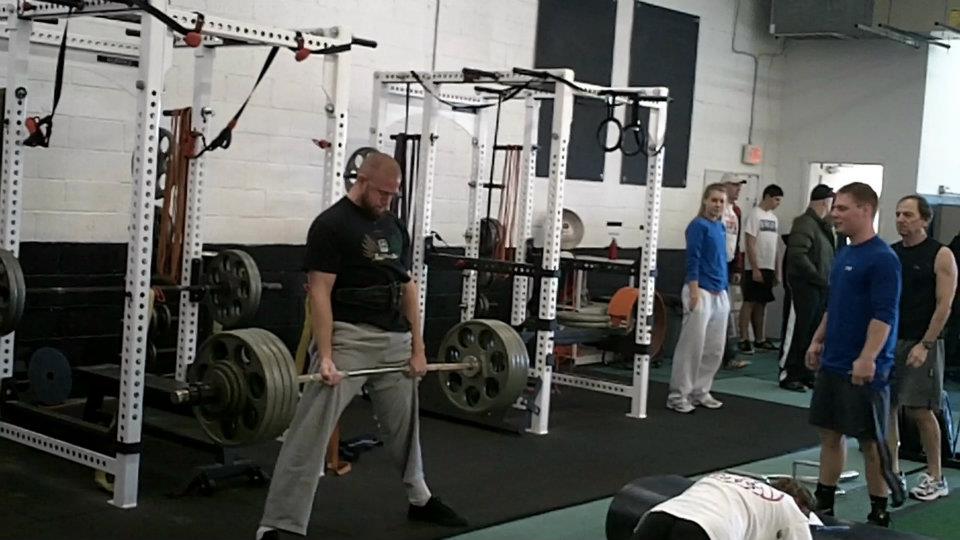
Knowledge Bomb: You don’t need to max out regularly to make your max go up!
Oftentimes, well-intentioned people become so caught up in the “if I’m not moving forward, then I must be moving backward” mentality that they feel they need to max out every single week during their barbell lifts. It’s one thing to make weekly incremental improvements in your assistance work – for example, adding an extra chain weight to your back for a set of pushups, or using ten more pounds for a lunge variation – but pushing the limits of the “big lifts” on a regular basis will lead to frustration and fatigue at best, and missed lifts or injury at worst.
This isn't to say one should live in trepidation of performing anything over 90% of their max, but there's something to be said for treating strength as a skill and not as something to be trifled with. It's obviously okay to train around 90% from time to time, but understand there's an immense difference between 90-95% loading parameters, and 100%; the difference in neurological output and mental strain is unreal, not to mention the recovery time.
While I hope it goes without saying that this is imperative for the recreational “Joe or Jane” lifter who is training for fitness and general wellness, seeking to become stronger while remaining injury free, it’s also extremely important for the competitive athlete who has a plethora of competing demands outside the gym walls.
Since an athlete is regularly practicing skill work, sprinting, and competing, the strength coach has to carefully construct their resistance training program so that it still develops their strength and power while yet not interfering with the countless other demands (physical and mental) they undergo outside of the training facility.
Believe me, I understand and respect the drive to get better each day. But “getting better” isn’t necessarily synonymous with banging your head, repeatedly against a brick wall in workout after workout. Just because you may be using submaximal loads – honing technique and working on rate of force development – doesn’t mean you’ll fail to get stronger simply because you aren’t regularly pushing the literal limits of your body. In fact, you’ll be pleasantly surprised to find you’ll end up where you want to be much faster this way.
Dan John and Pavel said it best: "'Coax' the 80% poundage up, instead of forcing the 100%. This is the patient approach of the professional."
There's a reason the strongest individuals in the world rarely (if ever) miss lifts and only go for TRUE maxes on a select few times per year. It simply works!
"You’re Doing It Wrong" #2 – Pigeonholing Yourself Into What a “Main” Movement Is
Just because you may not be prioritizing a powerlift (barbell squat, bench press, deadlift) or Olympic lift (power clean, snatch), in your training doesn’t mean you still can’t build muscle and get stronger.
Don’t get me wrong, the powerlifts and O-lifts are phenomenal from an efficiency standpoint - you can pack on large amounts of muscle, strength, and power while keeping your exercise quiver relatively small – but remember that many individuals, you perhaps included, simply may not be in a place where it’d be prudent to perform one or all of these lifts on a regular basis. This could be because of structural changes (i.e. femoroacetabular impingement, reactive bony changes on the acromion, etc.) immobility, poor stability, or anthropometry concerns.
Have some sort of structural pathology going with your hips? Unable to maintain a good mechanical position while squatting, due to poor stability and/or mobility? Try subbing out all barbell squatting exercise variations for a unilateral exercise, such as a barbell stepback lunge with a front squat grip:
This way you receive all the benefits of axial loading, can garner plenty of strength and stability benefits, while yet satiating your palate for placing a loaded bar on top of you.
Have an insanely long torso and short legs, so you find conventional deadlifting problematic? Try pulling Sumo-style or using the trap bar.
(Note: As I noted in this article, you can find a deadlift variation to suite ANY body-type, age, or ability level)
Shoulder bothering you? Perhaps it's time to take a mini break from barbell pressing (it's okay, the earth will continue to revolve on its axis). Become really proficient with landmine presses and dumbbell bench presses with a neutral grip:
Experiencing low back pain, and bent-over barbell rows are giving you trouble? No worries, you can still pack on plenty of muscle and strength using a dumbbell row alternative or seated row to tide yourself over.
Back pain so severe that any sort of bilateral squat or deadlift is irking it currently? Get some work done with heavy sled pushing!

The possibilities are nearly endless. Many times it’s not worth it to fall into the bravado that surrounds the various barbell lifts if one (or a few) of them don’t fit well with you. Find what exercise* works for YOU to use as a strength exercise and as a gauge for measuring progress.
Well, I’m already at well-over 1,000 words, so I’m going to cut it here for today. Stay tuned for Part 2 in which we’ll continue where we left off!
*Except for the leg press.
Give Me Strength!: The Process
It hurts. The short-term effects from strength training often leads to pushing the body to places the mind may not want to go. But, if the mind is open and willing, the body can be pushed to places it may not realize are possible. Strength-training, like any activity, requires a detailed process, which focuses on daily progression. Below are three tips to help your mind stay right as you get your body tight:
- Goal-Setting: It’s imperative to have daily, weekly, and monthly fitness and strength goals. These should not just be based on weight loss/gain or amount of weight lifted. Instead, there should be deliberate practice goals, which focus on progression. Focus on the process of improvement rather than simply end results. Examples: Daily - Commit to trying one new exercise [pick one to help you put extra emphasis on a weak area or an area you enjoy training] for each daily training session for a month; Weekly - Commit to a weekly schedule of weight training, avoid a haphazard approach... what time does your workout begin? Don't be late!; Monthly - Did you achieve your daily and weekly goals? What does the next month look like, what are you planning to accomplish on a daily level? Is it time to do a quantitative test yet?
- Willpower Talk: Use committed words like “will” over words like “gotta”. Direct attention to what you will do rather than what you gotta do. The more you talk about will the more you will get. For example, what is your weakest area that you WILL improve to build muscle and strength? A lower body unilateral exercise, perhaps?
- Expectation Scorecard: Create a scorecard for yourself to grade your mental performance during a strength-workout. Have categories like attitude, positive self-talk, energy management, etc. so that you will grade your mental-toughness. This will hold you accountable to maximizing performance.
A couple other things to consider: what is your pre-workout preparation? It probably involves some foam rolling and a warm-up, but are you preparing your mind to take full advantage of the soon to start training session? Are you fully focused when the first set begins?
Like most things in life, success in strength training, fitness, endurance training, fat-loss, etc. is at least 50% mental. The process of engaging in a long term progressive program also teaches excellent (mental) practices that translate into many other areas of life (discipline, goal setting, enjoyment, commitment, etc.).
Circuit Training for Fitness
Picture this:
You got out of work later than ususal... perfect timing to hit rush hour at its height and extend your normal 20-minute commute to the gym into an all-out 45-minute crawl full of frustration.
By the time you get to the gym, you only have about 25 minutes before you need to leave.
What do you do? Do you literally throw in your towel and just go home? How can you possibly salvage a decent training session out of the train wreck that was the afternoon?
Circuit Training is waiting to save the day! Well, so are Time Turners, but pretty much no one has one of those things...
What is Circuit Training?
The possibilities are limited only by your imagination (and your physical capacity. I know from personal experience that performing box jumps after a barbell sumo deadlift is a baaaaad idea).
Typically, circuits are comprised of 5-8 exercises and you want to work with weights about 75-80% of your max. Translation: pick weights that you could probably perform for 8-10 challenging repetitions. String them all together, and work through the circuit with minimal rest between exercises.
In terms of time, you can set up your circuit a couple of different ways:
1. Set a particular rep goal per exercise and then set your time for 15-25 minutes and see how many rounds of the circuit you can perform.
2. Pick a number of rounds to complete and try to finish as quickly as possible. Usually, if you have about 5-8 exercises, 5 rounds will be around 20-ish minutes.
Benefits of Circuits:
1. They're a great way to improve overall conditioning without watching your hard earned muscle mass wither away. Two recent research reviews (abstracts here and here) have found that steady state cardiovascular training can a) decrease power output (yikes! Not good for athletes that need to produce power aka: everyone) and b) compromise muscle mass (and thus strength) gains. This effect is seen most prominently when aerobic training is 3x/week for greater than 20 minutes. The metabolic pathways that aerobic and anaerobic (think strength training and sprint/interval training) are conflicting. It's very hard to maintain a large amount of muscle mass and be a long-distance runner!
Circuit training is similar, metabolically, to sprint/interval/hill training in that it preserves lean muscle mass.
Steady state cardiovascular training, on the other hand, can lead to elevated levels of cortisol (stress hormone) which can decrease the effectiveness of muscle-building hormones such as testosterone and insulin-like growth. It also encourages muscle protein break down.
While strength training too breaks down muscle tissue, the anabolic (building) environment produced by strength training encourages repair more than the catabolic (break down) environment of aerobic training. Strength coach Charles Poliquin says:
Whereas endurance exercises compromise anaerobic performance and body composition, anaerobic training modes such as sprint intervals and weight lifting will benefit endurance athletes if programed properly. To improve endurance performance, do a strength-type resistance training program with loads of 80 percent of the 1RM or heavier. This will train the type IIA muscle fibers so they increase the rate of force development and get faster.
Type IIA muscle fibers = strong, powerful muscles. We want those!
So if you're still with me, we'll move on to the second point.
2. It's time-efficient. After a quick dynamic warm-up and maybe a warm-up set or two of the planned exercises, the total time of a circuit should be no more than 25-minutes start to finish. 15-minutes would even be sufficient depending on the intensity of the exercise selection and weights used. Nice huh? It's just long enough to make you feel like you've worked out but not too long that you're home late for dinner.
3. (but really 2.5) Not only are they time-efficient but they're efficient in the sense that a circuit can hit a lot of muscle groups, through full ranges of motion, in one fell swoop. While a jog will really only get your legs (and, I would argue, not very well since the range of motion is small, the force production is low, and the intensity isn't that high either) and maybe some low level core activation, a circuit can be full body. Take a look at this sample:
Goblet or barbell squat x 6-8
Pushup x 8-10
Step back lunge x 6-8/side
3 Point Row x 8/side
Kettle bell swing x 10
Can you see the total body genius in that? We have lower body (both bilateral and unilateral movements), upper body (push and pull) and a delightful amount of full range of motion exercises. All of which, if one wanted, could be done with just one kettlebell.
Run through that baby 5 or 6 times and try to tell me that's not cardio. Oh wait, you can't. I can't hear you over your screaming lungs and gasping breaths.
4. Because circuits demand so much from your muscles and cardiovascular system, they're pretty calorically expensive, which means your body will be burning calories longer post-workout than they would after a lower intensity training session (aka: low-intensity, steady state cardio). On those above-linked research reviews, it was found that athletes reduced body fat when they performed high intensity exercise (sprints or circuits).
So, if you're looking for an efficient way to reduce body fat, preserve lean tissue, AND improve your cardiovascular fitness, circuit training is definitely a tool you want in your toolbox!
I feel obligated to note that strength training, solid strength training sessions, need to make up the bulk of your training week. Picking up heavy things repeatedly is the best way to build muscle and get stronger. Circuit training, while it won't make you weaker and can aid with strength gains, is inferior overall to 80-90% max lifting in terms of producing maximal strength gains. While I don't recommend basing your entire training plan around circuits, they are beneficial and even fun (yes, fun.) to throw in every once and a while.
Strength as a Foundation
On March 15, 2013 I became a regular person - well my perception of regular anyway - and I love it!
Why did I have to relinquish my super-hero status? I’ll leave it at this: I saw my dreams not just faltering, but failing. So, to get back on track, I stopped working two full-time jobs... which I had been doing for years for "fun" versus necessity. I took a break from my love-affair with iron. I also sit more than I have in about 15 years... that's a mega regular person activity!
Well, if we fast forward to today, my big dreams in life are properly realigned and effectively back within reach. But, I want to talk about what has happened to my physical foundation over that time.
SAPT’s methodology is based on the approach of Strength as a Foundation. We use various examples to explain why this is the best approach for building speed and explosiveness, but my favorite is “imagine shooting a cannon out of a canoe” sounds silly, right? Well that’s because it is. Never having operated an actual cannon myself, I can still easily imagine how ineffective and potentially dangerous it would be to try to shoot the thing out of a canoe.
The same concept holds true for performance training. If Strength as a Foundation is ignored, you’ve effectively set yourself or your child up for ineffective and potentially dangerous training.
Okay, so getting back to my little story: since becoming proudly “regular,” I’ve been working out at home and put a huge emphasis on improving my overall fitness. “Fitness” in this case meant I wanted to put a big focus on improving my cardiovascular system's functioning and efficiency. My exercise of choice? Running. And because of time limits I have only been lifting an average of 20-minutes, twice a week... but my running workouts stick around 60-90 minutes, 4-5 days a week.
Do you see where this is heading...?
I've let my foundation crack. My strength foundation. It sort of sucks. But, I planned for this to happen... I guess I just didn't know what it would feel like once I arrived. I've been lifting consistently since I was 19 years old. The longest break I’ve ever taken (up until this year) would have been a MAXIMUM of one week off from lifting. Crazy, but this 20-min/2x per week lifting has been going on for almost 4-months. With several weeks in there taken completely off from lifting.
I’ve been trying to shoot a cannon out of an ever destabilizing canoe. Attempting to keep up such a high volume, frequency, and intensity of running without maintaining my strength foundation is trouble. I’m feeling it now.
My goals have been accomplished in terms of “fitness” but I’ve been surprised what a slippery slope running that much and lifting that little has been. It’s like the losses are compounded. My knees often ache and the muscle mass in my legs (read: glutes and hamstrings) has dropped significantly.
What’s the plan and what’s the lesson?
I need to build muscle and lift weights more frequently. That’s the plan. And the lesson? As advertised, running really is detrimental to strength levels. I’m undecided about how I feel about this. Where I am in my life, running really lines up well with my mentality and goals. I can’t even begin to tell you how many excellent ideas I’ve had while running... SAPT was actually conceived during a run 6-years ago(!). But, I need to prioritize more prehab exercises to keep myself on the trails. In terms of the biggie compound lifts, eh, I’ll probably continue to take a break. 13 years straight of weight training means I’m certain the lure of the iron will pull me back when the time is right. In the meantime, I’ll continue setting a laser focus on building an amazing business and embracing my “regular” side.
Last week I attended a workshop on marketing for the small business owner. It was amazing and led by John Jantsch who is *tha guy* when it comes to this topic. As much as I believe the experience has already had a permanent and positive change on SAPT, I will try to exercise some self-control and stay on-topic. I do mention the experience for good reason: the first - and most tangible - impact from this workshop for our readers is in how we deliver content on the blog. Here are the changes you can look forward to:
- Each month will have a theme that each primary (MWF) post will address. This month's theme: Give Me Strength!
- We will be attempting to up our quality from an internal standpoint by actually editing posts ahead of time.
- All this requires *gasp* planning, so posts should be more reliable with few, if any, missed posts.
Please engage if you like or hate or even have no feeling about what you read here!

SAPT Virtual Sprint Seminar, Episode 1: The Falling Start
 This begins a series of virtual sprint "seminars" that I'm sure many of you will enjoy. I - along with two of our Summer interns, Josh and Goose - have been working with a number of our college baseball guys to improve their sprinting speed. Given we meet with them 2x/week outside of their usual lifting program, and that they're making some sort of improvement each and every session, it makes for excellent blogging fodder that hopefully you human movement geeks out there will enjoy.
Questions that will be answered in this episode:
- What is the Falling Start? And why does it help with improving sprint speed and mechanics?
- Why having or developing "quick feet" may NOT actually be the answer you're looking for when it comes to improving sprint speed.
- Common errors that nearly everyone makes during the falling start, and how to correct them.
- How to reduce your risk of injury when beginning a sprint training program.
- What Street Fighter can teach you about ensuring a strong acceleration off the line.
Comments? Feedback? Was this helpful? Mind blown? Share any thoughts below!
RUNFAST! Take a Peek At What It's All About
The first RunFast workout occured yesterday. Check out this great video that Goose created on-the-spot as we went through our first work out.
Prepare for the fall seasons this summer and come out and join us for conditioning, technique work, and loads of fun!