Foam Rolling, Lacrosse balls, and How To Use 'Em! Self-Myofascial Release Techniques
In Monday's post, I introduced SMR (self-myofascial release), what it does do, what it doesn't do, and why one should do it. Today is a quick video how to hit the major body parts.
There you have! Roll into your weekend!
Create Your Own Workout - Part 1: Program Movements, Not Muscles
Last Tuesday, I published a, dare I say, fantastic post explaining how to ensure consistency with your training, whatever mode of exercise that you prefer. It really comes down to finding something that you enjoy. Something that motivates you to get your butt off the couch and into the gym/yoga studio/Crossfit box to break a sweat or two.
You may be thinking, "I have a job, I have a girlfriend, I have to find time to go grocery shopping, do my laundry, make dinner, etc... I simply don't have time for exercise." Now I'm not going to sugarcoat this... You do have the time. How many hours a week do you spend browsing the internet, watching tv, or sitting in traffic? You're not the only one with a life, and there are plenty of people who find ways to fit a weekly exercise routine into their busy schedule.
It really all comes down to priorities... If you truly cared about taking care of your body then you would wake up an hour earlier to hit the gym, or head right to yoga after work and skip that traffic-laden commute home. Take responsibility for your actions. If you choose to spend your time doing other things, then own up to it. There's nothing wrong with not making physical activity a high priority, but making excuses will get you nowhere.
Now after that little rant... Let's get to what this post is really about: Providing you with a template to create your own workouts that will be effective and allow for continuous progression.
There are certainly many ways to skin a cat, and probably many more ways to write a workout. Today I'll be providing you one way, but it happens to be a great approach to strength training, if I do say so myself.
In the early days of my development as a weightlifter, I would write my own workouts and make sure I included a shoulder exercise, and an arm exercise, and a back exercise, and so on and so forth... Fortunately for me, I took an internship at SAPT and it changed my entire way of thinking.

I was introduced to the idea that movement patterns matter. Our human body is one unit. A biological machine whose individual parts do not work in isolation and must seamlessly coordinate in order to produce efficient movement and effective function.
Now, there are a number of movements that the human body should be capable of performing: Squatting, Hinging, Pulling, Pushing, Carrying, and Locomotion. You can separate these out into different vectors. For instance: a vertical push (OH Press) and a horizontal push (Bench Press) require your body to utilize different recruitment strategies to stabilize your joints and perform the task. A horizontal pull (any Rowing variation) will require more from your rhomboids, while a vertical pull (chinups) will require more force production from your lats. This is because the lats perform shoulder extension, and you will go through a greater shoulder extension ROM in a chinup than a row. You can further break out locomotion into bipedal (marching/sprinting/sled pushing) and quadrupedal (crawling variations).

It's incredibly useful to, instead of creating a workout based on body parts, create workouts based on these fundamental human movements. By doing so, you'll be effectively working every muscle in your body and forcing them to work together as a unit instead of isolating them as separate entities. Your anterior delts and triceps work together with your pecs to create a pushing force, so why spend the time isolating each muscle when you can progressively overload a pushup and hit all of them at once while also cementing a proper horizontal push-focused motor pattern?
Success in the gym is all about efficiency, and programming movements is as efficient as you can get. Stay tuned next week for part 2 of this epic series.
External Cuing to Clean Up a Crawl
If you're a regular on our blog, you know how much we love our crawling variations. With that said, it's always important that they are done right to elicit the correct carryover to our athletes. Occasionally we come across an individual with poor body awareness and this becomes an uphill battle. When situations such as this arise, you have to get creative in the presentation and cuing of the movement. Below is one of my favorite ways to add an external stimuli to slow down the movement and extract the correct fixations from the client.
Knowledge is Power: Summer Edition
Summer is here and it's hotter than ever. Luckily, SAPT is air-conditioned! Come get your lift on with us at SAPT Fairfax OR SAPT McLean!
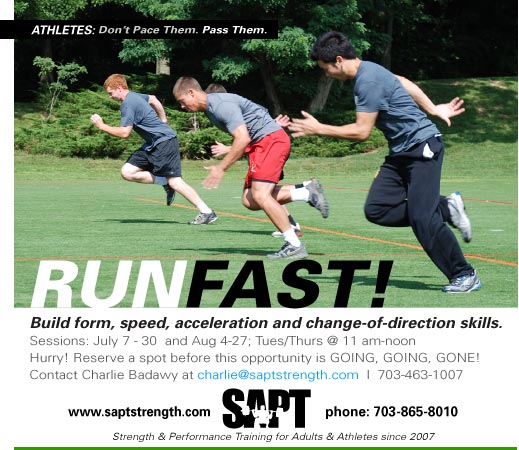
Also, in case you haven't heard... SAPT will be holding a speed and agility camp this summer called RunFAST! The program will be held on Tuesdays and Thursdays from 11AM-12PM. Session 1 will be held at the WT Woodson Track and Session 2 will be held at Robert Frost Middle School. Email Coach Charlie (charlie@saptstrength.com) for more details!
Until then, take a moment to sit down and read a couple of the incredibly informative links below.
Water, Water Everywhere -- Coach Kelsey Reed, SAPT
Squatting High? -- Charlie Weingroff, charlieweingroff.com
Overcoming Injury -- Brandon Lilley, Juggernaut Training Systems
3 Barbell Complexes To Make Your Workout Faster and Harder -- Jordan Syatt, Syatt Fitness
3 Things Women MUST Do For Simple Fat Loss -- Erika Hurst, Hurst Strength
*** Erika wrote a fantastic piece for us the other day. Check it out here: Cardiac Output Training for Strength Athletes
SMR: Magic Without A Wand
Today is the first day of our summer hours, and as such, I'm a bit short on time today. Therefore, I thought I'd dredge up a post from the archives that needed to see the light of day.
Every client at SAPT has "SMR" in their warm-up. What is this witchcraft called SMR?
SMR is more important than a wand is to Harry Potter.
Why? The short answer is we have a lot of gunky junk in our muscles that are impeding movements and causing aches and pains. And who wants to feel like a bag of junk?
Those in the fitness-know-how have probably heard of self-myofacial release (SMR) or at least have seen foam rollers lying around a lot of gyms (or, if you're us, lying around the house). A little rolling here and there does magical things for the body! One can instantly feel the difference even after only one time on that foam roller. Let us delve into the magical world of SMR.
What SMR does NOT do:
- Lengthen tissue/muscle- you'll hear this occasionally and SMR does NOT lengthen the tissues because a) the joint position doesn't change b) the SMR modality (aka foam roller) applies compression at a 90 degree angle to the muscle. Unless force is applied more along the length of the muscle, no lengthening will occur.
- Allow more fluid to the muscle- what? SMR is not open a flood gate of fluid to rush into the muscle.

What SMR DOES do:
- Releases tension in the muscles. How does it do that? Let's say there is a knot in the muscle (ball of fail, junk, gunk... pick you favorite term) and you sit on a foam roller or lacrosse ball and apply pressure to the knot.This provokes the ball-of-fail enough to cause it to release the tension. Kinda like a pesky little brother, he pokes you in the shoulder (SMR modality) until you finally explode out of annoyance (release tension).
How does that happen?
Our muscles are encapsulated in a tissued called fascia (there are SO many trails and tangents I could go on regarding fascia, but we'll stick with this for now). The fascia has little receptors (rufini corpuscles and pacini receptors for those who want to know stuff like that, they sound like Italian food.) that generate and relieve tension in a slow, deliberate pace.
*Side note* Our muscles also have similar receptors, the golgi tendon apparatus and muscle spindles, that react much more quickly to changes in length and tension in the muscle. For example, when the doc tests your reflexes by tapping on your knee, what he's doing is stretching the tendon quickly, which causes the muscle spindles in the quad to react, a signal is sent to the brain and the quad contracts (thus extending the knee a bit). It's actually really cool.

Anyway, these slower receptors (the rufini corpuscles and pacini receptors) also have neural components that govern them. Foam rolling short-circuits the neural components and these fascia-imbedded receptors (usually) freak out, shut down and take the tension with them.
Since they're slow-acting receptors then we need to foam roll/use a lax ball s-l-o-w-l-y. Hang out on those junky spots and you should feel them release a bit, then you can move one.
Just sit on a lacrosse ball. Your glutes will thank me.
Rage Against The Machines
The SAPT staff went on a field trip today. Our owner, Sarah Walls, was speaking at a networking event help by one of our business partners, Dawn Peters from Nakedhealth.com. It was a great event, filled with information and fantastic food. It also turned into a pretty eye-opening experience that urged me to write this blog post.
The theme of the event was "Slim into the Summer," and Sarah took the opportunity to speak about the benefits of exercise, what motivates someone to partake in this activity (because exercise is awesome.. duh), and provided some tips about how to approach incorporating exercise into your daily routine. What she did next was what really added to the experience...
Sarah had a slide or two focused on bringing forth some "Truths" and "Myths" regarding exercise. One of the "Truths" was that multi-joint compound movements are the way to go when it came to strength training. She briefly mentioned that the "old-school" methods of sitting on a machine and pumping out leg extensions was incredibly outdated and extremely sub-optimal. I didn't think twice about this statement, but when it came time for questions multiple individuals seem flabbergasted by her comment.
This got me thinking... Her message seemed incredibly obvious to me, but how many people out there actually don't realize this? How many people go to the gym multiple times a week and hop from machine to machine before walking out the front door without ever having performed a single free-weight movement?
I really shouldn't be surprised by this revelation. Every commercial gym I've ever been to is littered with machines, while the free weights are severely lacking. You're lucky if there are more than 2 or 3 squat racks in a commercial gym, and good luck finding kettlebells or sturdy resistance bands. It's really sad to see, especially as a strength and conditioning coach.
Let's quickly dispel this myth using everyone's favorite "get to the point" method, bullet points:
- Machines restrict you to a single plane of motion, typically forward and backwards.... this isn't how real life works. Free weights require multi-planar stability and provide much more carryover.
- Machines don't allow your muscles/joints/connective tissue to function as stabilizers, but only as movers. The multi-planar nature of free weights require you to stabilize and and help increase both muscular stability and strength.
- Free weights increase bone density to much greater extent than machines. This is incredibly important for women who are at a much higher risk for osteoporosis.
- You're sitting all day at work/school/watching TV... stop sitting while you're exercising. That's just laziness.
- To go with the above, resistance training should be used to help broaden and expand your movement patterns. We all know sitting isn't ideal, but in today's society it happens to be a necessity. Use resistance training/exercise to move in ways that you don't on a daily basis: squat, lunge, crawl, jump, push, pull, the list goes on and on.
Look at all those movement patterns!
- Free weights allow you to manipulate load placement in order to target various adaptations. For instance, you can tweak a squat to focus more on anti-flexion or anti-rotation depending on where you place the load.
- Free weights work your core to a much greater extent. As stated above, you can manipulate load placement to work on various functions of your core: anti-extension, anti-flexion, anti-rotation, anti-lateral flexion.
- Many machines isolate your muscles, but that's not how life works. You use your body as one unit and move in coordination. Resistance training should do the same. Why use a different machine to perform leg extensions, leg curls, leg presses, calf raises, hip abductions, hip adductions, when you can simply squat and deadlift?
These are really just a few of the reasons why you need to transition to a machine-free exercise program. Compound, free-weight exercises simply give you the biggest bang-for-your-buck and allow you to do the most with the brief amount of time you have to dedicate to the gym. The results you'll see will amaze you.