
Good Fitness Stuff to Read for the Week 4/9/12
Who Does MR Train? - Mike Robertson
If you train a celebrity or professional athlete, does this automatically bump you onto the list of best coaches/trainers in the industry? Are the strength coaches who work primarily with high school athletes worse athletic performance enhancement than those who work with the pros? Here Mike Robertson does an excellent job elucidating this issue, and bringing the topic to the forefront.
A Letter to My Younger Self - Jim Wendler
Here Jim Wendler (auther of the 5/3/1 method, a fantastic program I completed for six months myself, and the one that Sarah is currently doing) puts together a fantastic piece that I wish every high schooler would read. Even if you're not currently in high school, do yourself a favor and click the link above. Outside of the last sentence in the article, I found myself nodding in agreement to nearly everything Jim writes in his letter to his former self.
4 Tips for Learning New Exercises - Ben Bruno
Given that I've been deadlifting every day to improve my technique and performance in the lift, this post really hit home with me. Here Ben shares some excellent points on how to learn a new exercise, ranging from how often to do it, when to do it, and what intensity to do it at.
Steve & Kelsey Compete in a Wife Carrying Contest
I just returned from a trip to Pennsylvania and was trying to think of a very brief yet entertaining blog to post before heading into SAPT for the day. What immediately came to mind was to share a snippet of something AWESOME that Kelsey and I got to participate in last weekend: A wife carrying contest. What are these weird and wild things I speak of, you ask?
Well, some good friends of ours are getting married, and, instead of holding a women-only bridal shower (which is typically done....I think...) as part of the pre-wedding festivities, the couple wanted to have a large group, co-ed get together. Since their goal is to move to Finland after they get married, they desired to host a Wife Carrying Contest in honor of the national game of Finland.
Needless to say, the event was hilarious, fun, and challenging all at the same time (more than one couple took a spill upon the man tripping and falling headfirst).
Annnnddd......Kelsey and I took the gold medal, so you can rest assured your SAPT coaches did you proud! (Kelsey wrote a post on training for a wife carrying contest HERE, if you're interested)
Fortunately, someone grabbed an action shot of us, so I have proof that I'm not making this entire contest up:

"Why are you carrying Kelsey upside down like that" is probably the question you are asking me. Well, there are typically four ways to carry the woman (piggyback, over-shoulder, fireman carry, and upside down), and since the upside down method is the one typically used by the national champions in Europe, I figured I'd be foolish not to carry Kelsey like that. Naturally.
Here are a few wife carrying contest rules:
- The course has two dry obstacles and one water obstacle (typically a meter deep).
- The minimum weight of the wife to be carried must be 108lbs. If the wife does not weigh this much, then she must wear a backpack/rucksack on her to make her weigh at least 108lbs.
- The contestants only run the race two at a time (so you only have two couples running at once). The best time is then taken to determine the winner.
- The winner receives the wife's weight in beer.
- And, perhaps my favorite: The wife to be carried may be your own, the neighbor's, or "you may have found her farther afield", but she must be at least 17 years of age.
I'm heavily considering traveling to Maine (the North American wife carrying contest is held up there) to do this because, well, I don't think I really need to explain why this would be so epic.
Anyway, I'm done for now, hope you all have a great weekend.
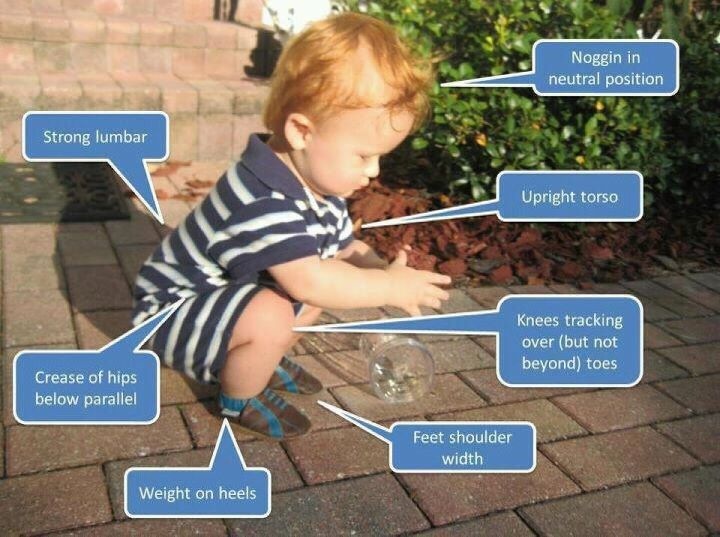
Are You Really Squatting Correctly?
We all know the cue of “drive your knees out” when squatting but have you ever had someone observe your squat or watched yourself on camera when squatting? If you haven’t you’d be surprised to find out that your knees are probably tracking incorrectly. When coaching the squat to our athletes and clients for the first time I notice two things that happen. The first thing is the knees just do not drive out at all leading to improper tracking and you get something that looks like this…
[vsw id="AabLx4YvJvg&list=UUKSYQ75Buogznl62rdbks2Q&index=3&feature=plcp" source="youtube" width="425" height="344" autoplay="no"]
As you can see from the video the knees never track with the middle of the feet and you are left with a continuous valgus collapse. This is due to a number of reasons (poor glute strength, lack of body awareness, tight adductors) but mostly because people grow out of the habit of squatting correctly because they simply stop doing it over the years. Yes, it is true that if you don’t use it you lose it. We all at one time possessed the ability to squat correctly we just don’t do any up keep and then quickly forget how to do it.
Anyways, after seeing this I'll tell the person for the next set that as they lower they need to actively drive their knees out or “towards the wall”. This is when I notice the second thing that typically goes wrong during a squat which you can observe from the video below.
[vsw id="_Vuw15qlRfg&list=UUKSYQ75Buogznl62rdbks2Q&index=2&feature=plcp" source="youtube" width="425" height="344" autoplay="no"]
This time you’ll see that yes the knees actively drive out but they drive out way to much at the beginning, they will shoot in as they get close to the bottom, then will shoot in once they switch to the concentric portion. Cue face in palm…
So what do you do now? When it comes to this I will simply ask the person what they feel is going on with their lower body throughout the movement. Undoubtedly they will say it feels weird or it feels like they are actively driving their knees out. I’ll go on to tell them what is actually going on and/or film them to show them. Most of the time I don’t need to film because I will explain what I want to see happen on the next set. I'll say, “On the next one I don’t want you to drive your knees out until you feel you are half way down. Once you feel you’re about half way I want you to really overcompensate by driving your knees out about twice as hard as you feel you need to”. What I’ll get out of this is exactly what I was looking for which is the knees tracking with the “middle” toe of the foot throughout the whole movement as you can see in the video below.
[vsw id="OoqbgRL_0XA&list=UUKSYQ75Buogznl62rdbks2Q&index=1&feature=plcp" source="youtube" width="425" height="344" autoplay="no"]
It’s amazing how well this has worked but also a little crazy. It takes someone literally trying to overcompensate twice as much from what they think “feels right” in order to get them to squat correctly. I’ll ask the person how that felt and they will always say “really weird!” My immediate response is well that’s actually exactly what it should look like and eventually the more you do it the more it will start to feel right.
I encourage you to have someone look at your squat who knows what they are doing or have someone record you so you can make sure you are squatting correctly. If your knees aren’t tracking correctly you probably won’t get much stronger and you will also be setting yourself up for injuries later on.
Hope this helps!
Straight Bar vs. Trap Bar Deadlifts, Part 2
In Part 1 we discussed the main differences between deadlifting with the trap bar vs. doing so with the straight bar, and also examined the primary muscles recruited through each pull. Part II will touch on some of the training implications - aka the, “How does this affect ME?” question. I like lists, so what follows are, in list form, some key points surrounding each deadlift variation.
The Trap Bar
1. I previously stated that the trap bar tends to be easier to learn how to deadlift with, and while I still stand by that claim, it doesn’t mean the trap bar can’t be royally screwed up if unaware of what to feel or look for.
Continue Reading....
(Note: The above link takes you to my most recent OneResult Article)
Q&A: Strength/Power vs Hypertrophy/Size?
Pardon my ignorance, but what is the difference between training for strength/power and for hypertrophy/size? It seems that if one becomes strong enough to squat 400 pounds or bench press 300, they are not going to be small and weak?
J – Thanks for the question. This is actually a great question that I don’t believe many people ever consider. It also touches on some of the fine points of programming and why – in my (not-so-humble) opinion – SAPT really excels at program design and getting our clients to their goals.
Your assumption that if someone is able to squat X and bench Y they will not be small and weak is basically correct. BUT, to get them to those goals you have to begin complementing the heavy compound or main movements with accessory and supplemental work that will effectively support the needed growth to hit those heavier maxes. When I say growth, I am referring to both neural growth/adaptations and actual muscle hypertrophy.
If one were to stick with a strict maximum strength development program they would be missing out on the strength and hypertrophy spectrum. The result would be very little hypertrophy because the volume will be so low… even though the weights will be very heavy. The primary result will be neural adaptations. As a side note, this is the style training I use with my college teams when I only want performance improvements and very little gain in weight or size: maximum strength, strength-speed, speed-strength, and speed methods.
On the other hand, if you begin to carefully combine the maximum strength work with some hypertrophy and strength set/rep ranges then you will be able to simultaneously (and very efficiently) gain the needed muscle to support the improved neural functions.
Hope this answer helps clear things up!
Q & A: Training for Mass vs. Power
Q: My first question is a classic one: how do the training programs of a body-builder and a "strongest man" competitor differ? In short--mass vs power. And why does the body-builder appear stronger than, for instance, the **German who clean and jerked 565lbs for his deceased wife? Ive heard so many different theories on this stuff...
A. First of all, for those of you reading who haven't seen the video referenced in the question, please see below. Doing so will automatically raise your testosterone levels by 150% (don't worry ladies, you can still benefit as there's a romantic side to the story).
It's important to note that:
A) Powerlifters and Olympic Lifters ("O-lifters") each care about one thing: the maximal amount of weight they can move for the FEW key lifts in their respective competitions (squat/bench/dead for powerlifters, and clean+jerk/snatch for O-lifters). Their end goal is to find the most efficient way to move the weight through the desired range. For example, powerlifters often create a huge arch in their back during a bench press so they don't have to move the bar as far up and down, and O-lifters learn to keep the bar as close to their body as possible so it doesn't "arc" out in front of them.
B) Bodybuilders, on the other hand, also only care about one thing, but it's entirely different: Aesthetics. Put another way, hypertrophy (hy-PUR-truh-fee), which simply means increasing the size of the muscle fibers.
(Note: Pardon me as the above points may seem very obvious, but it's important to note nonetheless.)
Training Differences
One could argue that the primary difference in training for these two respective goals (power vs. mass) comes down to the development of the nervous system. The German who clean+jerked 565lbs for his deceased wife trained his nervous system to "drive" the muscles to be able to contract+produce power as quickly and efficiently as possible. In an Olympic lifting context, this is typically done by moving sub-maximal weights at maximal speeds using low reps. An example of this would be executing power cleans for 5 sets of 2 reps at a weight than can be moved quickly and smoothly by the lifter. You can use this same principle with deadlifts, squats, and bench presses, too. In fact (as you may be well aware), many powerlifters use a high set/low rep at a low % to work on pure speed/power development. They are teaching their nervous systems to produce maximal force in as little time as possible. The faster one can do this, the more weight they can typically lift, or throw overhead.
Basically: you can become extremely "neurally efficient" without necessarily becoming big.
Heck, look at Tom Martin (180lbs) who set the world record for the deadlift in his weight class. He pulled 771lbs, yet appears wayyy less muscular than your average bodybuilder!
Let's briefly discuss training programs. If you take the program of a powerlifter and compare it to that of a bodybuilder, you'll immediately notice how much "simpler" the powerlifting program is compared to that of the bodybuilding program. Let's take a look at a sample "Leg Day:"
Powerlifting
Bodybuilding
1) Deadlift 5x2
2) Glute-Ham Raise 3x8
*3) Split Squat 3x10/side
4) Weighted Plank 3x :20
*Maybe
1) Squat 4x10
2) Deadlift 5x5
3) Leg Press 4x15
4a) Walking Lunges 4x10/side
4b) Seated Leg Extensions 3-4x10
5a) Lying Leg Curls 3-4x10
5b) Seated Calf Raise 3xInfinity
Elite-level powerlifters and Olympic lifters know how to "trim the fat" in order to do enough so that their main lift improves, but NOT so much to the point where their body has to recover from a bazillion supplementary exercises. This will depend on the lifter of course (some powerlifters find that their body responds to slightly more assistance work than others), but the common theme is that they do the minimum required to see their competition lifts improve.
Bodybuilders, on the other hand, are known for their extremely voluminous training sessions, often spending 90-120 minutes in a single workout. They'll also do whatever it takes in their training to maximize how large their muscles grow, examples including (but not limited to):
-manipulating their form to maximize tension on a particular muscle
-using a slow tempo (during both the lowering AND lifting portion)
-using machines to isolate a muscle (taking that muscle's "helpers" out of the equation....ex. in a squat the hamstrings+glutes are still going to help the primary mover - the quads - do the lift....but in a leg extension machine you can isolate the quads to a much greater degree).
-"supersetting" exercises for the same muscle group (ex. walking lunges paired with seated leg extensions) to "exhaust" a particular muscle
-choosing lifts that take the muscle through a greater range of motion (ex. doing a dumbbell bench press instead of a barbell bench press)
-etc. etc. etc.
It's also shown that the higher rep/volume style of bodybuilding leads to development of what's called sarcoplastic hypertrophy, or, in laymen's terms, increasing the size of the non-contractile portions of the muscle cell (muscle cells have both contractile and non-contractile tissue within them). This is another method through which they can look very very big but not necessarily possess the strength of powerlifters.
An Important Caveat
The immediate conclusion most people draw from this is that if their goals strictly lie in the sphere of aesthetics, then they should train like bodybuilders with a very high volume, high repetition approach. Which leads me to this:
The two training methodologies aren't necessarily mutually exclusive of each other, ESPECIALLY when it comes to training for aesthetics.
For example, my wife, Kelsey, earned her Pro Card in bodybuilding by primarily using a powerlifting-style approach in her training!

In fact, this is sometimes the biggest setback I see in people training solely for the goal of lookin' good: they aren't strong enough. I strongly feel that most people - even those with bodybuilding aspirations - should begin with (and continue to cycle in) "powerlifting'esque" training tools as many will be surprised at how much they grow simply by getting stronger on the compound lifts (squats, overhead presses, deadlifts, bench presses, chinups, etc.).
The "Illusion" of Bodybuilding
Alright, this is Q & A is already significantly more prolix than I was anticipating, so just one more point: Diet and creating an "illusion" are HUGE factors in making bodybuilders look bigger. Bodybuilders will diet down to insanely low bodyfat levels, and strategically manipulate their nutrition, to make themselves appear more "full" right before a competition. Not to mention, the spend hours practicing their poses in order to make their muscles appear larger than they actually are.
Going back to the example of my wife, many girls may look at the picture of her above and think "No way would I ever want to look manly and bulky like that!".
Guess what? Do you think that's how she looks walking around the street? Nope. Despite the fact that she has set American records in powerlifting (hint: she is very strong), she actually, *gasp,* looks very feminine, and sexy to boot, walking around day to day. The picture from her bodybuilding show is the result of very meticulous nutrient partitioning and hours of hard work practicing her poses and routines.
Here's a picture I found, via a quick desktop search, of us at a Lord of the Rings showing with a live orchestra. Which goes to say: bodybuilders don't look like they do on stage year-round.

And yes, the show was as cool as it sounds.
I bet if Matthias Steiner (the German O-lifter from the beginning) were to diet down to a very low bodyfat and manipulate his carbohydrate/water intake, he would look very, VERY muscular, too.
Another example: see the before/after photos of Dave Tate, a powerlifter who went on a "bodybuilding kick" and got his nutrition in order. I hope this helps prove my point.
Whew, anyway, I hoped this help elucidate some of the differences between training for mass vs. power. It was far from comprehensive (the topic can literally be discussed for days), but hopefully at least gets you started on the right track.
**On a side note: Matthias steiner should technically be considered one of the most powerful men in the world, as opposed to strongest - because he moves weight at a higher velocity - when compared to powerlifters who are some of the strongest people in the world. Kinda ironic how powerlifting actually involves moving heavy weights at a slow velocity, whereas Olympic lifting is all about moving it fast......